Loading...
Agustin de Iturbide vs Ferdinand VII of Spain
Agustin de Iturbide leads by 10.2 pts · 2 figures compared
…
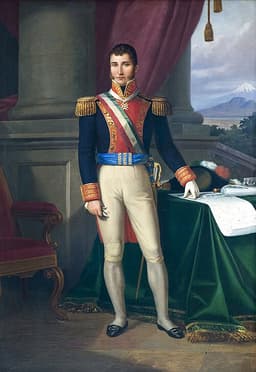
Agustin de Iturbide
Emperor · Modern
55.3Total
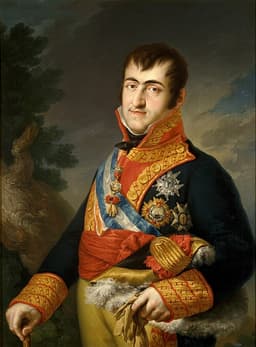
Ferdinand VII of Spain
Emperor · Modern
45.1Total
Basic Information
Born
1783
1784
Died
1824
1833
Era
Modern
Modern
Nationality
Mexico
Spain
Occupation
Emperor
Emperor
Civilization
Western
Western
Score Comparison
Military (10%)
52.5
14.9
Political (20%)
53.8
32.2
Influence (20%)
57.2
51.0
Legacy (20%)
46.7
41.7
Leadership (15%)
67.0
74.0
Strategy (15%)
60.0
45.0
TOTAL
55.3
45.1
Agustin de Iturbide — Complete Timeline
1820 AD
Switched sides to join the independence movementPolitical Action
Iturbide, a royalist general who had fought against the insurgents, was appointed to command the army against Vicente Guerrero. Instead of fighting, he negotiated with Guerrero and issued the Plan of Iguala on February 24, 1821, proposing independence, constitutional monarchy, and protection of the Catholic Church.
Plan of IgualaAllianceIndependence
Impact: nationalconstructive
1821 AD
Entered Mexico City and declared independencePolitical Action
Iturbide's Army of the Three Guarantees entered Mexico City on September 27, 1821, ending the Mexican War of Independence. The next day, the Declaration of Independence of the Mexican Empire was signed. Iturbide became the head of a provisional government, effectively ruling Mexico.
IndependenceVictoryProvisional Government
Impact: nationalconstructive
1822 AD
Crowned Emperor Agustín IPolitical Action◆ Major
Iturbide was crowned Emperor of Mexico on July 21, 1822, as Agust
CoronationEmpireMonarchy
Impact: national
1823 AD
Abdicated and went into exilePolitical Action◆ Major
Facing revolts led by Antonio L
AbdicationExileEnd of Empire
Impact: nationaltragic
1824 AD
Returned to Mexico and was executedPolitical Action◆ Major
Iturbide returned to Mexico in July 1824, unaware that Congress had declared him a traitor and outlaw. He was captured upon landing and executed by firing squad on July 19, 1824, in Padilla, Tamaulipas. His death ended any possibility of restoring the monarchy.
ExecutionReturnDeath
Impact: nationaltragic
Ferdinand VII of Spain — Complete Timeline
1808 AD
Accession to the thronePolitical Action◆ Major
Ferdinand VII became King of Spain after the abdication of his father Charles IV. His reign was interrupted by Napoleon's intervention and the Peninsular War, but he was restored in 1814.
SuccessionMonarchy
Impact: national
1814 AD
Abolition of the Constitution of 1812Political Action
Upon returning to Spain, Ferdinand VII abolished the liberal Constitution of 1812 and restored absolute monarchy. He persecuted liberals and reinstated the Inquisition, reversing the reforms of the Cortes of C
ConstitutionAbsolutismReaction
Impact: nationaldestructive
1820 AD
Trienio LiberalPolitical Action◆ Major
A military revolt led by Rafael del Riego forced Ferdinand VII to reinstate the Constitution of 1812, beginning the Trienio Liberal. Ferdinand was effectively a constitutional monarch for three years.
Liberal RevolutionConstitutionRevolt
Impact: national
1823 AD
French intervention and restoration of absolutismWar◆ Major
A French army, the Hundred Thousand Sons of Saint Louis, invaded Spain to restore Ferdinand VII's absolute power. The liberal government fell, and Ferdinand resumed repressive rule.
InterventionAbsolutismCongress of Vienna
Impact: regionaldestructive
1830 AD
Pragmatic Sanction of 1830Political Action◆ Major
Ferdinand VII issued the Pragmatic Sanction, abolishing Salic Law and allowing his daughter Isabella to inherit the throne. This led to the Carlist Wars after his death.
SuccessionLawCarlist Wars
Impact: national
Expert Analysis
Agustin de Iturbide vs Ferdinand VII of Spain
# The Emperor and the King: Two Paths from the Collapse of Empire
In the summer of 1822, two men stood at the pinnacle of power in the Spanish-speaking world, each believing he had found the answer to the chaos that had consumed his nation. In Mexico City, Agustín de Iturbide was crowned Emperor Agustín I beneath a canopy of gold and crimson, while across the Atlantic in Madrid, Ferdinand VII sat on a throne he had reclaimed through invasion and bloodshed. Both men sought to restore order after the Napoleonic Wars had shattered the old certainties. Both failed. But their failures were of profoundly different kinds—one a tragedy of ambition, the other a tragedy of stubbornness—and they illuminate the divergent fates of Spain and its former colony in the decades that followed.
Origins
Agustín de Iturbide was born in 1783 in Valladolid (now Morelia), the son of a Spanish father and a Mexican mother. He grew up in a world where the rigid caste system of New Spain had begun to crack, where creoles—those of Spanish blood born in the Americas—chafed at their exclusion from power. Iturbide entered the royalist army at fifteen, and by his twenties he had earned a reputation for both courage and cruelty, hunting down insurgents with a zeal that made him hated by the independence movement. He was, in every sense, a creature of the old order.
Ferdinand VII, born a year later in 1784 at the El Escorial palace, was a prince of the Bourbon dynasty, raised in the suffocating formality of the Spanish court. His childhood was shadowed by the machinations of his father Charles IV’s favorite, Manuel Godoy, and by the looming presence of revolutionary France. Where Iturbide learned war in the field, Ferdinand learned suspicion in the corridors of power. He was taught that monarchy was divine, that reform was treason, and that the people existed to obey.
Rise to Power
Ferdinand’s path to power was a study in passive resistance. In 1808, he orchestrated a coup against his own father, forcing Charles IV to abdicate. But Napoleon Bonaparte, then occupying Spain, saw an opportunity: he summoned both father and son to Bayonne, forced both to renounce the throne, and installed his brother Joseph instead. Ferdinand spent the next six years imprisoned in France, a martyr-king in absentia, while Spanish guerrillas fought the French in his name. When he returned in 1814, he was greeted as a liberator. He repaid that love by abolishing the liberal Constitution of 1812, which had been drafted by the Cortes in his absence, and restoring absolute monarchy with a vengeance.
Iturbide’s rise was more active, more violent, more ambiguous. In 1820, when a liberal revolt in Spain forced Ferdinand to reinstate the Constitution of 1812, the creole elites of New Mexico faced a dilemma: they feared the liberals’ anticlericalism and egalitarianism almost as much as they feared the insurgents who had been fighting for independence since 1810. Iturbide, still a royalist commander, was sent to crush the rebel Vicente Guerrero. Instead, he switched sides. In February 1821, he issued the Plan of Iguala, a clever compromise: independence, constitutional monarchy, and the preservation of the Catholic Church’s privileges. The Army of the Three Guarantees—Religion, Independence, Unity—marched into Mexico City on September 27, 1821, without firing a shot. Iturbide had done what no one else could: he had united royalists and insurgents, conservatives and liberals, in a single cause.
Leadership & Governance
Here the two men diverged most sharply. Ferdinand VII was a king who ruled by negation. He abolished constitutions, persecuted liberals, and surrounded himself with sycophants. His political score of 51.5 reflects a man who saw governance as the enforcement of obedience. When a military revolt in 1820 forced him to accept the Constitution of 1812 for three years—the Trienio Liberal—he chafed and plotted, and in 1823 he welcomed a French invasion, the Hundred Thousand Sons of Saint Louis, to restore his absolute power. He then spent the remaining decade of his reign purging his enemies, alienating his allies, and producing no lasting reform. His strategy score of 30.0 is damning: he had no plan beyond survival.
Iturbide, with a political score of 61.9 and a leadership score of 80.2, was more capable but no more fortunate. As emperor, he faced a bankrupt treasury, a divided Congress, and the hostility of republican idealists who had fought for independence only to see a monarch crowned. He tried to govern, but his methods were heavy-handed: he dissolved Congress, arrested opponents, and ruled by decree. He had no experience with liberal institutions and no patience for dissent. Within a year, his former ally Antonio López de Santa Anna rose in revolt, joined by Guadalupe Victoria and Vicente Guerrero. On March 19, 1823, Iturbide abdicated and fled to Europe.
Triumph & Tragedy
Ferdinand’s greatest triumph was his return in 1814—a moment of national euphoria that he squandered within months. His greatest tragedy was the Pragmatic Sanction of 1830, which abolished Salic Law to allow his daughter Isabella to inherit the throne. This act, born of his desperation for a male heir, triggered the Carlist Wars that would tear Spain apart for decades after his death. He died in 1833, leaving a country deeply divided between absolutists and liberals, his own legacy so tarnished that his total score of 54.3 places him among the least effective rulers of modern Europe.
Iturbide’s triumph was the Plan of Iguala itself—a masterstroke of political compromise that achieved independence with minimal bloodshed. His tragedy was that he could not sustain it. In exile, he heard that Mexico was falling into chaos, that republicans were fighting among themselves, that a foreign power might intervene. Believing he alone could save his country, he returned in July 1824, unaware that the Mexican Congress had declared him a traitor. He was captured, tried, and executed by firing squad on July 19, 1824. He was forty years old.
Character & Destiny
Ferdinand VII was defined by resentment. His years as a prisoner had taught him to distrust everyone, and he governed accordingly. He was not cruel for pleasure—his military score of 32.2 suggests he avoided war when possible—but he was cruel for control. He could not imagine a Spain that was not absolute, and so he destroyed every attempt to make it otherwise.
Iturbide was defined by ambition and a strange naivety. He believed that his personal authority, earned on the battlefield, could substitute for institutional legitimacy. He thought that Mexicans would accept an emperor because he had given them independence. He was wrong. His military score of 57.6 and strategy score of 65.0 show a competent commander, but he lacked the political subtlety to build a durable state.
Legacy
Ferdinand VII is remembered in Spain as the "Desired One" who became the "Traitor King"—a man who promised reform and delivered reaction. His reign set back Spanish liberalism by a generation. His legacy score of 57.1 reflects a ruler whose impact was largely negative.
Iturbide’s legacy is more complex. For decades after his death, he was vilified by Mexican liberals as a traitor to the republic. But in the twentieth century, his role in achieving independence was reassessed. Today, his name is inscribed in gold in the Mexican Congress, and he is recognized as one of the fathers of the nation. His legacy score of 64.2 acknowledges that he succeeded in the one thing that mattered most: he made Mexico independent. His failure was in trying to shape what came next.
Conclusion
Standing side by side in the graveyard of Spanish empire, Iturbide and Ferdinand VII embody two responses to the crisis of legitimacy that followed Napoleon’s wars. Ferdinand clung to the past and was destroyed by the future. Iturbide tried to seize the future and was destroyed by the past. Neither understood that the old world was gone forever—that constitutions, however imperfect, had replaced divine right; that the consent of the governed, however messy, had replaced the will of the king. Their stories are a reminder that the hardest task of leadership is not winning power, but knowing what to do with it once you have it.
Rankings
🥇
Agustin de IturbideLeader
Mil: 52.5Pol: 53.8Inf: 57.2
55.3
🥈
Ferdinand VII of Spain
Mil: 14.9Pol: 32.2Inf: 51.0
45.1
+10.2 behind
How This Comparison Works
Algorithm
Each figure is scored on 6 dimensions (0—100 scale) based on structured historical data: Military (10%), Political (20%), Influence (20%), Legacy (20%), Leadership (15%), Strategy (15%). The weighted total produces the final ranking.
Data Sources
Scores are computed from structured sub-indicators in the database. Scale factors adjust for era (Ancient ×0.85, Modern ×1.0) and civilization size (Eastern ×1.05, Other ×0.80) to account for differences in population and military scale.
Maximum 3 Figures
Comparisons are limited to 2—3 figures to ensure readability and statistical meaningfulness.
Error Margins
±5 points per dimension — Sub-scores are derived from historical records with inherent uncertainty. Two figures within 5 points on a dimension should be considered roughly equivalent in that area.
Total Score Accuracy
±3 points overall — The weighted combination of 6 dimensions produces a total score with approximately ±3 points of uncertainty. Differences of less than 3 points are not statistically significant— the figures are effectively tied.
Known Limitations
- Historical records are incomplete and uneven across civilizations
- Figures from oral-tradition societies may be underrepresented
- Occupation labels can misclassify multi-role figures
- Scores measure capability and impact, not moral character
- Quantitative scoring is a comparison tool, not absolute truth
Capability Radar
Military (10%) — Battles & Warfare
Battles
60
10
Win Rate
65
5
Expansion
50
5
Political (20%) — Governance & Reform
Reform
45
5
Diplomacy
55
20
Economy
30
10
Influence (20%) — Cultural & Global Reach
Cultural
40
15
Global
35
20
Legacy (20%) — Historical Impact
Historical
50
30
Longevity
30
20
Leadership (15%) — Power & Stability
Tenure
30
60
Stability
20
10
Strategy (15%) — Tactics & Innovation
Strategy
60
5
Tactics
55
5
Reform
40
5
Similar Comparisons
Comments & Discussion
RoyalistTurncoat6/16/2026
Iturbide wasn't some visionary liberator; he was a royalist officer who switched sides when it suited him. The Plan of Iguala was a cynical power grab, wrapping monarchism in a cloak of independence. Ferdinand VII, for all his incompetence, at least never pretended to be anything but a despotic Bourbon. Iturbide's "empire" lasted ten months because Mexico's elites saw through his act immediately. He executed his own former comrades to prove his loyalty—first to Spain, then to himself.
BourbonBlunder6/16/2026
费迪南七世就是个固执的白痴。1814年他废除1812年宪法时,亲手毁掉了让西班牙走向君主立宪的唯一机会。伊图尔维德至少尝试了妥协——三保证军保证了宗教、独立和统一,虽然最终失败。但西班牙国王连试都不愿试,结果呢?十九世纪变成了连续内战的血腥循环。他本可以是西班牙的开明改革者,却选择了做顽固不化的专制君主。
DataSkeptic6/16/2026
Let's look at actual numbers. Iturbide's Mexican Empire controlled about 4.5 million square kilometers, while Ferdinand's Spain proper was barely 500,000. Yet Iturbide's regime collapsed in 10 months, while Ferdinand clung to power for 11 years before chaos truly consumed Spain. The difference isn't ideology—it's that Mexico's elites saw Iturbide as a temporary fix, while Spain's aristocracy had centuries of dynastic loyalty. Iturbide's "empire" had no institutional depth, just a charismatic lea
古典学人6/16/2026
伊图尔维德让我想起罗马的奥托皇帝——一个靠军队拥立的短命君主,试图在帝国崩溃的混乱中抓住权力。他的加冕典礼模仿了拿破仑和查士丁尼的混合体,但墨西哥没有罗马的传统根基。费迪南七世更像是提比略式的暴君:多疑、残忍、毫无远见。两人都是旧秩序的产物,却都想在新世界重演过去的剧本。历史不会让重复的悲剧成功两次。
RevisionistCritic6/16/2026
Stop romanticizing Iturbide's "tragic ambition." He executed 300+ prisoners after the Battle of Azcapotzalco in 1821, including wounded insurgents begging for mercy. This wasn't a noble emperor—it was a war criminal who crowned himself. Ferdinand was a tyrant, yes, but at least he never pretended to be anything else. Mexico's independence didn't need a self-crowned emperor, and pretending Iturbide was some "tragic figure" whitewashes the blood he spilled to get that crown.