Loading...
Agustin de Iturbide vs Pedro I of Brazil
Agustin de Iturbide leads by 0.7 pts · 2 figures compared
…
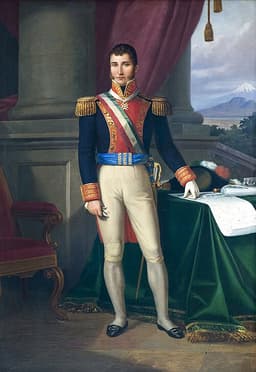
Agustin de Iturbide
Emperor · Modern
55.3Total
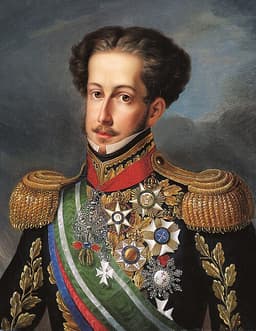
Pedro I of Brazil
Emperor · Modern
54.6Total
Basic Information
Born
1783
1798
Died
1824
1834
Era
Modern
Modern
Nationality
Mexico
Brazil
Occupation
Emperor
Emperor
Civilization
Western
Western
Score Comparison
Military (10%)
52.5
55.0
Political (20%)
53.8
62.7
Influence (20%)
57.2
59.0
Legacy (20%)
46.7
50.0
Leadership (15%)
67.0
53.2
Strategy (15%)
60.0
45.0
TOTAL
55.3
54.6
Agustin de Iturbide — Complete Timeline
1820 AD
Switched sides to join the independence movementPolitical Action
Iturbide, a royalist general who had fought against the insurgents, was appointed to command the army against Vicente Guerrero. Instead of fighting, he negotiated with Guerrero and issued the Plan of Iguala on February 24, 1821, proposing independence, constitutional monarchy, and protection of the Catholic Church.
Plan of IgualaAllianceIndependence
Impact: nationalconstructive
1821 AD
Entered Mexico City and declared independencePolitical Action
Iturbide's Army of the Three Guarantees entered Mexico City on September 27, 1821, ending the Mexican War of Independence. The next day, the Declaration of Independence of the Mexican Empire was signed. Iturbide became the head of a provisional government, effectively ruling Mexico.
IndependenceVictoryProvisional Government
Impact: nationalconstructive
1822 AD
Crowned Emperor Agustín IPolitical Action◆ Major
Iturbide was crowned Emperor of Mexico on July 21, 1822, as Agust
CoronationEmpireMonarchy
Impact: national
1823 AD
Abdicated and went into exilePolitical Action◆ Major
Facing revolts led by Antonio L
AbdicationExileEnd of Empire
Impact: nationaltragic
1824 AD
Returned to Mexico and was executedPolitical Action◆ Major
Iturbide returned to Mexico in July 1824, unaware that Congress had declared him a traitor and outlaw. He was captured upon landing and executed by firing squad on July 19, 1824, in Padilla, Tamaulipas. His death ended any possibility of restoring the monarchy.
ExecutionReturnDeath
Impact: nationaltragic
Pedro I of Brazil — Complete Timeline
1822 AD
Declaration of Independence of BrazilPolitical Action
Pedro I declared Brazil's independence from Portugal on September 7, 1822, at the Ipiranga River in S
Impact: globalprogressive
Coronation as Emperor of BrazilPolitical Action◆ Major
Pedro I was crowned Emperor of Brazil on December 1, 1822, in Rio de Janeiro. The coronation formalized the new imperial government, with Pedro I as constitutional monarch, though he retained significant executive powers.
Impact: nationalconstructive
1823 AD
War of Independence of BrazilWar◆ Major
Pedro I led Brazilian forces against Portuguese loyalists in the War of Independence. Key battles occurred in Bahia, Maranh
Impact: national
Dissolution of the Constituent AssemblyPolitical Action◆ Major
Pedro I dissolved the Constituent Assembly after conflicts over the constitution's limits on imperial power. He then imposed the 1824 Constitution, which granted the emperor extensive powers, including the Moderating Power, centralizing authority.
Impact: nationaldestructive
1831 AD
Abdication of the Brazilian ThronePolitical Action
Pedro I abdicated the Brazilian throne in favor of his five-year-old son Pedro II on April 7, 1831. He returned to Portugal to claim the Portuguese throne, leaving Brazil under a regency until his son came of age.
Impact: national
Expert Analysis
Pedro I of Brazil vs Agustin de Iturbide
# The Emperor Who Came Home to Die: Iturbide and Pedro I
On a sweltering July day in 1824, a man stepped off a ship at the port of Soto la Marina, on the Gulf coast of Mexico. He was forty-one years old, handsome still, with the bearing of a soldier who had once commanded armies. He believed he was returning to save his country. Within days, he would be shot against a wall, a traitor's death for the man who had given Mexico its independence. Fifteen hundred miles to the south, in Rio de Janeiro, another emperor sat on a throne he had seized from his own father. Pedro I of Brazil was twenty-six, confident, and about to embark on a reign that would last nearly a decade. Both men were emperors of newly independent American nations. Both had been hailed as liberators. Yet one died a martyr, the other a king. The difference lay not in their ambitions, but in the worlds they tried to rule.
Origins
Agustín de Iturbide was born in 1783 in Valladolid, now Morelia, into a family of Spanish *criollos*—pure-blooded Spaniards born in the New World. His father was a wealthy landowner, and young Agustín grew up in a world where the color of your skin mattered less than where you were born. The Spanish crown reserved high office for *peninsulares*, those born in Spain itself. Criollos like Iturbide could become rich, but they could never rule. This simmering resentment would define his life.
Pedro I was born in 1798 in Lisbon, a prince of the House of Braganza. His father was King John VI of Portugal. When Napoleon invaded Portugal in 1807, the entire royal family fled to Brazil, making Rio de Janeiro the capital of the Portuguese Empire. Young Pedro grew up not as a colonial subject, but as a prince in exile. He learned to ride horses in the hills of Rio, to speak Portuguese with a Brazilian accent, and to see the colony as his home. Where Iturbide was a provincial aristocrat nursing grievances, Pedro was a royal heir who had tasted power from childhood.
Rise to Power
Iturbide rose through the Spanish army, fighting against the Mexican independence movement for a decade. He was ruthless: in 1815, he defeated the rebel leader José María Morelos, earning promotion to colonel. He was a royalist to his bones—until 1820, when a liberal revolution in Spain threatened the privileges of the Church and the criollo elite. Suddenly, independence looked safer than Spanish rule. Iturbide switched sides with breathtaking speed. He proposed a plan: the Army of the Three Guarantees would fight for independence, union, and the Catholic faith. In 1821, he marched into Mexico City, and Mexico was free.
Pedro’s rise was less bloody but no less dramatic. When his father returned to Portugal in 1821, leaving Pedro as regent of Brazil, the Portuguese parliament tried to reduce Brazil back to colonial status. Pedro famously refused, declaring on January 9, 1822, “I will stay.” That September, at the Ipiranga River, he shouted “Independence or death!” and became the nation’s emperor. Where Iturbide had to betray his old masters, Pedro simply disobeyed his father.
Leadership & Governance
Iturbide’s empire lasted ten months. He was crowned Agustín I on July 21, 1822, after a military mutiny pressured Congress to accept him. But he had no blueprint for rule. Mexico was bankrupt, divided between republicans, monarchists, and regional strongmen. Iturbide tried to centralize power, but he had no administrative experience and little patience for politics. He arrested critics, shut down Congress, and governed by decree. His leadership score of 80.2 reflects his charisma and military skill, but his political score of 61.9 reveals a man who could win battles but not build institutions.
Pedro I faced similar problems: a vast territory, a weak economy, and a fractious elite. But he had one advantage Iturbide lacked: legitimacy. He was a Braganza, a royal born to rule. He could dissolve the Constituent Assembly in 1823, as he did when it tried to limit his power, and impose a constitution that still preserved his authority. He fought the War of Independence against Portuguese loyalists in Bahia and won. His military score of 65.0 and political score of 60.2 are close to Iturbide’s, but Pedro had something else: an heir. His son Pedro II would inherit the throne, providing continuity that Mexico lacked.
Triumph & Tragedy
Iturbide’s greatest moment was September 27, 1821, when his army entered Mexico City under a banner of green, white, and red. The city erupted in joy. He was the Liberator. His tragedy came two years later, when he abdicated on March 19, 1823, after revolts led by Antonio López de Santa Anna and Guadalupe Victoria. He went into exile in Europe, but in 1824, he heard that Mexico was falling into chaos. He returned, hoping to rally support. Instead, he was captured, tried, and executed on July 19, 1824. His last words were reportedly, “Mexicans! I die with honor, not as a traitor.”
Pedro’s triumph was the declaration of independence itself—a moment still celebrated in Brazil as the nation’s birth. But his tragedy was his own character. He was a passionate, impulsive man who had affairs, clashed with the elite, and grew increasingly unpopular. On April 7, 1831, after years of crisis, he abdicated in favor of his five-year-old son. He returned to Portugal, where he died in 1834 at age thirty-five, fighting for his daughter’s right to the Portuguese throne. He was a romantic figure, but a flawed ruler.
Character & Destiny
Iturbide was a man of principle who changed sides when his principles changed. He believed in order, religion, and monarchy, but he lacked the flexibility to compromise. His leadership score of 80.2 suggests he could inspire men, but his strategy score of 65.0 indicates he could not plan beyond the next battle. He was a soldier, not a statesman.
Pedro was more pragmatic. He knew when to bend and when to break. He dissolved a congress, but he also accepted a constitution. He was a better politician because he had been raised in a court, not a barracks. Yet both men were undone by the same force: the impossibility of building a stable monarchy in a hemisphere that was rapidly embracing republicanism. Mexico would have no more emperors. Brazil would have one more—Pedro II, who ruled for nearly fifty years—but the experiment ended in 1889.
Legacy
Iturbide is remembered as a villain by some, a hero by others. For decades, Mexican history textbooks portrayed him as a traitor to the independence movement. Today, his role is more nuanced: he was the man who made independence possible, but his empire was a failure. His legacy score of 64.2 reflects this ambiguity.
Pedro I is remembered as the founder of Brazil, a flawed but essential figure. His legacy score of 70.0 is higher, partly because Brazil’s monarchy lasted longer and partly because he left a son who became a beloved emperor. In Brazil, he is “Pedro the Liberator,” his statue standing in Rio de Janeiro’s main square.
Conclusion
One emperor returned home to die. The other left to die abroad. Iturbide’s body lies in Mexico City’s Cathedral, a martyr to a cause that rejected him. Pedro I’s heart is preserved in Portugal, a relic of a king who could not stay. Both men dreamed of empire in an age of revolution. Both failed. But one failure was a tragedy, the other a transition. The difference was not in their courage or their vision, but in the soil they tried to plant their thrones. Mexico was too fractured, Brazil too vast. In the end, the empires of the New World were built not by emperors, but by the people who outlasted them.
Rankings
🥇
Agustin de IturbideLeader
Mil: 52.5Pol: 53.8Inf: 57.2
55.3
🥈
Pedro I of Brazil
Mil: 55.0Pol: 62.7Inf: 59.0
54.6
+0.7 behind
How This Comparison Works
Algorithm
Each figure is scored on 6 dimensions (0—100 scale) based on structured historical data: Military (10%), Political (20%), Influence (20%), Legacy (20%), Leadership (15%), Strategy (15%). The weighted total produces the final ranking.
Data Sources
Scores are computed from structured sub-indicators in the database. Scale factors adjust for era (Ancient ×0.85, Modern ×1.0) and civilization size (Eastern ×1.05, Other ×0.80) to account for differences in population and military scale.
Maximum 3 Figures
Comparisons are limited to 2—3 figures to ensure readability and statistical meaningfulness.
Error Margins
±5 points per dimension — Sub-scores are derived from historical records with inherent uncertainty. Two figures within 5 points on a dimension should be considered roughly equivalent in that area.
Total Score Accuracy
±3 points overall — The weighted combination of 6 dimensions produces a total score with approximately ±3 points of uncertainty. Differences of less than 3 points are not statistically significant— the figures are effectively tied.
Known Limitations
- Historical records are incomplete and uneven across civilizations
- Figures from oral-tradition societies may be underrepresented
- Occupation labels can misclassify multi-role figures
- Scores measure capability and impact, not moral character
- Quantitative scoring is a comparison tool, not absolute truth
Capability Radar
Military (10%) — Battles & Warfare
Battles
60
35
Win Rate
65
40
Expansion
50
30
Political (20%) — Governance & Reform
Reform
45
45
Diplomacy
55
50
Economy
30
30
Influence (20%) — Cultural & Global Reach
Cultural
40
40
Global
35
45
Legacy (20%) — Historical Impact
Historical
50
55
Longevity
30
50
Leadership (15%) — Power & Stability
Tenure
30
55
Stability
20
25
Strategy (15%) — Tactics & Innovation
Strategy
60
35
Tactics
55
30
Reform
40
20
Similar Comparisons
Comments & Discussion
IturbideApologist6/16/2026
People romanticize Iturbide as a tragic hero, but the man was a political disaster. He literally crowned himself emperor after betraying the insurgents who actually fought for independence. The "Plan of Iguala" was a backroom deal with royalists, not a liberation movement. Pedro I at least had dynastic legitimacy and didn't get executed for incompetence. Iturbide returned to Mexico like a fool walking into a trap he set himself. Martyr? Please. He was a opportunist who overplayed his hand.
战场之魂6/16/2026
说Iturbide是烈士的人,你们搞错了重点。从军事史上看,他的失败早在他自己取消了骑兵改编时就注定了。墨西哥独立战争后,他的军队本质上还是殖民时期那套,士气低落到极点。而Pedro I在巴西靠的是组织更严密的、接受过拿破仑战争训练的核心部队。战场的残酷事实是:Iturbide的政治手腕再高,也掩盖不了他作为指挥官的战略短视。这不是命运,这是赤裸裸的实力差距。
GuardiánDelDato6/16/2026
Let's look at the numbers. Iturbide's empire lasted 11 months. Pedro I ruled for 9 years. One had a consistent tax base (Brazil's gold and sugar), the other inherited a bankrupt viceroyalty. Iturbide had to fund an army of 20,000 men with silver mines that had been wrecked by a decade of war. Pedro had Portuguese banks backing him. The comparison isn't about "fate"—it's about cold, hard economics and state capacity. Iturbide was doomed by the budget, not his personality.
废墟上的王冠6/16/2026
别拿"出身决定论"来简化这段历史。Pedro I是正牌王子没错,但他能坐稳王位是因为巴西社会的奴隶制支撑——贵族和农场主需要他维持对黑人人口的暴力控制。而Iturbide面对的墨西哥是种族仇恨更加盘根错节的社会,白人精英、混血、原住民之间几乎无法调和。这不是个人能力的差异,这是两个完全不同的压迫体系在为皇帝铺路或设障。说其中一个"更成功"的人,你们在赞美什么?
Chronicler39526/16/2026
The real tragedy is how both men tried to impose European imperial models on American realities. Iturbide modeled his court after Bourbon absolutism; Pedro aped his Braganza father. Both had classical education that taught them nothing about governing mestizo or indigenous populations. When Iturbide invoked "Augustus" in his coronation speech, the irony was lost on him: Augustus died in his bed. These men weren't building new Romes—they were building cages for themselves.