Loading...
Agustin de Iturbide vs Bayinnaung
Bayinnaung leads by 13.3 pts · 2 figures compared
…
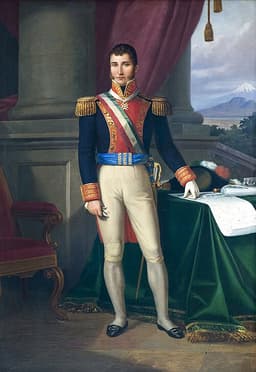
Agustin de Iturbide
Emperor · Modern
55.3Total
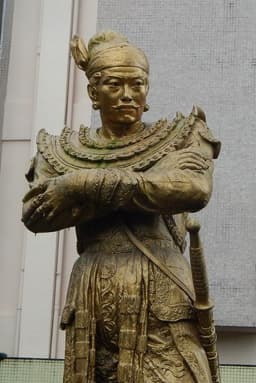
Bayinnaung
Emperor · Modern
68.6Total
Basic Information
Born
1783
1516
Died
1824
1581
Era
Modern
Modern
Nationality
Mexico
Myanmar
Occupation
Emperor
Emperor
Civilization
Western
Eastern
Score Comparison
Military (10%)
52.5
77.1
Political (20%)
53.8
82.0
Influence (20%)
57.2
65.0
Legacy (20%)
46.7
55.0
Leadership (15%)
67.0
74.0
Strategy (15%)
60.0
75.0
TOTAL
55.3
68.6
Agustin de Iturbide — Complete Timeline
1820 AD
Switched sides to join the independence movementPolitical Action
Iturbide, a royalist general who had fought against the insurgents, was appointed to command the army against Vicente Guerrero. Instead of fighting, he negotiated with Guerrero and issued the Plan of Iguala on February 24, 1821, proposing independence, constitutional monarchy, and protection of the Catholic Church.
Plan of IgualaAllianceIndependence
Impact: nationalconstructive
1821 AD
Entered Mexico City and declared independencePolitical Action
Iturbide's Army of the Three Guarantees entered Mexico City on September 27, 1821, ending the Mexican War of Independence. The next day, the Declaration of Independence of the Mexican Empire was signed. Iturbide became the head of a provisional government, effectively ruling Mexico.
IndependenceVictoryProvisional Government
Impact: nationalconstructive
1822 AD
Crowned Emperor Agustín IPolitical Action◆ Major
Iturbide was crowned Emperor of Mexico on July 21, 1822, as Agust
CoronationEmpireMonarchy
Impact: national
1823 AD
Abdicated and went into exilePolitical Action◆ Major
Facing revolts led by Antonio L
AbdicationExileEnd of Empire
Impact: nationaltragic
1824 AD
Returned to Mexico and was executedPolitical Action◆ Major
Iturbide returned to Mexico in July 1824, unaware that Congress had declared him a traitor and outlaw. He was captured upon landing and executed by firing squad on July 19, 1824, in Padilla, Tamaulipas. His death ended any possibility of restoring the monarchy.
ExecutionReturnDeath
Impact: nationaltragic
Bayinnaung — Complete Timeline
1550 AD
Establishment of the Toungoo EmpirePolitical Action
King Bayinnaung ascended the throne and began a series of military campaigns that created the largest empire in Southeast Asian history. At its peak, the Toungoo empire covered modern Myanmar, Thailand, Laos, and parts of China and India.
Toungoo EmpireSoutheast AsiaImperial Expansion
Impact: regionalconstructive
1557 AD
Conquest of the Shan StatesWar◆ Major
King Bayinnaung conquered the Shan States, bringing them under Toungoo control. This expansion added significant territory and resources to the Burmese empire.
Shan StatesToungoo ExpansionBurmese Empire
Impact: regional
1569 AD
Capture of AyutthayaWar
King Bayinnaung's forces captured the Siamese capital of Ayutthaya after a long siege. He installed a vassal king and made Siam a tributary state of the Toungoo empire.
Burmese-Siamese WarAyutthayaToungoo Empire
Impact: regional
1570 AD
Administrative ReformsReform◆ Major
King Bayinnaung implemented administrative reforms to govern his vast empire, including the appointment of governors and the standardization of laws and taxes. These reforms helped maintain control over conquered territories.
GovernanceAdministrationToungoo Empire
Impact: regionalconstructive
1574 AD
Conquest of Lan XangWar◆ Major
King Bayinnaung conquered the Lao kingdom of Lan Xang (modern Laos), bringing it under Toungoo control. This further expanded the Burmese empire to its greatest territorial extent.
Lan XangToungoo ExpansionLaos
Impact: regional
Expert Analysis
Bayinnaung vs Agustin de Iturbide
### The Emperor’s Two Crowns
In the summer of 1569, the Siamese capital of Ayutthaya fell after a brutal siege. The conqueror, King Bayinnaung of Burma’s Toungoo dynasty, entered the city not as a destroyer but as a master builder of empire. He installed a vassal king and departed, leaving a tributary state that would remember his shadow for centuries. Half a world away and 250 years later, on July 21, 1822, another man placed a crown on his own head in Mexico City. Agustín de Iturbide, a former royalist general, became Emperor Agustín I. His reign lasted less than a year. Bayinnaung’s empire stretched from the borders of India to the coast of Vietnam; Iturbide’s dissolved into civil war. Both men were emperors of fragile new states. Why did one succeed where the other failed? The answer lies not in their crowns, but in the soil from which they grew.
### Origins
Bayinnaung was born in 1516, the son of a minor noble in a fractious Burma. The Toungoo dynasty was itself young, barely a generation old, and the region was a patchwork of warring kingdoms. He grew up in a world where power was won by the sword and held by constant vigilance. His childhood friend and cousin, Tabinshwehti, became king, and Bayinnaung served as his general. He learned statecraft in the saddle, on campaign, and in the chaos of a land that had known no peace for decades. His era was one of total war, where the annihilation of a rival meant the survival of your own people. There was no room for sentiment, only for ruthlessness and strategy.
Agustín de Iturbide was born in 1783 in Valladolid (now Morelia), Mexico, into a wealthy Spanish-creole family. The world he entered was one of rigid social hierarchy, where the “peninsulares”—Spaniards born in Spain—sat at the top, and creoles like Iturbide, though rich and educated, were barred from the highest offices. The winds of revolution were blowing across the Atlantic: the American Revolution had succeeded, the French Revolution had shaken Europe, and in 1810, Miguel Hidalgo’s cry for Mexican independence had ignited a bloody rebellion. Iturbide’s father was a landowner; his son was a conservative, a man who craved order. He began his career fighting *against* the independence movement, hunting down revolutionaries with the same zeal he would later use to lead them.
### Rise to Power
Bayinnaung’s path was forged in fire. In 1550, his cousin King Tabinshwehti was assassinated, and the Toungoo kingdom teetered on the brink of collapse. Bayinnaung, then a general, did not hesitate. He fought off rivals, crushed rebellions, and ascended the throne that same year. His legitimacy came from victory. He did not inherit an empire; he built one, campaign by campaign. In 1557, he conquered the Shan States, a mosaic of principalities that had long plagued Burma’s borders. He did not simply defeat them—he integrated them, appointing governors and demanding tribute while allowing local rulers to keep their titles as vassals. It was a pragmatic empire, held together by fear and reward.
Iturbide’s rise was a sudden, dramatic pivot. In 1820, after a decade of brutal guerrilla war between royalists and insurgents, Spain itself was in turmoil. Iturbide, still a royalist commander, was appointed to crush the last rebel leader, Vicente Guerrero. Instead, he did the unthinkable: he switched sides. In February 1821, he met Guerrero and proposed the “Plan of Iguala,” a compromise that promised independence, monarchy, and the protection of the Catholic Church. He united royalists, rebels, and clergy under the banner of the “Army of the Three Guarantees.” On September 27, 1821, he marched into Mexico City. The war was over. He was the hero of the hour, the man who had delivered independence without a bloody final battle. His power came from a deal, not a conquest.
### Leadership & Governance
Bayinnaung ruled as a warrior-king on a permanent war footing. His administrative reforms in 1570 were designed for control: he appointed governors, standardized taxes, and built roads to move armies quickly. He was a master of siege warfare, as the capture of Ayutthaya in 1569 proved, and a brilliant strategist who understood that an empire of diverse peoples could not be ruled by terror alone. He married local princesses, respected Buddhist monasteries, and allowed conquered kings to remain as vassals as long as they paid tribute and sent troops. His empire was a machine of extraction and projection, but it was also a system of mutual obligation. He led from the front, and his men followed him because he had never lost a war.
Iturbide’s governance was a disaster. He was crowned emperor in 1822 after a military mutiny pressured a reluctant congress to accept him. But he had no administrative experience, no treasury, and no standing army beyond the personal loyalties of his officers. He faced an empty treasury, a devastated economy, and a society split between monarchists, republicans, and regional strongmen. He tried to rule by decree, but he had no Bayinnaung-style network of governors or vassals. He was a general who had become emperor overnight, and he governed like a man trying to hold a fistful of sand. Within months, his former ally Antonio López de Santa Anna raised the banner of rebellion. By March 1823, Iturbide had abdicated and fled to Europe.
### Triumph & Tragedy
Bayinnaung’s greatest moment was the conquest of Lan Xang in 1574, which brought modern Laos under his control. At his zenith, he ruled the largest empire Southeast Asia had ever seen—a domain that stretched from Manipur in the west to the Mekong River in the east. His tragedy was that it was built on his own shoulders. He died in 1581, and within a decade, the empire began to fracture. His successors lacked his military genius and political touch. The vassal kings he had subdued began to revolt. The great machine he had built required a master mechanic to keep it running; without him, it seized up.
Iturbide’s triumph was fleeting—the moment of independence in 1821, when he was hailed as the “Liberator of Mexico.” His tragedy was his return. In 1824, after hearing rumors of unrest, he sailed back from exile, believing he could still save his country. He did not know that the Mexican Congress had declared him a traitor and an outlaw, punishable by death. He was captured, and on July 19, 1824, he was executed by firing squad. He died as he had lived: a man of the old order, unable to understand the new one.
### Character & Destiny
Bayinnaung was a pragmatist with a vision of permanence. He knew that an empire of conquest had to become an empire of administration, or it would vanish. He was ruthless—he executed rivals without mercy—but he was also patient. He spent years consolidating each conquest before moving to the next. His character was shaped by a world where a king was a general first and a politician second. He understood power as a living, breathing thing that had to be fed with victories and nourished with order.
Iturbide was a romantic who believed in order but could not create it. He was brave, charismatic, and genuinely popular in 1821, but he had no ability to compromise or delegate. He saw himself as a Napoleon, a man who could impose a crown on a fractured nation by force of will. But Mexico in 1822 was not France in 1804. It was a land of deep regional loyalties, simmering class resentments, and a republican fervor that he could not suppress. His destiny was to be a bridge—a man who ended one era but could not begin the next.
### Legacy
Bayinnaung is remembered in Myanmar as a national hero, a unifier, and a builder. His name is synonymous with the golden age of the Toungoo dynasty, and his campaigns are still studied in military academies. Yet his empire was ephemeral, and his legacy is one of ambition as much as achievement. He is a figure of awe, not affection.
Iturbide’s legacy is more complicated. In Mexico, he is a controversial figure: the man who won independence, but also the emperor who failed. For decades, he was written out of official histories, seen as a monarchist embarrassment in a republican nation. Only recently have historians begun to re-evaluate him, recognizing that his Plan of Iguala was a masterstroke of political compromise, even if his empire was a house of cards. He is remembered as a cautionary tale: a man who reached for the sun and burned.
### Conclusion
Both Bayinnaung and Iturbide built empires on paper. Bayinnaung’s was written in blood and stone, lasting decades; Iturbide’s was written in ink and hope, lasting months. The difference was not ambition—both men had that in abundance. It was not even luck, though Bayinnaung had his share. The difference was that Bayinnaung’s empire grew from the ground up, rooted in a military culture that had been forged over generations. Iturbide’s empire was a roof without walls, a crown without a kingdom. In the end, the most powerful force in history is not the will of one man, but the patience of the soil that must support him. Bayinnaung understood that. Iturbide learned it too late.
Rankings
🥇
BayinnaungLeader
Mil: 77.1Pol: 82.0Inf: 65.0
68.6
🥈
Agustin de Iturbide
Mil: 52.5Pol: 53.8Inf: 57.2
55.3
+13.3 behind
How This Comparison Works
Algorithm
Each figure is scored on 6 dimensions (0—100 scale) based on structured historical data: Military (10%), Political (20%), Influence (20%), Legacy (20%), Leadership (15%), Strategy (15%). The weighted total produces the final ranking.
Data Sources
Scores are computed from structured sub-indicators in the database. Scale factors adjust for era (Ancient ×0.85, Modern ×1.0) and civilization size (Eastern ×1.05, Other ×0.80) to account for differences in population and military scale.
Maximum 3 Figures
Comparisons are limited to 2—3 figures to ensure readability and statistical meaningfulness.
Error Margins
±5 points per dimension — Sub-scores are derived from historical records with inherent uncertainty. Two figures within 5 points on a dimension should be considered roughly equivalent in that area.
Total Score Accuracy
±3 points overall — The weighted combination of 6 dimensions produces a total score with approximately ±3 points of uncertainty. Differences of less than 3 points are not statistically significant— the figures are effectively tied.
Known Limitations
- Historical records are incomplete and uneven across civilizations
- Figures from oral-tradition societies may be underrepresented
- Occupation labels can misclassify multi-role figures
- Scores measure capability and impact, not moral character
- Quantitative scoring is a comparison tool, not absolute truth
Capability Radar
Military (10%) — Battles & Warfare
Battles
60
85
Win Rate
65
90
Expansion
50
92
Political (20%) — Governance & Reform
Reform
45
70
Diplomacy
55
78
Economy
30
72
Influence (20%) — Cultural & Global Reach
Cultural
40
70
Global
35
55
Legacy (20%) — Historical Impact
Historical
50
75
Longevity
30
60
Leadership (15%) — Power & Stability
Tenure
30
85
Stability
20
65
Strategy (15%) — Tactics & Innovation
Strategy
60
88
Tactics
55
80
Reform
40
75
Similar Comparisons
Comments & Discussion
短命皇帝6/16/2026
从数据来看,伊图尔维德的帝国就是个数学笑话。他1822年登基,1823年就被赶下台,统治期不到11个月。而莽应龙在位31年,疆域从缅甸扩张到老挝和泰国,面积接近200万平方公里。伊图尔维德的墨西哥帝国巅峰不过460万平方公里纸面领土,实际控制区域不到一半,因为他连自己的军队都养不活——帝国军费占预算93%,却连一次像样的平叛都打不赢。数字不会说谎:一个是被人民碾碎的泡沫,一个是碾压人民的铁锤。
Elephant v Horse6/16/2026
A classics scholar would recognize this: Bayinnaung built his legitimacy on Buddhist kingship and the Mandala system of overlapping loyalties, a structure as old as the Ashokan empire. Iturbide borrowed Napoleon's coronation ceremony wholesale, including the self-crowning gesture, in a land that had just fought a decade-long anti-monarchist war. Bayinnaung understood that a crown must fit the cultural skull it rests on. Iturbide placed a French hat on a Mexican head and expected it to stay. That
农民起义的背叛者6/16/2026
我作为一个历史爱好者,最不能忍的就是把伊图尔维德吹成"独立英雄"的说法。他原本是西班牙军队里的刽子手,专门屠杀墨西哥独立游击队,手上沾满了原住民的鲜血。后来见风使舵,摇身一变当上"皇帝",本质上就是个投机分子。反观莽应龙,人家是实打实从底层打上来的——16岁就跟着表哥打仗,26岁靠战功当上大将,每一步都是血换来的。伊图尔维德这种变色龙,连和莽应龙相提并论的资格都没有。
Empire of Justice v Empire of 6/16/2026
Revisionist critic here: both men failed equally in the long run, but Bayinnaung failed forward. He created a administrative template—the Shan states under Burmese suzerainty—that lasted 300 years. Iturbide's sole lasting "achievement" was sparking a full-on civil war that left Mexico in chaos for decades. The Toungoo dynasty
Historian7676/16/2026
As a military historian, I see Bayinnaung as the superior strategist by far. He didn't just win battles; he understood logistics and manpower rotation, keeping his elephant corps fresh through a relay system across 1,500 miles. Iturbide's "Army of the Three Guarantees" was a political compromise in uniform, not a war machine. Bayinnaung conquered Siam twice and held it for 15 years. Iturbide couldn't hold Mexico City for 15 months. Real empire demands ruthless military infrastructure, not charis