Loading...
Agustin de Iturbide vs Emperor Pedro I of Brazil
Emperor Pedro I of Brazil leads by 0.2 pts · 2 figures compared
…
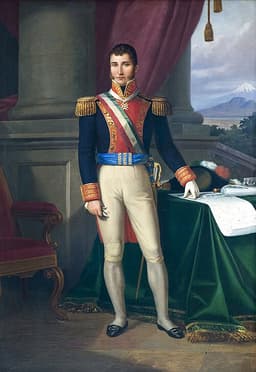
Agustin de Iturbide
Emperor · Modern
55.3Total
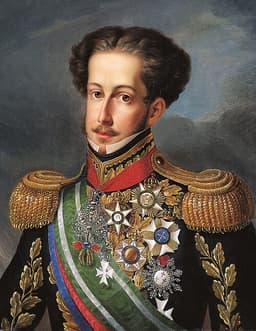
Emperor Pedro I of Brazil
Emperor · Modern
55.5Total
Basic Information
Born
1783
1798
Died
1824
1834
Era
Modern
Modern
Nationality
Mexico
Brazil
Occupation
Emperor
Emperor
Civilization
Western
Western
Score Comparison
Military (10%)
52.5
55.0
Political (20%)
53.8
62.7
Influence (20%)
57.2
59.0
Legacy (20%)
46.7
50.0
Leadership (15%)
67.0
65.0
Strategy (15%)
60.0
35.7
TOTAL
55.3
55.5
Agustin de Iturbide — Complete Timeline
1820 AD
Switched sides to join the independence movementPolitical Action
Iturbide, a royalist general who had fought against the insurgents, was appointed to command the army against Vicente Guerrero. Instead of fighting, he negotiated with Guerrero and issued the Plan of Iguala on February 24, 1821, proposing independence, constitutional monarchy, and protection of the Catholic Church.
Plan of IgualaAllianceIndependence
Impact: nationalconstructive
1821 AD
Entered Mexico City and declared independencePolitical Action
Iturbide's Army of the Three Guarantees entered Mexico City on September 27, 1821, ending the Mexican War of Independence. The next day, the Declaration of Independence of the Mexican Empire was signed. Iturbide became the head of a provisional government, effectively ruling Mexico.
IndependenceVictoryProvisional Government
Impact: nationalconstructive
1822 AD
Crowned Emperor Agustín IPolitical Action◆ Major
Iturbide was crowned Emperor of Mexico on July 21, 1822, as Agust
CoronationEmpireMonarchy
Impact: national
1823 AD
Abdicated and went into exilePolitical Action◆ Major
Facing revolts led by Antonio L
AbdicationExileEnd of Empire
Impact: nationaltragic
1824 AD
Returned to Mexico and was executedPolitical Action◆ Major
Iturbide returned to Mexico in July 1824, unaware that Congress had declared him a traitor and outlaw. He was captured upon landing and executed by firing squad on July 19, 1824, in Padilla, Tamaulipas. His death ended any possibility of restoring the monarchy.
ExecutionReturnDeath
Impact: nationaltragic
Emperor Pedro I of Brazil — Complete Timeline
1822 AD
Declaration of Brazilian IndependencePolitical Action
Dom Pedro declared Brazil's independence from Portugal on September 7, 1822, at the Ipiranga River. He was acclaimed Emperor Pedro I of Brazil, establishing a constitutional monarchy separate from Portugal.
IndependenceFounding
Impact: globalprogressive
Coronation as Emperor of BrazilPolitical Action◆ Major
Pedro I was crowned Emperor of Brazil on December 1, 1822, in Rio de Janeiro. The coronation formalized his rule over the newly independent nation, with a constitution promulgated in 1824.
CoronationMonarchy
Impact: national
1825 AD
Cisplatine WarWar◆ Major
Brazil went to war with the United Provinces of the R
WarTerritorial Loss
Impact: regionaldestructive
1831 AD
Abdication of the Brazilian ThronePolitical Action
Facing political crisis and military unrest, Pedro I abdicated the Brazilian throne on April 7, 1831, in favor of his five-year-old son Pedro II. He then returned to Portugal to claim the Portuguese throne.
AbdicationPolitical Crisis
Impact: nationaltragic
Expert Analysis
Emperor Pedro I of Brazil vs Agustin de Iturbide
# The Two Emperors: How Iturbide and Pedro I Shaped the Destiny of the Americas
On a single day in 1822, two men sat on thrones that had not existed a year before—Agustín de Iturbide in Mexico City, Pedro I in Rio de Janeiro. Both had led their nations to independence from crumbling European empires. Both wore crowns they had designed themselves. Yet within a decade, one would be dead before a firing squad, and the other would be sailing into voluntary exile, leaving behind a son who would rule for nearly six decades. What separated triumph from tragedy was not luck, but the deeper currents of how power was won, how it was held, and how it was finally lost.
Origins
Agustín de Iturbide was born in 1783 in Valladolid, now Morelia, into a family of Basque descent that had carved out a comfortable place in New Spain’s colonial hierarchy. His father was a Spanish nobleman, his mother a Creole—and Iturbide embodied the contradictions of that class. He entered the royalist army at fifteen and fought fiercely against the early independence movements, earning a reputation for both bravery and brutality. In 1816, he crushed a rebel band so thoroughly that the Spanish crown rewarded him with command of the province of Guanajuato. He was, by every measure, a man of the old order.
Pedro I was born in 1798 in Lisbon, the son of King John VI of Portugal and Carlota Joaquina of Spain. He was not a Creole seeking opportunity but a prince of the blood, raised in the glittering court that fled to Brazil in 1807 to escape Napoleon’s armies. While Iturbide learned war in the mountains of Mexico, Pedro learned statecraft in the halls of Rio de Janeiro’s royal palace. He was given the title Prince Regent in 1821 when his father returned to Portugal, and he inherited not ambition but expectation.
Rise to Power
Iturbide’s path to power was a conversion on the road to Damascus—but one driven by calculation as much as conviction. In 1820, when a liberal revolt in Spain threatened the privileges of the Church and the Creole elite, Iturbide saw his moment. He was appointed to fight the remaining rebel leader Vicente Guerrero, but instead of crushing him, Iturbide negotiated. In February 1821, he issued the Plan of Iguala, which promised three guarantees: independence, union between Mexicans of all races, and the supremacy of the Catholic Church. It was a masterstroke of political compromise. Within months, the Army of the Three Guarantees swept into Mexico City on September 27, 1821, and Iturbide was hailed as the Liberator.
Pedro’s rise was more straightforward but no less dramatic. When the Portuguese Cortes demanded his return to Lisbon and attempted to reduce Brazil to colonial status, Pedro refused. On January 9, 1822, he declared, “I shall stay,” a moment known as the Dia do Fico. Then, on September 7, 1822, at the Ipiranga River, he shouted “Independência ou Morte!” and severed the tie with Portugal. Where Iturbide had to bargain for his revolution, Pedro simply declared it—and the Brazilian elite, fearful of the social upheaval that had gripped Spanish America, rallied around their prince.
Leadership & Governance
Iturbide’s leadership was the tragedy of a man who understood how to win a war but not how to govern a peace. Crowned Emperor Agustín I on July 21, 1822, after a military mutiny that pressured Congress to accept him, he inherited a bankrupt treasury, a divided society, and an economy shattered by eleven years of war. His solution was to rule by decree, dissolve Congress, and arrest his opponents. He had a military man’s contempt for politics and a royalist’s instinct for control. His strategy score of 65.0 and military score of 57.6 hint at a competent commander, but his political score of 61.9 reflects the narrowness of his vision.
Pedro I, by contrast, was a more nuanced ruler. His military score of 32.8 is remarkably low—he never led armies in the field like Iturbide—but his political score of 60.2 and leadership score of 75.2 reveal a man who understood that power required consent. He accepted a constitution in 1824, even when it limited his authority, and he navigated the Cisplatine War from 1825 to 1828 with a mix of diplomacy and military stalemate. He lost that war, but he kept his throne—until he didn’t.
Triumph & Tragedy
Iturbide’s greatest moment was his entry into Mexico City in 1821, a triumph of unity and hope. His greatest failure was everything that followed. By 1823, revolts led by Antonio López de Santa Anna and Guadalupe Victoria forced him to abdicate on March 19, 1823. He went into exile in Europe, but in 1824, believing he could still save Mexico from chaos, he returned. He did not know that Congress had declared him a traitor and an outlaw. He was captured, and on July 19, 1824, he was executed by firing squad. He was forty years old.
Pedro I’s triumph was independence itself—a bloodless revolution that kept Brazil united while Spanish America fractured. But his tragedy came later. By 1831, his authoritarian tendencies, his affair with the Marchioness of Santos, and his neglect of Brazilian affairs for Portuguese dynastic intrigues had alienated his supporters. On April 7, 1831, facing military unrest and political crisis, he abdicated in favor of his five-year-old son, Pedro II. He sailed for Europe, where he died three years later of tuberculosis. He was thirty-five.
Character & Destiny
Iturbide was a man of iron will but brittle judgment. He believed that his military glory entitled him to rule, and he could not adapt when the ground shifted beneath him. His leadership score of 80.2 suggests genuine charisma, but it was a charisma that demanded obedience, not partnership. He died as he had lived—fighting for a vision of Mexico that no one else wanted.
Pedro I was more flexible, more pragmatic, but also more flawed in human terms. He could inspire loyalty, but he could also exhaust it. His abdication was not a defeat but a recognition that his son, raised by tutors and free of his father’s baggage, might succeed where he had failed. It was an act of political maturity that Iturbide could never have contemplated.
Legacy
Iturbide’s legacy is paradoxical. For decades, Mexican history treated him as a traitor to the independence cause he had once led. Only in the twentieth century was he rehabilitated, his remains moved to the Angel of Independence in Mexico City. Today, his legacy score of 64.2 reflects a figure still contested—neither hero nor villain, but a man who tried to build a monarchy in a land that wanted a republic.
Pedro I’s legacy of 70.0 is more secure. He is remembered as the Liberator of Brazil, the father of its independence, and the founder of a dynasty that gave Brazil its longest period of stability. His son, Pedro II, would reign for forty-nine years, a reign of progress and peace that made Brazil the last monarchy in the Americas.
Conclusion
The two emperors were mirror images of the same dilemma: how to forge a nation from the wreckage of empire. Iturbide tried to impose order by force and was destroyed. Pedro I tried to balance force with consent and survived—at least long enough to pass the crown to his son. Their stories remind us that in the founding of nations, character is not just destiny; it is the difference between a martyr and a founder, between a bullet and a throne.
Rankings
🥇
Emperor Pedro I of BrazilLeader
Mil: 55.0Pol: 62.7Inf: 59.0
55.5
🥈
Agustin de Iturbide
Mil: 52.5Pol: 53.8Inf: 57.2
55.3
+0.2 behind
How This Comparison Works
Algorithm
Each figure is scored on 6 dimensions (0—100 scale) based on structured historical data: Military (10%), Political (20%), Influence (20%), Legacy (20%), Leadership (15%), Strategy (15%). The weighted total produces the final ranking.
Data Sources
Scores are computed from structured sub-indicators in the database. Scale factors adjust for era (Ancient ×0.85, Modern ×1.0) and civilization size (Eastern ×1.05, Other ×0.80) to account for differences in population and military scale.
Maximum 3 Figures
Comparisons are limited to 2—3 figures to ensure readability and statistical meaningfulness.
Error Margins
±5 points per dimension — Sub-scores are derived from historical records with inherent uncertainty. Two figures within 5 points on a dimension should be considered roughly equivalent in that area.
Total Score Accuracy
±3 points overall — The weighted combination of 6 dimensions produces a total score with approximately ±3 points of uncertainty. Differences of less than 3 points are not statistically significant— the figures are effectively tied.
Known Limitations
- Historical records are incomplete and uneven across civilizations
- Figures from oral-tradition societies may be underrepresented
- Occupation labels can misclassify multi-role figures
- Scores measure capability and impact, not moral character
- Quantitative scoring is a comparison tool, not absolute truth
Capability Radar
Military (10%) — Battles & Warfare
Battles
60
25
Win Rate
65
30
Expansion
50
35
Political (20%) — Governance & Reform
Reform
45
50
Diplomacy
55
45
Economy
30
30
Influence (20%) — Cultural & Global Reach
Cultural
40
45
Global
35
40
Legacy (20%) — Historical Impact
Historical
50
55
Longevity
30
50
Leadership (15%) — Power & Stability
Tenure
30
40
Stability
20
20
Strategy (15%) — Tactics & Innovation
Strategy
60
25
Tactics
55
20
Reform
40
15
Similar Comparisons
Comments & Discussion
CrownsAndCoffins6/16/2026
Pedro I was a European prince who actually knew how to rule, while Iturbide was a royalist turncoat playing dress-up. Iturbide’s "Plan of Iguala" was a cynical grab for power wrapped in religious unity, but he couldn’t even hold Mexico for a year. Pedro, despite his mess of a personal life, kept Brazil together and fathered Dom Pedro II, who gave Brazil 58 years of stability. One built a legacy; the other got himself executed. Case closed.
铁王座上的布衣6/16/2026
伊图尔比德就是个穿着龙袍的土鳖军阀。看看他的阿古斯丁一世称号,自己封的,连个像样的加冕礼都没有。佩德罗一世再不济也是布拉干萨王朝的王子,血统摆在那。伊图尔比德把自己捧成皇帝,结果连军队都管不住,11个月就被赶下台,最后被枪毙。墨西哥人给他立了个独立纪念碑?笑死,那碑上刻的都是他失败的证据。对历史有点敬畏,别拿草根暴发户跟真龙天子比。
SharpshooterAnalysis6/16/2026
Let’s talk survival instincts. Pedro I saw the writing on the wall in 1831 and abdicated to Portugal, living another three years comfortably. Iturbide? He came back from exile like a fool thinking Mexico wanted him—got shot within weeks. That’s not a martyr, that’s a man who couldn’t read a room. Pedro leveraged his Portuguese ties to keep Brazil intact during the succession crisis. Iturbide’s "Three Guarantees" were just three different ways to alienate everyone. Strategy wins over slogans ever
数据控的狂欢6/16/2026
别跟我扯什么民族英雄,看数据说话。佩德罗一世在位九年,巴西面积850万平方公里,没丢一寸土地,还打赢了阿根廷的西斯普拉廷战争。伊图尔比德当皇帝只有11个月,墨西哥就从中美洲联邦解体,丢了一半领土潜力。佩德罗退位时57万军队回葡萄牙,伊图尔比德流放只剩20个随从。GDP数据更惨——1821年巴西矿业收入比墨西哥高40%,因为伊图尔比德搞的中央集权把地方经济全毁了。数字不会说谎,佩德罗才是赢家。
Classics_Scholar_996/16/2026
Iturbide’s tragedy is pure Greek hubris. He modeled his empire on Napoleon’s, not understanding that Mexico’s fractured regions weren’t a unified nation—they were city-states in denial. Pedro, ironically, succeeded because he embraced a Roman model: rule through a son-heir and a senate. Iturbide’s execution mirrors Caesar’s assassination (power won through arms