Loading...
Agim Ceku vs Sitiveni Rabuka
Sitiveni Rabuka leads by 4.4 pts · 2 figures compared
…

Agim Ceku
General · Modern
47.3Total
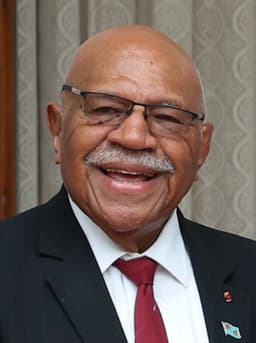
Sitiveni Rabuka
General · Modern
51.7Total
Basic Information
Born
1960
1948
Died
—
—
Era
Modern
Modern
Nationality
Kosovo
Fiji
Occupation
General
General
Civilization
Western
Other
Score Comparison
Military (10%)
38.3
10.2
Political (20%)
43.7
60.0
Influence (20%)
51.8
53.3
Legacy (20%)
41.7
46.7
Leadership (15%)
61.1
85.0
Strategy (15%)
43.3
39.6
TOTAL
47.3
51.7
Agim Ceku — Complete Timeline
1999 AD
KLA Chief of StaffWar◆ Major
Ceku served as the Chief of Staff of the Kosovo Liberation Army during the final phase of the Kosovo War. He was a key military strategist and commander.
Kosovo WarMilitary Command
Impact: regional
2006 AD
Elected Prime Minister of KosovoPolitical Action◆ Major
Ceku became Prime Minister of Kosovo under UN administration, succeeding Bajram Kosumi. He led the government during the final status negotiations and the run-up to independence.
Kosovo StatusGovernment
Impact: regional
2008 AD
Resigned as Prime MinisterPolitical Action
Ceku resigned after failing to form a coalition government following the 2007 elections. He was succeeded by Hashim Thaci.
Kosovo PoliticsTransition
Impact: regional
Sitiveni Rabuka — Complete Timeline
1987 AD
1987 Fijian Coup d'étatPolitical Action
Rabuka, as a colonel in the Fijian military, led a coup overthrowing the elected government of Timoci Bavadra. The coup was motivated by ethnic Fijian opposition to Indo-Fijian political influence. Rabuka declared Fiji a republic.
CoupMilitary InterventionEthnic Tension
Impact: nationaldestructive
1992 AD
1992 Election as Prime MinisterPolitical Action◆ Major
Rabuka transitioned from military leader to civilian politician, winning the 1992 general election as leader of the Fijian Political Party. He became Prime Minister, serving until 1999.
ElectionCivilian GovernmentPolitical Transition
Impact: national
1997 AD
1997 Constitution ReformReform◆ Major
Rabuka's government oversaw the adoption of a new constitution that removed ethnic-based voting and provided for a multi-ethnic government. The constitution aimed to reduce ethnic tensions and promote national unity.
ConstitutionReformEthnic Reconciliation
Impact: nationalconstructive
1999 AD
1999 General Election DefeatPolitical Action◆ Major
Rabuka's government was defeated in the general election by the Labour Party led by Mahendra Chaudhry. Rabuka stepped down as Prime Minister, marking the end of his first period in power.
Election DefeatGovernment ChangeChaudhry
Impact: national
2022 AD
2022 Return as Prime MinisterPolitical Action◆ Major
Rabuka led the People's Alliance to victory in the 2022 general election, forming a coalition government. He became Prime Minister again, 23 years after his previous tenure, promising democratic reforms.
ElectionReturn to PowerCoalition Government
Impact: national
Expert Analysis
Sitiveni Rabuka vs Agim Ceku
# The General Who Became Prime Minister
On a humid May morning in 1987, a Fijian colonel in full military regalia strode into Parliament House in Suva and calmly announced that the government was no more. Twelve years later and half a world away, another commander—this one a Kosovar Albanian who had fought a guerrilla war against Serbian forces—would walk the corridors of power in Pristina, not as a conqueror but as a prime minister. Sitiveni Rabuka and Agim Ceku both traded their uniforms for civilian suits, both led their nations through turbulent transitions, and both achieved what few generals ever manage: a second act in democratic politics. Yet their paths diverged in ways that reveal the peculiar alchemy of history, chance, and character.
Origins
Rabuka was born in 1948 on the island of Vanua Levu, into a Fiji that was still a British colony, a place where ethnic Fijians and Indo-Fijians coexisted in a fragile balance engineered by colonial administrators. He grew up in a world of village chiefs and Methodist hymns, where loyalty to tribe and land ran deeper than any abstract notion of citizenship. The military was a natural career for an ambitious Fijian man—it offered respect, order, and a path upward in a society where opportunities were scarce.
Ceku arrived in 1960, into a Kosovo that was part of Yugoslavia—a federation held together by Tito’s iron will. He was born into an ethnic Albanian family in a province where his people were second-class citizens, where speaking your language in public could bring trouble, where the memory of Ottoman rule and Serbian domination was never far from the surface. He joined the Yugoslav People’s Army, as many Albanians did, but when Yugoslavia began to tear apart in the 1990s, he chose sides. He fought in Croatia, then joined the Kosovo Liberation Army, a ragtag insurgency that would transform into a serious military force.
Rise to Power
Rabuka’s rise was sudden and surgical. In 1987, as a colonel, he led a coup that overthrew the newly elected government of Timoci Bavadra—an alliance of Indo-Fijians and progressive ethnic Fijians that threatened the traditional power structure. Rabuka claimed he was protecting indigenous Fijian rights, but the coup was also about preserving the dominance of the chiefly system from which he came. He seized power, handed it to civilians, then seized it again when he felt the reforms went too far. By 1992, he had transformed himself into a politician, winning the prime ministership in a democratic election. His military score of 19.9 reflects that he was never a battlefield commander, but his political score of 72.0 shows a man who understood power’s shifting currents.
Ceku’s path was forged in war. By 1999, he was chief of staff of the KLA, coordinating guerrilla operations against Serbian forces during NATO’s bombing campaign. He was a strategist with a score of 61.2—not a genius, but competent—and a leader who kept his ragtag army together under immense pressure. When the war ended and Kosovo came under UN administration, Ceku did not fade away. In 2006, he became prime minister, a role he held until 2008, when he resigned after failing to form a coalition. His political score of 63.5 is slightly lower than Rabuka’s, but his military score of 46.7 is far higher—he had actually led men in combat.
Leadership & Governance
As prime minister, Rabuka governed a deeply divided nation. His greatest achievement came in 1997, when his government oversaw a new constitution that removed ethnic-based voting and created a multiracial democracy. It was a remarkable act for a man who had once led a coup in the name of ethnic supremacy. Critics called it pragmatism; supporters called it growth. Rabuka’s leadership score of 77.4 suggests he had the charisma and cunning to hold together a coalition of chiefs, businessmen, and moderates. But his strategy score of 44.6 reveals a weakness for short-term thinking—he often reacted to events rather than shaping them.
Ceku governed Kosovo under UN supervision, a limbo status that made real sovereignty impossible. His task was to build institutions from scratch while managing the expectations of a population that had just emerged from war. He pushed for security sector reform, professionalizing the Kosovo Protection Corps, and maintained stability during the delicate period leading to Kosovo’s 2008 declaration of independence. His leadership score of 72.6 is comparable to Rabuka’s, but he lacked the same political maneuverability—his every move was watched by international administrators.
Triumph & Tragedy
Rabuka’s triumph was his return. In 2022, thirty-five years after his coup, he led the People’s Alliance to victory and became prime minister again. It was a redemption arc that few predicted—the coup leader turned elder statesman, welcomed back by a nation that had forgiven, if not forgotten. His tragedy was the 1999 election defeat, when voters rejected his coalition for the Labour Party of Mahendra Chaudhry, an Indo-Fijian. The election was free and fair, and Rabuka stepped down peacefully—a test of democracy that he passed.
Ceku’s triumph was the Kosovo War itself. He helped lead an insurgency that, against all odds, won international intervention and eventual independence. His tragedy was the failure of his political career—he never won a popular mandate, served only two years as prime minister, and was outmaneuvered by Hashim Thaçi, a younger and more ruthless politician. Ceku’s influence score of 71.5 is high, but his legacy score of 57.1 is lower than Rabuka’s 61.2—perhaps because he never completed the journey from warrior to statesman.
Character & Destiny
Rabuka was a chameleon—a man who could be a coup leader in the morning and a democrat by evening. He was charming, adaptable, and fundamentally pragmatic. He seemed to believe, genuinely, that he had done what was necessary for his people, and when circumstances changed, he changed with them. His total score of 61.0 reflects a man who was never the best at anything but was good enough at everything.
Ceku was a soldier first. He was disciplined, serious, and less comfortable with the compromises of politics. He had the respect of his troops but never quite mastered the art of coalition-building. His total score of 63.2 is slightly higher than Rabuka’s, but it masks a narrower range—he was a better military leader but a less flexible politician.
Legacy
Rabuka is remembered as Fiji’s most controversial figure—a man who broke democracy and then helped rebuild it. His legacy is complicated, and Fijians remain divided on whether he was a patriot or a power-seeker. But his return to power in 2022 suggests a nation that has come to terms with its past.
Ceku is remembered as a freedom fighter who helped liberate Kosovo. His legacy is more straightforward—he is honored as a hero of the war, even if his political career fell short. In Kosovo, the question is not whether he was right to fight, but whether he could have governed better.
Conclusion
Both men prove that generals can become democrats, but the journey is never clean. Rabuka’s path was longer and more winding, marked by a coup that he spent decades trying to justify. Ceku’s path was shorter and more direct, but he never quite escaped the shadow of the war that made him. In the end, what separates them is not their scores or their events but something harder to measure: the ability to change, to be forgiven, and to try again. Rabuka had that gift; Ceku did not. And in the messy arithmetic of history, that may be the difference between a footnote and a second chance.
Rankings
🥇
Sitiveni RabukaLeader
Mil: 10.2Pol: 60.0Inf: 53.3
51.7
🥈
Agim Ceku
Mil: 38.3Pol: 43.7Inf: 51.8
47.3
+4.4 behind
How This Comparison Works
Algorithm
Each figure is scored on 6 dimensions (0—100 scale) based on structured historical data: Military (10%), Political (20%), Influence (20%), Legacy (20%), Leadership (15%), Strategy (15%). The weighted total produces the final ranking.
Data Sources
Scores are computed from structured sub-indicators in the database. Scale factors adjust for era (Ancient ×0.85, Modern ×1.0) and civilization size (Eastern ×1.05, Other ×0.80) to account for differences in population and military scale.
Maximum 3 Figures
Comparisons are limited to 2—3 figures to ensure readability and statistical meaningfulness.
Error Margins
±5 points per dimension — Sub-scores are derived from historical records with inherent uncertainty. Two figures within 5 points on a dimension should be considered roughly equivalent in that area.
Total Score Accuracy
±3 points overall — The weighted combination of 6 dimensions produces a total score with approximately ±3 points of uncertainty. Differences of less than 3 points are not statistically significant— the figures are effectively tied.
Known Limitations
- Historical records are incomplete and uneven across civilizations
- Figures from oral-tradition societies may be underrepresented
- Occupation labels can misclassify multi-role figures
- Scores measure capability and impact, not moral character
- Quantitative scoring is a comparison tool, not absolute truth
Capability Radar
Military (10%) — Battles & Warfare
Battles
35
5
Win Rate
40
5
Expansion
15
5
Political (20%) — Governance & Reform
Reform
25
50
Diplomacy
30
45
Economy
20
40
Influence (20%) — Cultural & Global Reach
Cultural
20
30
Global
20
20
Legacy (20%) — Historical Impact
Historical
25
40
Longevity
15
30
Leadership (15%) — Power & Stability
Tenure
30
55
Stability
15
35
Strategy (15%) — Tactics & Innovation
Strategy
40
10
Tactics
45
10
Reform
20
5
Similar Comparisons
Comments & Discussion
BLOODY PEACEMAKER6/16/2026
Rabuka’s 1987 coup wasn’t about liberation—it was about ethnic supremacy. He overthrew a democratically elected government because he couldn’t stand an Indo-Fijian leading “his” country. That’s not a general becoming a statesman; that’s a racist colonel cozying up to chiefs and church elders. Ceku at least fought a genuine war of self-defense against Milosevic’s ethnic cleansing, then had the backbone to surrender his KLA uniform for NATO-backed diplomacy. One guy saved his people; the other sto
火药桶政客6/16/2026
拿塞库和拉布卡比?搞笑呢吧。塞库是科索沃解放军的硬汉,真刀真枪跟塞尔维亚干过,战后乖乖脱下军装搞政治,虽然争议大但至少推进了科索沃独立。拉布卡呢?一个两次发动政变的莽夫,1987年推翻民选政府,2000年又搞一次,纯粹为了保住斐济土著权力,搞出一堆种族骚乱和经济崩盘。民主?他两次废了它。别美化这两个人的轨迹,一个是真的战士,另一个是穿着军装的酋长。
DATA SKEPSIS6/16/2026
The “both became PM” framing is a classic historical cheat. Rabuka’s Fiji, with a 900,000 population and a Westminster system, is fundamentally incomparable to Ceku’s post-war Kosovo, which was a UN protectorate with zero recognition by Serbia and five EU states. One commanded a 3,500-man army; the other led decades of guerrilla networks. Measuring “success” by identical metrics ignores that Rabuka’s coups were about preserving a colonial-era racial hierarchy, while Ceku’s battles were about sta
经典书虫6/16/2026
作为古典学学生,我看出结构悲剧了。拉布卡和塞库都是柏拉图《理想国》里那类“哲学王”的反面——军人被迫治国,结果搞砸了民主。拉布卡政变后斐济宪法改了三次,种族冲突至今未消;塞库任总理两年就被赶下台,科索沃至今腐败横行、被欧盟当弃儿。两人都证明了:当你用剑夺权,你的西装永远沾血。历史上,从凯撒到克伦威尔,将军成不了好政客——这就是命运的irony。
TACTICAL PUNK6/16/2026
Rabuka’s Fijian coups were laughably inept—he literally walked in and arrested a sitting PM without a shot, but then couldn’t even write a constitution that lasted. Total amateur hour compared to Ceku, who orchestrated the KLA’s 1999 uprising while NATO