Loading...
Agim Ceku vs Deodoro da Fonseca
Deodoro da Fonseca leads by 1.5 pts · 2 figures compared
…

Agim Ceku
General · Modern
47.3Total
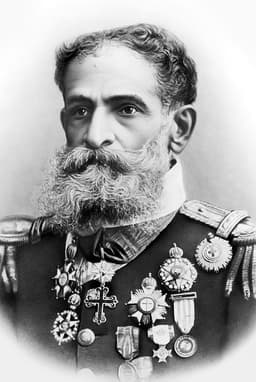
Deodoro da Fonseca
General · Modern
48.8Total
Basic Information
Born
1960
1827
Died
—
1892
Era
Modern
Modern
Nationality
Kosovo
Brazil
Occupation
General
General
Civilization
Western
Western
Score Comparison
Military (10%)
38.3
50.0
Political (20%)
43.7
45.1
Influence (20%)
51.8
54.1
Legacy (20%)
41.7
44.2
Leadership (15%)
61.1
57.6
Strategy (15%)
43.3
38.6
TOTAL
47.3
48.8
Agim Ceku — Complete Timeline
1999 AD
KLA Chief of StaffWar◆ Major
Ceku served as the Chief of Staff of the Kosovo Liberation Army during the final phase of the Kosovo War. He was a key military strategist and commander.
Kosovo WarMilitary Command
Impact: regional
2006 AD
Elected Prime Minister of KosovoPolitical Action◆ Major
Ceku became Prime Minister of Kosovo under UN administration, succeeding Bajram Kosumi. He led the government during the final status negotiations and the run-up to independence.
Kosovo StatusGovernment
Impact: regional
2008 AD
Resigned as Prime MinisterPolitical Action
Ceku resigned after failing to form a coalition government following the 2007 elections. He was succeeded by Hashim Thaci.
Kosovo PoliticsTransition
Impact: regional
Deodoro da Fonseca — Complete Timeline
1889 AD
Proclamation of the Brazilian RepublicPolitical Action
Deodoro da Fonseca led a military coup that overthrew Emperor Pedro II on November 15, 1889. He proclaimed the Republic of the United States of Brazil, ending 67 years of imperial rule.
CoupRepublic
Impact: globalprogressive
1891 AD
Election as First President of BrazilPolitical Action◆ Major
Deodoro da Fonseca was elected the first President of Brazil by the Constituent Congress on February 25, 1891. He took office under the new republican constitution, but his rule was brief and authoritarian.
ElectionPresidency
Impact: national
Dissolution of the National CongressPolitical Action◆ Major
Facing political opposition, Deodoro da Fonseca dissolved the National Congress on November 3, 1891, and declared a state of siege. This authoritarian act triggered a naval revolt and his eventual resignation.
AuthoritarianismPolitical Crisis
Impact: nationaldestructive
Resignation from the PresidencyPolitical Action◆ Major
Deodoro da Fonseca resigned the presidency on November 23, 1891, after a naval rebellion threatened his government. He handed power to Vice President Floriano Peixoto, ending his 9-month rule.
ResignationPolitical Crisis
Impact: nationaltragic
Expert Analysis
Deodoro da Fonseca vs Agim Ceku
# The General as Statesman: Two Paths from Battlefield to Power
On a November morning in 1891, Brazil’s first president, Marshal Deodoro da Fonseca, ordered the dissolution of the National Congress, stationing troops at the doors and declaring a state of siege. Just over a century later, in the spring of 2006, Agim Ceku, a former guerrilla commander who had never held civilian office, was sworn in as Prime Minister of Kosovo under United Nations administration. Two generals, two republics in the making, two attempts to translate military authority into political legitimacy. The contrast between their fates—one a founder who collapsed under the weight of his own ambition, the other a reluctant politician who navigated a fragile postwar transition—raises a question that echoes across history: What makes a warrior fit to govern?
Origins
Deodoro da Fonseca was born in 1827 in Alagoas, a province of the Brazilian Empire, into a military family with deep roots in the colonial aristocracy. His father and uncles had served in the wars of independence; his brother would become a prominent republican theorist. Young Deodoro entered the Military Academy at sixteen, where he absorbed not only the arts of war but the positivist philosophy that was reshaping the officer corps. By his thirties, he had fought in the Paraguayan War, earning a reputation for courage under fire and a temper that could flare without warning. He was, by all accounts, a man of the old order—devoted to hierarchy, suspicious of civilian politicians, and convinced that only the military could save Brazil from chaos.
Agim Ceku’s origins could hardly have been more different. Born in 1960 in the village of Çuškë, near Peja in what was then Yugoslavia’s autonomous province of Kosovo, he grew up under the shadow of Serbian dominance. His family were ethnic Albanians, farmers and craftsmen who had seen their language and culture systematically suppressed. Ceku joined the Yugoslav People’s Army as a young man, a pragmatic choice for a minority seeking opportunity, and rose to the rank of captain. But when Yugoslavia began to splinter in the 1990s, he deserted and joined the Kosovo Liberation Army—a ragtag insurgency with no state, no treasury, and no hope of conventional victory. Where Fonseca inherited a tradition of command, Ceku built one from scratch.
Rise to Power
Fonseca’s ascent was slow, steady, and fundamentally conservative. By 1887, at sixty years old, he was a respected marshal, but he had never sought political office. His moment came in 1889, when the aging Emperor Pedro II seemed to be drifting toward a succession crisis. Republican conspirators, led by the journalist Quintino Bocaiúva and the lawyer Rui Barbosa, approached Fonseca as a figurehead. They needed his uniform, his reputation, his ability to command the troops. On November 15, 1889, Fonseca led a bloodless coup, marching at the head of a column of soldiers to the War Ministry. The emperor abdicated without a fight. The Republic was proclaimed in a single day, and Fonseca, reluctantly, became its provisional head.
Ceku’s rise was far more violent and far more compressed. By 1999, when he was appointed Chief of Staff of the Kosovo Liberation Army, the war against Serbian forces was in its final, brutal phase. NATO had begun bombing Serbia in March, and the KLA—once dismissed as a band of farmers with hunting rifles—had become a conventional fighting force. Ceku’s role was to coordinate the guerrilla units into a coherent military structure, a task that required both tactical skill and the ability to impose discipline on fiercely independent commanders. When the war ended in June 1999, with Serbian forces withdrawing and a UN administration taking over, Ceku was one of the few KLA leaders who had not been tainted by accusations of war crimes. He demobilized his troops and slipped into the background—until the political crisis of 2006, when a fractured parliament turned to him as a compromise candidate for prime minister.
Leadership & Governance
As president, Fonseca governed like a man who had never learned to compromise. He had no party, no program, no patience for the endless debates of the Constituent Congress that drafted Brazil’s first republican constitution. When the Congress elected him president in February 1891, he accepted the office but resented the constraints. His cabinet was a collection of rivals; his vice president, Floriano Peixoto, was a rival marshal with his own ambitions. For nine months, Fonseca struggled to balance the demands of coffee planters, urban republicans, and military officers who wanted a dictatorship. In November, facing a vote of no confidence, he dissolved the Congress and declared a state of siege. The navy rebelled. The army hesitated. Within three weeks, Fonseca resigned, handing power to Peixoto and retreating into obscurity. He died the following year, a broken man.
Ceku’s premiership was a study in the opposite approach. He took office in March 2006 under UN supervision, with a mandate to prepare Kosovo for the final status talks that would determine whether the province became independent. He had no military authority—the Kosovo Protection Corps, the successor to the KLA, reported to the UN—and his government was a fragile coalition of former guerrillas and civilian technocrats. His leadership was managerial, not charismatic. He negotiated with international envoys, pushed through economic reforms, and kept the peace among rival factions. The high point came in February 2008, when Kosovo declared independence. Ceku was still prime minister, but the credit went to his predecessor, Hashim Thaçi, who had led the independence movement. When elections later that year failed to produce a coalition, Ceku resigned without a fight. He had governed for two years without a single crisis of authority.
Triumph & Tragedy
Fonseca’s triumph was the proclamation of the Republic itself—a moment of national transformation that he made possible by sheer force of presence. His tragedy was that he could not govern what he had created. The republic he founded was saved by his successor, Peixoto, who crushed the naval rebellion and established a stable, if authoritarian, regime. Fonseca’s name is remembered, but as a symbol of the instability that Brazil had to overcome.
Ceku’s triumph was subtler: he proved that a guerrilla commander could become a democratic politician. His tragedy was that he never fully escaped his past. The KLA’s wartime record—including allegations of kidnappings, executions, and organ trafficking—remained a stain on his reputation. In 2017, a French court issued an arrest warrant for him on war crimes charges, though he was never extradited. He lives today in Kosovo, a respected elder statesman but also a reminder of the violence that made independence possible.
Character & Destiny
Fonseca was proud, impulsive, and fundamentally aristocratic. He believed that leadership was a matter of will, not persuasion. When the Congress defied him, he saw it as a betrayal, not a negotiation. His personality was ill-suited to the messy, transactional world of republican politics.
Ceku was pragmatic, disciplined, and self-effacing. He had learned in the KLA that survival depended on alliances, not commands. He had no illusions about his own importance. When the moment came to step down, he did so without bitterness. His personality was perfectly suited to a transitional government that required a caretaker, not a visionary.
Legacy
Fonseca is a footnote in Brazilian history—the first president, but not the founder of the enduring republic. His face appears on the 100-cruzeiro note, but his name is rarely invoked in political discourse. He is remembered as a man who was too much a soldier to be a statesman.
Ceku’s legacy is more ambiguous. In Kosovo, he is honored as a military leader and a prime minister who guided the country to independence. But the war crimes allegations, whether true or not, ensure that he will never be a unifying figure. He is, like his country, caught between the violence of the past and the promise of the future.
Conclusion
The difference between Fonseca and Ceku is not simply a matter of skill or luck. It is a matter of historical context. Fonseca led a coup in a country that had been a stable empire for sixty-seven years; he had to invent a republic from scratch, with no democratic traditions to guide him. Ceku led a guerrilla movement in a failed state, then governed under the supervision of an international community that had already written the script for independence. One man tried to force history; the other let it carry him. In the end, it was the patient survivor, not the proud marshal, who left a more lasting mark. The general who knows when to lay down his sword may yet be the better ruler.
Rankings
🥇
Deodoro da FonsecaLeader
Mil: 50.0Pol: 45.1Inf: 54.1
48.8
🥈
Agim Ceku
Mil: 38.3Pol: 43.7Inf: 51.8
47.3
+1.5 behind
How This Comparison Works
Algorithm
Each figure is scored on 6 dimensions (0—100 scale) based on structured historical data: Military (10%), Political (20%), Influence (20%), Legacy (20%), Leadership (15%), Strategy (15%). The weighted total produces the final ranking.
Data Sources
Scores are computed from structured sub-indicators in the database. Scale factors adjust for era (Ancient ×0.85, Modern ×1.0) and civilization size (Eastern ×1.05, Other ×0.80) to account for differences in population and military scale.
Maximum 3 Figures
Comparisons are limited to 2—3 figures to ensure readability and statistical meaningfulness.
Error Margins
±5 points per dimension — Sub-scores are derived from historical records with inherent uncertainty. Two figures within 5 points on a dimension should be considered roughly equivalent in that area.
Total Score Accuracy
±3 points overall — The weighted combination of 6 dimensions produces a total score with approximately ±3 points of uncertainty. Differences of less than 3 points are not statistically significant— the figures are effectively tied.
Known Limitations
- Historical records are incomplete and uneven across civilizations
- Figures from oral-tradition societies may be underrepresented
- Occupation labels can misclassify multi-role figures
- Scores measure capability and impact, not moral character
- Quantitative scoring is a comparison tool, not absolute truth
Capability Radar
Military (10%) — Battles & Warfare
Battles
35
20
Win Rate
40
25
Expansion
15
10
Political (20%) — Governance & Reform
Reform
25
40
Diplomacy
30
25
Economy
20
15
Influence (20%) — Cultural & Global Reach
Cultural
20
20
Global
20
15
Legacy (20%) — Historical Impact
Historical
25
35
Longevity
15
20
Leadership (15%) — Power & Stability
Tenure
30
30
Stability
15
10
Strategy (15%) — Tactics & Innovation
Strategy
40
25
Tactics
45
20
Reform
20
15
Similar Comparisons
Comments & Discussion
No comments yet. Be the first to share your thoughts!