Loading...
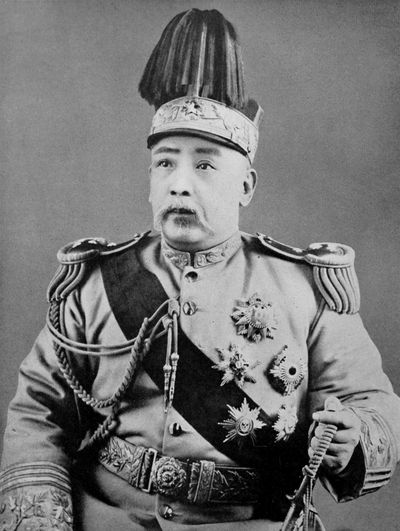
Yuan Shikai
ModernPoliticianChina1859 — 1916
Beiyang Army commander, first president of the Republic of China.
Compare Yuan Shikai with another historical figure:
Quick Facts
Born
1859
Died
1916
Country
China
Era
Modern
Occupation
Politician
Score Overview
Military (10%)45
Political (20%)72
Influence (20%)57
Legacy (20%)54
Leadership (15%)72
Strategy (15%)61
Total Score60.0
Yuan Shikai — Complete Timeline
1901 AD
Command of the Beiyang ArmyReform◆ Major
Yuan Shikai took command of the Beiyang Army, the most modern military force in late Qing China. He expanded and trained the army, which became the basis for his political power and later dominated Chinese politics.
Military reformBeiyang Army
Impact: national
1912 AD
Appointed First President of the Republic of ChinaPolitical Action
Yuan Shikai became the first president of the Republic of China after negotiating the abdication of the Qing emperor. He used his control of the Beiyang Army to pressure the revolutionary government into accepting his leadership.
PresidencyRepublic of China
Impact: national
1915 AD
Declaration of the Empire of ChinaPolitical Action◆ Major
Yuan Shikai declared himself emperor of the Empire of China, attempting to restore the monarchy. This move sparked widespread opposition from provincial leaders and foreign powers, leading to the collapse of his regime.
Monarchy restorationPolitical crisis
Impact: nationaldestructive
Signing of the Twenty-One DemandsPolitical Action◆ Major
Yuan Shikai accepted most of Japan's Twenty-One Demands, which expanded Japanese influence in China. The agreement granted Japan economic rights in Manchuria and Shandong, and was seen as a national humiliation.
DiplomacyJapanese imperialism
Impact: globaltragic
1916 AD
Death and Collapse of the Beiyang GovernmentPolitical Action◆ Major
Yuan Shikai died of uremia, leaving no clear successor. His death led to the fragmentation of the Beiyang Army into warlord factions, plunging China into a period of civil war and political instability.
Warlord eraPolitical fragmentation
Impact: nationaltragic
Detailed Scores
▶View all detailed scores
Military
Strategy
7
Tactics
7
Battles
7
Army Scale
6
War Impact
7
Political
Governance
8
Reform
8
Stability
8
Policy
8
Power
9
Influence
History
9
Global
8
Culture
9
Ideology
9
Legacy
9
People often compare with
See how Yuan Shikai stacks up against other historical figures
Popular Comparisons
Yuan Shikai vs Mustafa Kemal Ataturk
vs Mustafa Kemal Ataturk80
Yuan Shikai vs Mao Zedong
vs Mao Zedong79
Yuan Shikai vs Abraham Lincoln
vs Abraham Lincoln78
Yuan Shikai vs George Washington
vs George Washington77
Yuan Shikai vs Ito Hirobumi
vs Ito Hirobumi74
Yuan Shikai vs Winston Churchill
vs Winston Churchill72