Loading...
Ito Hirobumi vs Yuan Shikai
Ito Hirobumi leads by 13.8 pts · 2 figures compared
…
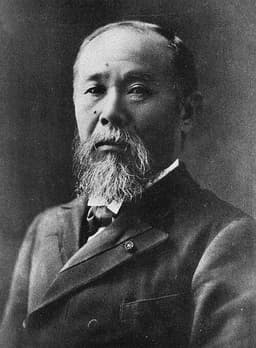
Ito Hirobumi
Politician · Modern
73.8Total
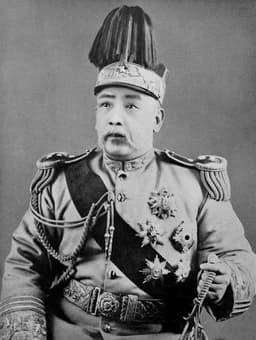
Yuan Shikai
Politician · Modern
60.0Total
Basic Information
Born
1841
1859
Died
1909
1916
Era
Modern
Modern
Nationality
Japan
China
Occupation
Politician
Politician
Civilization
Eastern
Eastern
Score Comparison
Military (10%)
50.0
45.0
Political (20%)
86.0
72.0
Influence (20%)
71.0
57.2
Legacy (20%)
80.0
54.0
Leadership (15%)
80.9
72.0
Strategy (15%)
60.0
61.2
TOTAL
73.8
60.0
Ito Hirobumi — Complete Timeline
1882 AD
Establishment of the Bank of JapanReform◆ Major
Under Ito Hirobumi's leadership, the Bank of Japan was established as the nation's central bank. It was modeled after European central banks and aimed to stabilize the currency and control inflation. This institution was crucial for Japan's economic modernization and industrial growth.
Central BankEconomic ReformModernization
Impact: nationalconstructive
1885 AD
First Prime Minister of JapanPolitical Action◆ Major
Ito Hirobumi became the first Prime Minister of Japan under the new cabinet system. He served four non-consecutive terms and was instrumental in shaping the modern Japanese state. His tenure focused on centralizing power, modernizing the economy, and strengthening the military.
Prime MinisterCabinet SystemMeiji Period
Impact: nationalconstructive
1889 AD
Drafting of the Meiji ConstitutionReform
Ito Hirobumi led the drafting of the Meiji Constitution, which established a constitutional monarchy with a bicameral parliament (the Diet). The constitution granted the emperor sovereign power but also provided for elected representatives. It was promulgated in 1889 and remained in effect until 1947.
ConstitutionMeiji PeriodGovernment Reform
Impact: nationalconstructive
1909 AD
Assassination at Harbin StationPolitical Action◆ Major
Ito Hirobumi was assassinated by Korean nationalist An Jung-geun at Harbin railway station in Manchuria. Ito was on a mission to negotiate with Russian officials regarding Korea. His death shocked Japan and was used to justify the formal annexation of Korea in 1910.
AssassinationKoreaAnnexation
Impact: globaltragic
Yuan Shikai — Complete Timeline
1901 AD
Command of the Beiyang ArmyReform◆ Major
Yuan Shikai took command of the Beiyang Army, the most modern military force in late Qing China. He expanded and trained the army, which became the basis for his political power and later dominated Chinese politics.
Military reformBeiyang Army
Impact: national
1912 AD
Appointed First President of the Republic of ChinaPolitical Action
Yuan Shikai became the first president of the Republic of China after negotiating the abdication of the Qing emperor. He used his control of the Beiyang Army to pressure the revolutionary government into accepting his leadership.
PresidencyRepublic of China
Impact: national
1915 AD
Declaration of the Empire of ChinaPolitical Action◆ Major
Yuan Shikai declared himself emperor of the Empire of China, attempting to restore the monarchy. This move sparked widespread opposition from provincial leaders and foreign powers, leading to the collapse of his regime.
Monarchy restorationPolitical crisis
Impact: nationaldestructive
Signing of the Twenty-One DemandsPolitical Action◆ Major
Yuan Shikai accepted most of Japan's Twenty-One Demands, which expanded Japanese influence in China. The agreement granted Japan economic rights in Manchuria and Shandong, and was seen as a national humiliation.
DiplomacyJapanese imperialism
Impact: globaltragic
1916 AD
Death and Collapse of the Beiyang GovernmentPolitical Action◆ Major
Yuan Shikai died of uremia, leaving no clear successor. His death led to the fragmentation of the Beiyang Army into warlord factions, plunging China into a period of civil war and political instability.
Warlord eraPolitical fragmentation
Impact: nationaltragic
Expert Analysis
Yuan Shikai vs Ito Hirobumi
### The Two Faces of Modernization: Yuan Shikai and Ito Hirobumi
On a crisp autumn day in 1909, a train pulled into Harbin station in Japanese-occupied Manchuria. As Ito Hirobumi, the elder statesman of Japan, stepped onto the platform, a young Korean nationalist named An Jung-geun stepped forward and fired three shots. The architect of Japan’s modern state crumpled to the ground, dead within minutes. Seven years later, in another capital, Yuan Shikai lay dying in Beijing’s Zhongnanhai compound, his body ravaged by uremia, his dream of a new imperial dynasty crumbling around him. One man was felled by a bullet; the other, by a disease of his own making. Both had sought to transform their ancient civilizations into modern powers. Why did one succeed, and the other fail so spectacularly? The answer lies not in circumstance alone, but in the very marrow of their characters.
### Origins: Two Sons of a Changing East
Yuan Shikai was born in 1859 into a military family in Henan province, the son of a minor gentry official. The Qing Empire was already in decline, reeling from the Opium Wars and the Taiping Rebellion. Yuan failed the civil service examinations twice—a humiliation that would shape his lifelong disdain for scholar-officials. He bought a minor military post instead, and by the 1880s, he had found his calling in Korea, where he served as a Qing commissioner and learned the hard lessons of power politics. His world was one of decay and improvisation, where a clever man could rise by seizing opportunities others missed.
Ito Hirobumi, born in 1841, came from a far humbler background—a farmer’s son from the Choshu domain. But Japan was different. The shock of Commodore Perry’s Black Ships in 1853 had shattered the Tokugawa shogunate’s isolation, and young Ito was swept up in the revolutionary fervor of the Meiji Restoration. He was part of a generation that studied abroad—he spent two years in London and Washington—and returned with a blueprint for a new nation. Where Yuan grew up learning to navigate a dying system, Ito grew up learning to build a new one.
### Rise to Power: The Strongman and the Scholar
Yuan’s path to power was forged in blood and steel. In 1901, after the Boxer Rebellion had nearly destroyed the Qing court, he was given command of the Beiyang Army—the most modern military force in China. He expanded it to 70,000 men, training them with German weapons and Japanese tactics, but ensuring their loyalty to him alone. When the Qing dynasty collapsed in 1912, Yuan was the only man who could negotiate between the revolutionaries in the south and the imperial court in the north. He struck a deal: the emperor would abdicate, and Yuan would become the first president of the Republic of China. It was a masterstroke of political cunning, but it rested on a foundation of personal ambition, not national vision.
Ito’s rise was different. He was not a warlord but a bureaucrat and intellectual. After helping to draft the Meiji Constitution in 1889—a document that balanced a powerful emperor with an elected parliament—he became Japan’s first prime minister in 1885, a position he would hold four times. His power came not from an army but from ideas. In 1882, he established the Bank of Japan, modeled on European central banks, to stabilize the currency. He understood that modernization required institutions, not just armies. While Yuan built a machine of men, Ito built a machine of laws.
### Leadership & Governance: Iron Fist vs. Constitutional Mind
Yuan Shikai ruled China as a dictator. As president, he banned political parties, dissolved parliament, and had his opponents assassinated. His military score of 60.7 reflects a competent but not brilliant commander; his political score of 74.2 is higher, but it was a politics of manipulation, not statesmanship. When he signed Japan’s notorious Twenty-One Demands in 1915—ceding vast economic rights in exchange for recognizing his government—he showed he would sacrifice national sovereignty for personal survival. The demands granted Japan control over Shandong, Manchuria, and key railways; Yuan accepted them to buy time, but the price was his legitimacy.
Ito Hirobumi, by contrast, governed through consensus and constitution. His political score of 87.2 and leadership score of 65.1 reveal a man who was more a brilliant architect than a charismatic commander. He did not seek to concentrate power but to distribute it through a parliamentary system. The Meiji Constitution, which he drafted, created a bicameral Diet, an independent judiciary, and a cabinet responsible to the emperor. It was a fragile balance, but it gave Japan a framework for stable growth. Ito’s vision was long-term: he knew that a nation could not be built on one man’s will.
### Triumph & Tragedy: The Emperor’s Dream and the Assassin’s Bullet
Yuan’s greatest triumph was also his greatest tragedy. In December 1915, he declared himself emperor of the Empire of China, hoping to restore the monarchy with himself as the founding sovereign. It was a catastrophic miscalculation. The provinces rose in rebellion; his own Beiyang generals abandoned him. Within three months, he was forced to cancel the empire. He died in June 1916, at age 57, leaving behind a fragmented nation and a Beiyang Army that splintered into warlord factions. His legacy score of 65.9 reflects a man who had everything—and threw it away.
Ito’s tragedy came at the hands of a Korean nationalist. He had become Japan’s first Resident-General of Korea in 1905, overseeing the colony’s annexation. On October 26, 1909, at Harbin station, An Jung-geun shot him dead. Ito’s death was a martyrdom for Japanese imperialism, but it also exposed the dark side of his project: modernization had come at the cost of another nation’s freedom. His influence score of 91.6 and legacy score of 81.0 show a man whose achievements were immense but whose methods were not without sin.
### Character & Destiny: The Pragmatist and the Visionary
Yuan Shikai was a master of survival. He had no ideology, only ambition. He famously said, “Power is like a tiger; if you ride it, you must keep riding, or it will devour you.” His personality was shaped by a world where loyalty was a currency and betrayal a tool. He trusted no one, and no one trusted him. When he declared himself emperor, he did so because he believed only a strongman could hold China together—but his strength was a facade.
Ito Hirobumi, by contrast, was a student of history. He once wrote, “A constitution is not a gift from heaven; it is a product of human effort.” He believed in institutions because he had seen how they could transform a feudal society into a modern state. He was not a warmonger; his military score of 48.6 is the lowest of any major Meiji leader. But he was a strategist of the long game, willing to compromise and learn. His assassination cut short a life that might have tempered Japanese militarism.
### Legacy: The Warlord and the Founding Father
Yuan Shikai is remembered today as a villain in Chinese history—a traitor who sold out his country, a dictator who destroyed the republic. The warlord era that followed his death plunged China into chaos for two decades. His name is synonymous with betrayal and failure.
Ito Hirobumi, however, is revered in Japan as one of the Meiji Restoration’s greatest figures. His face once appeared on the 1,000-yen note. The Meiji Constitution, though replaced after World War II, laid the groundwork for Japan’s modern democracy. Yet in Korea, he is remembered as a colonial oppressor, his assassination celebrated as an act of resistance.
### Conclusion: The Mirror of Modernity
Standing at the dawn of the twentieth century, Yuan Shikai and Ito Hirobumi faced the same question: how to make their ancient civilizations strong in a world of empires. One chose the path of the strongman, building a personal army and a personal throne. The other chose the path of the institution, drafting a constitution and a central bank. One died in bed, his empire already dead; the other died on a railway platform, his empire still alive. The difference was not in talent or opportunity, but in vision. Yuan saw power as something to be seized; Ito saw it as something to be shared. In that difference lies the entire story of modern East Asia.
Rankings
🥇
Ito HirobumiLeader
Mil: 50.0Pol: 86.0Inf: 71.0
73.8
🥈
Yuan Shikai
Mil: 45.0Pol: 72.0Inf: 57.2
60.0
+13.8 behind
How This Comparison Works
Algorithm
Each figure is scored on 6 dimensions (0—100 scale) based on structured historical data: Military (10%), Political (20%), Influence (20%), Legacy (20%), Leadership (15%), Strategy (15%). The weighted total produces the final ranking.
Data Sources
Scores are computed from structured sub-indicators in the database. Scale factors adjust for era (Ancient ×0.85, Modern ×1.0) and civilization size (Eastern ×1.05, Other ×0.80) to account for differences in population and military scale.
Maximum 3 Figures
Comparisons are limited to 2—3 figures to ensure readability and statistical meaningfulness.
Error Margins
±5 points per dimension — Sub-scores are derived from historical records with inherent uncertainty. Two figures within 5 points on a dimension should be considered roughly equivalent in that area.
Total Score Accuracy
±3 points overall — The weighted combination of 6 dimensions produces a total score with approximately ±3 points of uncertainty. Differences of less than 3 points are not statistically significant— the figures are effectively tied.
Known Limitations
- Historical records are incomplete and uneven across civilizations
- Figures from oral-tradition societies may be underrepresented
- Occupation labels can misclassify multi-role figures
- Scores measure capability and impact, not moral character
- Quantitative scoring is a comparison tool, not absolute truth
Capability Radar
Military (10%) — Battles & Warfare
Battles
0
45
Win Rate
0
55
Expansion
70
50
Political (20%) — Governance & Reform
Reform
95
55
Diplomacy
90
70
Economy
80
50
Influence (20%) — Cultural & Global Reach
Cultural
75
40
Global
80
35
Legacy (20%) — Historical Impact
Historical
85
65
Longevity
80
40
Leadership (15%) — Power & Stability
Tenure
85
60
Stability
85
30
Strategy (15%) — Tactics & Innovation
Strategy
0
65
Tactics
0
60
Reform
85
80
Similar Comparisons
Comments & Discussion
BoldEye806/16/2026
Comparing these two is like comparing a compass to a weather vane. Ito studied Roman law in London and adopted Prussia’s civil code, crafting Japan’s constitution with the precision of a Ciceronian statesman. Yuan, however, was a classic “junzi” gone rogue—he knew Confucian propriety but weaponized it for patronage. When Ito wrote Article 1 of the Meiji Constitution (“The Empire of Japan shall be reigned over by a line of Emperors unbroken for ages eternal”), he fused tradition with law. Yuan ju
TrueQuill26/16/2026
The comparison ignores cold hard statistics: under Ito, Japan’s literacy rate jumped from 20% to 50% by 1900, while under Yuan’s watch, China’s remained stagnant at 10%. Ito scaled railways tenfold; Yuan barely managed one rickety line in Beiyang. Modernization isn’t about charisma—it’s about metrics. Yuan’s “success” in Korea was just bribing eunuchs; Ito’s cabinet system actually collected taxes. Numbers don’t lie: Japan’s GDP per capita grew 50% faster under Ito. Full stop.|zh|这份对比忽视冰冷数据:伊藤时期
Chronicler61926/16/2026
Yuan Shikai is often romanticized as a tragic hero, but let’s call a spade a spade: he was a political opportunist who leaped between reform and autocracy when it suited him. Ito Hirobumi, by contrast, was a master architect, drafting Japan’s Meiji Constitution with a clear vision of modern nationhood. Yuan failed his exams twice—no wonder he resented scholars—while Ito studied in London and absorbed constitutional law firsthand. One built institutions; the other built personal power. That’s not