Loading...
Winston Churchill vs Yuan Shikai
Winston Churchill leads by 11.8 pts · 2 figures compared
…
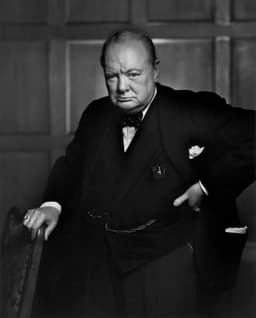
Winston Churchill
Politician · Modern
71.8Total
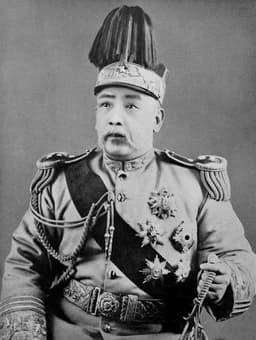
Yuan Shikai
Politician · Modern
60.0Total
Basic Information
Born
1874
1859
Died
1965
1916
Era
Modern
Modern
Nationality
United Kingdom
China
Occupation
Politician
Politician
Civilization
Western
Eastern
Score Comparison
Military (10%)
55.0
45.0
Political (20%)
78.0
72.0
Influence (20%)
75.0
57.2
Legacy (20%)
68.0
54.0
Leadership (15%)
82.0
72.0
Strategy (15%)
65.0
61.2
TOTAL
71.8
60.0
Winston Churchill — Complete Timeline
1940 AD
Appointed Prime Minister of the United KingdomPolitical Action◆ Major
On May 10, 1940, Winston Churchill became Prime Minister of the United Kingdom, replacing Neville Chamberlain. His appointment came as Nazi Germany invaded France and the Low Countries, and Churchill formed a coalition government to lead Britain through World War II.
World War IILeadershipCoalition Government
Impact: globalconstructive
Delivered the 'We Shall Fight on the Beaches' SpeechOther◆ Major
On June 4, 1940, Churchill delivered a speech to the House of Commons following the evacuation of British forces from Dunkirk. He declared that Britain would fight on the beaches, landing grounds, fields, streets, and hills, and never surrender, rallying British morale during the darkest days of World War II.
World War IIOratoryMorale
Impact: nationalconstructive
1941 AD
Signed the Atlantic CharterOther◆ Major
On August 14, 1941, Churchill and U.S. President Franklin D. Roosevelt signed the Atlantic Charter aboard HMS Prince of Wales. This joint declaration outlined post-war goals including self-determination, disarmament, and free trade, and became a foundational document for the Allied war aims and the United Nations.
World War IIAllied CooperationPost-war Planning
Impact: globalconstructive
1945 AD
Attended the Yalta ConferenceOther◆ Major
In February 1945, Churchill attended the Yalta Conference with Roosevelt and Stalin to discuss the post-war reorganization of Europe. The conference agreed on the division of Germany, the establishment of the United Nations, and the fate of Eastern Europe, though Churchill later expressed regret over concessions to Stalin.
World War IIPost-war SettlementBig Three
Impact: global
1946 AD
Delivered the 'Iron Curtain' SpeechOther◆ Major
On March 5, 1946, Churchill delivered a speech at Westminster College in Fulton, Missouri, where he stated that an 'iron curtain' had descended across Europe from Stettin to Trieste. This speech is widely regarded as marking the beginning of the Cold War, as it highlighted the division between Soviet-controlled Eastern Europe and the West.
Cold WarSoviet UnionDivision of Europe
Impact: globaldestructive
1953 AD
Awarded the Nobel Prize in LiteratureOther◆ Major
In 1953, Churchill was awarded the Nobel Prize in Literature for his historical writings, particularly 'The Second World War' and 'A History of the English-Speaking Peoples'. The Nobel committee cited his mastery of historical and biographical description as well as his brilliant oratory in defending human values.
LiteratureNobel PrizeHistorical Writing
Impact: nationalconstructive
Yuan Shikai — Complete Timeline
1901 AD
Command of the Beiyang ArmyReform◆ Major
Yuan Shikai took command of the Beiyang Army, the most modern military force in late Qing China. He expanded and trained the army, which became the basis for his political power and later dominated Chinese politics.
Military reformBeiyang Army
Impact: national
1912 AD
Appointed First President of the Republic of ChinaPolitical Action
Yuan Shikai became the first president of the Republic of China after negotiating the abdication of the Qing emperor. He used his control of the Beiyang Army to pressure the revolutionary government into accepting his leadership.
PresidencyRepublic of China
Impact: national
1915 AD
Declaration of the Empire of ChinaPolitical Action◆ Major
Yuan Shikai declared himself emperor of the Empire of China, attempting to restore the monarchy. This move sparked widespread opposition from provincial leaders and foreign powers, leading to the collapse of his regime.
Monarchy restorationPolitical crisis
Impact: nationaldestructive
Signing of the Twenty-One DemandsPolitical Action◆ Major
Yuan Shikai accepted most of Japan's Twenty-One Demands, which expanded Japanese influence in China. The agreement granted Japan economic rights in Manchuria and Shandong, and was seen as a national humiliation.
DiplomacyJapanese imperialism
Impact: globaltragic
1916 AD
Death and Collapse of the Beiyang GovernmentPolitical Action◆ Major
Yuan Shikai died of uremia, leaving no clear successor. His death led to the fragmentation of the Beiyang Army into warlord factions, plunging China into a period of civil war and political instability.
Warlord eraPolitical fragmentation
Impact: nationaltragic
Expert Analysis
Winston Churchill vs Yuan Shikai
# The Two Faces of Power: Churchill and Yuan Shikai
In the winter of 1915, as German zeppelins drifted over the English Channel and the trenches of France swallowed a generation, Winston Churchill sat in a cold rage at his country home, Chartwell. He had been forced from the Admiralty after the disaster at Gallipoli, his reputation in tatters, his political career seemingly over. Half a world away, in the Forbidden City of Beijing, Yuan Shikai was preparing to crown himself emperor of a new Chinese dynasty, believing he alone could hold his fractured nation together. One man had just lost everything; the other was about to lose everything. Their paths could not have been more different—and yet both were driven by the same desperate question: how does a leader save a crumbling empire?
Origins
Churchill was born into the heart of the British aristocracy, the son of Lord Randolph Churchill, a brilliant but erratic politician, and Jennie Jerome, an American heiress. His childhood was lonely, marked by a distant father and a mother who lived for society. He was sent to the brutal Harrow School, where he was mocked for his lisp and his red hair, and then to Sandhurst, where he barely scraped through. But from these early humiliations grew a fierce ambition and an unshakeable belief in his own destiny. He was a man of the nineteenth century, steeped in the glory of the British Empire, and he never doubted its moral rightness.
Yuan Shikai was born in 1859 to a landowning family in Henan, central China. His father died when he was young, and he was raised by his uncle, a minor official. Unlike Churchill, Yuan had little formal education—twice he failed the imperial civil service exams, the traditional path to power. Humiliated, he burned his books and joined the army, a profession then held in low regard. But in the chaos of the late Qing dynasty, riddled with foreign humiliation and internal rebellion, a soldier's ruthlessness was worth more than a scholar's poetry. Yuan was shrewd, patient, and utterly pragmatic. He learned to read men rather than texts.
Rise to Power
Churchill’s rise was a spectacle of audacity. He fought in colonial wars in India, Sudan, and South Africa, using each campaign as a platform to write books and make a name. In 1900, he was elected to Parliament as a Conservative, then crossed the floor to the Liberals when he saw the political wind shifting. By 1911, at age 37, he was First Lord of the Admiralty, the youngest man ever to hold the post. He was brilliant, arrogant, and impossible to ignore. Every step was a calculated gamble, driven by a conviction that history had chosen him.
Yuan Shikai’s rise was quieter, more dangerous. In 1882, he was sent to Korea as a Qing military attaché, where he crushed a rebellion with brutal efficiency. He returned to China in 1894 after the disastrous Sino-Japanese War, and by 1901 he had taken command of the Beiyang Army, the most modern force in China. He trained it personally, binding its officers to him with loyalty and patronage. When the Qing dynasty collapsed in 1912, Yuan was the only man with the guns to hold the country together. He negotiated the abdication of the last emperor, and in exchange, the revolutionaries made him the first president of the Republic of China. It was not a victory of ideas, but of pure, cold leverage.
Leadership & Governance
Churchill’s leadership was a furnace of will. During the Second World War, he became the voice of defiance, broadcasting to a besieged nation with speeches that thundered like artillery: “We shall fight on the beaches, we shall fight on the landing grounds, we shall fight in the fields and in the streets.” He was a military strategist of mixed success—he championed disastrous campaigns like Gallipoli and later the invasion of Norway—but his political genius lay in his ability to inspire. He built a coalition government, charmed Franklin Roosevelt, and stood like a bulldog against Hitler. His score of 85 for leadership is earned by the sheer force of his presence.
Yuan Shikai governed by calculation. As president, he ruled through the Beiyang Army, suppressing dissent with secret police and assassination. He understood that China needed modernization, but he had no vision for it beyond his own power. In 1915, facing Japanese pressure, he signed the Twenty-One Demands, granting Japan extraordinary influence in Manchuria and Shandong. It was a pragmatic choice—he had no navy to resist—but it poisoned his reputation. Then, in a fatal miscalculation, he declared himself emperor of a new dynasty, believing that only a strong monarch could unify China. The country erupted in rebellion. His score of 81.3 for leadership reflects a man who could command armies but could not inspire a nation.
Triumph & Tragedy
Churchill’s greatest triumph was the defeat of Nazi Germany. In 1945, he stood in a cheering crowd in London, hailed as the savior of civilization. His greatest tragedy came immediately after: the British people voted him out of office, preferring the socialist promises of Clement Attlee. He had won the war but lost the peace. He took it with grace, but the wound never healed.
Yuan Shikai’s triumph was his rise itself—the peasant’s son who became the first president of China. His tragedy was his fall. In 1916, just months after declaring himself emperor, he was forced to abdicate. The provinces rose against him, his own generals abandoned him, and he died of uremia, alone and despised. His death left China without a center, and the Beiyang Army splintered into warlord factions that would tear the country apart for decades.
Character & Destiny
Churchill was a man of grand gestures and deep melancholy. He suffered from what he called the “Black Dog” of depression, but he fought it with action, with whiskey, with painting, with words. He believed in destiny—his own and Britain’s. “The empires of the future are the empires of the mind,” he once said. He was romantic, flawed, sometimes reckless, but ultimately he understood that history is a story, and he wrote his part.
Yuan Shikai was a pragmatist to the bone. He had no ideology, no grand vision, only a cold assessment of power. He believed that China needed a strongman, but he could not see that the age of emperors was over. His tragedy was not that he was evil, but that he was limited. He could calculate the balance of forces, but he could not read the spirit of his age.
Legacy
Churchill’s legacy is carved in stone. He is remembered as the greatest Briton, a symbol of resistance, the man who refused to surrender. His writings won the Nobel Prize in Literature, and his speeches still echo in classrooms and parliaments. But his shadow is long—his imperial views, his role in the Bengal famine, his support for colonialism, all complicate the myth. He was a man of his time, and his time is passing.
Yuan Shikai’s legacy is more ambiguous. In China, he is often called a traitor for the Twenty-One Demands and a fool for his imperial dream. But his score of 65.9 for legacy reflects a deeper truth: he was the last man who might have held China together without the bloodbath of warlordism. He failed, but so did everyone else. He is remembered as a cautionary tale, a warning that power without purpose is a hollow crown.
Conclusion
Standing at the edge of their lives, Churchill and Yuan Shikai faced the same question: how do you lead when the world is burning? Churchill answered with poetry and defiance, Yuan with calculation and steel. One saved his nation; the other lost it. But both were prisoners of their own convictions—Churchill of his romance, Yuan of his cynicism. History judges them differently, but perhaps the difference was not in their abilities, but in the worlds they inhabited. Britain in 1940 had a people ready to fight; China in 1915 had a people exhausted by centuries of collapse. One leader rode the wave; the other was crushed by it. And that, in the end, is the cruelest lesson of history: a leader is only as great as the moment allows.
Rankings
🥇
Winston ChurchillLeader
Mil: 55.0Pol: 78.0Inf: 75.0
71.8
🥈
Yuan Shikai
Mil: 45.0Pol: 72.0Inf: 57.2
60.0
+11.8 behind
How This Comparison Works
Algorithm
Each figure is scored on 6 dimensions (0—100 scale) based on structured historical data: Military (10%), Political (20%), Influence (20%), Legacy (20%), Leadership (15%), Strategy (15%). The weighted total produces the final ranking.
Data Sources
Scores are computed from structured sub-indicators in the database. Scale factors adjust for era (Ancient ×0.85, Modern ×1.0) and civilization size (Eastern ×1.05, Other ×0.80) to account for differences in population and military scale.
Maximum 3 Figures
Comparisons are limited to 2—3 figures to ensure readability and statistical meaningfulness.
Error Margins
±5 points per dimension — Sub-scores are derived from historical records with inherent uncertainty. Two figures within 5 points on a dimension should be considered roughly equivalent in that area.
Total Score Accuracy
±3 points overall — The weighted combination of 6 dimensions produces a total score with approximately ±3 points of uncertainty. Differences of less than 3 points are not statistically significant— the figures are effectively tied.
Known Limitations
- Historical records are incomplete and uneven across civilizations
- Figures from oral-tradition societies may be underrepresented
- Occupation labels can misclassify multi-role figures
- Scores measure capability and impact, not moral character
- Quantitative scoring is a comparison tool, not absolute truth
Capability Radar
Military (10%) — Battles & Warfare
Battles
55
45
Win Rate
60
55
Expansion
40
50
Political (20%) — Governance & Reform
Reform
70
55
Diplomacy
85
70
Economy
60
50
Influence (20%) — Cultural & Global Reach
Cultural
85
40
Global
85
35
Legacy (20%) — Historical Impact
Historical
90
65
Longevity
80
40
Leadership (15%) — Power & Stability
Tenure
75
60
Stability
70
30
Strategy (15%) — Tactics & Innovation
Strategy
85
65
Tactics
65
60
Reform
70
80
Similar Comparisons
Comments & Discussion
反常识历史迷6/16/2026
你们搞错了重点。真正该比的是北洋军官和伊顿公学的精英文化。袁世凯手下段祺瑞、冯国璋这批人,武备学堂出身,讲实际。丘吉尔身边都是些贵族子弟,靠祖先吃饭。1912年袁逼清帝退位时一个兵都没动,而丘吉尔连自己内阁都要拉拢,高下立判。
圆梦考证员6/16/2026
这对比根本站不住脚。袁世凯签了二十一条,把山东给了日本,还要当洪宪皇帝闹笑话。丘吉尔再错也没背叛过英国。1915年袁在北京策划称帝时,甚至让长子袁克定伪造《顺天时报》骗他民意支持,这种自欺欺人还能和铁血首相比?
Classics Crank6/16/2026
Putting Churchill next to a man who dissolved parliament in 1914 is absurd. Churchill read Gibbon's Decline and Fall between wars; Yuan Shikai banned Confucian classics he found subversive. The British bulldog understood that history judges tyrants, while Yuan believed he could remake time itself—proclaiming himself emperor in 1915 like a bad play of Roman farce.
GrandQuill706/16/2026
Quantitative reality check: Churchill served as PM for 9 years across two crises, modernizing Britain's wartime economy. Yuan Shikai lasted 83 days as Hongxian Emperor before rebellion forced him to renounce. Churchill's approval rating hit 93% in 1940; Yuan's "empire" collapsed with 13 rebel provinces. One died in office respected; the other died of uremia in 1916, universally hated. Numbers don't lie.
Historian6826/16/2026
Calling both "empire savers" is lazy. Churchill bungled Gallipoli, sending ANZACs to slaughter through Dardanelles minefields—over 44,000 dead for nothing. Yuan Shikai actually modernized China's Beiyang Army, using German drill manuals and Krupp artillery to create East Asia's best fighting force by 1900. One man gambled with others' lives; the other built real power from scratch.