Loading...
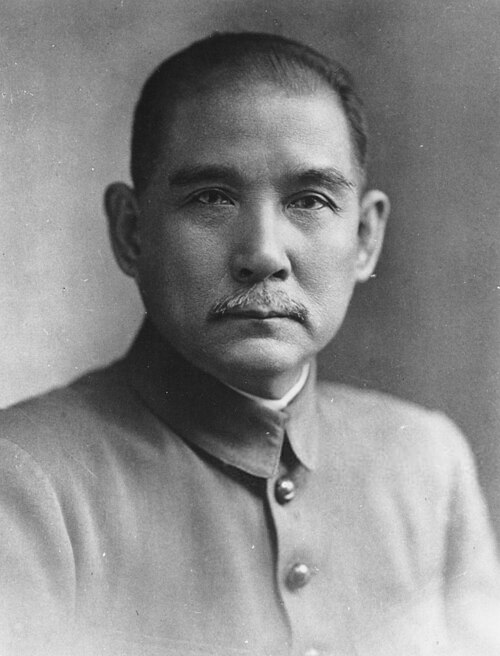
Sun Yat-sen
ModernRevolutionaryChina1866 — 1925
中国民主革命先行者,中华民国缔造者。提出三民主义思想,领导辛亥革命推翻帝制。
Compare Sun Yat-sen with another historical figure:
Quick Facts
Born
1866
Died
1925
Country
China
Era
Modern
Occupation
Revolutionary
Score Overview
Military (10%)45
Political (20%)68
Influence (20%)61
Legacy (20%)58
Leadership (15%)34
Strategy (15%)30
Total Score52.5
Sun Yat-sen — Complete Timeline
1894 AD
Founded the Revive China SocietyPolitical Action◆ Major
Sun Yat-sen founded the Revive China Society (Xingzhonghui) in Honolulu, the first modern revolutionary organization among overseas Chinese. The society aimed to overthrow the Qing dynasty and establish a republic, marking the beginning of organized revolutionary activity.
RevolutionOverseas ChineseRepublic
Impact: nationalconstructive
1911 AD
Led the Xinhai RevolutionPolitical Action
Sun Yat-sen's revolutionary activities culminated in the Wuchang Uprising of October 1911, which sparked the Xinhai Revolution. The uprising spread across China, leading to the abdication of the Qing emperor in 1912 and the end of 2,000 years of imperial rule.
RevolutionQing DynastyRepublic
Impact: globalconstructive
1912 AD
Proclaimed the Republic of ChinaPolitical Action
On January 1, 1912, Sun Yat-sen was inaugurated as the provisional president of the Republic of China in Nanjing. He proclaimed the establishment of the first republic in Asia, based on his Three Principles of the People: nationalism, democracy, and livelihood.
RepublicPresidencyThree Principles
Impact: globalconstructive
Resigned Presidency in Favor of Yuan ShikaiPolitical Action◆ Major
To secure the abdication of the Qing emperor and avoid civil war, Sun Yat-sen resigned the provisional presidency in February 1912 in favor of Yuan Shikai. This decision, while pragmatic, allowed Yuan to consolidate power and later attempt to restore the monarchy.
Power TransferYuan ShikaiCompromise
Impact: national
1919 AD
Reorganized the KuomintangPolitical Action◆ Major
Sun Yat-sen reorganized the Chinese Revolutionary Party into the Kuomintang (KMT) in 1919, with a more centralized structure. He later accepted Soviet aid and CCP members into the party under the policy of 'alliance with Russia and the Communists,' reshaping the revolutionary movement.
KuomintangSoviet AllianceCCP
Impact: nationalconstructive
Detailed Scores
▶View all detailed scores
Military
Strategy
6
Tactics
6
Battles
6
Army Scale
6
War Impact
6
Political
Governance
6
Reform
6
Stability
6
Policy
6
Power
6
Influence
History
7
Global
7
Culture
7
Ideology
8
Legacy
7
People often compare with
See how Sun Yat-sen stacks up against other historical figures
Popular Comparisons
Sun Yat-sen vs Vladimir Lenin
vs Vladimir Lenin71
Sun Yat-sen vs Ho Chi Minh
vs Ho Chi Minh63
Sun Yat-sen vs Abd el-Krim
vs Abd el-Krim62
Sun Yat-sen vs Emiliano Zapata
vs Emiliano Zapata56
Sun Yat-sen vs Bal Gangadhar Tilak
vs Bal Gangadhar Tilak53
Sun Yat-sen vs Lech Walesa
vs Lech Walesa52