Loading...
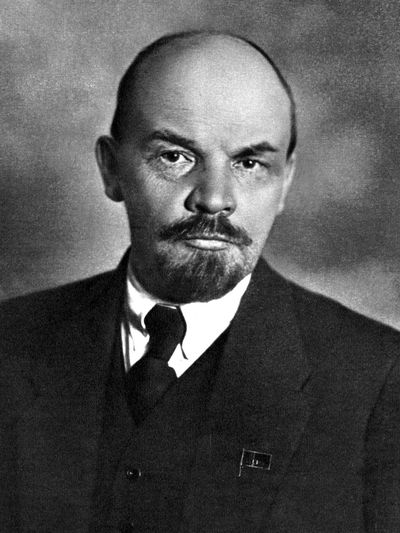
Vladimir Lenin
ModernRevolutionaryRussia1870 — 1924
俄国革命家,苏联的缔造者。领导十月革命建立世界上第一个社会主义国家。
Compare Vladimir Lenin with another historical figure:
Quick Facts
Born
1870
Died
1924
Country
Russia
Era
Modern
Occupation
Revolutionary
Score Overview
Military (10%)30
Political (20%)78
Influence (20%)82
Legacy (20%)72
Leadership (15%)80
Strategy (15%)60
Total Score71.2
Vladimir Lenin — Complete Timeline
1903 AD
Founding of the Bolshevik PartyPolitical Action
At the Second Congress of the Russian Social Democratic Labour Party in London, Lenin led a split that created the Bolshevik faction. The Bolsheviks advocated for a disciplined vanguard party of professional revolutionaries, a key element of Lenin's political strategy.
Political PartyRevolutionIdeology
Impact: global
1917 AD
April ThesesPolitical Action◆ Major
Lenin returned to Russia from exile and published the April Theses, calling for the overthrow of the Provisional Government, transfer of power to the soviets, and an end to World War I. This document set the Bolshevik agenda for the coming revolution.
RevolutionIdeologyPolitical Strategy
Impact: national
October RevolutionPolitical Action
Lenin led the Bolshevik seizure of power in Petrograd, capturing key government buildings and the Winter Palace. The revolution overthrew the Provisional Government and established the world's first socialist state, the Russian Soviet Federative Socialist Republic.
RevolutionCoupCommunism
Impact: global
1918 AD
Treaty of Brest-LitovskPolitical Action◆ Major
Lenin signed a separate peace treaty with the Central Powers, ceding vast territories including Ukraine, Belarus, and the Baltic states. The treaty ended Russia's involvement in World War I but caused significant territorial losses and internal opposition.
TreatyWorld War ITerritorial Loss
Impact: globaldestructive
1921 AD
New Economic Policy (NEP)Reform◆ Major
Lenin introduced the NEP, allowing limited private enterprise and market mechanisms to revive the war-torn Soviet economy. The policy replaced War Communism, permitting small-scale capitalism while the state retained control of major industries.
Economic ReformPolicyRecovery
Impact: nationalconstructive
1922 AD
Establishment of the Soviet UnionPolitical Action
Lenin oversaw the creation of the Union of Soviet Socialist Republics (USSR), a federation of Soviet republics. The new state consolidated Bolshevik control over much of the former Russian Empire and became a model for communist states worldwide.
State FormationCommunismFederation
Impact: global
Detailed Scores
▶View all detailed scores
Military
Strategy
6
Tactics
6
Battles
6
Army Scale
6
War Impact
6
Political
Governance
7
Reform
7
Stability
7
Policy
7
Power
7
Influence
History
7
Global
7
Culture
7
Ideology
8
Legacy
7
People often compare with
See how Vladimir Lenin stacks up against other historical figures
Popular Comparisons
Vladimir Lenin vs Ho Chi Minh
vs Ho Chi Minh63
Vladimir Lenin vs Abd el-Krim
vs Abd el-Krim62
Vladimir Lenin vs Emiliano Zapata
vs Emiliano Zapata56
Vladimir Lenin vs Bal Gangadhar Tilak
vs Bal Gangadhar Tilak53
Vladimir Lenin vs Sun Yat-sen
vs Sun Yat-sen53
Vladimir Lenin vs Lech Walesa
vs Lech Walesa52