Loading...
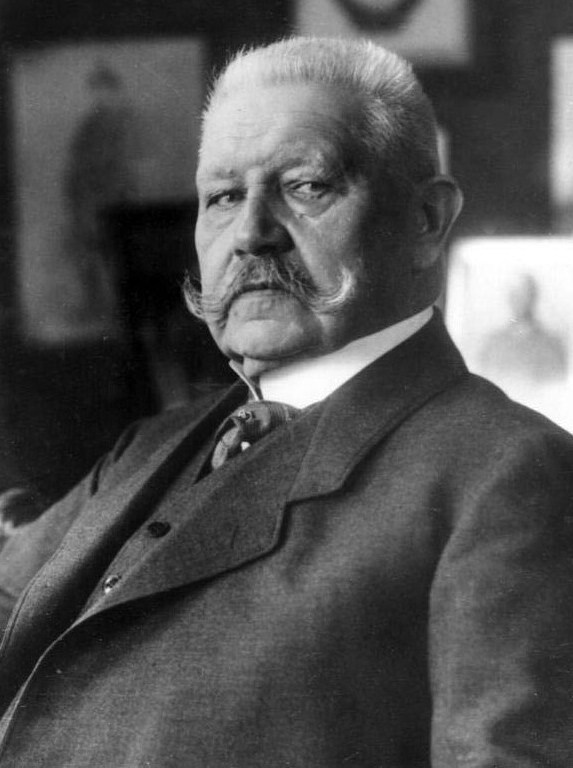
Paul von Hindenburg
ModernGeneralGermany1847 — 1934
German field marshal and later president who appointed Hitler.
Compare Paul von Hindenburg with another historical figure:
Quick Facts
Born
1847
Died
1934
Country
Germany
Era
Modern
Occupation
General
Score Overview
Military (10%)65
Political (20%)44
Influence (20%)82
Legacy (20%)55
Leadership (15%)64
Strategy (15%)53
Total Score62.2
Paul von Hindenburg — Complete Timeline
1914 AD
Battle of TannenbergWar
Hindenburg, with Ludendorff as chief of staff, commanded the German Eighth Army to a decisive victory over the Russian Second Army in East Prussia. The battle halted the Russian invasion and made Hindenburg a national hero.
World War IEastern FrontVictory
Impact: regional
1916 AD
Appointed Chief of the General StaffPolitical Action◆ Major
Hindenburg was appointed Chief of the General Staff of the German Army, replacing Erich von Falkenhayn. He and Ludendorff effectively became military dictators of Germany, directing all aspects of the war effort.
World War ICommandPower
Impact: national
1925 AD
Elected President of GermanyPolitical Action◆ Major
Hindenburg was elected as the second President of the Weimar Republic, defeating Wilhelm Marx in a runoff. His presidency marked a shift toward conservative and authoritarian rule, undermining the republic's democratic foundations.
Weimar RepublicElectionConservatism
Impact: national
1933 AD
Appointed Adolf Hitler as ChancellorPolitical Action
Hindenburg appointed Adolf Hitler as Chancellor of Germany, heading a coalition cabinet. This decision, made under political pressure and intrigue, enabled Hitler to consolidate power and ultimately dismantle the Weimar Republic.
Nazi RiseWeimar RepublicPower Transfer
Impact: globaldestructive
Reichstag Fire DecreePolitical Action◆ Major
Hindenburg signed the Reichstag Fire Decree, suspending civil liberties and allowing the Nazi regime to arrest political opponents. This decree was a key step in establishing the Nazi dictatorship.
Nazi DictatorshipCivil LibertiesRepression
Impact: nationaldestructive
Detailed Scores
▶View all detailed scores
Military
Strategy
7
Tactics
7
Battles
7
Army Scale
7
War Impact
7
Political
Governance
7
Reform
7
Stability
7
Policy
8
Power
8
Influence
History
9
Global
9
Culture
9
Ideology
10
Legacy
9
People often compare with
See how Paul von Hindenburg stacks up against other historical figures
Popular Comparisons
Paul von Hindenburg vs Shi Lang
vs Shi Lang66
Paul von Hindenburg vs Aleksandr Vasilevsky
vs Aleksandr Vasilevsky64
Paul von Hindenburg vs Ian Khama
vs Ian Khama60
Paul von Hindenburg vs Vang Pao
vs Vang Pao56
Paul von Hindenburg vs Michal Kazimierz Pac
vs Michal Kazimierz Pac54
Paul von Hindenburg vs Juan Vicente Gomez
vs Juan Vicente Gomez53