Loading...
Paul von Hindenburg vs Shi Lang
Shi Lang leads by 3.4 pts · 2 figures compared
…
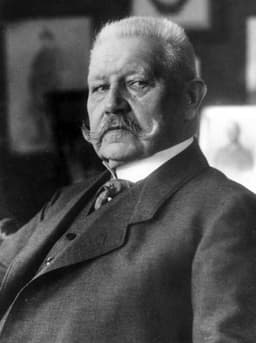
Paul von Hindenburg
General · Modern
62.2Total

Shi Lang
General · Modern
65.6Total
Basic Information
Born
1847
1621
Died
1934
1696
Era
Modern
Modern
Nationality
Germany
China
Occupation
General
General
Civilization
Western
Eastern
Score Comparison
Military (10%)
65.0
76.0
Political (20%)
43.7
72.0
Influence (20%)
82.0
62.0
Legacy (20%)
55.0
58.0
Leadership (15%)
64.0
68.0
Strategy (15%)
52.5
70.0
TOTAL
62.2
65.6
Paul von Hindenburg — Complete Timeline
1914 AD
Battle of TannenbergWar
Hindenburg, with Ludendorff as chief of staff, commanded the German Eighth Army to a decisive victory over the Russian Second Army in East Prussia. The battle halted the Russian invasion and made Hindenburg a national hero.
World War IEastern FrontVictory
Impact: regional
1916 AD
Appointed Chief of the General StaffPolitical Action◆ Major
Hindenburg was appointed Chief of the General Staff of the German Army, replacing Erich von Falkenhayn. He and Ludendorff effectively became military dictators of Germany, directing all aspects of the war effort.
World War ICommandPower
Impact: national
1925 AD
Elected President of GermanyPolitical Action◆ Major
Hindenburg was elected as the second President of the Weimar Republic, defeating Wilhelm Marx in a runoff. His presidency marked a shift toward conservative and authoritarian rule, undermining the republic's democratic foundations.
Weimar RepublicElectionConservatism
Impact: national
1933 AD
Appointed Adolf Hitler as ChancellorPolitical Action
Hindenburg appointed Adolf Hitler as Chancellor of Germany, heading a coalition cabinet. This decision, made under political pressure and intrigue, enabled Hitler to consolidate power and ultimately dismantle the Weimar Republic.
Nazi RiseWeimar RepublicPower Transfer
Impact: globaldestructive
Reichstag Fire DecreePolitical Action◆ Major
Hindenburg signed the Reichstag Fire Decree, suspending civil liberties and allowing the Nazi regime to arrest political opponents. This decree was a key step in establishing the Nazi dictatorship.
Nazi DictatorshipCivil LibertiesRepression
Impact: nationaldestructive
Shi Lang — Complete Timeline
1646 AD
Defected to the Qing DynastyPolitical Action◆ Major
Shi Lang defected from the Ming loyalist Zheng family to the Qing dynasty. He had previously served under Zheng Zhilong but switched sides after a personal conflict. The Qing appointed him as a naval commander, using his expertise against the Zheng regime.
Qing DynastyDefectionZheng Family
Impact: national
1662 AD
Appointed Admiral of the Qing NavyPolitical Action◆ Major
Shi Lang was appointed Admiral of the Qing navy. He was tasked with building a fleet capable of challenging the Zheng family's naval power, which controlled Taiwan and the southeastern coast. He oversaw shipbuilding and training of sailors.
Qing DynastyNavyAppointment
Impact: nationalconstructive
1683 AD
Led the Qing Invasion of TaiwanWar
Shi Lang commanded the Qing naval expedition that invaded Taiwan, then held by the Zheng family. His fleet defeated the Zheng navy at the Battle of Penghu, forcing the surrender of Zheng Keshuang and bringing Taiwan under Qing control.
Qing DynastyTaiwanConquest
Impact: regionalconstructive
Battle of PenghuWar◆ Major
Shi Lang's fleet engaged and defeated the Zheng navy at the Battle of Penghu (Pescadores). The victory destroyed the main Zheng naval force and opened the way for the Qing invasion of Taiwan. The battle was decisive in ending Zheng resistance.
Qing DynastyNaval BattlePenghu
Impact: regionalconstructive
Appointed Governor of TaiwanPolitical Action◆ Major
After the conquest of Taiwan, Shi Lang was appointed as the first Qing governor of the island. He advocated for Taiwan's incorporation into Fujian province and oversaw the establishment of Qing administration, including military garrisons and civil governance.
Qing DynastyTaiwanGovernorship
Impact: regionalconstructive
Expert Analysis
Origins
Paul von Hindenburg was born in 1847 in Posen, Prussia, into an aristocratic Junker family. He attended the Prussian Cadet Corps and was commissioned as a lieutenant in 1866. His early military service included the Austro-Prussian War and Franco-Prussian War, where he witnessed the unification of Germany under Prussian leadership. Hindenburg's background was steeped in conservative Prussian militarism, which shaped his worldview.
Shi Lang was born in 1621 in Fujian, China, into a family of Ming loyalist military officials. He grew up during the chaotic transition from Ming to Qing rule. His father was killed when Shi Lang was young, and he was taken in by Zheng Zhilong, a powerful pirate-merchant. Shi Lang received naval training under Zheng Zhilong and became a capable commander in the Zheng family's fleet. His origins were marked by instability and shifting loyalties.
Rise to Power
Hindenburg rose to prominence in 1914 at age 66, when he was recalled from retirement to command the German Eighth Army on the Eastern Front. With Erich Ludendorff as his chief of staff, he achieved a stunning victory over the Russian Second Army at the Battle of Tannenberg (August 26-30, 1914). This victory made Hindenburg a national hero and led to his appointment as Chief of the General Staff in 1916, effectively making him Germany's military dictator alongside Ludendorff. His reputation was built on this single battle, though his strategic contributions were often overstated.
Shi Lang's rise was more gradual. He defected from the Zheng family to the Qing dynasty in 1646 after a personal dispute with Zheng Chenggong (Koxinga). The Qing court, recognizing his naval expertise, appointed him as admiral in 1662. He spent decades building a fleet and planning the conquest of Taiwan, which was held by the Zheng family. His key turning point came in 1683 when he led the Qing invasion of Taiwan, culminating in the Battle of Penghu (July 16-17, 1683), where his fleet destroyed the Zheng navy. This victory led to his appointment as the first Qing governor of Taiwan.
Leadership & Governance
Hindenburg's leadership style was that of a figurehead; he delegated operational command to Ludendorff during World War I. As president (1925-1934), he governed conservatively, using emergency decrees under Article 48 of the Weimar Constitution. He appointed Hitler as Chancellor in January 1933, believing he could control the Nazis. His governance was reactive and failed to uphold democratic institutions. He signed the Reichstag Fire Decree in February 1933, which suspended civil liberties and enabled Nazi repression.
Shi Lang was a hands-on commander who personally led naval expeditions. As governor of Taiwan, he advocated for the island's incorporation into Fujian province, securing it as a Qing territory. He implemented policies to integrate Taiwan into the Qing administrative system, promoting trade and migration. His governance was pragmatic, focusing on consolidation and stability. Unlike Hindenburg, Shi Lang took direct responsibility for his actions and maintained control over his subordinates.
Triumph & Tragedy
Hindenburg's greatest triumph was the Battle of Tannenberg, where his forces encircled and destroyed the Russian Second Army, capturing 92,000 prisoners. This victory saved East Prussia and elevated him to national hero status. His greatest tragedy was appointing Hitler as Chancellor, which led to the end of the Weimar Republic and the horrors of the Nazi regime. Hindenburg also signed the Reichstag Fire Decree, enabling the persecution of political opponents. His legacy is permanently tarnished by these decisions.
Shi Lang's triumph was the conquest of Taiwan in 1683, which brought the island under Qing control for the first time. His victory at Penghu was decisive, leading to the surrender of the Zheng family. He was appointed governor and successfully integrated Taiwan into the Qing Empire. His tragedy lies in his defection from the Ming loyalists; he is sometimes viewed as a turncoat. His military score of 76.0 reflects his naval prowess, but his legacy is less known globally compared to Hindenburg's.
Character & Destiny
Hindenburg was cautious, conservative, and deferential to authority. He lacked political acumen and relied on advisors, often making poor decisions under pressure. His character led him to trust Hitler's promises, sealing his destiny as the man who enabled the Nazi rise. Historians assess him as a capable military figure but a failed politician. His political score of 43.7 reflects his ineptitude.
Shi Lang was ambitious, pragmatic, and decisive. He switched sides when it suited his interests, showing adaptability. His character drove him to pursue power and recognition from the Qing court. His destiny was to become the conqueror of Taiwan, a role that required both military skill and political maneuvering. His political score of 72.0 indicates his ability to navigate court politics.
Legacy
Hindenburg's legacy is overwhelmingly negative. He is remembered as the president who appointed Hitler and signed the Reichstag Fire Decree, enabling the Nazi dictatorship. His name is associated with the failure of the Weimar Republic. The Hindenburg disaster (the airship crash in 1937) further tarnished his name. His influence score of 82.0 reflects the impact of his decisions on world history, but his legacy score of 55.0 shows how poorly he is regarded.
Shi Lang's legacy is more positive in China. He is celebrated as the Qing admiral who conquered Taiwan and brought it under Chinese rule. His actions are seen as crucial for the unification of China. However, his defection and role in suppressing Ming loyalists make him a controversial figure. His legacy score of 58.0 is moderate, reflecting mixed views. His influence is largely confined to Chinese history.
Conclusion
Shi Lang had greater overall impact in terms of military and political effectiveness, as reflected in his total score of 65.6 compared to Hindenburg's 62.2. Shi Lang's conquest of Taiwan had lasting territorial and administrative consequences, integrating the island into China for centuries. Hindenburg's decisions enabled one of history's worst regimes. While Hindenburg's influence was global, it was destructive. Shi Lang's legacy, though less known, is more positive and enduring. Therefore, Shi Lang emerges as the more effective and impactful figure.
Rankings
🥇
Shi LangLeader
Mil: 76.0Pol: 72.0Inf: 62.0
65.6
🥈
Paul von Hindenburg
Mil: 65.0Pol: 43.7Inf: 82.0
62.2
+3.4 behind
How This Comparison Works
Algorithm
Each figure is scored on 6 dimensions (0—100 scale) based on structured historical data: Military (10%), Political (20%), Influence (20%), Legacy (20%), Leadership (15%), Strategy (15%). The weighted total produces the final ranking.
Data Sources
Scores are computed from structured sub-indicators in the database. Scale factors adjust for era (Ancient ×0.85, Modern ×1.0) and civilization size (Eastern ×1.05, Other ×0.80) to account for differences in population and military scale.
Maximum 3 Figures
Comparisons are limited to 2—3 figures to ensure readability and statistical meaningfulness.
Error Margins
±5 points per dimension — Sub-scores are derived from historical records with inherent uncertainty. Two figures within 5 points on a dimension should be considered roughly equivalent in that area.
Total Score Accuracy
±3 points overall — The weighted combination of 6 dimensions produces a total score with approximately ±3 points of uncertainty. Differences of less than 3 points are not statistically significant— the figures are effectively tied.
Known Limitations
- Historical records are incomplete and uneven across civilizations
- Figures from oral-tradition societies may be underrepresented
- Occupation labels can misclassify multi-role figures
- Scores measure capability and impact, not moral character
- Quantitative scoring is a comparison tool, not absolute truth
Capability Radar
Military (10%) — Battles & Warfare
Battles
75
75
Win Rate
70
80
Expansion
40
75
Political (20%) — Governance & Reform
Reform
20
50
Diplomacy
40
65
Economy
30
55
Influence (20%) — Cultural & Global Reach
Cultural
40
55
Global
70
45
Legacy (20%) — Historical Impact
Historical
75
65
Longevity
60
50
Leadership (15%) — Power & Stability
Tenure
65
60
Stability
10
60
Strategy (15%) — Tactics & Innovation
Strategy
65
80
Tactics
60
85
Reform
30
70
Similar Comparisons
Comments & Discussion
No comments yet. Be the first to share your thoughts!