Loading...
Aleksandr Vasilevsky vs Paul von Hindenburg
Aleksandr Vasilevsky leads by 1.7 pts · 2 figures compared
…
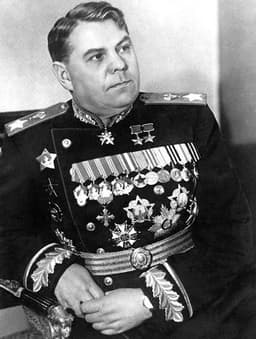
Aleksandr Vasilevsky
General · Modern
63.9Total
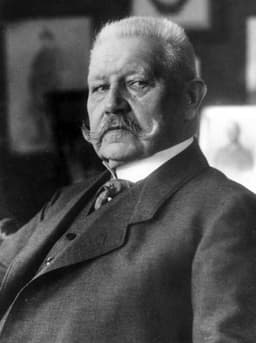
Paul von Hindenburg
General · Modern
62.2Total
Basic Information
Born
1895
1847
Died
1977
1934
Era
Modern
Modern
Nationality
USSR
Germany
Occupation
General
General
Civilization
Western
Western
Score Comparison
Military (10%)
85.0
65.0
Political (20%)
62.7
43.7
Influence (20%)
58.3
82.0
Legacy (20%)
55.0
55.0
Leadership (15%)
70.0
64.0
Strategy (15%)
72.0
52.5
TOTAL
63.9
62.2
Aleksandr Vasilevsky — Complete Timeline
1942 AD
Planned Operation Uranus at StalingradWar
Vasilevsky, as Chief of the General Staff, co-planned Operation Uranus, the Soviet counteroffensive that encircled the German 6th Army at Stalingrad. He coordinated the deployment of reserves and the timing of the attack. The operation was a turning point in World War II.
World War IIBattle of StalingradOperation Uranus
Impact: globalconstructive
Appointed Chief of the General StaffPolitical Action◆ Major
Vasilevsky was appointed Chief of the General Staff of the Soviet Armed Forces in June 1942, replacing Boris Shaposhnikov. He was responsible for strategic planning and coordination of major operations, including the Battle of Stalingrad and the Battle of Kursk.
World War IIGeneral StaffSoviet Union
Impact: nationalconstructive
1945 AD
Coordinated the Manchurian Strategic OffensiveWar
Vasilevsky was appointed commander-in-chief of Soviet forces in the Far East and planned the Manchurian Strategic Offensive against Japan. His forces defeated the Kwantung Army in a rapid campaign, leading to Japan's surrender and the end of World War II.
World War IIManchuriaJapan
Impact: globalconstructive
1949 AD
Appointed Minister of Defense of the Soviet UnionPolitical Action◆ Major
Vasilevsky was appointed Minister of Defense of the Soviet Union in 1949, succeeding Nikolai Bulganin. He oversaw the post-war reorganization of the Soviet military and the development of nuclear weapons. He served until 1953, when he was replaced after Stalin's death.
Cold WarSoviet UnionDefense Minister
Impact: nationalconstructive
Paul von Hindenburg — Complete Timeline
1914 AD
Battle of TannenbergWar
Hindenburg, with Ludendorff as chief of staff, commanded the German Eighth Army to a decisive victory over the Russian Second Army in East Prussia. The battle halted the Russian invasion and made Hindenburg a national hero.
World War IEastern FrontVictory
Impact: regional
1916 AD
Appointed Chief of the General StaffPolitical Action◆ Major
Hindenburg was appointed Chief of the General Staff of the German Army, replacing Erich von Falkenhayn. He and Ludendorff effectively became military dictators of Germany, directing all aspects of the war effort.
World War ICommandPower
Impact: national
1925 AD
Elected President of GermanyPolitical Action◆ Major
Hindenburg was elected as the second President of the Weimar Republic, defeating Wilhelm Marx in a runoff. His presidency marked a shift toward conservative and authoritarian rule, undermining the republic's democratic foundations.
Weimar RepublicElectionConservatism
Impact: national
1933 AD
Appointed Adolf Hitler as ChancellorPolitical Action
Hindenburg appointed Adolf Hitler as Chancellor of Germany, heading a coalition cabinet. This decision, made under political pressure and intrigue, enabled Hitler to consolidate power and ultimately dismantle the Weimar Republic.
Nazi RiseWeimar RepublicPower Transfer
Impact: globaldestructive
Reichstag Fire DecreePolitical Action◆ Major
Hindenburg signed the Reichstag Fire Decree, suspending civil liberties and allowing the Nazi regime to arrest political opponents. This decree was a key step in establishing the Nazi dictatorship.
Nazi DictatorshipCivil LibertiesRepression
Impact: nationaldestructive
Expert Analysis
Origins
Aleksandr Vasilevsky was born on September 30, 1895, in Novaya Golchikha, Russia, into a priest's family. He studied at the Kostroma Theological Seminary but left in 1915 to join the Imperial Russian Army during World War I. After graduating from an accelerated officer course, he served as a company commander on the Eastern Front, gaining early experience in warfare.
Paul von Hindenburg was born on October 2, 1847, in Posen, Prussia (now Poznań, Poland), into an aristocratic Junker family. He entered the Prussian Cadet Corps at age 11 and became a second lieutenant in the 3rd Foot Guards in 1866. He fought in the Austro-Prussian War (1866) and the Franco-Prussian War (1870-1871), earning the Iron Cross for bravery.
Rise to Power
Vasilevsky's rise accelerated after the Russian Revolution. He joined the Red Army in 1919 and fought in the Russian Civil War. By 1931, he became a staff officer, and in 1937, he was promoted to the General Staff. His meticulous planning caught Stalin's attention. In June 1942, Vasilevsky was appointed Chief of the General Staff, a position he held during critical operations like Operation Uranus at Stalingrad (November 1942).
Hindenburg's rise to prominence came unexpectedly in 1914. After a mediocre pre-war career, he was recalled from retirement at age 66 to command the German Eighth Army in East Prussia. With Erich Ludendorff as his chief of staff, he won the Battle of Tannenberg (August 1914) and the First Battle of the Masurian Lakes, becoming a national hero. In 1916, he was appointed Chief of the General Staff, effectively becoming the military dictator of Germany.
Leadership & Governance
Vasilevsky led through detailed planning and operational coordination. As Chief of the General Staff, he co-planned major offensives, including the Soviet counteroffensive at Stalingrad and the Battle of Kursk. His leadership style emphasized meticulous preparation and coordination between fronts. He scored 70.0 in leadership, reflecting his ability to manage complex operations. As Minister of Defense (1949-1953), he oversaw the post-war reorganization of the Soviet military.
Hindenburg's leadership was more symbolic. He relied heavily on Ludendorff for strategic decision-making during World War I. His governance as President of Germany (1925-1934) was marked by a conservative, authoritarian bent. He used emergency powers under Article 48, signed the Reichstag Fire Decree (1933), and appointed Adolf Hitler as Chancellor in January 1933, enabling the Nazi takeover. His leadership score of 64.0 reflects his passive style.
Triumph & Tragedy
Vasilevsky's greatest triumph was co-planning Operation Uranus at Stalingrad (November 1942), which encircled the German 6th Army and marked a turning point in World War II. He also commanded the Manchurian Strategic Offensive (August 1945), defeating the Japanese Kwantung Army in 11 days. His failures were less personal; he was involved in the failed Kharkov offensive in 1942, which resulted in heavy Soviet losses. Politically, he managed to survive Stalin's purges, though he was temporarily demoted in 1946.
Hindenburg's triumph was the Battle of Tannenberg, which made him a national icon. His tragedy was his role in enabling Hitler's rise. Despite personal reservations, he appointed Hitler as Chancellor and signed the Reichstag Fire Decree, which suspended civil liberties. His political score of 43.7 reflects these disastrous decisions. He died in 1934, leaving a legacy tarnished by his actions.
Character & Destiny
Vasilevsky was known for his calm, methodical nature and loyalty to Stalin. He was a technocrat who focused on operational details, earning him the trust of the Soviet leadership. His destiny was shaped by his ability to plan and execute complex operations, though he lacked the charismatic presence of other Soviet commanders.
Hindenburg was a stoic, conservative figure who embodied Prussian militarism. His character was marked by a sense of duty and deference to authority. His destiny was to be a symbol of German nationalism, but his inability to grasp the nature of Nazism led to his political manipulation. He scored 82.0 in influence, yet his legacy is defined by his greatest mistake.
Legacy
Vasilevsky's legacy lies in his military achievements. He is remembered as one of the finest staff officers in Soviet history, instrumental in planning the operations that defeated Nazi Germany. His influence on Soviet military doctrine persisted through the Cold War. He scored 58.3 in influence and 55.0 in legacy, reflecting his role as a planner rather than a public figure.
Hindenburg's legacy is deeply controversial. He is celebrated as a World War I hero but condemned for his role in the rise of Hitler. His presidency marked the end of the Weimar Republic and the beginning of Nazi dictatorship. His influence score of 82.0 reflects his impact on German history, but his legacy is negative due to his actions.
Conclusion
Aleksandr Vasilevsky had a greater impact as a military strategist, with a total score of 63.9 compared to Hindenburg's 62.2. Vasilevsky's planning at Stalingrad and Manchuria directly contributed to victory in World War II, while Hindenburg's political missteps enabled a catastrophic regime. Vasilevsky's military score of 85.0 far exceeds Hindenburg's 65.0, and his strategic successes have a more positive legacy. Hindenburg's influence was broader but ultimately destructive. Therefore, Vasilevsky emerges as the more effective and historically significant figure.
Rankings
🥇
Aleksandr VasilevskyLeader
Mil: 85.0Pol: 62.7Inf: 58.3
63.9
🥈
Paul von Hindenburg
Mil: 65.0Pol: 43.7Inf: 82.0
62.2
+1.7 behind
How This Comparison Works
Algorithm
Each figure is scored on 6 dimensions (0—100 scale) based on structured historical data: Military (10%), Political (20%), Influence (20%), Legacy (20%), Leadership (15%), Strategy (15%). The weighted total produces the final ranking.
Data Sources
Scores are computed from structured sub-indicators in the database. Scale factors adjust for era (Ancient ×0.85, Modern ×1.0) and civilization size (Eastern ×1.05, Other ×0.80) to account for differences in population and military scale.
Maximum 3 Figures
Comparisons are limited to 2—3 figures to ensure readability and statistical meaningfulness.
Error Margins
±5 points per dimension — Sub-scores are derived from historical records with inherent uncertainty. Two figures within 5 points on a dimension should be considered roughly equivalent in that area.
Total Score Accuracy
±3 points overall — The weighted combination of 6 dimensions produces a total score with approximately ±3 points of uncertainty. Differences of less than 3 points are not statistically significant— the figures are effectively tied.
Known Limitations
- Historical records are incomplete and uneven across civilizations
- Figures from oral-tradition societies may be underrepresented
- Occupation labels can misclassify multi-role figures
- Scores measure capability and impact, not moral character
- Quantitative scoring is a comparison tool, not absolute truth
Capability Radar
Military (10%) — Battles & Warfare
Battles
85
75
Win Rate
90
70
Expansion
70
40
Political (20%) — Governance & Reform
Reform
50
20
Diplomacy
65
40
Economy
40
30
Influence (20%) — Cultural & Global Reach
Cultural
45
40
Global
65
70
Legacy (20%) — Historical Impact
Historical
70
75
Longevity
60
60
Leadership (15%) — Power & Stability
Tenure
60
65
Stability
55
10
Strategy (15%) — Tactics & Innovation
Strategy
95
65
Tactics
80
60
Reform
75
30
Similar Comparisons
Comments & Discussion
No comments yet. Be the first to share your thoughts!