Loading...
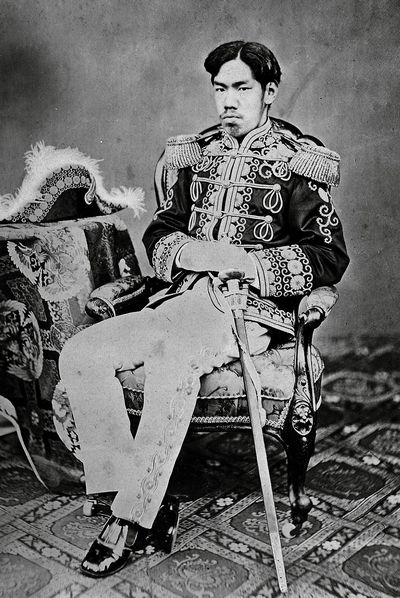
Emperor Meiji
ModernEmperorJapan1852 — 1912
日本第122代天皇。明治维新的核心象征,带领日本从封建国家走向现代化强国。
Compare Emperor Meiji with another historical figure:
Quick Facts
Born
1852
Died
1912
Country
Japan
Era
Modern
Occupation
Emperor
Score Overview
Military (10%)25
Political (20%)82
Influence (20%)75
Legacy (20%)68
Leadership (15%)80
Strategy (15%)66
Total Score69.2
Emperor Meiji — Complete Timeline
1868 AD
Meiji RestorationPolitical Action
Emperor Meiji was restored to political power after the fall of the Tokugawa shogunate. The new government, led by young samurai, abolished the feudal system and began modernizing Japan along Western lines, marking the start of the Meiji era.
RestorationModernizationPolitical Change
Impact: globalconstructive
Charter OathPolitical Action◆ Major
Emperor Meiji issued the Charter Oath, a five-article document outlining the principles of the new government. It promised deliberative assemblies, public participation, abolition of outdated customs, and the pursuit of knowledge worldwide.
ReformGovernment PolicyModernization
Impact: nationalprogressive
1871 AD
Abolition of the Han SystemReform◆ Major
The Meiji government abolished the feudal domains (han) and replaced them with prefectures under central control. This reform eliminated the power of the daimyo and created a unified, centralized state.
Administrative ReformCentralizationFeudalism
Impact: nationalconstructive
1889 AD
Promulgation of the Meiji ConstitutionPolitical Action
Emperor Meiji promulgated the Constitution of the Empire of Japan, establishing a constitutional monarchy with a bicameral parliament (Diet). The constitution granted the emperor supreme authority while creating a modern legal framework.
ConstitutionGovernmentLaw
Impact: nationalconstructive
1895 AD
Sino-Japanese War VictoryWar◆ Major
Japan defeated Qing China in the First Sino-Japanese War, gaining Taiwan, the Pescadores, and influence over Korea. The victory demonstrated Japan's military modernization and established it as a major Asian power.
WarVictoryImperial Expansion
Impact: regional
1902 AD
Anglo-Japanese AlliancePolitical Action◆ Major
Japan signed a military alliance with the United Kingdom, its first equal treaty with a Western power. The alliance recognized Japan's interests in Korea and provided diplomatic support, enhancing Japan's international standing.
DiplomacyAllianceInternational Relations
Impact: globalconstructive
1905 AD
Russo-Japanese War VictoryWar
Japan defeated Russia in the Russo-Japanese War, gaining control of Port Arthur, the Liaodong Peninsula, and southern Sakhalin. The victory shocked the world and marked the first time an Asian power defeated a European empire in modern warfare.
WarVictoryImperial Expansion
Impact: global
Detailed Scores
▶View all detailed scores
Military
Strategy
7
Tactics
6
Battles
6
Army Scale
6
War Impact
7
Political
Governance
7
Reform
7
Stability
7
Policy
7
Power
8
Influence
History
8
Global
8
Culture
8
Ideology
9
Legacy
8
People often compare with
See how Emperor Meiji stacks up against other historical figures
Popular Comparisons
Emperor Meiji vs Elizabeth of Russia
vs Elizabeth of Russia59
Emperor Meiji vs Henri Christophe
vs Henri Christophe59
Emperor Meiji vs Leopold II of Austria
vs Leopold II of Austria56
Emperor Meiji vs Augustus II the Strong
vs Augustus II the Strong55
Emperor Meiji vs Kaikhusrau Jahan
vs Kaikhusrau Jahan54
Emperor Meiji vs King Sukjong of Joseon
vs King Sukjong of Joseon52