Loading...
Emperor Meiji vs King Sukjong of Joseon
Emperor Meiji leads by 17.4 pts · 2 figures compared
…
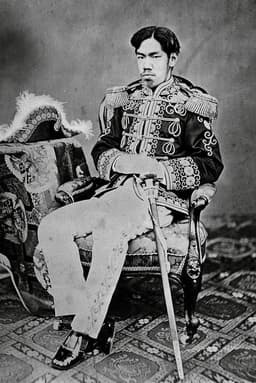
Emperor Meiji
Emperor · Modern
69.2Total

King Sukjong of Joseon
Emperor · Modern
51.8Total
Basic Information
Born
1852
1661
Died
1912
1720
Era
Modern
Modern
Nationality
Japan
Korea
Occupation
Emperor
Emperor
Civilization
Eastern
Eastern
Score Comparison
Military (10%)
25.0
10.2
Political (20%)
82.0
60.0
Influence (20%)
75.0
57.2
Legacy (20%)
68.0
50.0
Leadership (15%)
80.0
72.0
Strategy (15%)
66.3
42.3
TOTAL
69.2
51.8
Emperor Meiji — Complete Timeline
1868 AD
Meiji RestorationPolitical Action
Emperor Meiji was restored to political power after the fall of the Tokugawa shogunate. The new government, led by young samurai, abolished the feudal system and began modernizing Japan along Western lines, marking the start of the Meiji era.
RestorationModernizationPolitical Change
Impact: globalconstructive
Charter OathPolitical Action◆ Major
Emperor Meiji issued the Charter Oath, a five-article document outlining the principles of the new government. It promised deliberative assemblies, public participation, abolition of outdated customs, and the pursuit of knowledge worldwide.
ReformGovernment PolicyModernization
Impact: nationalprogressive
1871 AD
Abolition of the Han SystemReform◆ Major
The Meiji government abolished the feudal domains (han) and replaced them with prefectures under central control. This reform eliminated the power of the daimyo and created a unified, centralized state.
Administrative ReformCentralizationFeudalism
Impact: nationalconstructive
1889 AD
Promulgation of the Meiji ConstitutionPolitical Action
Emperor Meiji promulgated the Constitution of the Empire of Japan, establishing a constitutional monarchy with a bicameral parliament (Diet). The constitution granted the emperor supreme authority while creating a modern legal framework.
ConstitutionGovernmentLaw
Impact: nationalconstructive
1895 AD
Sino-Japanese War VictoryWar◆ Major
Japan defeated Qing China in the First Sino-Japanese War, gaining Taiwan, the Pescadores, and influence over Korea. The victory demonstrated Japan's military modernization and established it as a major Asian power.
WarVictoryImperial Expansion
Impact: regional
1902 AD
Anglo-Japanese AlliancePolitical Action◆ Major
Japan signed a military alliance with the United Kingdom, its first equal treaty with a Western power. The alliance recognized Japan's interests in Korea and provided diplomatic support, enhancing Japan's international standing.
DiplomacyAllianceInternational Relations
Impact: globalconstructive
1905 AD
Russo-Japanese War VictoryWar
Japan defeated Russia in the Russo-Japanese War, gaining control of Port Arthur, the Liaodong Peninsula, and southern Sakhalin. The victory shocked the world and marked the first time an Asian power defeated a European empire in modern warfare.
WarVictoryImperial Expansion
Impact: global
King Sukjong of Joseon — Complete Timeline
1688 AD
First Deposition of Queen InhyeonPolitical Action◆ Major
King Sukjong deposed Queen Inhyeon in favor of his concubine, Jang Hui-bin, after a power struggle. This act triggered a major factional conflict between the Southerners (supporting Jang) and the Westerners (supporting Inhyeon), reshaping court politics.
Royal DepositionFactional ConflictConcubine Power
Impact: nationaldestructive
1694 AD
Restoration of Queen InhyeonPolitical Action◆ Major
Sukjong restored Queen Inhyeon to her position after Jang Hui-bin's faction lost favor. This reversal led to the purge of the Southerners and the return of the Westerners to power, demonstrating Sukjong's use of queen changes to control factions.
Royal RestorationFactional ShiftCourt Politics
Impact: national
1700 AD
Promotion of Silhak (Practical Learning)Cultural
Sukjong's reign saw the rise of the Silhak movement, which emphasized practical reforms in agriculture, commerce, and technology. Scholars like Yi Ik gained influence, leading to policy discussions that later influenced Joseon modernization efforts.
Intellectual MovementReformSilhak
Impact: nationalprogressive
1701 AD
Second Deposition and Execution of Jang Hui-binPolitical Action◆ Major
Sukjong deposed and executed his concubine Jang Hui-bin after she was implicated in a plot to curse Queen Inhyeon. This event solidified the power of the Westerners and marked the end of Jang's influence, but also deepened factional hatred.
ExecutionConcubineFactional Violence
Impact: nationaltragic
Expert Analysis
Origins
Emperor Meiji, born Mutsuhito in 1852, was the son of Emperor Komei and raised in the secluded Kyoto Imperial Court. His education was traditional, emphasizing Confucian classics and poetry, but he also received exposure to Western learning through tutors. The Tokugawa shogunate controlled Japan, and the emperor had no political power.
King Sukjong, born Yi Sun in 1661, was the 19th monarch of Joseon. He was the son of King Hyeonjong and Queen Myeongseong. His education followed the standard Confucian curriculum for crown princes, focusing on classics, history, and statecraft. He ascended the throne at age 14 in 1674, inheriting a kingdom dominated by factional strife between the Southerners and Westerners.
Rise to Power
Meiji became emperor in 1867 at age 15, following his father's death. The Meiji Restoration began in 1868 when a coalition of samurai from Satsuma and Choshu overthrew the shogunate and restored imperial rule. Meiji was the symbolic head, but real power lay with oligarchs like Ito Hirobumi and Yamagata Aritomo. He was moved from Kyoto to Tokyo (formerly Edo) in 1869. The Charter Oath of 1868 set the direction for modernization.
Sukjong became king in 1674 at age 14. His reign was immediately embroiled in factional conflict. The Southerners supported his grandfather's policies, while the Westerners opposed them. Sukjong skillfully played factions against each other to consolidate power. In 1689, he deposed Queen Inhyeon and elevated his concubine Jang Hui-bin, triggering the Gisa Hwanguk purge where Southerners eliminated Westerners. He later reversed course in 1694, restoring Inhyeon and purging the Southerners.
Leadership & Governance
Meiji's leadership was indirect but transformative. He presided over the Meiji Constitution (1889), which established a constitutional monarchy with a Diet, but the emperor held supreme command of the military and could veto laws. He embodied national unity and modernization. His government implemented the abolition of feudalism, land tax reform, compulsory education, industrialization, and military conscription. Japan's military scored 25.0, reflecting its rapid modernization under his reign, though he was not a direct commander.
Sukjong's governance was reactive, focused on managing court factions. He promoted the Silhak (Practical Learning) movement, encouraging scholars like Yi Ik to propose reforms in agriculture and commerce. However, his frequent queen changes (three queens: Ingyeong, Inhyeon, and Inwon) and executions (Jang Hui-bin in 1701) destabilized the court. His political score is 60.0, reflecting his ability to maintain power but with limited national transformation.
Triumph & Tragedy
Meiji's triumphs include the Meiji Restoration, which transformed Japan into a modern state. Japan's victory in the First Sino-Japanese War (1894-1895) gained Taiwan and influence over Korea. The Anglo-Japanese Alliance (1902) recognized Japan as a major power. The Russo-Japanese War (1904-1905) victory stunned the world, gaining Port Arthur and southern Sakhalin. However, his reign also saw the suppression of the Freedom and People's Rights Movement and the annexation of Korea in 1910, which later contributed to regional tensions. His legacy score is 68.0.
Sukjong's triumphs include stabilizing the throne after decades of factional strife. He promoted Silhak, which laid groundwork for later reforms. However, his greatest tragedy was the execution of his beloved concubine Jang Hui-bin after she was accused of cursing Queen Inhyeon. The constant purges weakened the bureaucracy and wasted talent. His military score of 10.2 reflects a period of peace but also stagnation in defense.
Character & Destiny
Meiji was reserved and formal, projecting dignity and authority. He was not a decision-maker but a symbol of unity. His health was poor; he died of uremia in 1912. His character as a figurehead allowed the oligarchs to implement radical changes without monarchic interference.
Sukjong was decisive and manipulative, personally involved in court intrigues. He changed queens three times and executed his favorite concubine to maintain control. His character led to a reign of shifting alliances, which prevented long-term reforms. He died in 1720 after a 46-year reign.
Legacy
Meiji's legacy is profound: Japan became the first non-Western industrial power, with a modern military, education system, and constitution. His name defines an era (Meiji period, 1868-1912). Japan's rise led to its imperial expansion and eventual conflict with the West.
Sukjong's legacy is mixed. He maintained Joseon's independence but did not modernize. The Silhak movement influenced later reformers, but the factional system persisted. Korea remained a "hermit kingdom" until the late 19th century, when it fell under Japanese influence. His total score of 51.8 reflects limited impact compared to Meiji's 69.2.
Conclusion
Emperor Meiji had a greater impact on world history than King Sukjong. Meiji's score of 69.2 vs Sukjong's 51.8 reflects this. Meiji presided over a transformation that changed Japan from a feudal backwater to a global power within a generation. Sukjong's reign, while politically adept, did not alter Korea's trajectory. The Meiji Restoration set Japan on a path that reshaped Asia, while Joseon under Sukjong remained stagnant. Thus, Meiji's influence is clearly superior.
Rankings
🥇
Emperor MeijiLeader
Mil: 25.0Pol: 82.0Inf: 75.0
69.2
🥈
King Sukjong of Joseon
Mil: 10.2Pol: 60.0Inf: 57.2
51.8
+17.4 behind
How This Comparison Works
Algorithm
Each figure is scored on 6 dimensions (0—100 scale) based on structured historical data: Military (10%), Political (20%), Influence (20%), Legacy (20%), Leadership (15%), Strategy (15%). The weighted total produces the final ranking.
Data Sources
Scores are computed from structured sub-indicators in the database. Scale factors adjust for era (Ancient ×0.85, Modern ×1.0) and civilization size (Eastern ×1.05, Other ×0.80) to account for differences in population and military scale.
Maximum 3 Figures
Comparisons are limited to 2—3 figures to ensure readability and statistical meaningfulness.
Error Margins
±5 points per dimension — Sub-scores are derived from historical records with inherent uncertainty. Two figures within 5 points on a dimension should be considered roughly equivalent in that area.
Total Score Accuracy
±3 points overall — The weighted combination of 6 dimensions produces a total score with approximately ±3 points of uncertainty. Differences of less than 3 points are not statistically significant— the figures are effectively tied.
Known Limitations
- Historical records are incomplete and uneven across civilizations
- Figures from oral-tradition societies may be underrepresented
- Occupation labels can misclassify multi-role figures
- Scores measure capability and impact, not moral character
- Quantitative scoring is a comparison tool, not absolute truth
Capability Radar
Military (10%) — Battles & Warfare
Battles
20
10
Win Rate
30
10
Expansion
75
5
Political (20%) — Governance & Reform
Reform
95
65
Diplomacy
85
60
Economy
90
55
Influence (20%) — Cultural & Global Reach
Cultural
85
55
Global
85
30
Legacy (20%) — Historical Impact
Historical
90
60
Longevity
80
50
Leadership (15%) — Power & Stability
Tenure
85
70
Stability
70
50
Strategy (15%) — Tactics & Innovation
Strategy
70
10
Tactics
25
10
Reform
95
15
Similar Comparisons
Comments & Discussion
No comments yet. Be the first to share your thoughts!