Loading...
Elizabeth of Russia vs Emperor Meiji
Emperor Meiji leads by 9.9 pts · 2 figures compared
…

Elizabeth of Russia
Emperor · Modern
59.3Total
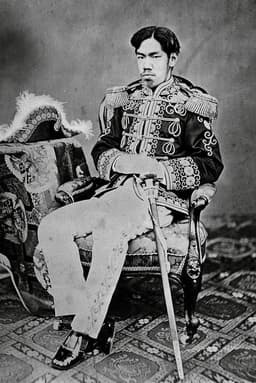
Emperor Meiji
Emperor · Modern
69.2Total
Basic Information
Born
1709
1852
Died
1762
1912
Era
Modern
Modern
Nationality
Russia
Japan
Occupation
Emperor
Emperor
Civilization
Western
Eastern
Score Comparison
Military (10%)
70.0
25.0
Political (20%)
60.0
82.0
Influence (20%)
55.0
75.0
Legacy (20%)
54.0
68.0
Leadership (15%)
72.0
80.0
Strategy (15%)
52.5
66.3
TOTAL
59.3
69.2
Elizabeth of Russia — Complete Timeline
1741 AD
Accession as Empress of RussiaPolitical Action◆ Major
Elizabeth seized the throne in a bloodless coup, overthrowing the infant Ivan VI and his regent. She was supported by the Preobrazhensky Regiment and popular sentiment against German dominance. Her accession restored the line of Peter the Great and was celebrated as a national revival.
CoupSuccessionNational Revival
Impact: nationalconstructive
1752 AD
Construction of the Catherine PalaceCultural
Elizabeth commissioned the reconstruction of the Catherine Palace in Tsarskoye Selo, designed by Francesco Bartolomeo Rastrelli. The palace, with its elaborate Baroque style, became a symbol of imperial opulence and a center of court life. It is a UNESCO World Heritage site.
ArchitectureBaroqueTsarskoye Selo
Impact: nationalconstructive
1753 AD
Abolition of Internal Customs TariffsReform◆ Major
Elizabeth abolished internal customs tariffs and tolls within Russia, which had hindered trade and economic development. This reform simplified taxation, promoted internal commerce, and increased state revenue through higher import duties. It was a significant step toward economic modernization.
Economic ReformTradeTaxation
Impact: nationalconstructive
1755 AD
Founding of Moscow UniversityCultural◆ Major
Elizabeth signed the decree establishing Moscow University, the first university in Russia, on the initiative of Mikhail Lomonosov. The university became a center of learning and science, promoting education and reducing reliance on foreign scholars. It remains a leading institution today.
EducationUniversityLomonosov
Impact: nationalconstructive
1756 AD
Participation in the Seven Years' WarWar◆ Major
Elizabeth led Russia into the Seven Years' War against Prussia, allying with Austria and France. Russian forces achieved major victories, including the occupation of Berlin in 1760. The war drained Russian resources but demonstrated its military power. Elizabeth's death in 1762 led to a reversal of policy.
Seven Years' WarPrussiaBerlin
Impact: global
Emperor Meiji — Complete Timeline
1868 AD
Meiji RestorationPolitical Action
Emperor Meiji was restored to political power after the fall of the Tokugawa shogunate. The new government, led by young samurai, abolished the feudal system and began modernizing Japan along Western lines, marking the start of the Meiji era.
RestorationModernizationPolitical Change
Impact: globalconstructive
Charter OathPolitical Action◆ Major
Emperor Meiji issued the Charter Oath, a five-article document outlining the principles of the new government. It promised deliberative assemblies, public participation, abolition of outdated customs, and the pursuit of knowledge worldwide.
ReformGovernment PolicyModernization
Impact: nationalprogressive
1871 AD
Abolition of the Han SystemReform◆ Major
The Meiji government abolished the feudal domains (han) and replaced them with prefectures under central control. This reform eliminated the power of the daimyo and created a unified, centralized state.
Administrative ReformCentralizationFeudalism
Impact: nationalconstructive
1889 AD
Promulgation of the Meiji ConstitutionPolitical Action
Emperor Meiji promulgated the Constitution of the Empire of Japan, establishing a constitutional monarchy with a bicameral parliament (Diet). The constitution granted the emperor supreme authority while creating a modern legal framework.
ConstitutionGovernmentLaw
Impact: nationalconstructive
1895 AD
Sino-Japanese War VictoryWar◆ Major
Japan defeated Qing China in the First Sino-Japanese War, gaining Taiwan, the Pescadores, and influence over Korea. The victory demonstrated Japan's military modernization and established it as a major Asian power.
WarVictoryImperial Expansion
Impact: regional
1902 AD
Anglo-Japanese AlliancePolitical Action◆ Major
Japan signed a military alliance with the United Kingdom, its first equal treaty with a Western power. The alliance recognized Japan's interests in Korea and provided diplomatic support, enhancing Japan's international standing.
DiplomacyAllianceInternational Relations
Impact: globalconstructive
1905 AD
Russo-Japanese War VictoryWar
Japan defeated Russia in the Russo-Japanese War, gaining control of Port Arthur, the Liaodong Peninsula, and southern Sakhalin. The victory shocked the world and marked the first time an Asian power defeated a European empire in modern warfare.
WarVictoryImperial Expansion
Impact: global
Expert Analysis
Origins
Elizabeth Petrovna was born in 1709, the daughter of Peter the Great and Catherine I. She grew up in the shadow of her father's reforms but received a limited education, focusing on dance and courtly graces. Her early life was marked by political instability after her mother's death, and she lived in relative obscurity during the reigns of her nephew Peter II and cousin Anna. In contrast, Emperor Meiji, born Mutsuhito in 1852, was the son of Emperor Komei and was raised in the isolation of the Kyoto Imperial Court. He received a traditional education in Chinese classics but was also exposed to Western ideas through his tutors. His upbringing was shielded from the political turmoil that engulfed Japan, including the arrival of Commodore Perry's Black Ships in 1853.
Rise to Power
Elizabeth seized the throne in a bloodless coup on December 6, 1741, overthrowing the infant Ivan VI and his regent, Anna Leopoldovna. She was supported by the Preobrazhensky Regiment, which she had cultivated through personal connections. Her accession was popular among the guards and the nobility, who saw her as a symbol of Peter the Great's legacy. Meiji's rise was more gradual and institutional. He ascended the throne in 1867 at age 14 after his father's death, but real power rested with the shogunate. The Meiji Restoration of 1868 was not his personal coup but a movement led by young samurai from Choshu and Satsuma, who used his name to legitimize the overthrow of the Tokugawa shogunate. By 1868, Meiji was declared the head of state, but he initially had little direct influence.
Leadership & Governance
Elizabeth's leadership style was personal and autocratic. She ruled through a circle of favorites, such as Alexei Razumovsky and Ivan Shuvalov, and often relied on her charm and temper. She abolished internal customs tariffs in 1754, which boosted trade, and founded Moscow University in 1755, advancing education. However, she neglected administrative reforms and left the state finances in disarray, especially due to war expenditures. Her governance was reactive rather than systematic. Meiji, by contrast, reigned as a constitutional monarch after 1889. The Meiji Constitution granted him supreme command of the military and the power to appoint ministers, but he generally followed the advice of his oligarchs, such as Ito Hirobumi and Yamagata Aritomo. Meiji's leadership was symbolic and unifying, embodying the nation's modernization. He oversaw the abolition of feudalism, the establishment of a centralized bureaucracy, and the rapid industrialization of Japan.
Triumph & Tragedy
Elizabeth's greatest triumph was Russia's performance in the Seven Years' War. Russian forces defeated Frederick the Great at the Battle of Kunersdorf in 1759 and briefly occupied Berlin in 1760. Her death in 1762, however, led to a reversal: her successor, Peter III, withdrew from the war, nullifying Russia's gains. Her greatest failure was her inability to secure a stable succession or implement lasting reforms. She left the treasury depleted and the government inefficient. Meiji's triumphs include the victory in the Russo-Japanese War (1904-1905), which established Japan as a world power, and the peaceful transformation of Japan into a modern state. His tragedies include the authoritarian turn after his death, as the military gained influence, and the human cost of rapid industrialization, including social unrest and the suppression of political dissent.
Character & Destiny
Elizabeth was known for her love of luxury, balls, and fashion. She was impulsive and emotional, but also politically astute when necessary. Her character led her to avoid hard decisions, such as appointing a successor, which contributed to the chaos after her death. Meiji was reserved and dignified, embodying the ideal of the emperor as a national father figure. His character, shaped by Confucian ethics and a sense of duty, allowed him to serve as a symbol of unity during Japan's transformation. However, his passivity in political matters meant that the oligarchs and military ultimately controlled policy, setting the stage for future militarism.
Legacy
Elizabeth's legacy is mixed: she is remembered as a patron of the arts and education, notably founding Moscow University and commissioning the Catherine Palace. However, her reign did not fundamentally alter Russia's trajectory. Her total score of 59.3 reflects limited long-term impact. Meiji's legacy is profound: he gave his name to an era that transformed Japan. The Meiji Restoration created a modern, industrialized nation that could compete with the West. His scores in political (82.0) and leadership (80.0) reflect his symbolic and unifying role. The Meiji Constitution, though flawed, established a framework for constitutional government. Japan's rise as a global power is directly tied to his reign.
Conclusion
Emperor Meiji had greater impact than Elizabeth of Russia. While Elizabeth scored 72.0 in leadership, her overall total of 59.3 is lower than Meiji's 69.2. Meiji's political score of 82.0 dwarfs Elizabeth's 60.0, reflecting his role in a transformative national project. Elizabeth's achievements, such as Moscow University, were significant but did not change the course of world history. Meiji's reign saw Japan emerge as a modern power, altering the global balance. Therefore, Meiji's influence is more enduring and widespread.
Rankings
🥇
Emperor MeijiLeader
Mil: 25.0Pol: 82.0Inf: 75.0
69.2
🥈
Elizabeth of Russia
Mil: 70.0Pol: 60.0Inf: 55.0
59.3
+9.9 behind
How This Comparison Works
Algorithm
Each figure is scored on 6 dimensions (0—100 scale) based on structured historical data: Military (10%), Political (20%), Influence (20%), Legacy (20%), Leadership (15%), Strategy (15%). The weighted total produces the final ranking.
Data Sources
Scores are computed from structured sub-indicators in the database. Scale factors adjust for era (Ancient ×0.85, Modern ×1.0) and civilization size (Eastern ×1.05, Other ×0.80) to account for differences in population and military scale.
Maximum 3 Figures
Comparisons are limited to 2—3 figures to ensure readability and statistical meaningfulness.
Error Margins
±5 points per dimension — Sub-scores are derived from historical records with inherent uncertainty. Two figures within 5 points on a dimension should be considered roughly equivalent in that area.
Total Score Accuracy
±3 points overall — The weighted combination of 6 dimensions produces a total score with approximately ±3 points of uncertainty. Differences of less than 3 points are not statistically significant— the figures are effectively tied.
Known Limitations
- Historical records are incomplete and uneven across civilizations
- Figures from oral-tradition societies may be underrepresented
- Occupation labels can misclassify multi-role figures
- Scores measure capability and impact, not moral character
- Quantitative scoring is a comparison tool, not absolute truth
Capability Radar
Military (10%) — Battles & Warfare
Battles
60
20
Win Rate
55
30
Expansion
60
75
Political (20%) — Governance & Reform
Reform
55
95
Diplomacy
65
85
Economy
60
90
Influence (20%) — Cultural & Global Reach
Cultural
65
85
Global
55
85
Legacy (20%) — Historical Impact
Historical
60
90
Longevity
55
80
Leadership (15%) — Power & Stability
Tenure
70
85
Stability
50
70
Strategy (15%) — Tactics & Innovation
Strategy
65
70
Tactics
40
25
Reform
50
95
Similar Comparisons
Comments & Discussion
No comments yet. Be the first to share your thoughts!