Loading...
Augustus II the Strong vs Emperor Meiji
Emperor Meiji leads by 14.4 pts · 2 figures compared
…
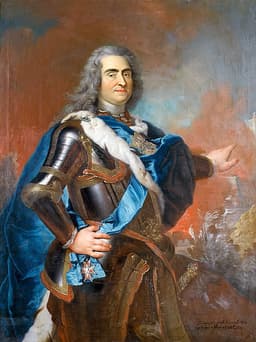
Augustus II the Strong
Emperor · Modern
54.8Total
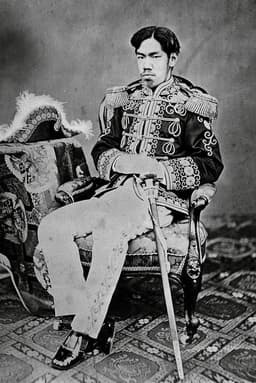
Emperor Meiji
Emperor · Modern
69.2Total
Basic Information
Born
1670
1852
Died
1733
1912
Era
Modern
Modern
Nationality
Poland
Japan
Occupation
Emperor
Emperor
Civilization
Western
Eastern
Score Comparison
Military (10%)
25.0
25.0
Political (20%)
72.0
82.0
Influence (20%)
58.0
75.0
Legacy (20%)
46.7
68.0
Leadership (15%)
62.0
80.0
Strategy (15%)
60.0
66.3
TOTAL
54.8
69.2
Augustus II the Strong — Complete Timeline
1697 AD
Election as King of PolandPolitical Action◆ Major
Augustus II was elected King of Poland and Grand Duke of Lithuania after converting to Catholicism. His election was supported by Russia and Austria, marking the beginning of his reign over the Polish-Lithuanian Commonwealth.
ElectionPolish-Lithuanian CommonwealthConversion
Impact: regional
Establishment of the Saxon-Polish UnionPolitical Action◆ Major
Augustus II created a personal union between Saxony and Poland, ruling both territories. This union lasted intermittently until 1763, linking the German electorate with the Polish-Lithuanian Commonwealth.
Personal UnionSaxonyPoland
Impact: regional
1700 AD
Alliance with Russia in the Great Northern WarWar◆ Major
Augustus II allied with Peter the Great of Russia and Frederick IV of Denmark against Sweden. This alliance initiated the Great Northern War, aiming to reduce Swedish dominance in the Baltic region.
Great Northern WarAllianceSweden
Impact: regional
1706 AD
Deposition from the Polish ThronePolitical Action◆ Major
Following Swedish King Charles XII's invasion of Poland, Augustus II was deposed by the Swedish-backed Stanis
DepositionTreaty of AltranstädtSwedish Invasion
Impact: regionaltragic
1709 AD
Restoration to the Polish ThronePolitical Action◆ Major
After the Swedish defeat at the Battle of Poltava, Augustus II was restored as King of Poland with Russian support. He returned to power but with diminished authority, effectively becoming a Russian client.
RestorationRussian InfluencePoltava
Impact: regional
Emperor Meiji — Complete Timeline
1868 AD
Meiji RestorationPolitical Action
Emperor Meiji was restored to political power after the fall of the Tokugawa shogunate. The new government, led by young samurai, abolished the feudal system and began modernizing Japan along Western lines, marking the start of the Meiji era.
RestorationModernizationPolitical Change
Impact: globalconstructive
Charter OathPolitical Action◆ Major
Emperor Meiji issued the Charter Oath, a five-article document outlining the principles of the new government. It promised deliberative assemblies, public participation, abolition of outdated customs, and the pursuit of knowledge worldwide.
ReformGovernment PolicyModernization
Impact: nationalprogressive
1871 AD
Abolition of the Han SystemReform◆ Major
The Meiji government abolished the feudal domains (han) and replaced them with prefectures under central control. This reform eliminated the power of the daimyo and created a unified, centralized state.
Administrative ReformCentralizationFeudalism
Impact: nationalconstructive
1889 AD
Promulgation of the Meiji ConstitutionPolitical Action
Emperor Meiji promulgated the Constitution of the Empire of Japan, establishing a constitutional monarchy with a bicameral parliament (Diet). The constitution granted the emperor supreme authority while creating a modern legal framework.
ConstitutionGovernmentLaw
Impact: nationalconstructive
1895 AD
Sino-Japanese War VictoryWar◆ Major
Japan defeated Qing China in the First Sino-Japanese War, gaining Taiwan, the Pescadores, and influence over Korea. The victory demonstrated Japan's military modernization and established it as a major Asian power.
WarVictoryImperial Expansion
Impact: regional
1902 AD
Anglo-Japanese AlliancePolitical Action◆ Major
Japan signed a military alliance with the United Kingdom, its first equal treaty with a Western power. The alliance recognized Japan's interests in Korea and provided diplomatic support, enhancing Japan's international standing.
DiplomacyAllianceInternational Relations
Impact: globalconstructive
1905 AD
Russo-Japanese War VictoryWar
Japan defeated Russia in the Russo-Japanese War, gaining control of Port Arthur, the Liaodong Peninsula, and southern Sakhalin. The victory shocked the world and marked the first time an Asian power defeated a European empire in modern warfare.
WarVictoryImperial Expansion
Impact: global
Expert Analysis
Origins
Augustus II the Strong (1670–1733) was born in Dresden as Frederick Augustus I, Elector of Saxony. He was the second son of John George III, Elector of Saxony, and inherited the electorate in 1694 after his brother's death. His family, the House of Wettin, ruled Saxony, a prosperous German state. Augustus received a thorough education in statecraft and military arts, and his physical strength earned him the nickname "the Strong." He was known for his immense physical prowess, reputedly able to bend horseshoes with his bare hands.
Emperor Meiji (1852–1912), born Mutsuhito, was the 122nd emperor of Japan. He was the son of Emperor Kōmei and was raised in the secluded imperial court in Kyoto. Japan was a feudal society under the Tokugawa shogunate, isolated from the world. Meiji's early years were marked by political turmoil, including the arrival of Commodore Perry's Black Ships in 1853, which forced Japan to open to foreign trade. Unlike Augustus, Meiji's upbringing was sheltered, but he was exposed to the growing movement to restore imperial rule.
Rise to Power
Augustus II rose to power through a combination of inheritance and political maneuvering. In 1694, he became Elector of Saxony. To secure the Polish throne, he converted from Lutheranism to Catholicism in 1697, a move that alienated many Saxons but gained him the support of the Polish nobility and the Habsburgs. He was elected King of Poland and Grand Duke of Lithuania in 1697, backed by Russia and Austria. His reign began with ambitions to expand Polish influence and reclaim lost territories.
Emperor Meiji ascended the throne in 1867 at age 14 after his father's death. His rise was not a personal ambition but a constitutional transition. However, the Meiji Restoration of 1868 was a coup d'état by young samurai from Chōshū and Satsuma domains who overthrew the Tokugawa shogunate and restored imperial rule. Meiji became the symbol of modernization, but real power lay with the oligarchs. His role was to legitimize radical reforms, including the abolition of feudalism and the establishment of a centralized state.
Leadership & Governance
Augustus II's leadership was characterized by absolutist ambitions and lavish spending. He ruled Saxony as an absolute monarch but faced constraints in Poland, where the nobility (szlachta) held extensive powers. He attempted to strengthen the monarchy by centralizing administration and building a strong army, but his efforts were hampered by the Liberum Veto, which allowed any noble to block legislation. His governance scored 62.0 in Leadership and 72.0 in Political, reflecting his ability to maneuver in complex politics. However, his military score was only 25.0, as he failed to achieve lasting military successes.
Emperor Meiji's leadership was indirect but symbolic. He presided over the Meiji Constitution of 1889, which established a constitutional monarchy with a parliament (Diet). While he had limited political power, his endorsement was crucial for reforms. His political score of 82.0 reflects the successful transition to a modern state. The Meiji government implemented sweeping changes: industrialization, universal education, a modern army, and legal reforms. Meiji's leadership score of 80.0 indicates his effectiveness as a unifying figure.
Triumph & Tragedy
Augustus II's triumphs include his election as King of Poland and his restoration after the Great Northern War. He also fostered cultural development, building the Zwinger Palace and collecting art. However, his greatest failure was the Great Northern War (1700–1721). His alliance with Russia against Sweden led to a Swedish invasion of Poland, his deposition in 1706, and the devastation of Saxony. After restoration in 1709, his power was severely diminished, and he failed to achieve his goal of establishing a hereditary monarchy in Poland. His legacy score of 46.7 reflects limited long-term impact.
Emperor Meiji's triumphs are monumental: the Meiji Restoration transformed Japan from a feudal state into a world power. Victories in the Sino-Japanese War (1894–1895) and Russo-Japanese War (1904–1905) established Japan as a major force. His reign saw the abolition of feudalism, modernization of industry, and adoption of Western technology. However, tragedies include the harsh treatment of peasants during industrialization and the suppression of political dissent. The Meiji Constitution granted limited democratic rights, and the emperor's divine status was used to justify militarism. His legacy score of 68.0 reflects Japan's rise but also its eventual path to imperialism.
Character & Destiny
Augustus II was known for his physical strength, charisma, and hedonism. He fathered over 300 children (though recognized only a few), earning his nickname. His character was ambitious but flawed by overreach and poor strategic judgment. His alliance with Peter the Great proved costly, and his inability to secure hereditary rule in Poland doomed his dynasty. His total score of 54.8 reflects a capable but ultimately unsuccessful ruler.
Emperor Meiji was reserved and dignified, embodying the transition from divine ruler to constitutional monarch. He was a figurehead but supported modernization. His character was shaped by duty and restraint, leaving actual governance to the oligarchs. His total score of 69.2 indicates greater effectiveness. His destiny was to oversee Japan's transformation, but his legacy includes the rise of militarism after his death.
Legacy
Augustus II's legacy is mixed. He left a cultural mark on Saxony with Baroque architecture and art collections, but his political ambitions in Poland failed. The Saxon-Polish union he established lasted until 1763 but was weak. He is remembered more for his personal excesses than for statecraft. His influence score of 58.0 reflects moderate impact.
Emperor Meiji's legacy is profound. Japan's modernization, industrialization, and emergence as a global power are directly tied to his reign. The Meiji era set the foundation for Japan's 20th-century trajectory. His influence score of 75.0 and legacy score of 68.0 underscore his lasting impact. However, the militarism that followed tarnished his image.
Conclusion
Emperor Meiji had a greater impact than Augustus II the Strong. Meiji's total score of 69.2 surpasses Augustus's 54.8 by 14.4 points. While Augustus was a talented politician, his failures in war and governance limited his achievements. Meiji, though a figurehead, presided over a transformation that reshaped Japan and the world. Augustus's legacy is confined to Central Europe and cultural artifacts, while Meiji's influence extends to modern global history. The verdict is clear: Emperor Meiji's reign was more consequential.
Rankings
🥇
Emperor MeijiLeader
Mil: 25.0Pol: 82.0Inf: 75.0
69.2
🥈
Augustus II the Strong
Mil: 25.0Pol: 72.0Inf: 58.0
54.8
+14.4 behind
How This Comparison Works
Algorithm
Each figure is scored on 6 dimensions (0—100 scale) based on structured historical data: Military (10%), Political (20%), Influence (20%), Legacy (20%), Leadership (15%), Strategy (15%). The weighted total produces the final ranking.
Data Sources
Scores are computed from structured sub-indicators in the database. Scale factors adjust for era (Ancient ×0.85, Modern ×1.0) and civilization size (Eastern ×1.05, Other ×0.80) to account for differences in population and military scale.
Maximum 3 Figures
Comparisons are limited to 2—3 figures to ensure readability and statistical meaningfulness.
Error Margins
±5 points per dimension — Sub-scores are derived from historical records with inherent uncertainty. Two figures within 5 points on a dimension should be considered roughly equivalent in that area.
Total Score Accuracy
±3 points overall — The weighted combination of 6 dimensions produces a total score with approximately ±3 points of uncertainty. Differences of less than 3 points are not statistically significant— the figures are effectively tied.
Known Limitations
- Historical records are incomplete and uneven across civilizations
- Figures from oral-tradition societies may be underrepresented
- Occupation labels can misclassify multi-role figures
- Scores measure capability and impact, not moral character
- Quantitative scoring is a comparison tool, not absolute truth
Capability Radar
Military (10%) — Battles & Warfare
Battles
40
20
Win Rate
30
30
Expansion
35
75
Political (20%) — Governance & Reform
Reform
50
95
Diplomacy
55
85
Economy
50
90
Influence (20%) — Cultural & Global Reach
Cultural
55
85
Global
45
85
Legacy (20%) — Historical Impact
Historical
50
90
Longevity
40
80
Leadership (15%) — Power & Stability
Tenure
60
85
Stability
30
70
Strategy (15%) — Tactics & Innovation
Strategy
40
70
Tactics
35
25
Reform
45
95
Similar Comparisons
Comments & Discussion
No comments yet. Be the first to share your thoughts!