Loading...
This comparison has not been analyzed yet.
One-time AI generation (~1 minute). Scores and timeline are already available below.
Emperor Meiji vs Leopold II of Austria
Emperor Meiji leads by 13.7 pts · 2 figures compared
…
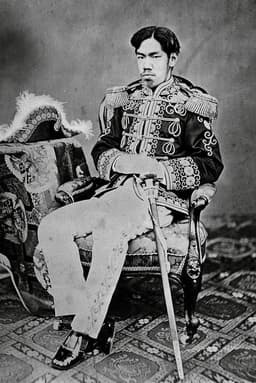
Emperor Meiji
Emperor · Modern
69.2Total

Leopold II of Austria
Emperor · Modern
55.5Total
Basic Information
Born
1852
1747
Died
1912
1792
Era
Modern
Modern
Nationality
Japan
Austria
Occupation
Emperor
Emperor
Civilization
Eastern
Western
Score Comparison
Military (10%)
25.0
50.0
Political (20%)
82.0
72.0
Influence (20%)
75.0
55.7
Legacy (20%)
68.0
46.7
Leadership (15%)
80.0
68.0
Strategy (15%)
66.3
38.6
TOTAL
69.2
55.5
Emperor Meiji — Complete Timeline
1868 AD
Meiji RestorationPolitical Action
Emperor Meiji was restored to political power after the fall of the Tokugawa shogunate. The new government, led by young samurai, abolished the feudal system and began modernizing Japan along Western lines, marking the start of the Meiji era.
RestorationModernizationPolitical Change
Impact: globalconstructive
Charter OathPolitical Action◆ Major
Emperor Meiji issued the Charter Oath, a five-article document outlining the principles of the new government. It promised deliberative assemblies, public participation, abolition of outdated customs, and the pursuit of knowledge worldwide.
ReformGovernment PolicyModernization
Impact: nationalprogressive
1871 AD
Abolition of the Han SystemReform◆ Major
The Meiji government abolished the feudal domains (han) and replaced them with prefectures under central control. This reform eliminated the power of the daimyo and created a unified, centralized state.
Administrative ReformCentralizationFeudalism
Impact: nationalconstructive
1889 AD
Promulgation of the Meiji ConstitutionPolitical Action
Emperor Meiji promulgated the Constitution of the Empire of Japan, establishing a constitutional monarchy with a bicameral parliament (Diet). The constitution granted the emperor supreme authority while creating a modern legal framework.
ConstitutionGovernmentLaw
Impact: nationalconstructive
1895 AD
Sino-Japanese War VictoryWar◆ Major
Japan defeated Qing China in the First Sino-Japanese War, gaining Taiwan, the Pescadores, and influence over Korea. The victory demonstrated Japan's military modernization and established it as a major Asian power.
WarVictoryImperial Expansion
Impact: regional
1902 AD
Anglo-Japanese AlliancePolitical Action◆ Major
Japan signed a military alliance with the United Kingdom, its first equal treaty with a Western power. The alliance recognized Japan's interests in Korea and provided diplomatic support, enhancing Japan's international standing.
DiplomacyAllianceInternational Relations
Impact: globalconstructive
1905 AD
Russo-Japanese War VictoryWar
Japan defeated Russia in the Russo-Japanese War, gaining control of Port Arthur, the Liaodong Peninsula, and southern Sakhalin. The victory shocked the world and marked the first time an Asian power defeated a European empire in modern warfare.
WarVictoryImperial Expansion
Impact: global
Leopold II of Austria — Complete Timeline
1790 AD
Suppression of the Belgian RevoltWar◆ Major
Leopold II sent Austrian troops to suppress the United Belgian States, which had declared independence from Habsburg rule in 1789. The revolt was crushed by December 1790, re-establishing Austrian control over the Southern Netherlands.
BelgiumRevoltHabsburg
Impact: regionaldestructive
Reversal of Joseph II's ReformsReform◆ Major
Upon becoming emperor, Leopold II reversed many of his brother Joseph II's radical reforms to pacify the nobility and clergy. He restored the privileges of the Estates and repealed the Edict of Toleration in some areas, stabilizing the Habsburg monarchy after years of unrest.
Counter-ReformStabilizationNobility
Impact: regional
1791 AD
Declaration of PillnitzPolitical Action◆ Major
Leopold II and King Frederick William II of Prussia issued the Declaration of Pillnitz, stating that the situation of the French royal family was a matter of common interest to all European sovereigns. This declaration was interpreted as a threat of intervention against the French Revolution.
French RevolutionMonarchyIntervention
Impact: global
Treaty of SistovaPolitical Action
Leopold II ended the Austro-Turkish War with the Treaty of Sistova, which restored the pre-war status quo. Austria gained only the small town of Or
Ottoman EmpirePeace TreatyStatus Quo
Impact: regional
This comparison has not been analyzed yet.
One-time AI generation (~1 minute). Scores and timeline are already available below.
Rankings
🥇
Emperor MeijiLeader
Mil: 25.0Pol: 82.0Inf: 75.0
69.2
🥈
Leopold II of Austria
Mil: 50.0Pol: 72.0Inf: 55.7
55.5
+13.7 behind
How This Comparison Works
Algorithm
Each figure is scored on 6 dimensions (0—100 scale) based on structured historical data: Military (10%), Political (20%), Influence (20%), Legacy (20%), Leadership (15%), Strategy (15%). The weighted total produces the final ranking.
Data Sources
Scores are computed from structured sub-indicators in the database. Scale factors adjust for era (Ancient ×0.85, Modern ×1.0) and civilization size (Eastern ×1.05, Other ×0.80) to account for differences in population and military scale.
Maximum 3 Figures
Comparisons are limited to 2—3 figures to ensure readability and statistical meaningfulness.
Error Margins
±5 points per dimension — Sub-scores are derived from historical records with inherent uncertainty. Two figures within 5 points on a dimension should be considered roughly equivalent in that area.
Total Score Accuracy
±3 points overall — The weighted combination of 6 dimensions produces a total score with approximately ±3 points of uncertainty. Differences of less than 3 points are not statistically significant— the figures are effectively tied.
Known Limitations
- Historical records are incomplete and uneven across civilizations
- Figures from oral-tradition societies may be underrepresented
- Occupation labels can misclassify multi-role figures
- Scores measure capability and impact, not moral character
- Quantitative scoring is a comparison tool, not absolute truth
Capability Radar
Military (10%) — Battles & Warfare
Battles
20
20
Win Rate
30
25
Expansion
75
15
Political (20%) — Governance & Reform
Reform
95
55
Diplomacy
85
70
Economy
90
50
Influence (20%) — Cultural & Global Reach
Cultural
85
40
Global
85
35
Legacy (20%) — Historical Impact
Historical
90
50
Longevity
80
40
Leadership (15%) — Power & Stability
Tenure
85
60
Stability
70
45
Strategy (15%) — Tactics & Innovation
Strategy
70
25
Tactics
25
20
Reform
95
30
Similar Comparisons
Comments & Discussion
No comments yet. Be the first to share your thoughts!