Loading...
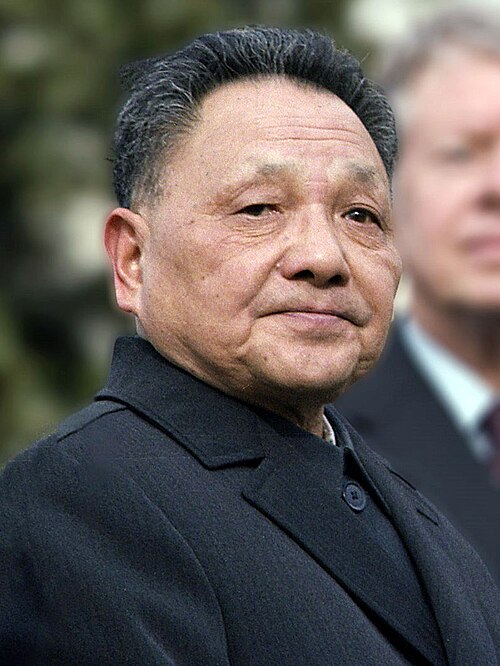
Deng Xiaoping
ModernPoliticianChina1904 — 1997
Paramount leader who initiated China's economic reforms.
Compare Deng Xiaoping with another historical figure:
Quick Facts
Born
1904
Died
1997
Country
China
Era
Modern
Occupation
Politician
Score Overview
Military (10%)30
Political (20%)90
Influence (20%)68
Legacy (20%)65
Leadership (15%)78
Strategy (15%)45
Total Score66.0
Deng Xiaoping — Complete Timeline
1978 AD
Third Plenum of the 11th Central CommitteePolitical Action
Deng Xiaoping consolidated power and announced the policy of Reform and Opening-Up. This meeting marked the end of Maoist class struggle as the national priority and shifted focus to economic modernization, initiating market-oriented reforms.
Economic ReformOpening-UpChina Modernization
Impact: globalconstructive
1980 AD
Establishment of Special Economic ZonesReform◆ Major
Deng Xiaoping approved the creation of Special Economic Zones in Shenzhen, Zhuhai, Shantou, and Xiamen. These zones offered tax incentives and market freedoms to attract foreign investment and technology, serving as experimental laboratories for capitalist practices within a socialist framework.
Economic ZonesForeign InvestmentMarket Reforms
Impact: nationalconstructive
1984 AD
Sino-British Joint Declaration on Hong KongPolitical Action◆ Major
Deng Xiaoping negotiated with British Prime Minister Margaret Thatcher to agree on the return of Hong Kong to Chinese sovereignty in 1997. The declaration established the 'One Country, Two Systems' principle, allowing Hong Kong to maintain its capitalist system for 50 years.
Hong KongDiplomacyOne Country Two Systems
Impact: globalconstructive
1989 AD
Tiananmen Square Protests CrackdownPolitical Action
Deng Xiaoping authorized the military to suppress pro-democracy protests in Tiananmen Square. The crackdown resulted in hundreds of civilian deaths and injuries, leading to international condemnation and a tightening of political control while economic reforms continued.
TiananmenSuppressionHuman Rights
Impact: globaldestructive
1992 AD
Southern Tour (Nanxun)Political Action◆ Major
Deng Xiaoping traveled to southern China to reaffirm the course of economic reform after conservative backlash. His speeches in Shenzhen and other cities revitalized market-oriented policies, accelerating foreign investment and pushing China toward a socialist market economy.
Economic ReformNanxunMarket Economy
Impact: nationalconstructive
Detailed Scores
▶View all detailed scores
Military
Strategy
4
Tactics
4
Battles
4
Army Scale
4
War Impact
4
Political
Governance
8
Reform
8
Stability
8
Policy
8
Power
8
Influence
History
8
Global
8
Culture
8
Ideology
9
Legacy
8
People often compare with
See how Deng Xiaoping stacks up against other historical figures
Popular Comparisons
Deng Xiaoping vs Mao Zedong
vs Mao Zedong79
Deng Xiaoping vs Abraham Lincoln
vs Abraham Lincoln78
Deng Xiaoping vs George Washington
vs George Washington77
Deng Xiaoping vs Winston Churchill
vs Winston Churchill72
Deng Xiaoping vs Franklin D. Roosevelt
vs Franklin D. Roosevelt71
Deng Xiaoping vs Joseph Stalin
vs Joseph Stalin69