Loading...
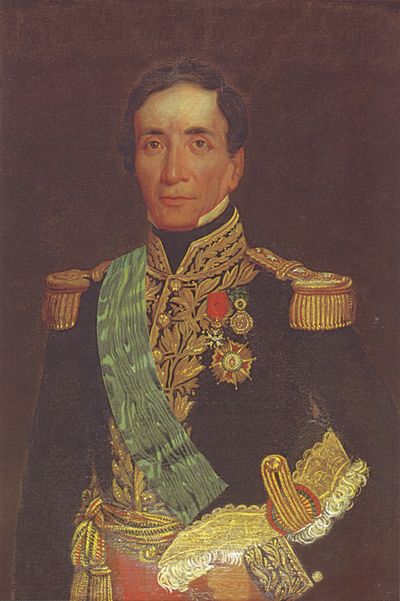
Andres de Santa Cruz
ModernGeneralBolivia1792 — 1865
President of Bolivia and Peru who created the Peru-Bolivia Confederation.
Compare Andres de Santa Cruz with another historical figure:
Quick Facts
Born
1792
Died
1865
Country
Bolivia
Era
Modern
Occupation
General
Score Overview
Military (10%)68
Political (20%)59
Influence (20%)62
Legacy (20%)50
Leadership (15%)68
Strategy (15%)66
Total Score60.5
Andres de Santa Cruz — Complete Timeline
1823 AD
Battle of ZepitaWar
Santa Cruz commanded Peruvian forces in a victory over Spanish royalists at Zepita during the Peruvian War of Independence. This battle enhanced his military reputation and contributed to the eventual liberation of Peru from Spanish rule.
Peruvian War of IndependenceBattleLiberation
Impact: regional
1826 AD
Presidency of PeruPolitical Action
Santa Cruz served as President of the Council of Government of Peru from 1826 to 1827, effectively ruling the country. His administration focused on centralizing power and organizing the state, but he was overthrown by a rebellion led by Agust
PresidencyPeruCentralization
Impact: national
1829 AD
Presidency of BoliviaPolitical Action◆ Major
Santa Cruz became President of Bolivia in 1829, serving until 1839. He implemented administrative reforms, stabilized the economy, and modernized the military, establishing Bolivia as a more coherent state after the chaos following independence.
PresidencyBoliviaReforms
Impact: nationalconstructive
1836 AD
War of the ConfederationWar◆ Major
Chile and Argentina declared war on the Peru-Bolivia Confederation, viewing it as a threat to the balance of power. Santa Cruz led the confederation's forces in a conflict that lasted until 1839, ultimately resulting in the confederation's defeat.
WarChileArgentinaConfederation
Impact: regional
Creation of the Peru-Bolivia ConfederationPolitical Action
Santa Cruz established the Peru-Bolivia Confederation, uniting Bolivia and Peru into a single state with himself as Supreme Protector. This confederation aimed to create a powerful Andean nation and challenged the regional influence of Chile and Argentina.
ConfederationUnificationAndean Power
Impact: regional
1839 AD
Battle of YungayWar
Santa Cruz's confederation forces were decisively defeated by the Chilean army at the Battle of Yungay. This defeat led to the dissolution of the Peru-Bolivia Confederation and forced Santa Cruz into exile, ending his political project.
BattleDefeatEnd of Confederation
Impact: regionaltragic
Exile and DeathPolitical Action
After the defeat at Yungay, Santa Cruz fled to Ecuador and later to France. He spent the rest of his life in exile, making unsuccessful attempts to return to power. He died in France in 1865, never regaining his former influence.
ExileDeathFailure
Impact: nationaltragic
Detailed Scores
▶View all detailed scores
Military
Strategy
7
Tactics
7
Battles
7
Army Scale
7
War Impact
8
Political
Governance
8
Reform
8
Stability
8
Policy
8
Power
8
Influence
History
9
Global
9
Culture
9
Ideology
10
Legacy
9
People often compare with
See how Andres de Santa Cruz stacks up against other historical figures
Popular Comparisons
Andres de Santa Cruz vs Napoleon Bonaparte
vs Napoleon Bonaparte71
Andres de Santa Cruz vs Samori Toure
vs Samori Toure71
Andres de Santa Cruz vs Hyder Ali
vs Hyder Ali69
Andres de Santa Cruz vs Yitzhak Rabin
vs Yitzhak Rabin66
Andres de Santa Cruz vs Shi Lang
vs Shi Lang66
Andres de Santa Cruz vs Tadeusz Kosciuszko
vs Tadeusz Kosciuszko64