Loading...
Yuwen Yong vs Zhao Kuangyin
Zhao Kuangyin leads by 4.3 pts · 2 figures compared
…
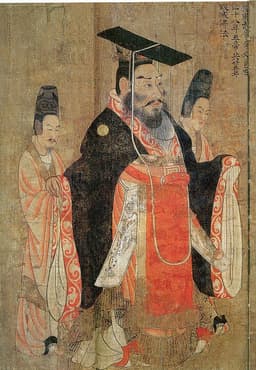
Yuwen Yong
Emperor · Medieval
67.2Total
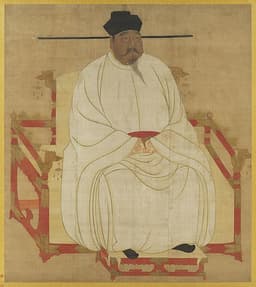
Zhao Kuangyin
Emperor · Medieval
71.5Total
Basic Information
Born
543
927
Died
578
976
Era
Medieval
Medieval
Nationality
China
China
Occupation
Emperor
Emperor
Civilization
Eastern
Eastern
Score Comparison
Military (10%)
78.0
78.0
Political (20%)
78.0
84.0
Influence (20%)
58.0
68.0
Legacy (20%)
54.0
65.0
Leadership (15%)
85.0
74.0
Strategy (15%)
69.1
68.0
TOTAL
67.2
71.5
Yuwen Yong — Complete Timeline
574 AD
Suppression of Buddhism in Northern ZhouReform◆ Major
Emperor Wu of Northern Zhou (Yuwen Yong) ordered the suppression of Buddhism, confiscating monastic lands, forcing monks and nuns to return to lay life, and destroying temples. He aimed to increase state revenue and military manpower, strengthening the state.
Northern ZhouBuddhist PersecutionReform
Impact: nationaldestructive
577 AD
Conquest of Northern QiWar
Emperor Wu led a successful campaign against the rival Northern Qi dynasty, conquering its territory and unifying northern China under Northern Zhou. This victory ended the division of the north and set the stage for the Sui dynasty's unification of all China.
Northern ZhouUnificationNorthern Qi
Impact: regionalconstructive
578 AD
Death during campaign against the TurksWar◆ Major
Emperor Wu died of illness while leading a campaign against the G
Northern ZhouMilitary CampaignDeath
Impact: regionaltragic
Zhao Kuangyin — Complete Timeline
960 AD
Founded Song dynastyPolitical Action
Zhao Kuangyin, a general of Later Zhou, was proclaimed emperor by his troops at Chenqiao. He established the Song dynasty, ending the Five Dynasties period and beginning a new era of Chinese history.
Song dynastyFoundingChenqiao
Impact: globalconstructive
961 AD
Removed military power from generalsPolitical Action◆ Major
Zhao Kuangyin invited senior generals to a banquet and persuaded them to retire peacefully. This 'removal of military power over wine' prevented military coups and centralized control.
Song dynastyMilitary reformCentralization
Impact: nationalconstructive
963 AD
Unified southern ChinaWar◆ Major
Zhao Kuangyin launched campaigns to conquer the southern kingdoms, including Jingnan, Later Shu, and Southern Tang. By his death, most of China was reunified under Song rule.
Song unificationConquestSouthern kingdoms
Impact: national
Expert Analysis
Yuwen Yong vs Zhao Kuangyin
# The Emperor Who Chose Peace and the Emperor Who Died for War
On a spring evening in 961, Zhao Kuangyin sat drinking with his most powerful generals in the Kaifeng palace. As cups were refilled and laughter echoed through the hall, the Song founder suddenly wept. His generals, startled, asked what troubled their emperor. Zhao Kuangyin confessed that he could not sleep at night, haunted by the fear that one day his own troops might drape a yellow robe over another man's shoulders—just as they had done for him. Within months, those same generals had retired to comfortable estates, their armies disbanded, their swords hung on walls. Half a world away in spirit, yet only fourteen years earlier, another emperor had taken a different path. Yuwen Yong of Northern Zhou had ridden at the head of his cavalry, smashing through enemy lines, personally leading charges against the Northern Qi. He died in the saddle at age thirty-five, still reaching for a sword.
Origins
Zhao Kuangyin was born in 927 into a military family serving the Later Zhou dynasty, one of the short-lived kingdoms that had splintered from the fallen Tang Empire. He grew up in a world of warlords and shifting alliances, where loyalty lasted only as long as the next betrayal. His father had struggled to keep the family afloat, and young Zhao learned early that power was a fragile thing—easily won, easily lost.
Yuwen Yong, born in 543, came from the Xianbei warrior aristocracy that had dominated northern China after the collapse of the Western Jin. His family had been rulers, then captives, then rulers again. He was raised in a court where poison and dagger decided succession. His elder brother, Emperor Ming, was murdered by a regent. Yuwen Yong himself spent his early years pretending to be simple-minded, biding his time while his cousin Yuwen Hu held the real power. For twelve years, he played the fool, smiling as his cousin humiliated him, waiting for the moment to strike.
Rise to Power
Zhao Kuangyin's ascent was almost accidental. In 960, while leading an army to resist a supposed invasion from the north, his soldiers stopped at Chenqiao驿站. That night, they burst into his tent and draped a yellow imperial robe over his shoulders. Whether he truly resisted or merely performed reluctance, Zhao Kuangyin accepted the mandate. He marched back to Kaifeng, and the child emperor of Later Zhou abdicated without a fight.
Yuwen Yong's rise was far bloodier. In 572, after years of patient deception, he finally acted. He lured his cousin Yuwen Hu into the imperial palace for what was supposed to be a visit to the Empress Dowager. As Yuwen Hu bowed, Yuwen Yong struck him from behind with a jade scepter. When the blow only wounded, a servant finished the job with a sword. That night, Yuwen Yong assumed personal rule. He was twenty-nine years old, and he had learned that power was something you took, not something given.
Leadership & Governance
The two emperors governed in radically different ways. Zhao Kuangyin's philosophy was one of gentle persuasion. He famously told his generals over that wine-soaked evening that life was short, that wealth and pleasure were better than ambition and war. He bought their swords with silk and land, and he transformed the Song military into a bureaucracy controlled by civilian officials. He also reformed the examination system, opening government service to talented commoners. His goal was stability, and he achieved it—the Song dynasty would last over three centuries.
Yuwen Yong governed with iron discipline. He saw Buddhism as a drain on state resources—monasteries held tax-exempt land, and monks did not serve in armies. In 574, he ordered the suppression of Buddhism, confiscating monastic property and forcing hundreds of thousands of monks and nuns back into secular life. Temples were destroyed, scriptures burned. He did this not out of religious hatred but out of cold calculation: a state needed soldiers and taxpayers, not monks. His reforms strengthened Northern Zhou's economy and military, allowing him to conquer the rival Northern Qi in 577, unifying northern China for the first time in decades.
Triumph & Tragedy
Zhao Kuangyin's greatest triumph was the unification of southern China. Between 963 and 976, he absorbed kingdom after kingdom—Jingnan, Later Shu, Southern Tang—often through a combination of military pressure and diplomatic persuasion. He rarely destroyed his enemies; he incorporated them. The Southern Tang ruler Li Yu, a poet and aesthete, was allowed to live out his days in comfortable captivity. Zhao Kuangyin understood that conquest without reconciliation was merely destruction.
Yuwen Yong's triumph was the conquest of Northern Qi in 577, a campaign he personally led with brilliant strategy. He used feints and rapid marches, his army covering ground that left enemies bewildered. The Northern Qi capital fell, and Yuwen Yong unified the north. But his tragedy came immediately after. In 578, while leading a campaign against the Göktürks, he fell ill and died. He was thirty-five. His son was a child, and within three years, a usurper named Yang Jian had seized the throne, founding the Sui dynasty. Everything Yuwen Yong had built was inherited by another man.
Character & Destiny
Zhao Kuangyin was cautious, generous, and deeply pragmatic. He once said, "I would rather lose a thousand pieces of gold than lose the heart of one general." His personality shaped a dynasty that valued culture over combat, poetry over military glory. He died at age forty-nine, possibly poisoned by his own brother, but his system outlived him.
Yuwen Yong was ambitious, ruthless, and direct. He once told his ministers, "I do not seek to be a sage king. I seek to be a conqueror." His death on campaign was the tragic fulfillment of that ambition—he lived by the sword and died by the sword, or rather, by the fever that came from living in the saddle too long.
Legacy
Zhao Kuangyin is remembered as the founder of the Song dynasty, a golden age of Chinese culture, commerce, and innovation. His decision to weaken the military created a stable but vulnerable empire—the Song would eventually fall to invaders from the north, unable to mount effective resistance. His legacy is one of peace bought at the price of strength.
Yuwen Yong is remembered as a brilliant conqueror whose dynasty vanished almost as soon as it was born. His suppression of Buddhism earned him condemnation from later historians, but his unification of the north paved the way for the Sui and Tang dynasties that followed. He built the foundation; others built the house.
Conclusion
One emperor chose peace and built a dynasty that lasted three centuries. The other chose war and built an empire that vanished within three years. Yet neither choice was entirely right. Zhao Kuangyin's Song would be remembered for its art and commerce, but also for its military weakness. Yuwen Yong's Northern Zhou would be forgotten as a dynasty, but its unification made possible the golden age of Tang. In the end, both emperors did what their times demanded—and their times demanded very different things.
Rankings
🥇
Zhao KuangyinLeader
Mil: 78.0Pol: 84.0Inf: 68.0
71.5
🥈
Yuwen Yong
Mil: 78.0Pol: 78.0Inf: 58.0
67.2
+4.3 behind
How This Comparison Works
Algorithm
Each figure is scored on 6 dimensions (0—100 scale) based on structured historical data: Military (10%), Political (20%), Influence (20%), Legacy (20%), Leadership (15%), Strategy (15%). The weighted total produces the final ranking.
Data Sources
Scores are computed from structured sub-indicators in the database. Scale factors adjust for era (Ancient ×0.85, Modern ×1.0) and civilization size (Eastern ×1.05, Other ×0.80) to account for differences in population and military scale.
Maximum 3 Figures
Comparisons are limited to 2—3 figures to ensure readability and statistical meaningfulness.
Error Margins
±5 points per dimension — Sub-scores are derived from historical records with inherent uncertainty. Two figures within 5 points on a dimension should be considered roughly equivalent in that area.
Total Score Accuracy
±3 points overall — The weighted combination of 6 dimensions produces a total score with approximately ±3 points of uncertainty. Differences of less than 3 points are not statistically significant— the figures are effectively tied.
Known Limitations
- Historical records are incomplete and uneven across civilizations
- Figures from oral-tradition societies may be underrepresented
- Occupation labels can misclassify multi-role figures
- Scores measure capability and impact, not moral character
- Quantitative scoring is a comparison tool, not absolute truth
Capability Radar
Military (10%) — Battles & Warfare
Battles
75
75
Win Rate
80
85
Expansion
80
75
Political (20%) — Governance & Reform
Reform
85
90
Diplomacy
70
85
Economy
75
80
Influence (20%) — Cultural & Global Reach
Cultural
40
70
Global
40
60
Legacy (20%) — Historical Impact
Historical
65
80
Longevity
50
75
Leadership (15%) — Power & Stability
Tenure
60
65
Stability
70
85
Strategy (15%) — Tactics & Innovation
Strategy
75
80
Tactics
70
70
Reform
85
90
Similar Comparisons
Comments & Discussion
Swordless Architect6/16/2026
Zhao Kuangyin’s "cup of peace" was a masterstroke of soft power, but it came at a cost—his dynasty would spend centuries paying tribute to nomadic empires. By disarming his generals over wine, he traded military might for internal stability, leaving the Song perpetually vulnerable. Meanwhile, Yuwen Yong’s personal bravery on the battlefield unified the north through sheer force. One man built a house of cards; the other forged an empire of iron. History doesn’t forgive the timid.
铁血真言6/16/2026
说赵匡胤是“和平皇帝”?别逗了,他杯酒释兵权根本是懦夫之举!北周宇文邕三十五岁战死沙场,那才是真皇帝——亲率骑兵冲锋,灭北齐,定北方。赵匡胤呢?用金银换将军退休,结果呢?北宋两百年被辽、金、西夏按着打。要我说,和平是用铁骑打出来的,不是用酒杯换来的。宇文邕死了,但他的威慑力让敌人颤抖;赵匡胤活着,却让子孙跪着求饶。
Chronos Watchman6/16/2026
The real tragedy here isn’t their deaths—it’s the divergent legacies. Yuwen Yong died at 35, but his Northern Zhou conquest of Northern Qi in 577 set the stage for Sui unification. Zhao Kuangyin lived to 49, yet his appeasement strategy cursed the Song with perpetual border crises. The Tang empire fell because generals grew too powerful; Zhao overcorrected, while Yuwen balanced personal valor with institutional reform. One was a catalyst, the other a cautionary tale.
雨夜散人6/16/2026
数据不会骗人:宇文邕在位十二年,灭北齐、收突厥,疆域翻倍;赵匡胤在位十六年,连燕云十六州都没拿回来!所谓“杯酒释兵权”不过是自我麻醉——他怕兵变,却怕出了个积贫积弱的宋朝。看看后世:契丹称帝,女真南侵,蒙古灭国,哪个不是从赵匡胤的“和平幻想”开始?宇文邕虽死,但他死得壮烈;赵匡胤活了,却活成了笑话。
Endgames Analyst6/16/2026
It’s not about who died gloriously or who lived cautiously—it’s about timing. Yuwen Yong’s death in 578 cut short a campaign against the Turks that could have reshaped Eurasia. Zhao Kuangyin’s peace bought Song a century of economic flowering, but at the cost of military readiness. The universe doesn’t reward bravery or caution; it rewards outcomes. Yuwen’s empire fragmented; Zhao’s endured for three centuries. That’s the only death-count that matters.