Loading...
Yoweri Museveni vs Yuan Shikai
Yoweri Museveni leads by 3.9 pts · 2 figures compared
…
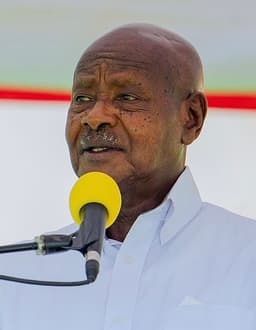
Yoweri Museveni
Politician · Modern
63.9Total
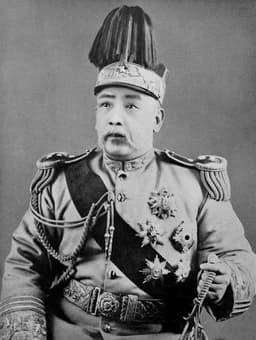
Yuan Shikai
Politician · Modern
60.0Total
Basic Information
Born
1944
1859
Died
—
1916
Era
Modern
Modern
Nationality
Uganda
China
Occupation
Politician
Politician
Civilization
Other
Eastern
Score Comparison
Military (10%)
67.5
45.0
Political (20%)
72.0
72.0
Influence (20%)
61.0
57.2
Legacy (20%)
50.0
54.0
Leadership (15%)
80.0
72.0
Strategy (15%)
66.3
61.2
TOTAL
63.9
60.0
Yoweri Museveni — Complete Timeline
1986 AD
Bush War Victory and Capture of KampalaWar
Museveni's National Resistance Army (NRA) captured Kampala, ending the Ugandan Bush War. He was sworn in as President on January 29, 1986, overthrowing the government of Tito Okello and beginning his long rule.
Ugandan Bush WarSeizure of PowerNRA
Impact: national
Introduction of the Movement SystemPolitical Action◆ Major
Museveni established a 'no-party' Movement system, banning political party activity. This system concentrated power in the National Resistance Movement (NRM) and was justified as necessary to prevent ethnic conflict, but was criticized as authoritarian.
Political SystemNRMAuthoritarianism
Impact: national
1998 AD
Invasion of the Democratic Republic of CongoWar◆ Major
Ugandan forces, allied with Rwanda, invaded the Democratic Republic of Congo (DRC) to overthrow Laurent Kabila. This intervention escalated the Second Congo War, drawing in multiple African nations and causing widespread devastation.
Second Congo WarRegional ConflictIntervention
Impact: regionaldestructive
2005 AD
Constitutional Amendment Removing Term LimitsPolitical Action◆ Major
Museveni's government pushed through a constitutional amendment removing presidential term limits. This allowed him to run for a third term in 2006 and subsequent elections, consolidating his hold on power and drawing domestic and international criticism.
Constitutional ChangeTerm LimitsPower Consolidation
Impact: nationaldestructive
2014 AD
Anti-Homosexuality ActPolitical Action◆ Major
Museveni signed the Anti-Homosexuality Act, which imposed life imprisonment for certain same-sex acts. The law was widely condemned internationally, leading to aid cuts from some Western nations, though it was later annulled by the Constitutional Court on procedural grounds.
LGBTQ RightsLegislationInternational Condemnation
Impact: nationaldestructive
Yuan Shikai — Complete Timeline
1901 AD
Command of the Beiyang ArmyReform◆ Major
Yuan Shikai took command of the Beiyang Army, the most modern military force in late Qing China. He expanded and trained the army, which became the basis for his political power and later dominated Chinese politics.
Military reformBeiyang Army
Impact: national
1912 AD
Appointed First President of the Republic of ChinaPolitical Action
Yuan Shikai became the first president of the Republic of China after negotiating the abdication of the Qing emperor. He used his control of the Beiyang Army to pressure the revolutionary government into accepting his leadership.
PresidencyRepublic of China
Impact: national
1915 AD
Declaration of the Empire of ChinaPolitical Action◆ Major
Yuan Shikai declared himself emperor of the Empire of China, attempting to restore the monarchy. This move sparked widespread opposition from provincial leaders and foreign powers, leading to the collapse of his regime.
Monarchy restorationPolitical crisis
Impact: nationaldestructive
Signing of the Twenty-One DemandsPolitical Action◆ Major
Yuan Shikai accepted most of Japan's Twenty-One Demands, which expanded Japanese influence in China. The agreement granted Japan economic rights in Manchuria and Shandong, and was seen as a national humiliation.
DiplomacyJapanese imperialism
Impact: globaltragic
1916 AD
Death and Collapse of the Beiyang GovernmentPolitical Action◆ Major
Yuan Shikai died of uremia, leaving no clear successor. His death led to the fragmentation of the Beiyang Army into warlord factions, plunging China into a period of civil war and political instability.
Warlord eraPolitical fragmentation
Impact: nationaltragic
Expert Analysis
Yuan Shikai vs Yoweri Museveni
# The Emperor and the Guerrilla: Two Paths to Power in a Fractured Century
On a winter morning in 1916, Yuan Shikai lay dying in Beijing, his body ravaged by uremia and his dream of a new imperial dynasty crumbling around him. Half a world away and seventy years later, Yoweri Museveni marched into Kampala at the head of a ragtag guerrilla army, his eyes set not on a throne but on a presidency he would hold for decades. Both men seized power in moments of national crisis. Both commanded armies, shaped governments, and left behind legacies tangled in ambition and blood. Yet one ended in disgrace and fragmentation, the other in an iron grip that has yet to fully loosen. What separates a would-be emperor from a guerrilla president? The answer lies not in their scores—nearly identical on paper—but in the worlds that made them.
Origins
Yuan Shikai was born in 1859 into a landed gentry family in Henan Province, a world still ruled by the Qing dynasty but shuddering under the weight of Western cannon fire. The Opium Wars had already exposed China’s weakness, and the Taiping Rebellion had nearly torn the empire apart. Yuan grew up in the shadow of collapse, learning that survival required cunning, not Confucian virtue. He failed the civil service examinations—the traditional path to power—and instead bought a minor military post. His was a world of patronage, corruption, and the raw calculus of force.
Museveni entered the world in 1944 in Ntungamo, a village in southwestern Uganda under British colonial rule. His father was a cattle herder, his mother a farmer. Unlike Yuan, Museveni’s path was shaped by the anti-colonial fervor sweeping Africa. He studied political science at the University of Dar es Salaam in Tanzania, where he absorbed Marxist theory and the writings of Frantz Fanon. Where Yuan learned to navigate a dying empire, Museveni learned to build a new one—from the bush, if necessary.
Rise to Power
Yuan’s ascent was a masterclass in opportunism. In 1901, he took command of the Beiyang Army, the most modern force in late Qing China. He drilled it into a personal instrument, filling its ranks with loyal officers and Western-style training. When the Qing dynasty tottered after the 1911 Revolution, Yuan did not fight for the emperor—he negotiated. He extracted the abdication of the child emperor Puyi in exchange for the presidency of the new Republic. It was a bloodless coup, a transaction of power.
Museveni’s rise was anything but bloodless. In 1981, after a disputed election, he took to the bush with twenty-seven men to launch the Ugandan Bush War. For five years, his National Resistance Army (NRA) fought a grinding guerrilla campaign against the brutal regimes of Milton Obote and Tito Okello. Museveni built his army not on professional drill but on political education—every soldier was a teacher, every village a classroom. When the NRA captured Kampala in January 1986, Museveni did not declare himself emperor. He stood in the parliament building and promised a “fundamental change” in Ugandan politics.
Leadership & Governance
As president, Yuan Shikai governed like a warlord in a suit. He suppressed the nascent parliament, sidelined revolutionaries like Sun Yat-sen, and ruled by decree. His political score of 74.2 reflects his skill at maneuvering, but his vision was backward-looking. In 1915, he accepted most of Japan’s Twenty-One Demands, a humiliating treaty that expanded Japanese control over Manchuria and Shandong. It was a pragmatic move—he needed Japanese support—but it poisoned his legitimacy. That same year, he declared himself emperor of the “Empire of China,” a move that sparked nationwide revolt. His military score of 60.7 is modest, but his leadership score of 81.3 suggests real charisma—yet it was charisma without a cause larger than himself.
Museveni’s governance was more sophisticated. He introduced the “Movement System,” a no-party state that banned political parties and concentrated power in his hands. It was authoritarian, but it brought stability to a country torn apart by Idi Amin and Obote. He courted Western aid, opened Uganda’s economy, and fought HIV/AIDS with remarkable success. His military score of 61.8 is nearly identical to Yuan’s, but his strategy score of 58.8 is lower—a reflection of disastrous foreign adventures, like the 1998 invasion of the Democratic Republic of Congo, which dragged Uganda into a regional war. Yet Museveni survived where Yuan did not, because he understood the modern art of staying in power: change the rules.
Triumph & Tragedy
Yuan’s greatest moment was also his undoing. The declaration of the Empire of China in 1915 was meant to restore order, but it ignited a firestorm. Provinces declared independence, and his own Beiyang generals turned against him. He was forced to cancel the monarchy in March 1916, a humiliating retreat. He died three months later, leaving a power vacuum that splintered China into warlord fiefdoms. His legacy is a cautionary tale: the man who could have united China instead tore it apart.
Museveni’s triumph was the capture of Kampala in 1986, a victory that ended years of civil war. But his tragedy is the slow erosion of the ideals he once championed. In 2005, he pushed through a constitutional amendment removing term limits, allowing him to rule indefinitely. In 2014, he signed the Anti-Homosexuality Act, a law that drew global condemnation. The guerrilla who promised change became the autocrat who blocked it.
Character & Destiny
Yuan Shikai was a creature of the late Qing—cunning, pragmatic, and utterly cynical. He believed that power was a thing to be held, not shared. His personality was shaped by a world where loyalty was bought and betrayal was routine. He could not imagine a republic because he had never seen one work.
Museveni was a creature of the Cold War—ideological, patient, and ruthless. He believed that power was a thing to be built, not inherited. His personality was shaped by the struggle against colonialism and the chaos that followed. He could imagine a democracy, but he chose not to build one.
Legacy
Yuan Shikai is remembered as a traitor and a failure—the man who sold out China to Japan and tried to restore a dead dynasty. His total score of 70.6 is generous; in Chinese history, he is a villain.
Museveni’s legacy is more ambiguous. His influence score of 73.0 reflects his long reign, but his legacy score of 66.8 is stained by corruption, repression, and the betrayal of his early promise. In Uganda, he is both father and jailer.
Conclusion
Two men, two centuries, two paths to power. Yuan Shikai reached for a crown and lost everything. Yoweri Museveni reached for a presidency and never let go. Their scores are nearly identical, but their stories are not. Yuan’s tragedy was that he lived in a world that had already moved on. Museveni’s tragedy is that he lived in a world that had not yet moved far enough. In the end, both remind us that power is not a score—it is a story, and the storyteller always has the last word.
Rankings
🥇
Yoweri MuseveniLeader
Mil: 67.5Pol: 72.0Inf: 61.0
63.9
🥈
Yuan Shikai
Mil: 45.0Pol: 72.0Inf: 57.2
60.0
+3.9 behind
How This Comparison Works
Algorithm
Each figure is scored on 6 dimensions (0—100 scale) based on structured historical data: Military (10%), Political (20%), Influence (20%), Legacy (20%), Leadership (15%), Strategy (15%). The weighted total produces the final ranking.
Data Sources
Scores are computed from structured sub-indicators in the database. Scale factors adjust for era (Ancient ×0.85, Modern ×1.0) and civilization size (Eastern ×1.05, Other ×0.80) to account for differences in population and military scale.
Maximum 3 Figures
Comparisons are limited to 2—3 figures to ensure readability and statistical meaningfulness.
Error Margins
±5 points per dimension — Sub-scores are derived from historical records with inherent uncertainty. Two figures within 5 points on a dimension should be considered roughly equivalent in that area.
Total Score Accuracy
±3 points overall — The weighted combination of 6 dimensions produces a total score with approximately ±3 points of uncertainty. Differences of less than 3 points are not statistically significant— the figures are effectively tied.
Known Limitations
- Historical records are incomplete and uneven across civilizations
- Figures from oral-tradition societies may be underrepresented
- Occupation labels can misclassify multi-role figures
- Scores measure capability and impact, not moral character
- Quantitative scoring is a comparison tool, not absolute truth
Capability Radar
Military (10%) — Battles & Warfare
Battles
65
45
Win Rate
70
55
Expansion
55
50
Political (20%) — Governance & Reform
Reform
60
55
Diplomacy
70
70
Economy
55
50
Influence (20%) — Cultural & Global Reach
Cultural
45
40
Global
50
35
Legacy (20%) — Historical Impact
Historical
55
65
Longevity
50
40
Leadership (15%) — Power & Stability
Tenure
85
60
Stability
50
30
Strategy (15%) — Tactics & Innovation
Strategy
80
65
Tactics
75
60
Reform
60
80
Similar Comparisons
Comments & Discussion
YUAN_THESKEPSIS6/16/2026
The data comparison is misleading. Yuan Shikai’s China had a GDP per capita around $600 (1990 dollars) and a population over 400 million, while Museveni’s Uganda started at about $200 GDP per capita with 12 million people. Different scales entirely. Yuan tried to nationalize a decaying empire; Museveni pacified a small, fractured nation. Fancy charts can’t erase that the contexts are apples and spaceships. Stop pretending a ten-year reign equals forty years of consolidation.
小丑皇帝6/16/2026
袁世凯只当了83天皇帝,就被全国唾弃;穆塞韦尼当了近40年总统,还能指望着儿子接班。差距在哪?袁世凯是旧时代的产物,妄想复辟帝制,结果活活气死。穆塞韦尼是新时代的操控者,懂得玩选举、搞军阀平衡。数据上分数相同?笑话!一个是被历史碾碎的丑角,一个是当代非洲的权术大师。
GUILLOTINE_GAZE6/16/2026
Let’s cut the academic hedging. Yuan Shikai disbanded parliament and murdered opposition lawmakers—classic authoritarian playbook. Museveni removed term limits in 2005, didn’t kill his rivals but jailed and exiled them. Both are unapologetic power consolidators. The difference: Yuan’s China had 2,000 years of imperial precedent, so his empire attempt was logical but doomed. Museveni’s Uganda had no precedent for such longevity—he had to craft his own system. Yuan failed because his model was old
赤脚将军6/16/2026
袁世凯的军队有西式训练和克虏伯大炮,结果在护国战争中一败涂地。穆塞韦尼的解放军都拿着AK-47和自制地雷,却硬是从丛林里打出了政权。关键不在于装备,而在于人心的向背。袁世凯靠的是旧军阀的银子,穆塞韦尼靠的是农村游击队的热血。历史从不给纸老虎留情。