Loading...
Wu Zetian vs Zhao Kuangyin
Zhao Kuangyin leads by 1.5 pts · 2 figures compared
…

Wu Zetian
Emperor · Medieval
70.0Total
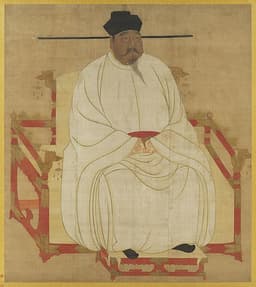
Zhao Kuangyin
Emperor · Medieval
71.5Total
Basic Information
Born
624
927
Died
705
976
Era
Medieval
Medieval
Nationality
China
China
Occupation
Emperor
Emperor
Civilization
Eastern
Eastern
Score Comparison
Military (10%)
60.0
78.0
Political (20%)
62.7
84.0
Influence (20%)
65.0
68.0
Legacy (20%)
80.0
65.0
Leadership (15%)
78.0
74.0
Strategy (15%)
66.3
68.0
TOTAL
70.0
71.5
Wu Zetian — Complete Timeline
655 AD
Became Empress ConsortPolitical Action◆ Major
Wu Zetian was elevated from concubine to empress consort of Emperor Gaozong of Tang in 655. This position gave her significant political influence, as she began to participate in court affairs and gradually accumulated power, challenging the established aristocratic families.
Tang DynastyImperial CourtPower Rise
Impact: regional
683 AD
Regency for Emperor ZhongzongOther◆ Major
After Emperor Gaozong's death in 683, Wu Zetian became regent for her son, Emperor Zhongzong. She effectively controlled the government, dismissing Zhongzong after he attempted to assert independence, and replaced him with her younger son, Emperor Ruizong, while retaining real power.
Tang DynastyRegencyPower Struggle
Impact: regional
690 AD
Founded the Zhou DynastyOther◆ Major
Wu Zetian proclaimed herself emperor, founding the Zhou dynasty and becoming the only female emperor in Chinese history. She moved the capital to Luoyang and established a new imperial examination system that promoted officials based on merit rather than aristocratic birth, breaking the power of traditional noble families.
Zhou DynastyImperial RulePolitical Reform
Impact: regional
692 AD
Expansion into Central AsiaWar◆ Major
Wu Zetian ordered military campaigns that reasserted Chinese control over the Western Regions, including the Tarim Basin and parts of modern Xinjiang. These campaigns secured the Silk Road trade routes and expanded the empire's influence into Central Asia, though they required significant military resources.
Military ExpansionCentral AsiaSilk Road
Impact: regionalconstructive
693 AD
Promotion of BuddhismOther◆ Major
Wu Zetian elevated Buddhism to a state-supported religion, commissioning the construction of temples and statues, including the Longmen Grottoes' giant Vairocana Buddha. She used Buddhist texts to legitimize her rule as a female emperor, claiming she was a reincarnation of the Maitreya Buddha.
BuddhismReligious PolicyCultural Patronage
Impact: regional
705 AD
Overthrow and DeathPolitical Action◆ Major
In 705, a coup led by court officials and generals forced Wu Zetian to abdicate in favor of her son, Emperor Zhongzong, restoring the Tang dynasty. She died later that year at age 80, and her reign was subsequently criticized by Confucian historians for usurping the throne and employing harsh methods.
Tang DynastyCoupAbdication
Impact: regionaldestructive
Zhao Kuangyin — Complete Timeline
960 AD
Founded Song dynastyPolitical Action
Zhao Kuangyin, a general of Later Zhou, was proclaimed emperor by his troops at Chenqiao. He established the Song dynasty, ending the Five Dynasties period and beginning a new era of Chinese history.
Song dynastyFoundingChenqiao
Impact: globalconstructive
961 AD
Removed military power from generalsPolitical Action◆ Major
Zhao Kuangyin invited senior generals to a banquet and persuaded them to retire peacefully. This 'removal of military power over wine' prevented military coups and centralized control.
Song dynastyMilitary reformCentralization
Impact: nationalconstructive
963 AD
Unified southern ChinaWar◆ Major
Zhao Kuangyin launched campaigns to conquer the southern kingdoms, including Jingnan, Later Shu, and Southern Tang. By his death, most of China was reunified under Song rule.
Song unificationConquestSouthern kingdoms
Impact: national
Expert Analysis
Zhao Kuangyin vs Wu Zetian
### The Dragon’s Two Faces: Wu Zetian and Zhao Kuangyin
On a spring morning in 705, the most powerful woman in Chinese history lay dying in her palace at Luoyang. Wu Zetian, the only female emperor to rule China in her own name, had been forced to abdicate just months earlier, her reign ended by a coup that restored her son to the throne. Half a continent away, in the imperial archives of Kaifeng, scholars would soon begin compiling the annals of another ruler: Zhao Kuangyin, the founder of the Song dynasty, who died peacefully in his bed in 976 after a reign marked not by bloodshed but by negotiation. These two figures, both scoring nearly identical on the historian’s composite scale—75.6 for Wu, 75.5 for Zhao—could not have been more different in their paths, their methods, and their ultimate fates. What drove one to shatter every glass ceiling of the medieval world, and the other to build a dynasty on a foundation of gentle persuasion?
### Origins
Wu Zetian was born in 624, into a world where a woman’s destiny was measured by her beauty and her obedience. Her father was a timber merchant who had risen to minor officialdom, but her family lacked the aristocratic pedigree of the great clans. At fourteen, she entered the palace of Emperor Taizong as a lowly concubine, a fifth-rank “talented one.” There, she learned the brutal calculus of court survival: charm could win favor, but only cunning could keep it. When Taizong died, she was sent to a Buddhist convent, as custom demanded—a living death for a woman past her prime. But she had already caught the eye of his son, the sickly and indecisive Gaozong. By 655, she had clawed her way back, become his empress, and begun her long ascent.
Zhao Kuangyin, born in 927, came from a military family in a time of chaos. The Tang dynasty had collapsed, and China was splintered into the Five Dynasties and Ten Kingdoms—an era when generals could become emperors overnight. Zhao was a burly, good-natured man, known for his skill with a bow and his loyalty to his commanders. He served the Later Zhou dynasty, rising through the ranks not by intrigue but by competence. His world was one of naked force, where a man’s life could be ended by a stray arrow or a whispered rumor. Yet Zhao learned a different lesson from this violence: that power built on fear was never secure.
### Rise to Power
Wu Zetian’s ascent was a masterpiece of calculated ruthlessness. After Gaozong suffered a stroke in 660, she effectively ruled through him, sidelining rivals with accusations of treason. She crushed a rebellion led by her own son, Li Xian, and when Gaozong died in 683, she placed her youngest son on the throne as a puppet. In 690, she dispensed with the fiction entirely, declaring herself emperor of a new Zhou dynasty. Her path was paved with the blood of her enemies—and, legend says, of her own infant daughter, whom she allegedly smothered to frame the empress who stood in her way.
Zhao Kuangyin’s rise was almost accidental. In 960, while leading an army against the Khitan, his troops mutinied at Chenqiao, draping a yellow robe over his shoulders and proclaiming him emperor. He accepted, but with a caveat: no harm would come to the child emperor of the Later Zhou. This was not mercy born of weakness; it was strategy. Zhao understood that the legitimacy of a new dynasty depended on its predecessor’s blood being untainted. He marched back to the capital, where the boy emperor abdicated peacefully. The Song dynasty was born without a single sword drawn in the capital.
### Leadership & Governance
Wu Zetian governed as she had risen: with an iron grip and a fierce intelligence. She expanded the empire into Central Asia, sending armies against the Tibetans and the Turks. She reformed the civil service examination system, opening it to commoners—including women, for the first time in Chinese history—thereby breaking the monopoly of the old aristocratic clans. Her court was a meritocracy of talent, staffed by officials promoted solely for their ability. But she also maintained a secret police network, the “Palace Censors,” who rooted out dissent with torture and execution. Her rule was efficient, but it was also terrifying.
Zhao Kuangyin governed through the opposite principle: disarmament. In 961, he invited his most powerful generals to a banquet, filled their cups with wine, and told them that their lives were too short to waste on ambition. In a famous exchange, he said, “If I were not emperor, I would be a commoner, and so would you.” The generals, understanding the implied threat, retired to their estates, their military commands replaced by sinecures. Zhao then divided the army into smaller units, rotated commanders, and placed civil officials in charge of military logistics. He unified the southern kingdoms through a combination of diplomacy and limited warfare, conquering Jingnan in 963 and Later Shu soon after. His strategy was to consolidate power by dismantling it—a paradox that worked.
### Triumph & Tragedy
Wu Zetian’s greatest triumph was her sheer existence: a woman who ruled China, who built her own dynasty, who died in her bed at the age of eighty-one. Her legacy includes the expansion of the empire, the promotion of Buddhism as a state religion, and the elevation of merit over birth. But her tragedy was that her reign was seen as an aberration. After her death, the Zhou dynasty was erased from official history by her successors, who restored the Tang. She was remembered as a monster—the “Empress Who Killed Her Own Child”—a cautionary tale for any woman who dared to exceed her station.
Zhao Kuangyin’s triumph was the Song dynasty itself, which lasted for over three centuries and became one of the most culturally and economically vibrant periods in Chinese history. His tragedy was subtler: by stripping the military of power, he left the Song vulnerable to invasion. His descendants would face the Khitan, the Jurchen, and finally the Mongols, who would conquer China in 1279. The very peace he built contained the seeds of its own destruction.
### Character & Destiny
Wu Zetian’s character was forged in the crucible of a world that hated her for being a woman. She was brilliant, paranoid, and ruthless—qualities that were necessary for her survival but that also made her isolated. She trusted no one, not even her own children, and her reign was a constant war against the court that despised her. Her destiny was to break the mold, but in breaking it, she shattered herself.
Zhao Kuangyin’s character was that of a conciliator. He was a man of genuine modesty, who once said, “I am not a sage, but I try to follow the path of the sages.” He believed that power could be wielded without cruelty, that loyalty could be bought with trust rather than fear. His destiny was to build a dynasty on the foundation of peace, but that peace came at the cost of strength.
### Legacy
Wu Zetian is remembered today as a feminist icon, a symbol of what a woman could achieve in a world that denied her every right. Her tomb, at the Qianling Mausoleum, stands next to Gaozong’s, a silent testament to her audacity. Zhao Kuangyin is remembered as the “Emperor of the Yellow Robe,” the founder of a golden age, but also as the man who made China weak. His portrait hangs in every Song dynasty history book, a round-faced, gentle figure, the opposite of a warrior.
### Conclusion
What separates these two rulers is not their scores, but their souls. Wu Zetian climbed a mountain of corpses to reach the throne; Zhao Kuangyin walked a path of silk. One used fear to rule, the other used trust. One was a storm, the other a calm sea. Yet both faced the same fundamental question: how do you hold power in a world that wants to take it from you? Their answers were as different as their fates, but both were true to the times that shaped them. Wu Zetian’s China was a world of treacherous courts and ambitious clans; Zhao Kuangyin’s was a world of warring kingdoms and exhausted armies. Each gave their world what it needed—and what it could bear. In the end, the historian’s numbers may be close, but the stories they tell are worlds apart.
Rankings
🥇
Zhao KuangyinLeader
Mil: 78.0Pol: 84.0Inf: 68.0
71.5
🥈
Wu Zetian
Mil: 60.0Pol: 62.7Inf: 65.0
70.0
+1.5 behind
How This Comparison Works
Algorithm
Each figure is scored on 6 dimensions (0—100 scale) based on structured historical data: Military (10%), Political (20%), Influence (20%), Legacy (20%), Leadership (15%), Strategy (15%). The weighted total produces the final ranking.
Data Sources
Scores are computed from structured sub-indicators in the database. Scale factors adjust for era (Ancient ×0.85, Modern ×1.0) and civilization size (Eastern ×1.05, Other ×0.80) to account for differences in population and military scale.
Maximum 3 Figures
Comparisons are limited to 2—3 figures to ensure readability and statistical meaningfulness.
Error Margins
±5 points per dimension — Sub-scores are derived from historical records with inherent uncertainty. Two figures within 5 points on a dimension should be considered roughly equivalent in that area.
Total Score Accuracy
±3 points overall — The weighted combination of 6 dimensions produces a total score with approximately ±3 points of uncertainty. Differences of less than 3 points are not statistically significant— the figures are effectively tied.
Known Limitations
- Historical records are incomplete and uneven across civilizations
- Figures from oral-tradition societies may be underrepresented
- Occupation labels can misclassify multi-role figures
- Scores measure capability and impact, not moral character
- Quantitative scoring is a comparison tool, not absolute truth
Capability Radar
Military (10%) — Battles & Warfare
Battles
65
75
Win Rate
70
85
Expansion
75
75
Political (20%) — Governance & Reform
Reform
85
90
Diplomacy
80
85
Economy
85
80
Influence (20%) — Cultural & Global Reach
Cultural
85
70
Global
70
60
Legacy (20%) — Historical Impact
Historical
90
80
Longevity
85
75
Leadership (15%) — Power & Stability
Tenure
90
65
Stability
75
85
Strategy (15%) — Tactics & Innovation
Strategy
75
80
Tactics
60
70
Reform
80
90
Similar Comparisons
Comments & Discussion
No comments yet. Be the first to share your thoughts!