Loading...
Timur vs Zhao Kuangyin
Zhao Kuangyin leads by 5.9 pts · 2 figures compared
…
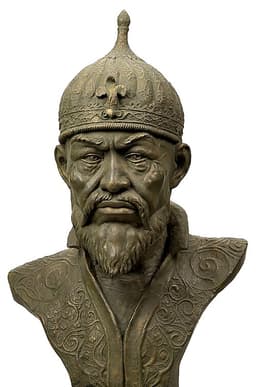
Timur
Emperor · Medieval
65.6Total
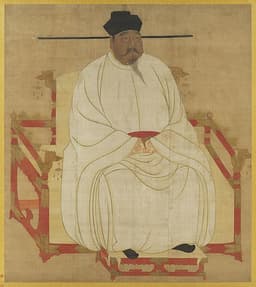
Zhao Kuangyin
Emperor · Medieval
71.5Total
Basic Information
Born
1336
927
Died
1405
976
Era
Medieval
Medieval
Nationality
Timurid Empire
China
Occupation
Emperor
Emperor
Civilization
Middle Eastern
Eastern
Score Comparison
Military (10%)
79.0
78.0
Political (20%)
70.0
84.0
Influence (20%)
70.0
68.0
Legacy (20%)
40.0
65.0
Leadership (15%)
79.8
74.0
Strategy (15%)
77.6
68.0
TOTAL
65.6
71.5
Timur — Complete Timeline
1362 AD
Battle of the Terek RiverWar
Timur defeated the Mongol ruler of the Chagatai Khanate, establishing his control over Transoxiana. This victory marked the beginning of his rise to power, as he captured Samarkand and declared himself emir.
Rise to PowerBattleCentral Asia
Impact: regional
1387 AD
Conquest of PersiaWar◆ Major
Timur launched a campaign into Persia, capturing Isfahan and Shiraz. He suppressed a revolt in Isfahan by massacring tens of thousands of inhabitants, establishing his reputation for extreme brutality and consolidating control over the region.
ConquestMassacrePersia
Impact: regionaldestructive
1395 AD
Campaign against the Golden HordeWar◆ Major
Timur defeated the Golden Horde under Tokhtamysh at the Battle of the Terek River. He sacked Sarai, the Horde's capital, and destroyed its trade networks, permanently weakening the Mongol state and securing his northern frontier.
ConquestGolden HordeBattle
Impact: regionaldestructive
1398 AD
Sack of DelhiWar◆ Major
Timur invaded the Delhi Sultanate, defeating Sultan Nasir-ud-Din Mahmud Shah Tughluq. His army sacked Delhi, massacring tens of thousands of civilians and destroying the city's infrastructure, then withdrew with immense plunder.
ConquestMassacreIndia
Impact: regionaldestructive
1402 AD
Battle of AnkaraWar
Timur defeated the Ottoman Sultan Bayezid I at Ankara, capturing him. The victory shattered Ottoman power, leading to a civil war among Bayezid's sons and delaying Ottoman expansion into Europe for a decade.
BattleOttoman EmpireDecisive Victory
Impact: global
1404 AD
Construction of SamarkandCultural◆ Major
Timur invested heavily in transforming Samarkand into a cultural and architectural center. He brought artisans from conquered lands to build mosques, madrasas, and the Bibi-Khanym Mosque, making the city a showcase of Timurid art and learning.
ArchitecturePatronageCultural Center
Impact: regionalconstructive
1405 AD
Death during campaign against Ming ChinaWar◆ Major
Timur died of illness while leading a massive army toward the Ming dynasty's borders. His death ended the planned invasion of China and led to the fragmentation of his empire among his sons and grandsons.
DeathCampaignMing Dynasty
Impact: regional
Zhao Kuangyin — Complete Timeline
960 AD
Founded Song dynastyPolitical Action
Zhao Kuangyin, a general of Later Zhou, was proclaimed emperor by his troops at Chenqiao. He established the Song dynasty, ending the Five Dynasties period and beginning a new era of Chinese history.
Song dynastyFoundingChenqiao
Impact: globalconstructive
961 AD
Removed military power from generalsPolitical Action◆ Major
Zhao Kuangyin invited senior generals to a banquet and persuaded them to retire peacefully. This 'removal of military power over wine' prevented military coups and centralized control.
Song dynastyMilitary reformCentralization
Impact: nationalconstructive
963 AD
Unified southern ChinaWar◆ Major
Zhao Kuangyin launched campaigns to conquer the southern kingdoms, including Jingnan, Later Shu, and Southern Tang. By his death, most of China was reunified under Song rule.
Song unificationConquestSouthern kingdoms
Impact: national
Expert Analysis
Zhao Kuangyin vs Timur
# The Conqueror and the Unifier
On a winter night in 960, a Chinese general named Zhao Kuangyin was roused from his tent by his own soldiers, who draped a yellow imperial robe over his shoulders and declared him emperor. Forty-two years later, in the summer of 1402, the Turco-Mongol warlord Timur watched from a hilltop as the Ottoman Sultan Bayezid I was dragged before him in chains, the once-mighty Ottoman army broken and scattered across the plains of Ankara. Two men, two worlds, two radically different paths to power—yet both would reshape the history of their civilizations. What drove one to build an empire of blood and bones, and the other to forge a dynasty of peace and prosperity?
Origins
Zhao Kuangyin was born in 927 into a military family serving the Later Zhou dynasty, one of the short-lived kingdoms that had carved up China after the fall of the Tang. His father was a respected officer, and young Zhao grew up surrounded by the chaos of the Five Dynasties and Ten Kingdoms period—a time when warlords rose and fell like autumn leaves, and no throne seemed secure. He learned early that power was fleeting, and that the only lasting currency was trust.
Timur, born in 1336 near Samarkand, came from a different world entirely. He was a minor noble of the Barlas tribe, a Turkicized Mongol clan that claimed descent from Genghis Khan—though the claim was thin. His early life was marked by the brutal politics of the steppe: shifting alliances, sudden betrayals, and the constant threat of annihilation. A wound to his leg in his youth left him permanently lame, earning him the Persian nickname *Timur-e Lang*, or Timur the Lame. But that limp did not slow his ambition; it only sharpened it.
Rise to Power
Zhao Kuangyin’s ascent was almost accidental. In 960, as a trusted general of the Later Zhou, he was ordered north to repel a Khitan invasion. But before he could reach the front, his troops mutinied—not against him, but for him. They wanted a strong emperor, not a child ruler in Kaifeng. Zhao accepted the robe, but he did so reluctantly, making his officers swear loyalty to the new dynasty he would call Song. It was a coup, but a bloodless one.
Timur’s rise was anything but bloodless. In 1362, at the Battle of the Terek River, he defeated the Mongol ruler of the Chagatai Khanate, seizing control of Transoxiana. From there, he spent decades consolidating power through a relentless cycle of conquest and betrayal. He allied with the nomadic leader Tokhtamysh, only to see him turn against him; he crushed the Golden Horde in 1395, sacking their capital Sarai; he swept through Persia, leaving cities like Isfahan in ruins after massacring tens of thousands. For Timur, power was not given—it was taken, and taken with fire.
Leadership & Governance
Zhao Kuangyin’s genius lay not in conquest but in restraint. In 961, he invited his most powerful generals to a banquet and, over cups of wine, persuaded them to retire peacefully. This "removal of military power" became legendary: he offered them wealth, land, and honor in exchange for their swords. He then centralized the bureaucracy, promoted civil service exams, and built a government that valued scholars over soldiers. His military campaigns—unifying southern China by 963—were efficient but measured, designed to absorb rather than destroy.
Timur ruled through terror and spectacle. His military strategy was a masterpiece of logistics and psychological warfare: he would devastate a region so thoroughly that no one would dare resist again. At the Battle of Ankara in 1402, he not only defeated Bayezid I but humiliated him, keeping the sultan in a cage and parading him across Anatolia. Yet Timur was also a patron of culture: he brought artisans from conquered cities to Samarkand, transforming it into a jewel of Islamic architecture, with blue-tiled mosques and observatories. He could build and burn with equal passion.
Triumph & Tragedy
Zhao Kuangyin’s greatest triumph was the unification of China—a feat that ended decades of fragmentation. His tragedy was that he died suddenly in 976, possibly assassinated by his own brother, leaving a dynasty that would eventually succumb to the very military weakness he had created. The Song would become culturally brilliant but militarily vulnerable, a paradox born from his desire for peace.
Timur’s triumph was his empire itself—stretching from the Indus to the Mediterranean, the largest land empire since Genghis. His tragedy came in 1405, when he died of illness while marching toward the Ming dynasty, his dream of conquering China unfulfilled. His empire, built on fear and force, crumbled within a generation.
Character & Destiny
Zhao Kuangyin was a man of caution and calculation. He understood that power, once seized, must be legitimized through institutions, not bloodlines. His famous saying—"I have no enmity with the people, only with the corrupt"—reflected a ruler who saw governance as a moral duty. His destiny was to be the architect of a golden age.
Timur was a man of fire and fury. He saw history as a canvas to be painted in red. "I am not a man of blood," he once claimed, "but I am a man of iron." His destiny was to be remembered as a destroyer who built, a builder who destroyed—a figure of terrifying contradictions.
Legacy
Zhao Kuangyin is remembered as a wise founder, the first of the Song emperors who presided over a renaissance in Chinese art, science, and philosophy. His decision to disarm the generals shaped Chinese history for centuries, for better and worse. Today, he is a symbol of peaceful transition and enlightened rule.
Timur is remembered as a scourge of God, a conqueror whose name still echoes in the ruins of Isfahan and Delhi. Yet his legacy is complex: he revived the Silk Road, patronized scholars, and his descendants—the Mughals—would later rule India. He is both a monster and a monument.
Conclusion
Two men, two empires. Zhao Kuangyin chose to build a house that would stand for centuries, even if its walls were thin. Timur chose to build a mountain that would tower for a moment, then crumble. One trusted in institutions; the other trusted in terror. Their stories remind us that history judges not by the size of the empire, but by the shape of the peace that follows. And perhaps, in the end, the quiet unifier from Kaifeng understood something the lame conqueror from Samarkand never could: that the hardest battle is not the one you win, but the one you choose not to fight.
Rankings
🥇
Zhao KuangyinLeader
Mil: 78.0Pol: 84.0Inf: 68.0
71.5
🥈
Timur
Mil: 79.0Pol: 70.0Inf: 70.0
65.6
+5.9 behind
How This Comparison Works
Algorithm
Each figure is scored on 6 dimensions (0—100 scale) based on structured historical data: Military (10%), Political (20%), Influence (20%), Legacy (20%), Leadership (15%), Strategy (15%). The weighted total produces the final ranking.
Data Sources
Scores are computed from structured sub-indicators in the database. Scale factors adjust for era (Ancient ×0.85, Modern ×1.0) and civilization size (Eastern ×1.05, Other ×0.80) to account for differences in population and military scale.
Maximum 3 Figures
Comparisons are limited to 2—3 figures to ensure readability and statistical meaningfulness.
Error Margins
±5 points per dimension — Sub-scores are derived from historical records with inherent uncertainty. Two figures within 5 points on a dimension should be considered roughly equivalent in that area.
Total Score Accuracy
±3 points overall — The weighted combination of 6 dimensions produces a total score with approximately ±3 points of uncertainty. Differences of less than 3 points are not statistically significant— the figures are effectively tied.
Known Limitations
- Historical records are incomplete and uneven across civilizations
- Figures from oral-tradition societies may be underrepresented
- Occupation labels can misclassify multi-role figures
- Scores measure capability and impact, not moral character
- Quantitative scoring is a comparison tool, not absolute truth
Capability Radar
Military (10%) — Battles & Warfare
Battles
95
75
Win Rate
92
85
Expansion
96
75
Political (20%) — Governance & Reform
Reform
78
90
Diplomacy
70
85
Economy
82
80
Influence (20%) — Cultural & Global Reach
Cultural
88
70
Global
85
60
Legacy (20%) — Historical Impact
Historical
90
80
Longevity
75
75
Leadership (15%) — Power & Stability
Tenure
85
65
Stability
65
85
Strategy (15%) — Tactics & Innovation
Strategy
93
80
Tactics
94
70
Reform
80
90
Similar Comparisons
Comments & Discussion
CLEAVER_AND_SCEPTER6/16/2026
Zhao Kuangyin’s “yellow robe” coup is the most overrated origin story in Chinese history. It’s a staged performance, not a true military seizure. Compare that to Timur’s battlefield genius at Ankara—defeating Bayezid with a Mongol feigned retreat that the Ottomans fell for hook, line, and sinker. Zhao unified by bribery and bureaucracy, not blood. Timur conquered from Delhi to Damascus. Give me the warlord who actually swung a sword.
灰袍史官6/16/2026
我忍不住要问:你们怎么总把赵匡胤的“杯酒释兵权”当成政治智慧?分明是恐惧深重的软弱!真正的强者如铁木真,靠的是真刀真枪的征服,而不是请杯酒就打发功臣。赵匡胤的宋朝后来被辽、金、西夏轮番羞辱,难道不是因为他那套“重文轻武”的软弱基因?统一就靠耍嘴皮子和撒银子,可笑!历史该给赵匡胤评个“收买之王”的称号。
OBSIDIAN_HORSE6/16/2026
Data skeptic here: The comparison ignores GDP. Under Zhao, Song China’s economy grew 400% in a century, while Timur’s empire collapsed within years of his death. Zhao’s unification created the world’s first paper money, a stable civil service, and a population boom. Timur left ruined cities and pyramids of skulls. Who’s the better “conqueror”? One built a system, the other built a legend. Numbers don’t lie.
天启铁骑6/16/2026
我不同意什么“和平王朝”的鬼话!赵匡胤的宋朝确实富,可那种富是建立在军事实力孱弱的代价上。看看檀渊之盟——每年给辽国岁币,那叫和谈?分明是花钱买苟安。相比之下,帖木儿三次西征,把奥斯曼打得几百年抬不起头。历史从来不相信温柔的微笑,只认铁与血。赵匡胤唯一做对的事,就是没和帖木儿同时代生存。
Balkan_Wolf6/16/2026
From a steppe perspective, Timur was the last true Mongol unifier—his Chagatai lineage gave him legitimacy Zhao could only dream of. Zhao had to invent the “Mandate of Heaven” to justify his usurpation. Timur? He claimed direct descent from Genghis and openly mocked settled empires. He saw Bayezid’s Ottoman court as soft, decadent. And he was right. Zhao built a bureaucratic cage; Timur built a graveyard for overmatched kings. I know which legacy I’d respect.