Loading...
This comparison has not been analyzed yet.
One-time AI generation (~1 minute). Scores and timeline are already available below.
Tadeusz Kosciuszko vs William Halsey
Tadeusz Kosciuszko leads by 10.6 pts · 2 figures compared
…
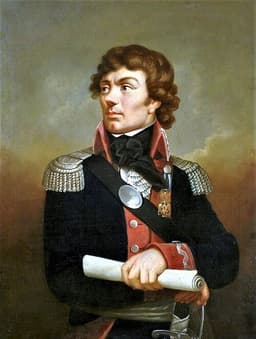
Tadeusz Kosciuszko
General · Modern
64.1Total

William Halsey
General · Modern
53.5Total
Basic Information
Born
1746
1882
Died
1817
1959
Era
Modern
Modern
Nationality
Poland
United States
Occupation
General
General
Civilization
Western
Western
Score Comparison
Military (10%)
47.5
78.0
Political (20%)
68.0
29.3
Influence (20%)
68.0
56.7
Legacy (20%)
68.0
58.0
Leadership (15%)
64.5
47.3
Strategy (15%)
55.0
55.0
TOTAL
64.1
53.5
Tadeusz Kosciuszko — Complete Timeline
1777 AD
Battle of Saratoga (engineering contributions)War◆ Major
Kosciuszko designed fortifications and selected defensive positions for the American army at Saratoga. His work contributed to the American victory, a turning point in the Revolutionary War.
American RevolutionSaratogaEngineering
Impact: regional
1778 AD
Fortification of West PointWar◆ Major
Kosciuszko was assigned to fortify West Point on the Hudson River. He designed and supervised the construction of fortifications that made the site a key American stronghold for the remainder of the war.
American RevolutionWest PointFortifications
Impact: regionalconstructive
1794 AD
Kosciuszko UprisingWar
Kosciuszko led a national uprising in Poland against Russian and Prussian occupation. He proclaimed the Act of Insurrection and won the Battle of Rac
Polish UprisingIndependenceDefeat
Impact: nationaltragic
Battle of RacławiceWar◆ Major
Kosciuszko led Polish forces, including peasant scythemen, to victory over a larger Russian army at Rac
Kosciuszko UprisingBattlePeasants
Impact: national
Capture and imprisonment at the Battle of MaciejowiceWar◆ Major
Kosciuszko was wounded and captured by Russian forces at the Battle of Maciejowice. His capture effectively ended the uprising, and he was imprisoned in St. Petersburg until 1796.
Kosciuszko UprisingCaptureImprisonment
Impact: nationaltragic
William Halsey — Complete Timeline
1941 AD
Attack on Pearl HarborWar◆ Major
Halsey was at sea commanding Task Force 8 when the Japanese attacked Pearl Harbor. His carrier, USS Enterprise, was returning from delivering aircraft to Wake Island. The attack galvanized Halsey's aggressive approach to the Pacific War.
World War IIPacific TheaterNaval Command
Impact: global
1942 AD
Doolittle RaidWar◆ Major
Halsey commanded the naval task force that transported Lieutenant Colonel Doolittle's B-25 bombers to within striking distance of Japan. The raid on Tokyo boosted American morale and forced Japan to reconsider its defensive perimeter.
World War IIPacific TheaterAir Raid
Impact: regionalconstructive
1944 AD
Battle of Leyte GulfWar◆ Major
Halsey commanded the Third Fleet during the Battle of Leyte Gulf. He pursued the Japanese Northern Force, leaving the invasion fleet vulnerable. His decision to chase the decoy force was criticized, but the battle resulted in the destruction of Japanese naval power.
World War IIPacific TheaterNaval Battle
Impact: regional
Typhoon CobraOther◆ Major
Halsey's Third Fleet sailed into Typhoon Cobra in the Philippine Sea. Three destroyers capsized and sank, with over 800 sailors lost. Halsey was found guilty of errors of judgment in a court of inquiry but was not punished.
World War IINaval DisasterWeather
Impact: regionaltragic
1945 AD
Surrender of JapanPolitical Action◆ Major
Halsey's Third Fleet was present in Tokyo Bay for the formal surrender of Japan on September 2, 1945. He had advocated for a more aggressive blockade and bombing campaign to force Japan's surrender earlier.
World War IIPacific TheaterSurrender
Impact: globalconstructive
This comparison has not been analyzed yet.
One-time AI generation (~1 minute). Scores and timeline are already available below.
Rankings
🥇
Tadeusz KosciuszkoLeader
Mil: 47.5Pol: 68.0Inf: 68.0
64.1
🥈
William Halsey
Mil: 78.0Pol: 29.3Inf: 56.7
53.5
+10.6 behind
How This Comparison Works
Algorithm
Each figure is scored on 6 dimensions (0—100 scale) based on structured historical data: Military (10%), Political (20%), Influence (20%), Legacy (20%), Leadership (15%), Strategy (15%). The weighted total produces the final ranking.
Data Sources
Scores are computed from structured sub-indicators in the database. Scale factors adjust for era (Ancient ×0.85, Modern ×1.0) and civilization size (Eastern ×1.05, Other ×0.80) to account for differences in population and military scale.
Maximum 3 Figures
Comparisons are limited to 2—3 figures to ensure readability and statistical meaningfulness.
Error Margins
±5 points per dimension — Sub-scores are derived from historical records with inherent uncertainty. Two figures within 5 points on a dimension should be considered roughly equivalent in that area.
Total Score Accuracy
±3 points overall — The weighted combination of 6 dimensions produces a total score with approximately ±3 points of uncertainty. Differences of less than 3 points are not statistically significant— the figures are effectively tied.
Known Limitations
- Historical records are incomplete and uneven across civilizations
- Figures from oral-tradition societies may be underrepresented
- Occupation labels can misclassify multi-role figures
- Scores measure capability and impact, not moral character
- Quantitative scoring is a comparison tool, not absolute truth
Capability Radar
Military (10%) — Battles & Warfare
Battles
55
85
Win Rate
60
80
Expansion
30
85
Political (20%) — Governance & Reform
Reform
45
10
Diplomacy
55
20
Economy
35
10
Influence (20%) — Cultural & Global Reach
Cultural
65
55
Global
55
60
Legacy (20%) — Historical Impact
Historical
70
65
Longevity
60
50
Leadership (15%) — Power & Stability
Tenure
40
30
Stability
30
15
Strategy (15%) — Tactics & Innovation
Strategy
65
70
Tactics
70
75
Reform
50
40
Similar Comparisons
Comments & Discussion
No comments yet. Be the first to share your thoughts!