Loading...
Sitiveni Rabuka vs Suchinda Kraprayoon
Sitiveni Rabuka leads by 14.6 pts · 2 figures compared
…
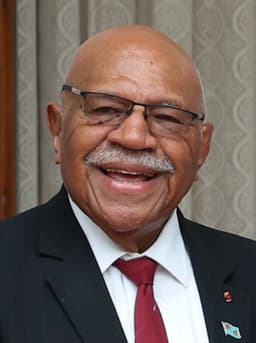
Sitiveni Rabuka
General · Modern
51.7Total
Suchinda Kraprayoon
General · Modern
37.1Total
Basic Information
Born
1948
1933
Died
—
—
Era
Modern
Modern
Nationality
Fiji
Thailand
Occupation
General
General
Civilization
Other
Eastern
Score Comparison
Military (10%)
10.2
10.2
Political (20%)
60.0
27.9
Influence (20%)
53.3
47.1
Legacy (20%)
46.7
37.5
Leadership (15%)
85.0
45.0
Strategy (15%)
39.6
39.6
TOTAL
51.7
37.1
Sitiveni Rabuka — Complete Timeline
1987 AD
1987 Fijian Coup d'étatPolitical Action
Rabuka, as a colonel in the Fijian military, led a coup overthrowing the elected government of Timoci Bavadra. The coup was motivated by ethnic Fijian opposition to Indo-Fijian political influence. Rabuka declared Fiji a republic.
CoupMilitary InterventionEthnic Tension
Impact: nationaldestructive
1992 AD
1992 Election as Prime MinisterPolitical Action◆ Major
Rabuka transitioned from military leader to civilian politician, winning the 1992 general election as leader of the Fijian Political Party. He became Prime Minister, serving until 1999.
ElectionCivilian GovernmentPolitical Transition
Impact: national
1997 AD
1997 Constitution ReformReform◆ Major
Rabuka's government oversaw the adoption of a new constitution that removed ethnic-based voting and provided for a multi-ethnic government. The constitution aimed to reduce ethnic tensions and promote national unity.
ConstitutionReformEthnic Reconciliation
Impact: nationalconstructive
1999 AD
1999 General Election DefeatPolitical Action◆ Major
Rabuka's government was defeated in the general election by the Labour Party led by Mahendra Chaudhry. Rabuka stepped down as Prime Minister, marking the end of his first period in power.
Election DefeatGovernment ChangeChaudhry
Impact: national
2022 AD
2022 Return as Prime MinisterPolitical Action◆ Major
Rabuka led the People's Alliance to victory in the 2022 general election, forming a coalition government. He became Prime Minister again, 23 years after his previous tenure, promising democratic reforms.
ElectionReturn to PowerCoalition Government
Impact: national
Suchinda Kraprayoon — Complete Timeline
1991 AD
Leadership of the 1991 Thai Coup d'ÉtatPolitical Action◆ Major
General Suchinda Kraprayoon led the National Peace Keeping Council in a bloodless coup that overthrew Prime Minister Chatichai Choonhavan. The coup was justified by claims of corruption and political instability, establishing a military junta.
CoupMilitary JuntaPower Seizure
Impact: nationaldestructive
1992 AD
Appointment as Prime MinisterPolitical Action◆ Major
After a general election, Suchinda was appointed Prime Minister despite not being an elected MP. His appointment sparked widespread protests, as it was seen as a continuation of military rule and a violation of democratic principles.
Prime MinisterControversyMilitary Rule
Impact: nationaldestructive
Black May 1992 Uprising and ResignationPolitical Action
Massive pro-democracy protests in Bangkok, led by Chamlong Srimuang, demanded Suchinda's resignation. The military crackdown resulted in dozens of deaths. King Bhumibol intervened, leading to Suchinda's resignation and the restoration of civilian government.
UprisingBlack MayResignation
Impact: nationaltragic
Expert Analysis
Sitiveni Rabuka vs Suchinda Kraprayoon
### The General Who Stepped Back
On a sweltering May morning in 1992, the streets of Bangkok turned into a battlefield. Tanks rolled through the city center, and soldiers fired into crowds of unarmed protesters. General Suchinda Kraprayoon, the man who had ordered the crackdown, sat in his office, watching his political dream die in a hail of tear gas and bullets. Half a world away, in the South Pacific, another general faced a very different fate. Sitiveni Rabuka, who had also seized power by force, was preparing to hand it back—not under duress, but by choice. Two coup leaders, two paths, two starkly different endings. Why did one cling to power until it destroyed him, while the other learned to let go?
### Origins
Suchinda Kraprayoon was born in 1933, into a Thailand still ruled by absolute monarchy, though the 1932 revolution had already planted the seeds of military dominance. He grew up in a world where the army was the ultimate arbiter of politics, where coups were as routine as elections. The Thai military elite saw themselves as guardians of the nation, above the messy squabbles of democracy. Suchinda absorbed this ethos completely. He was a product of the system—loyal, disciplined, and convinced that only men in uniform could keep the country stable.
Sitiveni Rabuka, by contrast, was born in 1948, in a Fiji still under British colonial rule. His upbringing was humble, in a village on the island of Vanua Levu. He joined the military not out of ambition but as a path to education and respect. Fiji’s army was small, professional, and deeply intertwined with the country’s ethnic divisions. Indigenous Fijians dominated the ranks, while Indo-Fijians, descendants of indentured laborers, held economic power. Rabuka grew up with a fierce loyalty to his people, but also with a colonial-era respect for the rule of law. He was a man torn between two worlds: the traditional Fijian chiefly system and the modern British military code.
### Rise to Power
Suchinda’s rise was methodical. He climbed the ranks of the Thai army, serving in the elite Special Forces and later as a close aide to powerful generals. By 1991, he was a key figure in the National Peace Keeping Council, the junta that overthrew Prime Minister Chatichai Choonhavan in a bloodless coup. The coup was presented as a cleanup operation, a purge of corruption. Suchinda, with his stern face and quiet demeanor, became the face of the new order.
Rabuka’s rise was more dramatic and personal. In 1987, as a colonel, he led a coup that toppled the newly elected government of Timoci Bavadra, a coalition that included many Indo-Fijians. Rabuka acted out of fear—fear that indigenous Fijians would lose control of their land and destiny. But unlike Suchinda, Rabuka did not enjoy the coup. He later described it as a burden, a necessary evil. He was a reluctant soldier, haunted by the knowledge that he had broken the very law he had sworn to uphold.
### Leadership & Governance
Suchinda’s leadership was rigid, authoritarian, and ultimately brittle. After the 1992 general election, he was appointed prime minister despite not being an elected MP—a move that infuriated the growing pro-democracy movement. His governance was a continuation of military rule: top-down, suspicious of dissent, and reliant on force. He had no vision beyond stability, no plan for reform. When protests erupted in May 1992, his instinct was to crush them. The result was Black May: dozens dead, hundreds wounded, and Suchinda’s reputation shattered forever.
Rabuka’s governance was a study in evolution. After seizing power, he initially tried to entrench ethnic Fijian dominance. But he soon realized that Fiji could not survive as a pariah state. In 1992, he won election as prime minister, and over the next seven years, he underwent a remarkable transformation. He supported the 1997 constitution, which removed ethnic-based voting and created a multiracial democracy. It was a stunning reversal—the coup leader becoming the architect of reconciliation. Rabuka did not just govern; he learned.
### Triumph & Tragedy
Suchinda’s greatest moment was also his greatest failure. The 1991 coup was executed cleanly, without bloodshed. But the tragedy of Black May erased any legacy of competence. He resigned after just 49 days as prime minister, a man broken by his own stubbornness. He never held power again.
Rabuka’s tragedy was the 1987 coup itself, an act that set Fiji on a path of instability. But his triumph came later: the 1997 constitution, a document that, for a time, promised a united Fiji. He lost the 1999 election to Mahendra Chaudhry, Fiji’s first Indo-Fijian prime minister, and stepped down gracefully. Then, in a twist that seemed almost unbelievable, he returned to power in 2022, winning election as prime minister again at the age of 74. Rabuka had the rare gift of redemption.
### Character & Destiny
Suchinda’s character was forged in certainty. He believed in the supremacy of the military, in the rightness of his cause. That certainty was his strength, but also his fatal flaw. When the protests came, he could not bend. He could not see that the world had changed. His destiny was to be a symbol of the old order, crushed by the new.
Rabuka’s character was marked by doubt. He was a man who could admit he was wrong. He once said, “I did what I thought was right at the time, but I have learned.” That humility allowed him to evolve, to seek forgiveness, to build a legacy not on power but on peace. His destiny was to be a paradox: a coup leader who became a democrat.
### Legacy
Suchinda is remembered in Thailand as a footnote, a cautionary tale. The 1992 protests were a turning point for Thai democracy, but the military never fully retreated. His name is invoked as a warning against authoritarian overreach, but little more. His legacy score of 52.4 reflects a man who was important, but not great.
Rabuka’s legacy is more complex. In Fiji, he is both hero and villain, depending on whom you ask. Indigenous Fijians often see him as a protector; Indo-Fijians remember the pain of the coup. But his later reforms earned him international respect. His legacy score of 61.2 is modest, but it undersells his transformation. He is one of the few coup leaders in history to voluntarily dismantle the system he created.
### Conclusion
The difference between Suchinda and Rabuka is not in their ambitions, but in their capacity for change. Suchinda saw power as an end; Rabuka saw it as a means. One was trapped by his past; the other was liberated by his willingness to learn from it. In the end, the general who stepped back left a deeper mark than the general who stood his ground. History, it seems, rewards those who can say, “I was wrong.”
Rankings
🥇
Sitiveni RabukaLeader
Mil: 10.2Pol: 60.0Inf: 53.3
51.7
🥈
Suchinda Kraprayoon
Mil: 10.2Pol: 27.9Inf: 47.1
37.1
+14.6 behind
How This Comparison Works
Algorithm
Each figure is scored on 6 dimensions (0—100 scale) based on structured historical data: Military (10%), Political (20%), Influence (20%), Legacy (20%), Leadership (15%), Strategy (15%). The weighted total produces the final ranking.
Data Sources
Scores are computed from structured sub-indicators in the database. Scale factors adjust for era (Ancient ×0.85, Modern ×1.0) and civilization size (Eastern ×1.05, Other ×0.80) to account for differences in population and military scale.
Maximum 3 Figures
Comparisons are limited to 2—3 figures to ensure readability and statistical meaningfulness.
Error Margins
±5 points per dimension — Sub-scores are derived from historical records with inherent uncertainty. Two figures within 5 points on a dimension should be considered roughly equivalent in that area.
Total Score Accuracy
±3 points overall — The weighted combination of 6 dimensions produces a total score with approximately ±3 points of uncertainty. Differences of less than 3 points are not statistically significant— the figures are effectively tied.
Known Limitations
- Historical records are incomplete and uneven across civilizations
- Figures from oral-tradition societies may be underrepresented
- Occupation labels can misclassify multi-role figures
- Scores measure capability and impact, not moral character
- Quantitative scoring is a comparison tool, not absolute truth
Capability Radar
Military (10%) — Battles & Warfare
Battles
5
5
Win Rate
5
5
Expansion
5
5
Political (20%) — Governance & Reform
Reform
50
5
Diplomacy
45
10
Economy
40
5
Influence (20%) — Cultural & Global Reach
Cultural
30
5
Global
20
5
Legacy (20%) — Historical Impact
Historical
40
10
Longevity
30
5
Leadership (15%) — Power & Stability
Tenure
55
10
Stability
35
5
Strategy (15%) — Tactics & Innovation
Strategy
10
10
Tactics
10
10
Reform
5
5
Similar Comparisons
Comments & Discussion
Teak Tank Trap6/16/2026
Looking at Suchinda vs. Rabuka is like comparing a machete to a scalpel. Suchinda ordered live fire on unarmed protesters—930 were hospitalized in Bangkok's "Black May"—because he couldn't fathom legitimacy without a gun. Rabuka, meanwhile, staged his 1987 coup but then actually wrote a new constitution and handed power back in 1992 via democratic elections. One man learned that force without consent is tyranny; the other learned nothing.
沉默的椰壳6/16/2026
说Suchinda是“独裁者”,简直都算抬举他。1992年他下令对示威者开枪时,连自己的国防部长都公开反对。而Rabuka呢?他发动政变后却发现,没有民意的武力就像没子弹的枪——2000年斐济再政变时,他甚至站在民主一边去反对新强人。Suchinda把权力当战利品,Rabuka却把权力当信托。区别:一个打到最后只剩枪,一个打到一半学会了赌。
Pacific Turncoat6/16/2026
People romanticize Rabuka as the "good coupmaker" too easily. Yes, he stepped down in 1992—after stacking Fiji's constitution with indigenous Fijian veto power over every cabinet decision. That's not humility; it's surgical authoritarianism dressed in democratic clothes. Suchinda at least failed openly, while Rabuka engineered a racialized power structure that still haunts Fiji. One crashed his tank in public; the other parked it inside parliament and called it peace.
热带的鳄鱼6/16/2026
把Rabuka和Suchinda放一起比,野史都比正史精彩。Suchinda出身军队世家,从越战学来的逻辑是“你敢反抗我就碾碎你”;而Rabuka是在殖民地长大的酋长之子,政变后跑去牛津读了两年书——一个真正见过世界的人。Suchinda失败是因为他只会用泰语思考权力;Rabuka成功是因为他最后学会了用英文写宪法。教育,不是学历,是视野上的差距。
Data-First Colonel6/16/2026
Let's cut the moral theater. Suchinda's crackdown killed at least 44 confirmed; Rabuka's 1987 coup had zero civilian deaths. That's not personality—that's operational doctrine. Suchinda ran a conscript army shooting its own people; Rabuka's Fijian troops stayed under tight command discipline. The difference is professional military culture, not personal wisdom. One general ran a mob with tanks; the other ran an army with standards.