Loading...
Sima Yi vs Suetonius Paulinus
Sima Yi leads by 5.3 pts · 2 figures compared
…
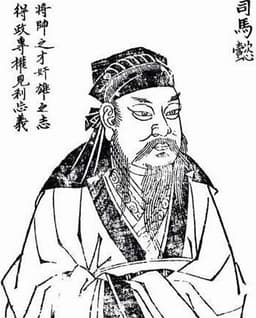
Sima Yi
General · Ancient
58.3Total
Suetonius Paulinus
General · Ancient
53.0Total
Basic Information
Born
179
10
Died
251
70
Era
Ancient
Ancient
Nationality
China
Roman Empire
Occupation
General
General
Civilization
Eastern
Western
Score Comparison
Military (10%)
75.0
85.0
Political (20%)
59.2
27.9
Influence (20%)
58.3
56.4
Legacy (20%)
40.0
52.0
Leadership (15%)
66.0
43.8
Strategy (15%)
74.4
66.3
TOTAL
58.3
53.0
Sima Yi — Complete Timeline
228 AD
Battle of JietingWar◆ Major
Sima Yi led the Cao Wei forces to defeat the Shu Han army at Jieting, forcing Zhuge Liang to retreat. This victory prevented Shu from capturing the Chang'an region and secured Wei's western border.
BattleCao WeiShu HanThree Kingdoms
Impact: regionalconstructive
231 AD
Defense of HefeiWar
Sima Yi successfully defended the city of Hefei against an Eastern Wu invasion led by Sun Quan. He repelled the Wu forces, maintaining Wei control over the Huai River region.
DefenseCao WeiEastern WuThree Kingdoms
Impact: regionalconstructive
249 AD
Coup at Gaoping TombsPolitical Action
Sima Yi staged a coup against the regent Cao Shuang at the Gaoping Tombs. He seized control of the Cao Wei government, executing Cao Shuang and his faction. This event gave the Sima clan effective control over Wei.
CoupCao WeiThree KingdomsPower Struggle
Impact: nationaldestructive
251 AD
Death and Posthumous HonorsOther◆ Major
Sima Yi died in 251 AD. His descendants later founded the Jin dynasty, fulfilling his ambition. He was posthumously honored as Emperor Xuan of Jin, though he never ruled as emperor himself.
DeathJin DynastyLegacy
Impact: national
Suetonius Paulinus — Complete Timeline
42 AD
Expedition Across the Atlas MountainsWar◆ Major
As governor of Mauretania, Paulinus led a Roman expedition across the Atlas Mountains. He was the first Roman to do so, exploring the interior of North Africa and reporting on the geography and peoples of the region.
ExplorationNorth AfricaMilitary Expedition
Impact: regionalconstructive
61 AD
Defeat of Boudicca's RevoltWar
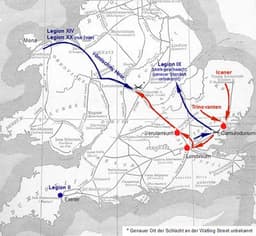
Paulinus, as governor of Britain, defeated the massive rebellion led by Queen Boudicca of the Iceni. At the Battle of Watling Street, his outnumbered legions crushed the British forces, ending the revolt and restoring Roman control.
Roman BritainBattleRebellion
Impact: regional
Recall from Britain After the RevoltPolitical Action
Despite his victory over Boudicca, Paulinus was recalled from Britain by Emperor Nero. His harsh punitive measures against the Britons were criticized, and he was replaced by a more conciliatory governor.
Roman BritainRecallNero
Expert Analysis
Origins
Sima Yi (179-251 AD) was born into a prominent Han dynasty family in Henei Commandery (modern Henan, China). His father, Sima Fang, served as a minor official, and Sima Yi was educated in Confucian classics and military strategy. He began his career as a clerk under the warlord Cao Cao, gradually rising through the ranks due to his administrative skills and strategic acumen. Suetonius Paulinus (c. 10-69 AD) was a Roman equestrian from the Italian peninsula. Little is known of his early life, but he likely served as a military tribune in Germania or Britain before becoming governor of Mauretania (modern Morocco and Algeria), where he led an expedition across the Atlas Mountains—the first Roman to do so. His career was shaped by the Roman military system, emphasizing discipline and engineering.
Rise to Power
Sima Yi's rise began when he joined Cao Cao's court in 208 AD, initially as a minor advisor. He gained trust by supporting Cao Cao's son, Cao Pi, in succession disputes. In 226 AD, after Cao Pi's death, Sima Yi became regent for the young Emperor Cao Rui. He solidified power through military victories against Shu Han and Eastern Wu. His turning point came in 249 AD with the coup at Gaoping Tombs: while the regent Cao Shuang accompanied the emperor to a tomb, Sima Yi seized the capital, Luoyang, and accused Cao Shuang of treason. Cao Shuang surrendered, and Sima Yi had him and his faction executed, becoming the de facto ruler of Wei. Suetonius Paulinus rose through the cursus honorum, serving as governor of Mauretania (c. 41-42 AD) and later as consul in 45 AD. In 58 AD, he was appointed governor of Britain, where he faced the massive rebellion of Queen Boudicca in 60-61 AD. His decisive victory at the Battle of Watling Street, despite being outnumbered, established his reputation as a capable general.
Leadership & Governance
Sima Yi governed through strategic alliances and ruthless elimination of rivals. He maintained stability in Wei by promoting agriculture, reducing taxes, and strengthening the military. His leadership style was cautious and calculating, avoiding direct confrontation with Zhuge Liang in the field, instead using fortified positions and scorched-earth tactics. In contrast, Suetonius Paulinus was a direct commander, leading from the front at Watling Street. His governance in Britain was harsh, imposing heavy penalties on rebels after the revolt, which led to his recall by Nero in 61 AD due to complaints of excessive cruelty. Sima Yi's governance scores 59.2 in political skill, reflecting his ability to navigate court intrigues, while Paulinus scores 27.9, indicating his failure to manage political consequences.
Triumph & Tragedy
Sima Yi's greatest triumph was the coup at Gaoping Tombs, which allowed his family to found the Jin dynasty in 266 AD. He also defeated Zhuge Liang's Northern Expeditions, notably at the Battle of Jieting in 228 AD, where he used a surprise attack to rout Shu forces. His tragedy was that he never became emperor himself, dying in 251 AD before his descendants seized the throne. Additionally, his harsh crackdown on rivals created lasting resentment. Suetonius Paulinus's triumph was crushing Boudicca's revolt, saving Roman Britain from collapse. At Watling Street, his disciplined legionaries (about 10,000) defeated a force of over 100,000 Britons, killing 80,000 with minimal Roman losses. His tragedy was his recall after the victory, tarnishing his legacy. He also failed to secure a major command afterward, dying in obscurity during the Year of the Four Emperors (69 AD).
Character & Destiny
Sima Yi was patient, calculating, and duplicitous. He feigned illness to deceive Cao Shuang, and his coup was meticulously planned. His character—cautious but ambitious—allowed him to outlast rivals like Zhuge Liang (who scored 74.4 in strategy, similar to Sima Yi's 74.4). His destiny was to lay the foundation for the Jin dynasty. Suetonius Paulinus was bold, decisive, but politically naive. He prioritized military victory over political alliances, which led to his downfall. His character suited a battlefield commander but not a provincial governor. Historical assessments note his strategic skill (66.3) but criticize his lack of political acumen.
Legacy
Sima Yi's legacy is profound: his descendants founded the Jin dynasty (265-420 AD), which reunified China after the Three Kingdoms period. His military strategies, especially defensive warfare, influenced later Chinese generals. He is remembered as a master strategist, though often vilified for his usurpation. Suetonius Paulinus is remembered primarily for defeating Boudicca, a key event in British history. His expedition across the Atlas Mountains was a geographical achievement. However, his legacy is overshadowed by Boudicca's fame. In terms of long-term impact, Sima Yi's influence on Chinese history is greater, with a legacy score of 40.0, while Paulinus scores 52.0, but this reflects more on his military fame than enduring political change.
Conclusion
Sima Yi had a greater overall impact on history than Suetonius Paulinus. While Paulinus achieved a decisive military victory (military score 85.0 vs. Sima Yi's 75.0), Sima Yi's political maneuvering (59.2 vs. 27.9) and strategic patience allowed him to change the course of Chinese history, establishing a dynasty that ruled for over 150 years. Paulinus's victory, though crucial for Roman Britain, did not alter the Roman Empire's trajectory significantly. Sima Yi's total score of 58.3 edges out Paulinus's 53.0, but the gap widens when considering influence and legacy: Sima Yi's actions led to the Jin dynasty's unification of China, while Paulinus's legacy is confined to a single rebellion. Therefore, Sima Yi is the more consequential historical figure.
Rankings
🥇
Sima YiLeader
Mil: 75.0Pol: 59.2Inf: 58.3
58.3
🥈
Suetonius Paulinus
Mil: 85.0Pol: 27.9Inf: 56.4
53.0
+5.3 behind
How This Comparison Works
Algorithm
Each figure is scored on 6 dimensions (0—100 scale) based on structured historical data: Military (10%), Political (20%), Influence (20%), Legacy (20%), Leadership (15%), Strategy (15%). The weighted total produces the final ranking.
Data Sources
Scores are computed from structured sub-indicators in the database. Scale factors adjust for era (Ancient ×0.85, Modern ×1.0) and civilization size (Eastern ×1.05, Other ×0.80) to account for differences in population and military scale.
Maximum 3 Figures
Comparisons are limited to 2—3 figures to ensure readability and statistical meaningfulness.
Error Margins
±5 points per dimension — Sub-scores are derived from historical records with inherent uncertainty. Two figures within 5 points on a dimension should be considered roughly equivalent in that area.
Total Score Accuracy
±3 points overall — The weighted combination of 6 dimensions produces a total score with approximately ±3 points of uncertainty. Differences of less than 3 points are not statistically significant— the figures are effectively tied.
Known Limitations
- Historical records are incomplete and uneven across civilizations
- Figures from oral-tradition societies may be underrepresented
- Occupation labels can misclassify multi-role figures
- Scores measure capability and impact, not moral character
- Quantitative scoring is a comparison tool, not absolute truth
Capability Radar
Military (10%) — Battles & Warfare
Battles
78
70
Win Rate
75
75
Expansion
72
60
Political (20%) — Governance & Reform
Reform
65
30
Diplomacy
82
50
Economy
70
30
Influence (20%) — Cultural & Global Reach
Cultural
65
40
Global
55
40
Legacy (20%) — Historical Impact
Historical
80
60
Longevity
75
50
Leadership (15%) — Power & Stability
Tenure
80
40
Stability
75
40
Strategy (15%) — Tactics & Innovation
Strategy
85
75
Tactics
88
80
Reform
60
30
Similar Comparisons
Comments & Discussion
No comments yet. Be the first to share your thoughts!