Loading...
Gim Yu-sin vs Suetonius Paulinus
Gim Yu-sin leads by 7.8 pts · 2 figures compared
…

Gim Yu-sin
General · Ancient
60.8Total
Suetonius Paulinus
General · Ancient
53.0Total
Basic Information
Born
-595
10
Died
—
70
Era
Ancient
Ancient
Nationality
Korea
Roman Empire
Occupation
General
General
Civilization
Eastern
Western
Score Comparison
Military (10%)
90.0
85.0
Political (20%)
68.0
27.9
Influence (20%)
56.7
56.4
Legacy (20%)
40.0
52.0
Leadership (15%)
68.0
43.8
Strategy (15%)
72.0
66.3
TOTAL
60.8
53.0
Gim Yu-sin — Complete Timeline
612 AD
Battle of SalsuWar◆ Major
Gim Yu-sin fought in the Battle of Salsu during the Goguryeo-Sui War. The Silla and Goguryeo forces defeated the Sui Chinese army, inflicting heavy casualties and repelling the invasion.
Goguryeo-Sui WarBattleVictory
Impact: regionalconstructive
660 AD
Battle of HwangsanbeolWar
Gim Yu-sin commanded Silla forces at the Battle of Hwangsanbeol against the Baekje army. The Silla victory led to the fall of Baekje, a key step in the unification of the Three Kingdoms of Korea.
UnificationSillaBaekje
Impact: regionalconstructive
668 AD
Unification of the Three KingdomsWar
Gim Yu-sin led Silla forces in the conquest of Goguryeo, completing the unification of the Three Kingdoms of Korea under Silla. He was appointed as the highest-ranking official in the unified kingdom.
UnificationSillaGoguryeo
Impact: regionalconstructive
Suetonius Paulinus — Complete Timeline
42 AD
Expedition Across the Atlas MountainsWar◆ Major
As governor of Mauretania, Paulinus led a Roman expedition across the Atlas Mountains. He was the first Roman to do so, exploring the interior of North Africa and reporting on the geography and peoples of the region.
ExplorationNorth AfricaMilitary Expedition
Impact: regionalconstructive
61 AD
Defeat of Boudicca's RevoltWar
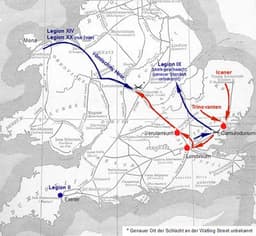
Paulinus, as governor of Britain, defeated the massive rebellion led by Queen Boudicca of the Iceni. At the Battle of Watling Street, his outnumbered legions crushed the British forces, ending the revolt and restoring Roman control.
Roman BritainBattleRebellion
Impact: regional
Recall from Britain After the RevoltPolitical Action
Despite his victory over Boudicca, Paulinus was recalled from Britain by Emperor Nero. His harsh punitive measures against the Britons were criticized, and he was replaced by a more conciliatory governor.
Roman BritainRecallNero
Expert Analysis
Origins
Gim Yu-sin was born in 595 CE into the Silla aristocracy, the son of General Kim Seo-hyun. He grew up in the turbulent period of the Three Kingdoms of Korea (Silla, Baekje, Goguryeo), where warfare was constant. From age 15, he trained in martial arts and military strategy, becoming a hwarang (elite warrior) and quickly rising through Silla's ranks. His early exposure to Silla's alliance with Tang China shaped his diplomatic and military vision.
Suetonius Paulinus was born around 10 CE in Italy, likely into an equestrian family. Little is known of his early life, but his career in the Roman military began under Emperor Claudius. He served as a legate in Mauretania (modern Morocco), where he became the first Roman to lead an expedition across the Atlas Mountains in 41 CE, demonstrating his ambition and tactical skill. This achievement earned him the governorship of Britain in 58 CE.
Rise to Power
Gim Yu-sin's rise was gradual and tied to Silla's unification efforts. In 629 CE, he defeated the Baekje army at the Battle of Nihang, gaining King Jinpyeong's favor. However, his major turning point came in 660 CE when he commanded Silla forces in the Battle of Hwangsanbeol, a decisive victory over Baekje that led to its fall. His alliance with Tang China was key: he coordinated with Tang General Su Dingfang to besiege Baekje's capital, Sabi. After Baekje's collapse, he was appointed as Sangdaedeung (highest official) and led the final campaign against Goguryeo in 668 CE, completing unification. His political skill was evident in maintaining Silla's autonomy against Tang influence.
Suetonius Paulinus rose through imperial favor and military success. In 41 CE, his Atlas expedition earned him recognition, but his defining moment came in 60 CE as governor of Britain. When Queen Boudicca led a massive rebellion of Britons—destroying Camulodunum, Londinium, and Verulamium—Paulinus gathered his forces and, despite being outnumbered (10,000 Romans vs. 230,000 Britons), defeated them at the Battle of Watling Street in 61 CE. His tactical discipline turned the tide, but his harsh punitive measures—massacring civilians and scorching land—led to his recall by Nero in 62 CE, ending his rise.
Leadership & Governance
Gim Yu-sin's leadership blended military prowess with political acumen (score 68.0). He forged alliances with Tang China while ensuring Silla's dominance, often using diplomacy to isolate enemies. For example, he secured Tang support for campaigns against Baekje and Goguryeo, then later expelled Tang forces from the Korean Peninsula in the Silla–Tang War (670–676). His governance after unification focused on integrating former enemies, granting amnesty to Baekje and Goguryeo nobles, and consolidating Silla's bureaucratic system. However, his political maneuvering created tensions among rival nobles.
Suetonius Paulinus was a strict, disciplinarian commander (leadership score 43.8). His victory at Watling Street relied on tactical discipline: he positioned his troops on a narrow battlefield to nullify the Britons' numerical advantage, using legionaries in tight formation to repel charges. However, his governance was harsh: after the revolt, he slaughtered British survivors and destroyed crops, aiming to break resistance. This brutality alienated Roman officials and Britons alike, leading to his recall. His political naivete (score 27.9) overshadowed his military success.
Triumph & Tragedy
Gim Yu-sin's greatest triumph was unifying the Three Kingdoms under Silla in 668 CE, a feat that ended centuries of war and created a stable Korean state. His military score of 90.0 reflects his battlefield successes, but his tragedy lies in the legacy of unification: Silla's dominance led to the suppression of Baekje and Goguryeo cultures, and his later years saw political infighting. He died in 673 CE, revered but aware of the fragility of his achievement.
Suetonius Paulinus's triumph was crushing Boudicca's revolt, which saved Roman Britain from collapse. His military score of 85.0 highlights this victory, but his tragedy was his recall: his harshness made him a scapegoat, and he never regained high command. He died in obscurity around 69 CE, his achievement overshadowed by his reputation for cruelty.
Character & Destiny
Gim Yu-sin was pragmatic and patient, willing to ally with Tang despite past conflicts to achieve unification. His decisions were calculated, often sacrificing short-term gains for long-term stability. This character shaped his destiny: he succeeded where others failed but left a mixed legacy of conquest and integration.
Suetonius Paulinus was aggressive and uncompromising. His Atlas expedition showed boldness, but his harshness in Britain revealed a lack of empathy. His character led to his downfall: his victory was marred by excessive force, costing him political support.
Legacy
Gim Yu-sin's legacy is foundational: he is celebrated as the unifier of Korea, with statues and shrines across South Korea. His military strategies are studied, and his role in ending the Three Kingdoms period shaped Korean identity. However, his influence score of 56.7 reflects limited global recognition compared to other generals.
Suetonius Paulinus's legacy is narrower: he is remembered primarily for defeating Boudicca, a battle that secured Roman rule in Britain for another 350 years. His Atlas expedition was a minor feat. His legacy score of 52.0 places him as a footnote in Roman history.
Conclusion
Gim Yu-sin had greater impact than Suetonius Paulinus. His unification of Korea created a stable state that lasted centuries, while Paulinus's victory, though dramatic, only preserved the status quo. Gim Yu-sin's total score of 60.8 vs. Paulinus's 53.0 reflects this: his military and political skills combined to achieve a lasting transformation. Paulinus's harshness limited his effectiveness, while Gim Yu-sin's strategic alliances built a nation. Thus, Gim Yu-sin's legacy as a unifier outweighs Paulinus's as a suppressor of revolt.
Rankings
🥇
Gim Yu-sinLeader
Mil: 90.0Pol: 68.0Inf: 56.7
60.8
🥈
Suetonius Paulinus
Mil: 85.0Pol: 27.9Inf: 56.4
53.0
+7.8 behind
How This Comparison Works
Algorithm
Each figure is scored on 6 dimensions (0—100 scale) based on structured historical data: Military (10%), Political (20%), Influence (20%), Legacy (20%), Leadership (15%), Strategy (15%). The weighted total produces the final ranking.
Data Sources
Scores are computed from structured sub-indicators in the database. Scale factors adjust for era (Ancient ×0.85, Modern ×1.0) and civilization size (Eastern ×1.05, Other ×0.80) to account for differences in population and military scale.
Maximum 3 Figures
Comparisons are limited to 2—3 figures to ensure readability and statistical meaningfulness.
Error Margins
±5 points per dimension — Sub-scores are derived from historical records with inherent uncertainty. Two figures within 5 points on a dimension should be considered roughly equivalent in that area.
Total Score Accuracy
±3 points overall — The weighted combination of 6 dimensions produces a total score with approximately ±3 points of uncertainty. Differences of less than 3 points are not statistically significant— the figures are effectively tied.
Known Limitations
- Historical records are incomplete and uneven across civilizations
- Figures from oral-tradition societies may be underrepresented
- Occupation labels can misclassify multi-role figures
- Scores measure capability and impact, not moral character
- Quantitative scoring is a comparison tool, not absolute truth
Capability Radar
Military (10%) — Battles & Warfare
Battles
75
70
Win Rate
80
75
Expansion
85
60
Political (20%) — Governance & Reform
Reform
65
30
Diplomacy
80
50
Economy
60
30
Influence (20%) — Cultural & Global Reach
Cultural
70
40
Global
55
40
Legacy (20%) — Historical Impact
Historical
80
60
Longevity
75
50
Leadership (15%) — Power & Stability
Tenure
70
40
Stability
75
40
Strategy (15%) — Tactics & Innovation
Strategy
82
75
Tactics
78
80
Reform
60
30
Similar Comparisons
Comments & Discussion
No comments yet. Be the first to share your thoughts!