Loading...
Shamil Basayev vs Zhang Xianzhong
Shamil Basayev leads by 2.0 pts · 2 figures compared
…
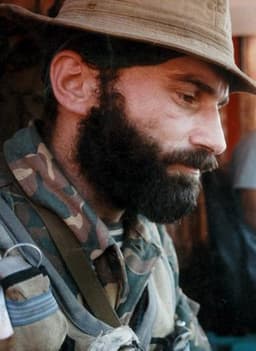
Shamil Basayev
Revolutionary · Modern
43.1Total

Zhang Xianzhong
Revolutionary · Modern
41.1Total
Basic Information
Born
1965
1606
Died
—
1647
Era
Modern
Modern
Nationality
Chechnya
China
Occupation
Revolutionary
Revolutionary
Civilization
Western
Eastern
Score Comparison
Military (10%)
40.0
55.0
Political (20%)
35.0
35.0
Influence (20%)
45.5
44.8
Legacy (20%)
35.0
40.0
Leadership (15%)
57.1
35.4
Strategy (15%)
51.7
38.3
TOTAL
43.1
41.1
Shamil Basayev — Complete Timeline
1995 AD
Budyonnovsk Hospital Hostage CrisisWar◆ Major
Basayev led a raid on the Russian town of Budyonnovsk, taking over 1,000 hostages in a hospital. The crisis ended with a negotiated settlement that allowed him to return to Chechnya. This attack demonstrated Chechen reach into Russia.
Hostage CrisisTerrorismChechnya
Impact: nationaldestructive
1999 AD
Invasion of DagestanWar
Basayev led Chechen and Islamist fighters into Dagestan to support local rebels. This invasion triggered the Second Chechen War as Russia responded with a full-scale military campaign. The invasion failed to gain local support.
DagestanChechnyaInvasion
Impact: regionaldestructive
2002 AD
Moscow Theater Hostage CrisisWar◆ Major
Basayev orchestrated the Moscow theater hostage crisis, where Chechen militants took 850 people hostage. Russian forces ended the siege with gas, killing 130 hostages. The attack increased international condemnation of Chechen rebels.
Hostage CrisisTerrorismMoscow
Impact: nationaldestructive
2004 AD
Beslan School SiegeWar◆ Major
Basayev planned the Beslan school siege, where militants took over 1,100 people hostage. The siege ended in a bloody assault, resulting in 334 deaths, mostly children. This attack was widely condemned globally.
Hostage CrisisTerrorismBeslan
Impact: globaltragic
2006 AD
Killed by Russian ExplosivesWar◆ Major
Basayev was killed in Ingushetia when a truck loaded with explosives detonated. Russian intelligence claimed responsibility. His death removed the most prominent Chechen rebel commander.
AssassinationChechnyaRussia
Impact: regional
Zhang Xianzhong — Complete Timeline
1630 AD
Launched Rebellion in ShaanxiWar◆ Major
Zhang Xianzhong joined a peasant rebellion in Shaanxi province during the late Ming dynasty. He quickly rose to become a major rebel leader, gathering a large army and establishing a base of operations in the region.
Ming DynastyRebellionShaanxi
Impact: regionaldestructive
1644 AD
Captured and Sacked ChengduWar◆ Major
Zhang Xianzhong captured the city of Chengdu, the capital of Sichuan province. He then proclaimed the Daxi dynasty and made Chengdu his capital. The capture was accompanied by widespread destruction and massacres of the local population.
Ming-Qing TransitionSichuanMassacre
Impact: regionaldestructive
Proclaimed the Daxi DynastyPolitical Action◆ Major
Zhang Xianzhong proclaimed the Daxi (Great Western) dynasty in Sichuan. He established a government and minted his own coinage. His rule was characterized by extreme violence, including the systematic killing of scholars, officials, and civilians.
Daxi DynastyProclamationSichuan
Impact: regionaldestructive
1647 AD
Killed in Battle Against Qing ForcesWar◆ Major
Zhang Xianzhong was killed in battle against Qing forces in Xichong, Sichuan. His death led to the collapse of the Daxi dynasty. The Qing conquest of Sichuan was completed shortly after, but the province had been devastated by years of warfare.
Qing DynastyBattleDeath
Impact: regionaltragic
Expert Analysis
Shamil Basayev vs Zhang Xianzhong
# The Rebel's Mirror: Zhang Xianzhong and Shamil Basayev
On a September morning in 2004, the world watched in horror as flames engulfed a school in Beslan, North Ossetia, while Chechen militants held over a thousand children and adults hostage. Three hundred and sixty years earlier and half a world away, the city of Chengdu in Sichuan province witnessed a different kind of terror: Zhang Xianzhong, a Chinese rebel leader who had just proclaimed himself emperor of the Daxi dynasty, ordered the systematic slaughter of the city's inhabitants, leaving rivers of blood in the streets. Two revolutionaries, separated by centuries and civilizations, yet bound by a common thread of violence and ambition. What drove these men, and why did their paths lead to such different outcomes?
Origins
Zhang Xianzhong was born in 1606 into the twilight of the Ming dynasty, a time of famine, corruption, and crumbling imperial authority. A peasant from Shaanxi province, he grew up in a world where survival meant cunning and strength. The Ming state, weakened by internal decay and external threats from the Manchu Qing in the north, could no longer feed its people or maintain order. Desperation bred rebellion, and young Zhang found his calling in the chaos.
Shamil Basayev, born in 1965 in the Chechen village of Dyshne-Vedeno, came of age in a different kind of collapse. The Soviet Union, like the Ming dynasty, was an empire in decline. Chechnya, a mountainous region in the Caucasus, had been conquered by Russia in the 19th century, and its people nursed a deep resentment against Moscow. Basayev was named after Imam Shamil, the legendary Chechen leader who had fought the Russian Empire for decades. The name was both a blessing and a burden.
Rise to Power
Zhang Xianzhong's rise was swift and brutal. In 1630, he joined a peasant rebellion in Shaanxi, and his charisma and ruthlessness quickly propelled him to leadership. By 1644, as the Ming dynasty collapsed under the weight of famine, rebellion, and Manchu invasion, Zhang captured Chengdu, the capital of Sichuan. There, he proclaimed the Daxi dynasty, minted his own coins, and established a government. But his rule was built on terror: he massacred entire populations, destroyed cities, and reduced Sichuan to a wasteland.
Basayev's path was equally violent but shaped by modern warfare. In 1995, he led the Budyonnovsk hospital hostage crisis, taking over 1,000 hostages to force Russian negotiations. The crisis ended with a ceasefire that gave Chechen fighters a temporary victory. In 1999, he invaded Dagestan, triggering the Second Chechen War. By 2002, he orchestrated the Moscow theater hostage crisis, where 850 people were taken hostage. The siege ended in a bloody Russian assault. In 2004, he planned the Beslan school siege, a tragedy that would define his legacy.
Leadership & Governance
Zhang Xianzhong's governance was a paradox. He established a court, minted currency, and attempted to create a functioning state. But his rule was marred by paranoia and cruelty. He massacred not only his enemies but also his own officials, scholars, and even peasants. His military strategy relied on terror: he believed that fear would ensure loyalty. Yet his political wisdom was nonexistent. He alienated the very people he needed to rule.
Basayev, by contrast, was a master of asymmetric warfare. He understood that he could not defeat Russia in a conventional battle, so he turned to hostage-taking and terrorism. His military score of 55.8 reflects his tactical skill, but his political score of 38.8 reveals his failure to build a sustainable movement. Unlike Zhang, Basayev never attempted to govern. He was a guerrilla commander, not a statesman. His vision was destruction, not construction.
Triumph & Tragedy
Zhang Xianzhong's greatest moment was his capture of Chengdu and the proclamation of the Daxi dynasty. For a brief moment, he was an emperor. But his greatest failure was his inability to consolidate power. His massacres depopulated Sichuan, leaving the province vulnerable to conquest by the Qing. In 1647, he was killed in battle against Qing forces in Xichong. His dynasty collapsed with him.
Basayev's greatest triumph was the Budyonnovsk hospital siege, which forced Russia to negotiate. But his greatest tragedy was Beslan. The siege ended in a bloodbath, with over 330 dead, half of them children. Basayev's reputation, already tarnished, was forever stained. In 2006, he was killed in Ingushetia when a truck loaded with explosives detonated. Russian intelligence claimed responsibility.
Character & Destiny
Zhang Xianzhong was a product of his time. The late Ming dynasty was a world of chaos, where mercy was weakness and cruelty was strength. He believed that only through absolute terror could he secure his rule. But his paranoia consumed him. He trusted no one, and no one trusted him.
Basayev was also a product of his time—the post-Soviet chaos of the 1990s. He believed that only through violence could Chechnya achieve independence. But his methods alienated the international community and even many Chechens. He became a symbol of terror, not freedom.
Legacy
Zhang Xianzhong is remembered in China as a monster. His massacres are a dark chapter in Chinese history. The Qing dynasty used his brutality to justify their conquest, and later historians condemned him as a villain. His legacy score of 56.0 reflects this mixed memory.
Basayev is remembered in Chechnya as a freedom fighter, but in Russia and the West as a terrorist. His legacy score of 47.7 is lower, reflecting the controversy surrounding his methods. Both men left behind a trail of blood and a question that haunts history: Can violence ever be justified in the pursuit of power?
Conclusion
Two rebels, two worlds, one truth: the path of violence leads to destruction. Zhang Xianzhong and Shamil Basayev were products of their eras, shaped by collapse and chaos. But their stories are not just about their times—they are about the human capacity for cruelty and the tragic consequences of ambition unchecked by wisdom. As we look back at their lives, we are reminded that history is not just a record of events but a mirror reflecting our own choices. What would we do in their place? Perhaps that is the most unsettling question of all.
Rankings
🥇
Shamil BasayevLeader
Mil: 40.0Pol: 35.0Inf: 45.5
43.1
🥈
Zhang Xianzhong
Mil: 55.0Pol: 35.0Inf: 44.8
41.1
+2.0 behind
How This Comparison Works
Algorithm
Each figure is scored on 6 dimensions (0—100 scale) based on structured historical data: Military (10%), Political (20%), Influence (20%), Legacy (20%), Leadership (15%), Strategy (15%). The weighted total produces the final ranking.
Data Sources
Scores are computed from structured sub-indicators in the database. Scale factors adjust for era (Ancient ×0.85, Modern ×1.0) and civilization size (Eastern ×1.05, Other ×0.80) to account for differences in population and military scale.
Maximum 3 Figures
Comparisons are limited to 2—3 figures to ensure readability and statistical meaningfulness.
Error Margins
±5 points per dimension — Sub-scores are derived from historical records with inherent uncertainty. Two figures within 5 points on a dimension should be considered roughly equivalent in that area.
Total Score Accuracy
±3 points overall — The weighted combination of 6 dimensions produces a total score with approximately ±3 points of uncertainty. Differences of less than 3 points are not statistically significant— the figures are effectively tied.
Known Limitations
- Historical records are incomplete and uneven across civilizations
- Figures from oral-tradition societies may be underrepresented
- Occupation labels can misclassify multi-role figures
- Scores measure capability and impact, not moral character
- Quantitative scoring is a comparison tool, not absolute truth
Capability Radar
Military (10%) — Battles & Warfare
Battles
45
55
Win Rate
40
50
Expansion
15
60
Political (20%) — Governance & Reform
Reform
5
5
Diplomacy
10
10
Economy
5
5
Influence (20%) — Cultural & Global Reach
Cultural
20
20
Global
20
15
Legacy (20%) — Historical Impact
Historical
25
35
Longevity
15
25
Leadership (15%) — Power & Stability
Tenure
10
30
Stability
5
5
Strategy (15%) — Tactics & Innovation
Strategy
35
40
Tactics
55
45
Reform
20
10
Similar Comparisons
Comments & Discussion
Basayev’s Fuse6/16/2026
Comparing Basayev to Zhang is like comparing a nuclear bomb to a cannon. Basayev's terror was tactical: Beslan was a calculated, asymmetrical attack against a modern state—Russia. Zhang's massacres were brutal housecleaning, wiping out Sichuan’s elite to secure a newborn dynasty. One aimed to cripple a superpower; the other, to erase a city. Context is everything, and lumping them as "rebels" ignores the strategic DNA of 2004 versus 1647.
数据铁匠6/16/2026
不懂数字就爱瞎类比。张献忠在四川屠了多少人?保守估计几百万,现代学者说可能上千万——将近当时四川人口的一半。巴萨耶夫呢?别斯兰死了334人,包括186个孩子。一个是种族灭绝级的大屠杀,一个是恐怖主义暴行。量级完全不同。非要把两个放一起比,不是历史盲就是故意煽情。
Classical Violence Analyst6/16/2026
Call them both rebels if you must, but their bodies tell different stories. Zhang Xianzhong’s legend was a Chinese emperor’s nightmare—the "Sichuan massacre" wiped out entire clans and rewrote provincial history for centuries. Basayev, meanwhile, was a sovereign fighter in a war Chechnya actually won for a time. One destroyed a civilization; the other fought for one. That's not a mirror—it's a funhouse reflection.
历史正名者6/16/2026
你们把巴萨耶夫和张献忠并列,是不是太抬举张献忠了?张是个内战的产物,干的事很野蛮,但本质上是个旧式军阀——屠城、抢粮、称帝。巴萨耶夫可是现代恐怖主义的标志性人物,他的行动有录像、有宣言、有全球影响。张献忠的历史形象多半是清朝瞎编的,而巴萨耶夫是凭自己本事打下了“恐怖分子”的烙印。别混为一谈。