Loading...
Rurik vs Zhao Kuangyin
Zhao Kuangyin leads by 11.9 pts · 2 figures compared
…
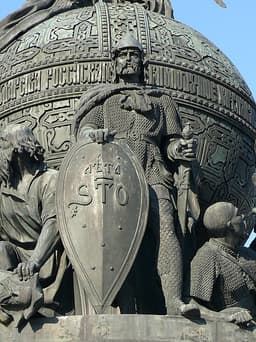
Rurik
Emperor · Medieval
59.6Total
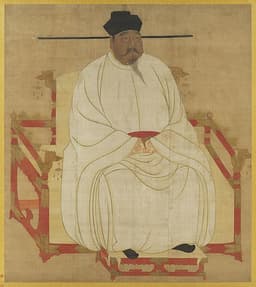
Zhao Kuangyin
Emperor · Medieval
71.5Total
Basic Information
Born
830
927
Died
879
976
Era
Medieval
Medieval
Nationality
Kievan Rus
China
Occupation
Emperor
Emperor
Civilization
Western
Eastern
Score Comparison
Military (10%)
50.0
78.0
Political (20%)
35.1
84.0
Influence (20%)
82.0
68.0
Legacy (20%)
68.0
65.0
Leadership (15%)
55.3
74.0
Strategy (15%)
35.7
68.0
TOTAL
59.6
71.5
Rurik — Complete Timeline
860 AD
Sent Askold and Dir to ConstantinopleWar
According to tradition, Rurik sent his lieutenants Askold and Dir to raid Constantinople. While the historicity is uncertain, this event is associated with the first Rus' attack on the Byzantine Empire, highlighting early Rus' expansion.
RaidByzantine EmpireExpansion
Impact: regional
862 AD
Founded the Rurik dynastyPolitical Action
According to the Primary Chronicle, Rurik, a Varangian chieftain, was invited by Slavic and Finnic tribes to rule over them. He established his capital at Novgorod, founding the Rurik dynasty that would rule Kievan Rus' and later the Tsardom of Russia until 1598.
FoundationVarangianKievan Rus'
Impact: global
864 AD
Consolidated control over NovgorodPolitical Action◆ Major
Rurik consolidated his rule over Novgorod and the surrounding territories, suppressing a rebellion led by Vadim the Bold. He established a centralized authority that became the basis for the early Russian state.
ConsolidationNovgorodRebellion
Impact: regional
Zhao Kuangyin — Complete Timeline
960 AD
Founded Song dynastyPolitical Action
Zhao Kuangyin, a general of Later Zhou, was proclaimed emperor by his troops at Chenqiao. He established the Song dynasty, ending the Five Dynasties period and beginning a new era of Chinese history.
Song dynastyFoundingChenqiao
Impact: globalconstructive
961 AD
Removed military power from generalsPolitical Action◆ Major
Zhao Kuangyin invited senior generals to a banquet and persuaded them to retire peacefully. This 'removal of military power over wine' prevented military coups and centralized control.
Song dynastyMilitary reformCentralization
Impact: nationalconstructive
963 AD
Unified southern ChinaWar◆ Major
Zhao Kuangyin launched campaigns to conquer the southern kingdoms, including Jingnan, Later Shu, and Southern Tang. By his death, most of China was reunified under Song rule.
Song unificationConquestSouthern kingdoms
Impact: national
Expert Analysis
Zhao Kuangyin vs Rurik
# The Emperor Who Let Go and the Chieftain Who Held On
On a spring evening in 961, the most powerful general in China invited his old comrades to a banquet. Wine flowed, music played, and the mood was warm. Then, as the candles burned low, Zhao Kuangyin sighed and said to his guests: “I lie awake at night, unable to sleep. You see, everyone wants to be emperor.” The generals froze. But instead of ordering their execution, he offered them wealth, land, and peaceful retirement. They accepted. Across the world, two centuries earlier, another warlord named Rurik had taken the opposite path—clutching power with iron fingers, founding a dynasty that would rule for seven hundred years. Why did one emperor choose to let go, while the other held on with all his might?
Origins
Zhao Kuangyin was born in 927 into a military family serving the crumbling Tang dynasty’s successor states. China had splintered into the Five Dynasties and Ten Kingdoms—an age of constant war where no general trusted his neighbor, and coups were as common as harvests. Zhao grew up watching emperors rise and fall like autumn leaves. He learned that power built on swords could be shattered by swords.
Rurik emerged from the mists of the 830s, a Varangian chieftain from Scandinavia. The Primary Chronicle tells us he was “invited” by Slavic and Finnic tribes to rule over them—a story that may be more legend than fact. But whether invited or conqueror, Rurik operated in a world where the only law was the sword. The vast forests and rivers of the East European Plain offered no stable empires, only scattered tribes and trading posts. To survive, a leader had to be ruthless.
Rise to Power
Zhao Kuangyin’s path was forged in battle. As a general of the Later Zhou dynasty, he proved himself a brilliant commander, winning campaigns against Northern Han and Southern Tang. In 960, when the child emperor of Later Zhou faced a sudden invasion, Zhao’s troops marched north—then stopped at Chenqiao. There, his soldiers draped a yellow robe over his shoulders and proclaimed him emperor. Zhao accepted, but he knew the danger: he had just done what he had seen done a dozen times before. He was now the usurper, and every general in the realm knew how the game was played.
Rurik’s rise is shrouded in uncertainty. According to tradition, in 862 he established himself at Novgorod, a key trading post on the route from the Baltic to Byzantium. Two years later, he crushed a rebellion led by a local strongman named Vadim the Bold. If the story is true, Rurik’s power came not from acclamation but from conquest—and he held it through fear. He sent his lieutenants Askold and Dir to raid Constantinople in 860, projecting force far beyond his borders. He was building not an empire, but a pirate kingdom.
Leadership & Governance
Here the two men diverged completely. Zhao Kuangyin’s genius was in disarming power. After the famous banquet of 961, he redistributed military commands, centralized control of the army, and promoted civil officials over generals. He spent the next decade conquering the southern kingdoms—Jingnan, Later Shu, Southern Tang—but he did so with a system designed to prevent any single commander from becoming too powerful. His political score of 75.9 reflects this: he was not a conqueror but a consolidator, a man who understood that lasting rule requires legitimacy, not just force.
Rurik, with a political score of 51.2, governed differently. He ruled Novgorod through personal loyalty and the threat of violence. There were no civil bureaucracies, no Confucian scholars, no peaceful retirements. His leadership score of 79.7 suggests he was charismatic enough to hold a band of warriors together, but his strategy score of 52.0 reveals a chieftain who thought in terms of raids and tribute, not long-term institution-building. He left behind a dynasty, but not a system.
Triumph & Tragedy
Zhao Kuangyin’s greatest triumph was the unification of China—a feat that had eluded all the warlords of the Five Dynasties. By 976, he had brought the south under Song control and was preparing to march north against the Liao dynasty. But then, at age 49, he died suddenly—possibly murdered by his own brother, who succeeded him as Emperor Taizong. His tragedy was that he never completed his work. The northern border would remain a wound for the Song dynasty’s entire history.
Rurik’s triumph was simpler: he founded a dynasty. His tragedy is that we know almost nothing about him. The Primary Chronicle’s account is a mix of folklore and political myth. Did he really exist? Was he a single man or a composite of several chieftains? His military score of 41.5 suggests he was no great general, but his influence score of 68.7 shows that the legend mattered more than the man. He became the ancestor of the rulers of Kievan Rus’, and later of Russia itself—a symbolic father to a nation.
Character & Destiny
Zhao Kuangyin was a man who understood the psychology of power. He knew that the greatest threat to his rule was not foreign invasion but his own generals. So he traded their swords for silk robes. He knew that the Song dynasty could not survive if it followed the patterns of the Five Dynasties, where every general dreamed of a yellow robe. His leadership score of 82.3 reflects this rare wisdom: he was a ruler who could see beyond his own ambition.
Rurik was a man of his time—a Viking chieftain in a brutal world. He held what he took, and he took what he could. His leadership score of 79.7 suggests he was respected, even feared, but his legacy was built on blood and uncertainty. He did not build institutions; he built a bloodline. And that bloodline would outlast him by centuries, but it would also carry the seeds of endless conflict.
Legacy
Zhao Kuangyin left behind a dynasty that ruled China for over three hundred years. The Song dynasty became an age of prosperity, culture, and innovation—but also of military weakness, precisely because Zhao had disarmed the generals. His solution to the problem of usurpation created a new problem: vulnerability to invasion. His legacy score of 75.1 reflects this mixed achievement: he unified China but left it defenseless.
Rurik left behind a dynasty that ruled Russia until 1598. The Rurikids would produce Ivan the Terrible and the founders of the Russian state. But Rurik himself remains a shadow, a symbol more than a man. His legacy score of 68.7 is lower than Zhao’s, not because his dynasty was less important, but because his personal achievements were so uncertain. He is remembered for what he started, not for what he did.
Conclusion
Two men, two worlds. One chose to let go, the other to hold on. Zhao Kuangyin’s banquet of 961 was a stroke of political genius—but it also created a dynasty that would eventually fall to invaders. Rurik’s iron grip founded a royal line that would last centuries—but it also ensured that Russia would be ruled by autocrats, not institutions. The difference between them was not in strength or courage, but in vision. Zhao saw that power must be shared to be stable; Rurik saw that power must be held to be real. Both were right, and both were wrong. And the nations they shaped still live with the consequences.
Rankings
🥇
Zhao KuangyinLeader
Mil: 78.0Pol: 84.0Inf: 68.0
71.5
🥈
Rurik
Mil: 50.0Pol: 35.1Inf: 82.0
59.6
+11.9 behind
How This Comparison Works
Algorithm
Each figure is scored on 6 dimensions (0—100 scale) based on structured historical data: Military (10%), Political (20%), Influence (20%), Legacy (20%), Leadership (15%), Strategy (15%). The weighted total produces the final ranking.
Data Sources
Scores are computed from structured sub-indicators in the database. Scale factors adjust for era (Ancient ×0.85, Modern ×1.0) and civilization size (Eastern ×1.05, Other ×0.80) to account for differences in population and military scale.
Maximum 3 Figures
Comparisons are limited to 2—3 figures to ensure readability and statistical meaningfulness.
Error Margins
±5 points per dimension — Sub-scores are derived from historical records with inherent uncertainty. Two figures within 5 points on a dimension should be considered roughly equivalent in that area.
Total Score Accuracy
±3 points overall — The weighted combination of 6 dimensions produces a total score with approximately ±3 points of uncertainty. Differences of less than 3 points are not statistically significant— the figures are effectively tied.
Known Limitations
- Historical records are incomplete and uneven across civilizations
- Figures from oral-tradition societies may be underrepresented
- Occupation labels can misclassify multi-role figures
- Scores measure capability and impact, not moral character
- Quantitative scoring is a comparison tool, not absolute truth
Capability Radar
Military (10%) — Battles & Warfare
Battles
15
75
Win Rate
20
85
Expansion
30
75
Political (20%) — Governance & Reform
Reform
30
90
Diplomacy
35
85
Economy
25
80
Influence (20%) — Cultural & Global Reach
Cultural
50
70
Global
60
60
Legacy (20%) — Historical Impact
Historical
70
80
Longevity
80
75
Leadership (15%) — Power & Stability
Tenure
40
65
Stability
30
85
Strategy (15%) — Tactics & Innovation
Strategy
20
80
Tactics
15
70
Reform
10
90
Similar Comparisons
Comments & Discussion
数据拆解师6/16/2026
拿两个不同时空的人对比就是耍流氓。赵匡胤杯酒释兵权是在961年,那时中国已有成熟文官体系;留里克在830年代接手的可是东欧原始部落联盟,不攥紧刀把子连三天都活不过。宋太祖能“仁慈”是因为有科举制度托底,留里克连字母都没有。要我说,这种比较就是拿明朝的剑斩清朝的官——完全关公战秦琼。
Varangian Logistics6/16/2026
Funny how Chinese historians romanticize Zhao’s “restraint” while ignoring that he literally stole the throne from a child emperor. Rurik at least waited for an invitation—even if the chronicle is propaganda. Zhao’s banquet was just a PR stunt; he still executed generals who refused to retire, like Li Chongjin in 963. The Varangian model actually worked: Rurik’s descendants created the first East Slavic state, Kyivan Rus’, with trade and law codes. Zhao’s “peaceful” centralization? It eventually
历史课代表6/16/2026
别被“杯酒释兵权”骗了,赵匡胤的温柔刀杀人不见血。他把禁军将领全部换成自己心腹,还搞出更戍法让兵不识将、将不识兵——这哪是仁慈?这是对武将系统性不信任的极致表现。反观留里克,虽然手段硬,但诺曼人那套“勇士契约”反而激发了亲兵忠诚度。宋太祖留下的软弱基因,直接导致后来幽云十六州永远拿不回来;而留里克的后代伊戈尔还敢打君士坦丁堡呢。谁更有种,一目了然。
Golden Cangue6/16/2026
You’re all missing the real story: Zhao’s “letting go” was a control freak’s masterpiece. By granting generals honorary titles with no real power, he essentially created a golden cage for the military class. Rurik’s “holding on” was just standard Viking practice—share loot to keep loyalty
Historian9336/16/2026
Zhao’s cup-removing act wasn't benevolence—it was cold calculus. He’d seen five dynasties fall in fifty-three years because generals kept staging coups. By buying off his comrades with silk and sinecures, he created China’s most stable civil bureaucracy. Meanwhile, Rurik’s iron grip birthed seven centuries of fratricidal princely wars. One emperor broke the cycle of violence; one chieftain imported it. The numbers don’t lie: Song China lasted 319 years; Rurik’s dynasty managed 740—but at what co