Loading...
Rurik vs Yuwen Yong
Yuwen Yong leads by 7.6 pts · 2 figures compared
…
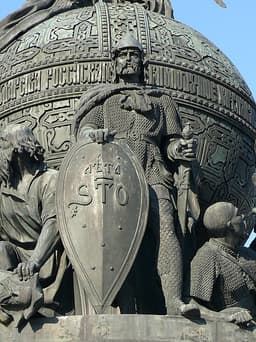
Rurik
Emperor · Medieval
59.6Total
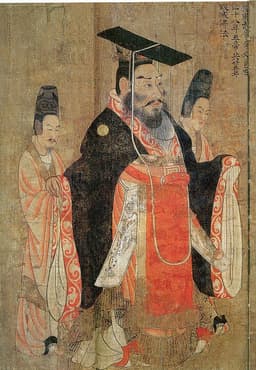
Yuwen Yong
Emperor · Medieval
67.2Total
Basic Information
Born
830
543
Died
879
578
Era
Medieval
Medieval
Nationality
Kievan Rus
China
Occupation
Emperor
Emperor
Civilization
Western
Eastern
Score Comparison
Military (10%)
50.0
78.0
Political (20%)
35.1
78.0
Influence (20%)
82.0
58.0
Legacy (20%)
68.0
54.0
Leadership (15%)
55.3
85.0
Strategy (15%)
35.7
69.1
TOTAL
59.6
67.2
Rurik — Complete Timeline
860 AD
Sent Askold and Dir to ConstantinopleWar
According to tradition, Rurik sent his lieutenants Askold and Dir to raid Constantinople. While the historicity is uncertain, this event is associated with the first Rus' attack on the Byzantine Empire, highlighting early Rus' expansion.
RaidByzantine EmpireExpansion
Impact: regional
862 AD
Founded the Rurik dynastyPolitical Action
According to the Primary Chronicle, Rurik, a Varangian chieftain, was invited by Slavic and Finnic tribes to rule over them. He established his capital at Novgorod, founding the Rurik dynasty that would rule Kievan Rus' and later the Tsardom of Russia until 1598.
FoundationVarangianKievan Rus'
Impact: global
864 AD
Consolidated control over NovgorodPolitical Action◆ Major
Rurik consolidated his rule over Novgorod and the surrounding territories, suppressing a rebellion led by Vadim the Bold. He established a centralized authority that became the basis for the early Russian state.
ConsolidationNovgorodRebellion
Impact: regional
Yuwen Yong — Complete Timeline
574 AD
Suppression of Buddhism in Northern ZhouReform◆ Major
Emperor Wu of Northern Zhou (Yuwen Yong) ordered the suppression of Buddhism, confiscating monastic lands, forcing monks and nuns to return to lay life, and destroying temples. He aimed to increase state revenue and military manpower, strengthening the state.
Northern ZhouBuddhist PersecutionReform
Impact: nationaldestructive
577 AD
Conquest of Northern QiWar
Emperor Wu led a successful campaign against the rival Northern Qi dynasty, conquering its territory and unifying northern China under Northern Zhou. This victory ended the division of the north and set the stage for the Sui dynasty's unification of all China.
Northern ZhouUnificationNorthern Qi
Impact: regionalconstructive
578 AD
Death during campaign against the TurksWar◆ Major
Emperor Wu died of illness while leading a campaign against the G
Northern ZhouMilitary CampaignDeath
Impact: regionaltragic
Expert Analysis
Yuwen Yong vs Rurik
### The Chieftain and the Emperor: Two Paths to Founding a Dynasty
In the misty forests of what would one day become Russia, a Varangian chieftain named Rurik accepted an invitation from warring Slavic tribes to bring order to their lands. Half a continent away, in the war-scorched plains of northern China, a prince named Yuwen Yong seized an empire and set out to reshape the spiritual and political landscape of his world. Both men founded dynasties that would echo through centuries, yet their stories could not be more different. One is a figure shrouded in legend, his very existence debated; the other is a concrete emperor whose reforms and conquests were written in blood and stone. What drove these two founders to such divergent outcomes? The answer lies not only in their characters but in the very nature of their times.
### Origins
Rurik emerges from the haze of the ninth century, a Varangian—likely a Norse warrior and trader—who, according to the *Primary Chronicle*, was invited around 862 by Slavic and Finnic tribes to rule over them. His historicity is so uncertain that some scholars consider him a purely legendary figure, a mythic ancestor invented to legitimize later rulers. The Vikings of his era were not empire-builders in the Roman or Chinese mold; they were raiders, merchants, and mercenaries who carved out petty kingdoms along river routes from the Baltic to the Black Sea. Rurik’s world was one of fluid loyalties, small-scale warfare, and oral traditions. He was a product of a society where power was personal and fragile.
Yuwen Yong, born in 543, lived in a very different world. He was a member of the Xianbei elite, a nomadic people who had conquered parts of northern China during the chaotic Northern and Southern Dynasties period. His family had already established the Northern Zhou dynasty, and Yuwen Yong grew up in a court steeped in Chinese bureaucratic tradition, Confucian ethics, and Buddhist influence. His era was one of sophisticated statecraft, where emperors commanded armies of hundreds of thousands and issued edicts that could reshape the beliefs of millions. Where Rurik’s power was based on personal charisma and the loyalty of a few hundred warriors, Yuwen Yong’s rested on a complex administrative machine inherited from centuries of Chinese imperial rule.
### Rise to Power
Rurik’s rise was less a conquest than an invitation. According to tradition, the Slavic and Finnic tribes of the region, exhausted by internal strife, sent a message to the Varangians: “Our land is great and rich, but there is no order in it. Come to rule and reign over us.” Rurik accepted, establishing himself first at Ladoga and then consolidating control over Novgorod by 864, suppressing a rebellion led by a local strongman named Vadim the Bold. His path was that of a warlord who became a ruler by consent—or at least by the perception of necessity. He did not conquer a vast territory; he was granted a foothold and expanded it through alliances and force.
Yuwen Yong’s rise was far more deliberate and bloody. He became emperor of Northern Zhou in 560 at the age of seventeen, but real power was held by his cousin Yuwen Hu, a regent who controlled the court and the army. For over a decade, Yuwen Yong played the role of a passive, even foolish, young ruler, biding his time. In 572, he staged a coup, ambushing and killing Yuwen Hu with his own hands. It was a moment of cold, calculated ruthlessness. From that point, he ruled alone, and his rise was a testament to patience, deception, and the willingness to shed family blood for the sake of absolute power.
### Leadership & Governance
Rurik’s leadership was that of a chieftain, not an emperor. He ruled through personal bonds and the distribution of plunder. He sent his lieutenants Askold and Dir to raid Constantinople around 860, a venture that likely failed but demonstrated his ability to project power along the Dnieper River. His governance was minimal: he collected tribute, settled disputes, and defended his territory. He left no law code, no administrative reforms, no religious policy. His legacy was not in the structure he built but in the dynasty he founded—a lineage that would eventually rule the vast state of Kievan Rus’.
Yuwen Yong was a reformer and a conqueror. In 574, he ordered a sweeping suppression of Buddhism, confiscating monastic lands, forcing monks and nuns back into secular life, and destroying temples. This was not mere persecution; it was a strategic move to centralize state power, reclaim tax revenues, and break the influence of a wealthy, autonomous Buddhist establishment. He also reformed the military, blending Xianbei cavalry traditions with Chinese infantry tactics. His greatest achievement came in 577, when he conquered the rival Northern Qi dynasty, unifying northern China under his rule. His governance was systematic, ideological, and aimed at creating a strong, centralized state.
### Triumph & Tragedy
Rurik’s triumph was the founding of a dynasty that would last over 700 years, long after his death. His tragedy is that we know almost nothing about him. He is a symbol, not a man. His greatest achievement—the establishment of the Rurikid line—may not even have been his conscious design. He was a Viking chieftain who happened to be in the right place at the right time, and history turned him into a patriarch.
Yuwen Yong’s triumph was the unification of northern China and the creation of a powerful, reformed state. His tragedy was his death at the age of thirty-five, in 578, while on campaign against the Göktürks. He died of illness, leaving his empire to a son who would squander his father’s gains within years. Had Yuwen Yong lived, he might have conquered the southern Chen dynasty and reunified all of China under the Northern Zhou. Instead, his dynasty collapsed, and it was the Sui dynasty that would achieve his dream.
### Character & Destiny
Rurik’s character is a blank slate, but we can infer that he was pragmatic, adaptable, and perhaps lucky. He did not impose his Norse culture on the Slavs; he merged with them. His destiny was to become a legend, a founding father whose story was told and retold to legitimize the power of his descendants.
Yuwen Yong’s character is more vivid: he was patient, ruthless, and visionary. He waited years to strike against his cousin, then acted with decisive brutality. He suppressed Buddhism not out of personal hatred but out of political calculation. He died young, but his brief reign was packed with ambition. His destiny was to be a tragic hero—a man who almost united China but fell short, a cautionary tale of what might have been.
### Legacy
Rurik’s legacy is immense and intangible. The Rurik dynasty ruled the Kievan Rus’ and later the Tsardom of Russia until the Time of Troubles in the early 17th century. He is remembered as the founder of Russian statehood, even if his historicity is questionable. In Russian national mythology, he is the Viking who brought order to the Slavs, a symbol of the union between Scandinavian vigor and Slavic endurance.
Yuwen Yong’s legacy is more concrete but less celebrated. He weakened Buddhism in northern China, paving the way for the secular Confucian state that would dominate later dynasties. His military and administrative reforms were inherited by the Sui and Tang dynasties, which used them to create the golden age of medieval China. Yet he is often overshadowed by the more famous unifiers, Emperor Wen of Sui and Emperor Taizong of Tang. He is remembered by historians as a capable but harsh ruler, a reformer whose work was completed by others.
### Conclusion
Rurik and Yuwen Yong stand at opposite ends of the spectrum of historical founders. One is a shadow, a name that has become a symbol; the other is a man of flesh and blood, whose decisions can be traced in documents and archaeological remains. One founded a dynasty that lasted centuries; the other built a state that collapsed within a generation. Yet both were products of their times: Rurik, the Viking chieftain of a world without writing, whose legend was written by others; Yuwen Yong, the emperor of a literate civilization, whose story is recorded in annals and chronicles. Their differences remind us that history is not only about what people do but about how their stories are told—and that the most powerful legacies are often the ones we can least verify.
Rankings
🥇
Yuwen YongLeader
Mil: 78.0Pol: 78.0Inf: 58.0
67.2
🥈
Rurik
Mil: 50.0Pol: 35.1Inf: 82.0
59.6
+7.6 behind
How This Comparison Works
Algorithm
Each figure is scored on 6 dimensions (0—100 scale) based on structured historical data: Military (10%), Political (20%), Influence (20%), Legacy (20%), Leadership (15%), Strategy (15%). The weighted total produces the final ranking.
Data Sources
Scores are computed from structured sub-indicators in the database. Scale factors adjust for era (Ancient ×0.85, Modern ×1.0) and civilization size (Eastern ×1.05, Other ×0.80) to account for differences in population and military scale.
Maximum 3 Figures
Comparisons are limited to 2—3 figures to ensure readability and statistical meaningfulness.
Error Margins
±5 points per dimension — Sub-scores are derived from historical records with inherent uncertainty. Two figures within 5 points on a dimension should be considered roughly equivalent in that area.
Total Score Accuracy
±3 points overall — The weighted combination of 6 dimensions produces a total score with approximately ±3 points of uncertainty. Differences of less than 3 points are not statistically significant— the figures are effectively tied.
Known Limitations
- Historical records are incomplete and uneven across civilizations
- Figures from oral-tradition societies may be underrepresented
- Occupation labels can misclassify multi-role figures
- Scores measure capability and impact, not moral character
- Quantitative scoring is a comparison tool, not absolute truth
Capability Radar
Military (10%) — Battles & Warfare
Battles
15
75
Win Rate
20
80
Expansion
30
80
Political (20%) — Governance & Reform
Reform
30
85
Diplomacy
35
70
Economy
25
75
Influence (20%) — Cultural & Global Reach
Cultural
50
40
Global
60
40
Legacy (20%) — Historical Impact
Historical
70
65
Longevity
80
50
Leadership (15%) — Power & Stability
Tenure
40
60
Stability
30
70
Strategy (15%) — Tactics & Innovation
Strategy
20
75
Tactics
15
70
Reform
10
85
Similar Comparisons
Comments & Discussion
塞北刀客6/16/2026
你们这群人比什么比?宇文邕灭佛的时候,北周府兵制改革的细账你们算过吗?他裁撤寺庙没收的铜像,够打多少兵器?鲁里克连墓都找不到,你跟我说他跟宇文邕比?历史不是比谁名气大,是比谁留的遗产硬。宇文邕的均田令和府兵制,直接喂饱了隋唐两朝,这才是真本事。
RurikTheLess6/16/2026
Classic East-West false equivalence. Rurik's "invitation" narrative is basically a Varangian PR stunt that Russian chroniclers wrote centuries later to give the Kievan Rus' some Scandinavian street cred. Meanwhile Yuwen Yong was busy purging Buddhism to consolidate state power - an actual, documented policy with measurable outcomes. One guy might have existed, the other definitely restructured an empire. This isn't a comparison, it's a category error.
守碑人6/16/2026
把鲁里克和宇文邕放一起,本身就是对北周武帝的侮辱。宇文邕亲征北齐时,鲁里克的孙子们还在诺夫哥罗德跟部落酋长抢毛皮呢。一个靠铁血改革、府兵制、灭佛积财统一北方的实干家,跟一个传说中可能存在的维京海盗头子比?我建议你们先去读读《周书》再来聊。
VarangianGhost6/16/2026
Let's be real: Rurik's story is a foundation myth so flimsy that even the Russian Primary Chronicle admits the locals *asked* him to come rule them. That's not a conqueror, that's a medieval temp agency hire. Yuwen Yong personally led cavalry charges, executed his own cousin for corruption, and secularized Buddhist temples to fund his wars. I'll take the guy with confirmed kill counts over a maybe-Viking any day.
Chronicler21606/16/2026
Rurik is a convenient myth for tsars who needed a Nordic daddy to explain why they weren't just steppe barbarians. Yuwen Yong actually existed—we have his edicts, his military campaigns, and his systematic destruction of Buddhist monastic wealth. One is a bedtime story for nationalists, the other is a man who literally fought Daoist alchemists for control of state ideology. Stop comparing legends to emperors.