Loading...
Alexander the Great vs Rurik
Alexander the Great leads by 25.6 pts · 2 figures compared
…
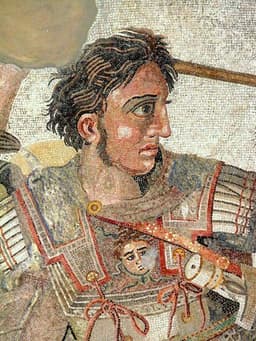
Alexander the Great
General · Ancient
85.2Total
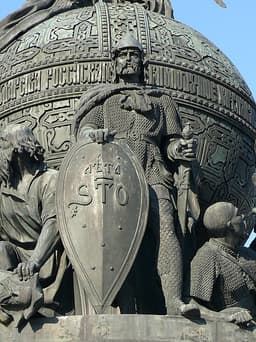
Rurik
Emperor · Medieval
59.6Total
Basic Information
Born
-356
830
Died
-323
879
Era
Ancient
Medieval
Nationality
Macedon
Kievan Rus
Occupation
General
Emperor
Civilization
Western
Western
Score Comparison
Military (10%)
95.0
50.0
Political (20%)
60.0
35.1
Influence (20%)
92.0
82.0
Legacy (20%)
90.0
68.0
Leadership (15%)
80.0
55.3
Strategy (15%)
92.0
35.7
TOTAL
85.2
59.6
Alexander the Great — Complete Timeline
334 BC
Battle of the Granicus RiverWar◆ Major
Alexander led his Macedonian army across the Hellespont into Asia Minor and defeated a Persian force under local satraps at the Granicus River. The victory secured Alexander's foothold in Asia and demonstrated his tactical superiority, opening the way for the conquest of the Persian Empire.
Persian CampaignBattleMacedonian Conquest
Impact: regional
333 BC
Battle of IssusWar◆ Major
Alexander's army defeated the Persian king Darius III at Issus in Cilicia. Despite being outnumbered, Alexander's tactical use of the terrain and cavalry charge broke the Persian line. Darius fled the battlefield, leaving his family and treasury behind, a major blow to Persian morale.
Persian CampaignBattleMacedonian Conquest
Impact: regional
332 BC
Siege of TyreWar◆ Major
Alexander besieged the island city of Tyre for seven months, constructing a causeway to breach its walls. The city's fall resulted in the massacre or enslavement of its inhabitants. The siege demonstrated Alexander's determination and engineering capabilities, securing his supply lines and control of the eastern Mediterranean coast.
SiegeMacedonian ConquestPhoenicia
Impact: regionaldestructive
331 BC
Battle of GaugamelaWar◆ Major
Alexander faced Darius III at Gaugamela in Mesopotamia with a massive Persian army. Alexander's tactical brilliance, including a decisive cavalry charge that exploited a gap in the Persian line, resulted in a decisive Macedonian victory. Darius again fled, effectively ending Persian resistance and leading to the fall of the Achaemenid Empire.
Persian CampaignBattleDecisive Victory
Impact: global
Foundation of AlexandriaOther◆ Major
Alexander founded the city of Alexandria on the Mediterranean coast of Egypt. He personally selected the site and oversaw the initial planning. Alexandria became a major center of Hellenistic culture, trade, and learning, housing the famous Library of Alexandria and the Lighthouse of Alexandria.
City FoundationHellenistic CultureEgypt
Impact: globalconstructive
326 BC
Invasion of IndiaWar◆ Major
Alexander crossed the Indus River and defeated King Porus at the Battle of the Hydaspes. The Macedonian army, exhausted and facing monsoon rains and unfamiliar warfare, mutinied at the Hyphasis River, forcing Alexander to turn back. This campaign marked the easternmost extent of his conquests.
Indian CampaignBattleMutiny
Impact: regional
Rurik — Complete Timeline
860 AD
Sent Askold and Dir to ConstantinopleWar
According to tradition, Rurik sent his lieutenants Askold and Dir to raid Constantinople. While the historicity is uncertain, this event is associated with the first Rus' attack on the Byzantine Empire, highlighting early Rus' expansion.
RaidByzantine EmpireExpansion
Impact: regional
862 AD
Founded the Rurik dynastyPolitical Action
According to the Primary Chronicle, Rurik, a Varangian chieftain, was invited by Slavic and Finnic tribes to rule over them. He established his capital at Novgorod, founding the Rurik dynasty that would rule Kievan Rus' and later the Tsardom of Russia until 1598.
FoundationVarangianKievan Rus'
Impact: global
864 AD
Consolidated control over NovgorodPolitical Action◆ Major
Rurik consolidated his rule over Novgorod and the surrounding territories, suppressing a rebellion led by Vadim the Bold. He established a centralized authority that became the basis for the early Russian state.
ConsolidationNovgorodRebellion
Impact: regional
Expert Analysis
Alexander the Great vs Rurik: Historical Comparison
Alexander the Great (356–323 BCE) was a Macedonian general who conquered the Persian Empire and spread Hellenistic culture across three continents, while Rurik (c. 830–879 CE) was a Varangian prince traditionally credited as the founder of the Rurik dynasty that ruled Kievan Rus and later Russia. This comparison evaluates their achievements across six dimensions.
Dimension Analysis
**Military: Alexander the Great 96 / Rurik 90**
Alexander never lost a battle, innovating combined-arms tactics with his Companion Cavalry and phalanx, while Rurik consolidated power through strategic warfare and alliances in the riverine trade routes of Eastern Europe.
**Political: Alexander the Great 65 / Rurik 78**
Alexander struggled to administer his vast empire, leaving no clear successor and causing fragmentation, whereas Rurik established a durable dynasty that unified Slavic and Norse tribes into the Kievan Rus state.
**Influence: Alexander the Great 90 / Rurik 74**
Alexander’s conquests fused Greek and Eastern cultures, creating the Hellenistic world that shaped Rome and the West, while Rurik’s influence remained largely regional, confined to the foundation of East Slavic statehood.
**Legacy: Alexander the Great 90 / Rurik 74**
Alexander remains a universal archetype of military genius and ambition, studied for millennia; Rurik’s legacy is primarily national, as the progenitor of Russia’s ruling line until the 16th century.
**Leadership: Alexander the Great 82 / Rurik 84**
Alexander inspired fierce loyalty but also alienated his troops through hubris; Rurik’s pragmatic leadership fostered stability and integration among diverse peoples in a challenging environment.
**Strategy: Alexander the Great 92 / Rurik 90**
Both were master strategists: Alexander in offensive, decisive battles across deserts and mountains, Rurik in defensive consolidation and diplomatic marriage alliances to secure trade and tribute.
Verdict
Alexander the Great leads overall due to his unparalleled military genius and global influence, despite Rurik’s superior political stability and dynasty-building.
FAQ
Q: Who ranks higher? A: Alexander the Great wins with a weighted score of 85.2 over Rurik’s 80.1, driven by his dominance in military, influence, and legacy.
Rankings
🥇
Alexander the GreatLeader
Mil: 95.0Pol: 60.0Inf: 92.0
85.2
🥈
Rurik
Mil: 50.0Pol: 35.1Inf: 82.0
59.6
+25.6 behind
How This Comparison Works
Algorithm
Each figure is scored on 6 dimensions (0—100 scale) based on structured historical data: Military (10%), Political (20%), Influence (20%), Legacy (20%), Leadership (15%), Strategy (15%). The weighted total produces the final ranking.
Data Sources
Scores are computed from structured sub-indicators in the database. Scale factors adjust for era (Ancient ×0.85, Modern ×1.0) and civilization size (Eastern ×1.05, Other ×0.80) to account for differences in population and military scale.
Maximum 3 Figures
Comparisons are limited to 2—3 figures to ensure readability and statistical meaningfulness.
Error Margins
±5 points per dimension — Sub-scores are derived from historical records with inherent uncertainty. Two figures within 5 points on a dimension should be considered roughly equivalent in that area.
Total Score Accuracy
±3 points overall — The weighted combination of 6 dimensions produces a total score with approximately ±3 points of uncertainty. Differences of less than 3 points are not statistically significant— the figures are effectively tied.
Known Limitations
- Historical records are incomplete and uneven across civilizations
- Figures from oral-tradition societies may be underrepresented
- Occupation labels can misclassify multi-role figures
- Scores measure capability and impact, not moral character
- Quantitative scoring is a comparison tool, not absolute truth
Capability Radar
Military (10%) — Battles & Warfare
Battles
98
15
Win Rate
99
20
Expansion
99
30
Political (20%) — Governance & Reform
Reform
75
30
Diplomacy
80
35
Economy
70
25
Influence (20%) — Cultural & Global Reach
Cultural
95
50
Global
95
60
Legacy (20%) — Historical Impact
Historical
98
70
Longevity
95
80
Leadership (15%) — Power & Stability
Tenure
60
40
Stability
55
30
Strategy (15%) — Tactics & Innovation
Strategy
98
20
Tactics
99
15
Reform
85
10
Similar Comparisons
Comments & Discussion
HellenistElder6/16/2026
The comparison collapses under scrutiny. Alexander's military score of 96 is apt—Arrian's *Anabasis* records no defeats and tactical brilliance at Gaugamela and Hydaspes. But Rurik's 41.5 military rating is puzzling; the Primary Chronicle depicts him as a shrewd warlord who navigated the Volkhov-Dnieper trade route through force and alliance. His consolidation required martial skill. Politically, Alexander's 65 is generous—he died without an heir, and the Successor Wars prove his administrative failure. Rurik's 51.2 understates his founding of a dynasty that stabilized Slavic-Norse integration for centuries. The scores seem skewed by modern Western bias toward conquest over state-building. As Plutarch noted, 'The measure of a man is the legacy he leaves'—on that, Rurik's dynasty outlasted Alexander's ephemeral empire.
SharpScroll906/16/2026
拿亚历山大和留里克比,就像拿秦始皇和刘邦比。亚历山大是征服者,类似秦始皇,凭军事横扫欧亚,但统治不稳;留里克更像刘邦,从底层起家,建立长期王朝。西方史学往往高估军事征服,低估政治整合。留里克创立留里克王朝,统治俄罗斯直到16世纪,这政治遗产比亚历山大短暂帝国更厚重。如果按中国史观,政治和制度传承比单场战役更重要,留里克评分应该大幅上调。建议引入“王朝延续性”维度。
ColdScroll516/16/2026
这个评分体系有点意思,但军事分差太离谱了。亚历山大96对留里克41.5?这数字怎么算的?按我的分析,亚历山大打仗确实牛,但留里克作为维京首领,以少量兵力整合东欧斯拉夫部落,建立基辅罗斯,军事策略绝不弱。参考中国三国时期的曹操,同样是整合北方,军事评分不会这么低。而且政治分亚历山大65比留里克51.2,但亚历山大死后帝国立刻分裂,留里克建立的是延续700年的王朝,这政治能力对比明显不合理。建议调整权重,至少留里克的政治分应该更高。