Loading...
Ramon Castilla vs Shi Dakai
Ramon Castilla leads by 0.1 pts · 2 figures compared
…
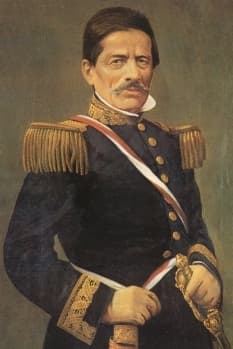
Ramon Castilla
General · Modern
59.7Total
Shi Dakai
General · Modern
59.6Total
Basic Information
Born
1797
1831
Died
1867
1863
Era
Modern
Modern
Nationality
Peru
China
Occupation
General
General
Civilization
Western
Eastern
Score Comparison
Military (10%)
40.0
76.0
Political (20%)
72.0
45.0
Influence (20%)
56.7
56.7
Legacy (20%)
52.0
54.0
Leadership (15%)
78.0
72.0
Strategy (15%)
60.0
68.1
TOTAL
59.7
59.6
Ramon Castilla — Complete Timeline
1824 AD
Battle of AyacuchoWar
Castilla fought as a junior officer in the decisive Battle of Ayacucho, which ended Spanish rule in Peru. This victory secured Peruvian independence and marked the end of the Spanish Empire in South America, shaping Castilla's nationalist views.
Peruvian War of IndependenceBattleLiberation
Impact: regional
1845 AD
First Presidency of PeruPolitical Action◆ Major
Castilla was elected President of Peru in 1845, serving until 1851. His first term focused on economic development, including the guano boom, and infrastructure projects such as railroads and ports, modernizing the Peruvian state.
PresidencyEconomic DevelopmentGuano
Impact: nationalconstructive
1854 AD
Abolition of Slavery in PeruReform◆ Major
During his second presidency, Castilla issued a decree abolishing slavery in Peru on December 3, 1854. This reform freed approximately 25,000 slaves and was part of a broader liberal agenda, though it faced opposition from slave-owning elites.
AbolitionSlaveryHuman Rights
Impact: nationalprogressive
Abolition of Indigenous TributeReform◆ Major
Castilla also abolished the indigenous tribute tax in 1854, which had been a burden on native communities since colonial times. This measure aimed to integrate indigenous peoples into the Peruvian state as equal citizens, though its implementation was uneven.
Indigenous RightsTax ReformCitizenship
Impact: nationalprogressive
1855 AD
Second Presidency and Guano BoomPolitical Action◆ Major
Castilla served a second term from 1855 to 1862, during the peak of the guano export boom. He used guano revenues to fund public works, pay off foreign debt, and modernize the military, but also faced criticism for corruption and over-reliance on a single resource.
PresidencyGuanoModernization
Impact: nationalconstructive
1860 AD
Constitutional Reform of 1860Reform◆ Major
Castilla oversaw the adoption of a new constitution in 1860, which established a centralized republic with a strong executive. The constitution remained in effect until 1920 and shaped Peru's political structure, though it limited regional autonomy.
ConstitutionPolitical ReformCentralization
Impact: nationalconstructive
Shi Dakai — Complete Timeline
1851 AD
Jintian UprisingWar◆ Major
Shi Dakai joined the Taiping Rebellion at its inception in Jintian, Guangxi. As a core leader, he helped organize the rebel forces and was appointed Wing King, becoming one of the key military commanders of the Taiping Heavenly Kingdom.
Taiping RebellionUprisingMilitary Command
Impact: national
1854 AD
Battle of XiangtanWar◆ Major
Shi Dakai led Taiping forces to a major victory at Xiangtan, Hunan, defeating Qing imperial troops. This battle secured Taiping control over key territories in the Yangtze River valley and demonstrated his military skill.
Taiping RebellionBattleVictory
Impact: regional
1856 AD
Tianjing IncidentPolitical Action
Shi Dakai returned to Tianjing (Nanjing) after the internal purge of the Eastern King Yang Xiuqing and the murder of the Northern King Wei Changhui. He condemned the violence and was forced to flee, leading to a split in Taiping leadership.
Taiping RebellionInternal ConflictPurge
Impact: nationaltragic
1858 AD
Campaign in Zhejiang and FujianWar
Shi Dakai led a separate Taiping army into Zhejiang and Fujian provinces, capturing several cities. This campaign expanded Taiping influence into southeastern China but also isolated his forces from the main Taiping base.
Taiping RebellionCampaignExpansion
Impact: regional
1863 AD
Battle of Baishui RiverWar◆ Major
Shi Dakai's army was trapped and defeated by Qing forces at the Baishui River in Sichuan. He was captured and executed shortly after, marking the end of his military career and a significant loss for the Taiping cause.
Taiping RebellionBattleDefeatDeath
Impact: nationaltragic
Expert Analysis
Shi Dakai vs Ramon Castilla
# The General and the King: Two Paths Through Revolution
On a December morning in 1854, Ramon Castilla stood in Lima’s Plaza de Armas and signed a decree that would forever change Peru. Thousands of enslaved men and women, brought in chains from Africa across generations, were suddenly free. Half a world away, nine years later on a riverbank in Sichuan, Shi Dakai knelt before Qing executioners. The “Wing King” of the Taiping Heavenly Kingdom, a man who had commanded armies that terrified the imperial court, watched his own blood stain the stones of Baishui River. Both men were generals. Both were revolutionaries. One died a victor, the other a martyr. Their lives, separated by oceans and empires, ask a haunting question: what separates triumph from tragedy when history’s tides turn?
Origins
Ramon Castilla was born in 1797 in Tarapacá, then a dusty corner of the Viceroyalty of Peru. His father was a Spanish colonial administrator, his mother a woman of mixed descent. The boy grew up in a world where the Spanish crown seemed eternal, where slavery was law, and where indigenous people paid tribute to a king three thousand miles away. But the winds of the Napoleonic Wars were already shaking the empire. Castilla joined the royalist army as a young man, then switched sides when independence became inevitable. He was a pragmatist before he was a patriot.
Shi Dakai came into the world in 1831, in a village in Guangxi, southern China. The Qing Dynasty was rotting from within—corrupt officials, opium addiction, foreign gunboats, and famines that killed millions. Shi was born into a wealthy landowning family, but he read the forbidden books of the Hakka scholar Hong Xiuquan, who claimed to be the younger brother of Jesus Christ. Hong’s message was simple: the Manchu rulers were demons, and the Chinese people must rise to build a Heavenly Kingdom on earth. Shi was fifteen when he first heard this call. By twenty, he was a king.
Rise to Power
Castilla’s path was slow and political. He fought at the Battle of Ayacucho in 1824 as a junior officer, the last great battle of the Spanish-American wars. He watched the Spanish viceroy surrender, and he watched his fellow officers scramble for power in the chaos that followed. For two decades, Castilla served as a minister, a diplomat, a senator—never the loudest voice, but always the one who understood how to count votes and collect debts. When he was elected president in 1845, it was because the elites trusted him. He was safe. He was competent. He was not a visionary.
Shi Dakai’s rise was meteoric and bloody. In 1851, he joined the Jintian Uprising, the spark that ignited the Taiping Rebellion. Within months, he was named the Wing King—the sixth ranking leader of a movement that would eventually control much of southern China. His military brilliance was undeniable. At the Battle of Xiangtan in 1854, he crushed Qing forces with a combination of careful planning and ferocious assault. Soldiers followed him because he shared their rations and slept on the same ground. He was not safe. He was not competent in the ordinary sense. He was electric.
Leadership & Governance
Castilla governed like a banker who had inherited a gold mine. During his first term, he balanced budgets, built railroads, and paid off foreign debts. But the real treasure came after 1855, when he returned to the presidency just as the guano boom exploded. Peru’s coastal islands were covered in centuries of seabird droppings—the finest fertilizer in the world. European farmers paid fortunes for it. Castilla used that money to abolish slavery in 1854, to end the indigenous tribute tax that same year, and to write a new constitution in 1860 that centralized power in Lima. He was not a democrat; he was a modernizer who believed that a strong state could lift a backward nation.
Shi Dakai governed like a prophet who had never learned to compromise. In the territories he controlled, he abolished private property, distributed land to peasants, and enforced strict moral codes—no opium, no gambling, no foot binding. He was merciful to the poor and merciless to the corrupt. But the Taiping Kingdom was a theocracy, and Shi was a king in a court full of kings. In 1856, the Tianjing Incident tore the movement apart. The Eastern King, Yang Xiuqing, tried to seize total power. The Heavenly King, Hong Xiuquan, ordered his murder. Shi Dakai returned to the capital to stop the bloodshed, only to watch his own family slaughtered by jealous rivals. He fled with his army, never to return.
Triumph & Tragedy
Castilla’s greatest moment was the abolition decree. He did not free the slaves because he was a moral visionary—he did it because he needed soldiers for a civil war, and because he understood that the guano economy required free labor. But the result was the same. Nearly twenty-five thousand people walked out of bondage. He also abolished the tribute that had crushed indigenous communities since the conquistadors. For a few years, Peru was the richest country in South America, and Castilla was its architect.
Shi Dakai’s greatest moment was his campaign through Zhejiang and Fujian in 1858. Cut off from the Taiping heartland, he led his army through hostile territory, capturing cities, recruiting followers, and evading Qing forces with a brilliance that became legendary. But it was a retreat disguised as a conquest. He was wandering, looking for a kingdom that no longer existed. In 1863, at the Baishui River in Sichuan, his army was trapped. Surrounded, starving, and outnumbered, Shi surrendered—not to save himself, but to spare his soldiers. The Qing executed him by slow slicing. He was thirty-two years old.
Character & Destiny
Castilla was patient, calculating, and lucky. He understood that history moves in cycles, not leaps. He did not try to create a new world; he tried to fix the one he had. When he died in 1867, Peru was still poor, still divided, still struggling. But the constitution he wrote lasted decades. The slavery he abolished never returned. His legacy was not a revolution, but a foundation.
Shi Dakai was brilliant, loyal, and doomed. He believed that the Heavenly Kingdom was real, that justice could be achieved on earth, and that his comrades would share his vision. They did not. The Taiping Rebellion ended in 1864, one year after his death, with the burning of Nanjing and the massacre of hundreds of thousands. Shi’s failure was not military—it was political. He could win battles, but he could not win the war within his own movement.
Legacy
Today, Ramon Castilla has statues in Lima, schools named after him, and a place in every Peruvian history textbook. He is remembered as the liberator of slaves and the father of the modern state. Shi Dakai is remembered in China as a tragic hero, a man of honor in a sea of betrayal, but also as a warning—a reminder that even the purest ideals can be destroyed by human weakness. One man built a nation. The other burned for a dream.
Conclusion
Standing at the end of their stories, we see that both men tried to reshape the world around them. Castilla used money and law; Shi used faith and the sword. Castilla died in his bed, Shi on the execution ground. But the difference between them is not simply luck. Castilla understood that power is about institutions, not armies. Shi understood that justice is about sacrifice, not survival. Neither was entirely right. Neither was entirely wrong. In the end, the general who freed slaves and the king who died for a kingdom both remind us that history judges not by intentions, but by what lasts.
Rankings
🥇
Ramon CastillaLeader
Mil: 40.0Pol: 72.0Inf: 56.7
59.7
🥈
Shi Dakai
Mil: 76.0Pol: 45.0Inf: 56.7
59.6
+0.1 behind
How This Comparison Works
Algorithm
Each figure is scored on 6 dimensions (0—100 scale) based on structured historical data: Military (10%), Political (20%), Influence (20%), Legacy (20%), Leadership (15%), Strategy (15%). The weighted total produces the final ranking.
Data Sources
Scores are computed from structured sub-indicators in the database. Scale factors adjust for era (Ancient ×0.85, Modern ×1.0) and civilization size (Eastern ×1.05, Other ×0.80) to account for differences in population and military scale.
Maximum 3 Figures
Comparisons are limited to 2—3 figures to ensure readability and statistical meaningfulness.
Error Margins
±5 points per dimension — Sub-scores are derived from historical records with inherent uncertainty. Two figures within 5 points on a dimension should be considered roughly equivalent in that area.
Total Score Accuracy
±3 points overall — The weighted combination of 6 dimensions produces a total score with approximately ±3 points of uncertainty. Differences of less than 3 points are not statistically significant— the figures are effectively tied.
Known Limitations
- Historical records are incomplete and uneven across civilizations
- Figures from oral-tradition societies may be underrepresented
- Occupation labels can misclassify multi-role figures
- Scores measure capability and impact, not moral character
- Quantitative scoring is a comparison tool, not absolute truth
Capability Radar
Military (10%) — Battles & Warfare
Battles
45
75
Win Rate
50
70
Expansion
30
75
Political (20%) — Governance & Reform
Reform
85
50
Diplomacy
70
45
Economy
75
40
Influence (20%) — Cultural & Global Reach
Cultural
55
55
Global
50
40
Legacy (20%) — Historical Impact
Historical
65
60
Longevity
60
45
Leadership (15%) — Power & Stability
Tenure
65
55
Stability
60
35
Strategy (15%) — Tactics & Innovation
Strategy
45
80
Tactics
40
85
Reform
55
60
Similar Comparisons
Comments & Discussion
No comments yet. Be the first to share your thoughts!