Loading...
Muhammadu Buhari vs Shi Dakai
Shi Dakai leads by 8.1 pts · 2 figures compared
…
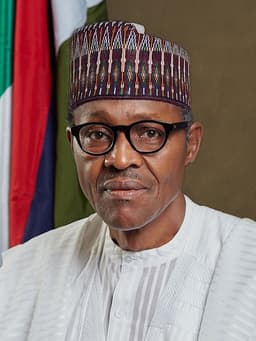
Muhammadu Buhari
General · Modern
51.5Total
Shi Dakai
General · Modern
59.6Total
Basic Information
Born
1942
1831
Died
—
1863
Era
Modern
Modern
Nationality
Nigeria
China
Occupation
General
General
Civilization
Other
Eastern
Score Comparison
Military (10%)
22.6
76.0
Political (20%)
68.0
45.0
Influence (20%)
53.3
56.7
Legacy (20%)
43.3
54.0
Leadership (15%)
72.0
72.0
Strategy (15%)
41.0
68.1
TOTAL
51.5
59.6
Muhammadu Buhari — Complete Timeline
1983 AD
1983 Nigerian coup d'étatPolitical Action
Major General Muhammadu Buhari led a military coup that overthrew the civilian government of President Shehu Shagari. Buhari cited corruption and economic mismanagement as justifications, and he became the head of state.
CoupMilitary RuleCorruption
Impact: nationaldestructive
1984 AD
War Against Indiscipline (WAI)Reform◆ Major
Buhari launched the War Against Indiscipline, a campaign to enforce discipline and order in Nigerian society. It included harsh penalties for minor offenses, such as queue-jumping, and was criticized for human rights abuses.
DisciplineSocial PolicyHuman Rights
Impact: nationaldestructive
1985 AD
Overthrow by Ibrahim BabangidaPolitical Action◆ Major
Buhari was overthrown in a palace coup led by his Chief of Army Staff, Ibrahim Babangida. Babangida cited Buhari's authoritarian style and failure to address the economy as reasons for the coup.
CoupOverthrowBabangida
Impact: national
2015 AD
Anti-corruption campaignReform◆ Major
Buhari launched a high-profile anti-corruption campaign, targeting government officials and recovering stolen assets. The campaign was praised internationally but criticized for being selective and politically motivated.
Anti-CorruptionReformGovernance
Impact: nationalconstructive
Election as President of NigeriaPolitical Action
Buhari won the 2015 Nigerian presidential election, defeating incumbent Goodluck Jonathan. This was the first time an opposition candidate had defeated a sitting president in Nigeria's history, marking a democratic milestone.
ElectionDemocracyOpposition Victory
Impact: nationalprogressive
Shi Dakai — Complete Timeline
1851 AD
Jintian UprisingWar◆ Major
Shi Dakai joined the Taiping Rebellion at its inception in Jintian, Guangxi. As a core leader, he helped organize the rebel forces and was appointed Wing King, becoming one of the key military commanders of the Taiping Heavenly Kingdom.
Taiping RebellionUprisingMilitary Command
Impact: national
1854 AD
Battle of XiangtanWar◆ Major
Shi Dakai led Taiping forces to a major victory at Xiangtan, Hunan, defeating Qing imperial troops. This battle secured Taiping control over key territories in the Yangtze River valley and demonstrated his military skill.
Taiping RebellionBattleVictory
Impact: regional
1856 AD
Tianjing IncidentPolitical Action
Shi Dakai returned to Tianjing (Nanjing) after the internal purge of the Eastern King Yang Xiuqing and the murder of the Northern King Wei Changhui. He condemned the violence and was forced to flee, leading to a split in Taiping leadership.
Taiping RebellionInternal ConflictPurge
Impact: nationaltragic
1858 AD
Campaign in Zhejiang and FujianWar
Shi Dakai led a separate Taiping army into Zhejiang and Fujian provinces, capturing several cities. This campaign expanded Taiping influence into southeastern China but also isolated his forces from the main Taiping base.
Taiping RebellionCampaignExpansion
Impact: regional
1863 AD
Battle of Baishui RiverWar◆ Major
Shi Dakai's army was trapped and defeated by Qing forces at the Baishui River in Sichuan. He was captured and executed shortly after, marking the end of his military career and a significant loss for the Taiping cause.
Taiping RebellionBattleDefeatDeath
Impact: nationaltragic
Expert Analysis
Muhammadu Buhari vs Shi Dakai
# The General’s Two Roads: Shi Dakai and Muhammadu Buhari
In the summer of 1863, a man who had once commanded hundreds of thousands knelt on the banks of the Baishui River in Sichuan, his army annihilated, his dream of a heavenly kingdom drowned in blood. One hundred and fifty-two years later and half a world away, another general stood before a crowd in Abuja, raising his hand to take the oath of office as the democratically elected president of Africa’s most populous nation. Both were soldiers who seized history by the throat. One ended in execution; the other in a second act of power. What made the difference?
Origins
Shi Dakai was born in 1831 into a prosperous Hakka family in Guangxi, southern China. The Qing Dynasty was rotting from within—corrupt, humiliated by foreign powers, and wracked by rebellion. Shi was educated in the Confucian classics but never sat for the imperial examinations; his world was one of clan loyalties and rural unrest. He was barely twenty when he met Hong Xiuquan, a failed scholar who claimed to be the brother of Jesus Christ, and joined the Taiping Rebellion—a movement that promised to overthrow the Manchus and establish a “Heavenly Kingdom of Great Peace.”
Muhammadu Buhari was born in 1942 in Daura, a dusty town in northern Nigeria, then a British colony. His father was a village chief, his upbringing steeped in Fulani traditions and Islamic discipline. Nigeria gained independence when Buhari was eighteen, and he chose the army as his path—a common route for ambitious young men in a fractured, oil-rich nation where ethnic rivalries and corruption were already festering. He trained at the Nigerian Military Training College and later in India, the United Kingdom, and the United States, absorbing the ethos of order, hierarchy, and national unity.
The eras shaped them: Shi came of age in a crumbling empire where rebellion was the only language of change; Buhari, in a newborn nation where the military was seen as the only institution capable of holding the country together.
Rise to Power
Shi Dakai’s ascent was meteoric. In 1851, at the Jintian Uprising, he helped organize the Taiping forces and was named the “Wing King”—one of the original kings of the movement. He proved himself a brilliant field commander. At the Battle of Xiangtan in 1854, he crushed Qing imperial troops, securing Hunan and opening the way for the Taiping advance. By 1856, the Taiping had captured Nanjing and established their capital. Shi was not just a general; he was a prince of a would-be dynasty.
Buhari’s rise was quieter but no less decisive. In 1983, Nigeria’s civilian government under President Shehu Shagari was mired in corruption and economic collapse. Major General Buhari led a coup that overthrew him, citing “the mismanagement of the economy and the corrupt practices of the civilian regime.” He became head of state, promising discipline and reform. The bloodless coup was welcomed by many Nigerians weary of chaos.
Leadership & Governance
Here the two men diverged like rivers splitting a continent.
Shi Dakai governed as a prince of the Taiping Heavenly Kingdom, which blended Christian theology with Chinese utopianism. He was known for his personal integrity—he refused to accumulate wealth, lived simply, and treated his soldiers with respect. Militarily, he was the Taiping’s finest strategist, adept at maneuver warfare and siegecraft. But politically, he was a subordinate in a fractious court. The Taiping leadership was riven by paranoia and ambition, and Shi could never master the palace.
Buhari, by contrast, ruled Nigeria with an iron hand. His “War Against Indiscipline,” launched in 1984, was a campaign of brutal social engineering: soldiers beat citizens for queue-jumping, public floggings were common, and journalists were jailed. He imprisoned political opponents and froze foreign debt payments. His governance was authoritarian, efficient, and deeply unpopular among the elite. His military score is low—20.7—because his rule was administrative, not martial. But his leadership score of 77.5 reflects his unyielding will.
Triumph & Tragedy
Shi Dakai’s greatest moment was also his most tragic. In 1856, the Tianjing Incident tore the Taiping apart. The Eastern King Yang Xiuqing attempted to seize power; the Heavenly King Hong Xiuquan ordered his murder, and a bloody purge followed, killing thousands. Shi Dakai rushed back to Nanjing to stop the slaughter, but he was too late. He rebuked Hong, who then turned on him. Shi fled the capital with his family, but his wife and children were murdered. He led a separate army into Zhejiang and Fujian, capturing cities and keeping the rebellion alive, but he was now a fugitive within his own movement.
Buhari’s first triumph was his coup; his first tragedy was his overthrow. In 1985, his own Chief of Army Staff, Ibrahim Babangida, ousted him in a palace coup, citing Buhari’s “authoritarian style.” Buhari was imprisoned for three years. He emerged bitter but unbroken, and spent the next three decades in the political wilderness, running for president and losing—until 2015, when he won.
Character & Destiny
Shi Dakai was a man of principle in a movement of zealots. He was loyal to the Taiping ideal but repelled by its excesses. When he left Nanjing, he took his army south, refusing to fight his former comrades. In 1863, trapped by Qing forces at the Baishui River, he surrendered himself to spare his remaining troops. The Qing executed him slowly—by the thousand cuts. He was 32. His character—honorable, trusting, unwilling to compromise—was his glory and his doom.
Buhari was a man of discipline in a nation of chaos. He never apologized for the War Against Indiscipline. He returned to power in 2015 as a democrat, but his governance remained rigid: his anti-corruption campaign recovered billions, but the economy stagnated, and his health failed. He was reelected in 2019, but by then, the energy was gone. His character—inflexible, moralistic, persistent—carried him back to power but limited what he could achieve there.
Legacy
Shi Dakai is remembered in China as the “Wing King”—a tragic hero, the best of the Taiping, a brilliant general undone by a flawed cause and a brutal era. His legacy score of 65.9 reflects his status as a romantic figure, not a builder. The Taiping Rebellion failed, but his name survives in folk songs and novels.
Buhari’s legacy is more contested. To his supporters, he is a father figure who fought corruption and gave Nigeria a functioning government. To his critics, he is an autocrat who jailed dissidents and mismanaged the economy. His legacy score of 56.7 is lower than Shi’s, but his influence—70.3—is higher, because he actually ruled a modern nation-state. He left office in 2023, alive and free.
Conclusion
Shi Dakai and Muhammadu Buhari both believed that the sword could forge a better world. One died in agony, his kingdom a memory; the other died in his bed, his presidency a chapter in a still-unfolding story. The difference was not talent—Shi was the greater general—but context. Shi fought for a doomed revolution in a closed empire; Buhari for a struggling democracy in an open world. One was crushed by history; the other learned to ride it. Their lives ask us: Is it better to die for a dream, or to live long enough to see it fail?
Rankings
🥇
Shi DakaiLeader
Mil: 76.0Pol: 45.0Inf: 56.7
59.6
🥈
Muhammadu Buhari
Mil: 22.6Pol: 68.0Inf: 53.3
51.5
+8.1 behind
How This Comparison Works
Algorithm
Each figure is scored on 6 dimensions (0—100 scale) based on structured historical data: Military (10%), Political (20%), Influence (20%), Legacy (20%), Leadership (15%), Strategy (15%). The weighted total produces the final ranking.
Data Sources
Scores are computed from structured sub-indicators in the database. Scale factors adjust for era (Ancient ×0.85, Modern ×1.0) and civilization size (Eastern ×1.05, Other ×0.80) to account for differences in population and military scale.
Maximum 3 Figures
Comparisons are limited to 2—3 figures to ensure readability and statistical meaningfulness.
Error Margins
±5 points per dimension — Sub-scores are derived from historical records with inherent uncertainty. Two figures within 5 points on a dimension should be considered roughly equivalent in that area.
Total Score Accuracy
±3 points overall — The weighted combination of 6 dimensions produces a total score with approximately ±3 points of uncertainty. Differences of less than 3 points are not statistically significant— the figures are effectively tied.
Known Limitations
- Historical records are incomplete and uneven across civilizations
- Figures from oral-tradition societies may be underrepresented
- Occupation labels can misclassify multi-role figures
- Scores measure capability and impact, not moral character
- Quantitative scoring is a comparison tool, not absolute truth
Capability Radar
Military (10%) — Battles & Warfare
Battles
10
75
Win Rate
10
70
Expansion
5
75
Political (20%) — Governance & Reform
Reform
30
50
Diplomacy
25
45
Economy
20
40
Influence (20%) — Cultural & Global Reach
Cultural
25
55
Global
25
40
Legacy (20%) — Historical Impact
Historical
30
60
Longevity
20
45
Leadership (15%) — Power & Stability
Tenure
45
55
Stability
15
35
Strategy (15%) — Tactics & Innovation
Strategy
15
80
Tactics
15
85
Reform
20
60
Similar Comparisons
Comments & Discussion
数据屠夫6/16/2026
别拿Shi Dakai和Buhari比,数据根本不在同一量级。Buhari那年头的尼日利亚GDP是1860年代中国的多少倍?通信技术、国际压力、民众识字率,全都不一样。拿个人决策解释成败,太天真了。Shi Dakai的军队只有冷兵器和少数火铳,Buhari指挥的是现代军队和石油经济。环境变量这么多,你们却只谈“性格决定命运”?省省吧。
Purple Mountain Ghost6/16/2026
Shi Dakai was a brilliant field commander who made a fatal political error: he split his army to appease Hong Xiuquan’s jealousy. Any military historian knows you never divide forces before a decisive battle against a numerically superior foe. Buhari, by contrast, understood power consolidation. He staged a coup, held onto control, then reinvented himself as a democrat. Shi chose honor over survival; Buhari chose power over principles. That's the difference between a martyr and a politician.
Classics Scrivener6/16/2026
Both men were shaped by rigid moral codes—Shi by Confucian loyalty and Taiping theology, Buhari by Fulani honor and military discipline. But here's the key: Shi's fatal execution was a ritualized performance of imperial vengeance, while Buhari's democratic ascent was a modern bureaucratic transition. Shi's world demanded he die for his cause; Buhari's gave him the option to adapt and survive. The comparison isn't about generals, but about the worlds they operated in.
江湖郎中6/16/2026
说Buhari是民主转化成功案例?笑死。尼日利亚2015年选举那是部族政治和石油利益勾结的结果,跟民主理想差远了。Shi Dakai至少在战场上堂堂正正打到最后,Buhari呢?当总统期间腐败照样横行,东北部博科圣地照样猖狂。要我说,将军就该死在战场上,别跑到政坛去当政客。Shi是英雄,Buhari是官僚,没得比。
Bastion Breaker6/16/2026
Both men are tragic examples of militarism failing to civilize power. Shi Dakai died because his military logic couldn't adapt to the complex politics of Sichuan—local gentry, Qing spies, ethnic rivalries. Buhari survived because he could pivot from coup-maker to democratic candidate, but his presidency was still a disaster for human rights. The real lesson: generals make terrible peacetime leaders, whether in 19th-century China or 21st-century Nigeria. Military skill doesn't translate to govern