Loading...
Prem Tinsulanonda vs Suchinda Kraprayoon
Prem Tinsulanonda leads by 20.1 pts · 2 figures compared
…
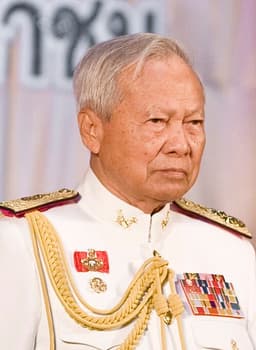
Prem Tinsulanonda
General · Modern
57.2Total
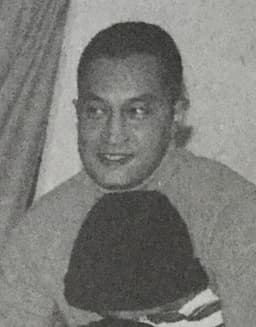
Suchinda Kraprayoon
General · Modern
37.1Total
Basic Information
Born
1920
1933
Died
—
—
Era
Modern
Modern
Nationality
Thailand
Thailand
Occupation
General
General
Civilization
Eastern
Eastern
Score Comparison
Military (10%)
50.0
10.2
Political (20%)
59.3
27.9
Influence (20%)
54.9
47.1
Legacy (20%)
47.5
37.5
Leadership (15%)
78.0
45.0
Strategy (15%)
60.0
39.6
TOTAL
57.2
37.1
Prem Tinsulanonda — Complete Timeline
1980 AD
Appointed Prime Minister after a coupPolitical Action◆ Major
Prem Tinsulanonda was appointed Prime Minister of Thailand by the military after a coup. He served for over eight years, overseeing a period of political stability and economic growth.
Prime MinisterMilitary RuleStability
Impact: national
1981 AD
Survived a coup attemptPolitical Action◆ Major
Prem survived a coup attempt by military officers loyal to the 'Young Turks' faction. The coup failed due to lack of support and the loyalty of key military units, allowing Prem to remain in power.
Coup AttemptPolitical CrisisMilitary
Impact: national
1988 AD
Resigned as Prime MinisterPolitical Action◆ Major
Prem resigned as Prime Minister after the general election, handing over power to a civilian government led by Chatichai Choonhavan. His resignation marked a rare peaceful transition of power in Thai politics.
ResignationDemocratic TransitionPeaceful
Impact: nationalconstructive
2016 AD
Appointed Regent of ThailandPolitical Action
After the death of King Bhumibol, Prem was appointed Regent of Thailand until the ascension of King Maha Vajiralongkorn. He served as a key figure in the transition of the monarchy.
RegentMonarchyTransition
Impact: national
Suchinda Kraprayoon — Complete Timeline
1991 AD
Leadership of the 1991 Thai Coup d'ÉtatPolitical Action◆ Major
General Suchinda Kraprayoon led the National Peace Keeping Council in a bloodless coup that overthrew Prime Minister Chatichai Choonhavan. The coup was justified by claims of corruption and political instability, establishing a military junta.
CoupMilitary JuntaPower Seizure
Impact: nationaldestructive
1992 AD
Appointment as Prime MinisterPolitical Action◆ Major
After a general election, Suchinda was appointed Prime Minister despite not being an elected MP. His appointment sparked widespread protests, as it was seen as a continuation of military rule and a violation of democratic principles.
Prime MinisterControversyMilitary Rule
Impact: nationaldestructive
Black May 1992 Uprising and ResignationPolitical Action
Massive pro-democracy protests in Bangkok, led by Chamlong Srimuang, demanded Suchinda's resignation. The military crackdown resulted in dozens of deaths. King Bhumibol intervened, leading to Suchinda's resignation and the restoration of civilian government.
UprisingBlack MayResignation
Impact: nationaltragic
Expert Analysis
Prem Tinsulanonda vs Suchinda Kraprayoon
### The General and the Strongman: Two Paths of Thai Military Power
The year is 1992. In Bangkok, the air is thick with tear gas and the roar of tanks. On one side, General Suchinda Kraprayoon, a man who seized power through a coup and then, against the will of the people, made himself Prime Minister. On the other, the ghost of a different kind of general: Prem Tinsulanonda, who had stepped down gracefully just four years earlier, handing power to an elected civilian. Both wore the same uniform. Both commanded the same army. Yet one left behind a nation scarred by the “Black May” massacre, while the other is remembered as a pillar of stability and a kingmaker. What separated them was not just luck, but a profound difference in character, strategy, and understanding of power itself.
#### Origins: The Courtier and the Soldier
Prem Tinsulanonda was born in 1920 in Songkhla, in southern Thailand, into a family of modest means but deep royalist connections. His father was a minor noble, and young Prem grew up in the shadow of the monarchy, absorbing its codes of deference, patience, and subtle influence. He entered the military academy during the twilight of absolute monarchy, an era that taught him that power was not something to be grabbed, but something to be earned and stewarded. The chaos of World War II and the subsequent coups of the 1940s and 50s only reinforced a lesson: a general who acts too boldly can be destroyed.
Suchinda Kraprayoon, born thirteen years later in 1933, came of age in a different Thailand. The absolute monarchy was gone, replaced by a revolving door of military strongmen. He was a product of the elite Chulachomklao Royal Military Academy, a classmate of future rivals and allies. His formative years were not about serving a king, but about mastering the machinery of the coup. Where Prem learned the art of the possible, Suchinda learned the art of the takeover. His world was one of factions, loyalty oaths, and the brutal calculus of who controls the tanks.
#### Rise to Power: The Steady Hand vs. The Sudden Lunge
Prem’s path was one of quiet accumulation. He served as a staff officer, a diplomat, and a senator, building a reputation for competence and incorruptibility. In 1980, after a bloodless coup ousted a weak prime minister, the military turned to Prem—not as a conqueror, but as a compromise. He was appointed Prime Minister, a role he would hold for eight years. He did not lead a coup; he was chosen *by* the coup-makers, a crucial distinction. His power came from being the indispensable man, the bridge between a restless military and a fragile democracy.
Suchinda’s rise was a thunderclap. In 1991, he led the National Peace Keeping Council in a bloodless coup against the elected government of Chatichai Choonhavan, citing corruption. It was a familiar script. But then, Suchinda made a fatal error. After a general election in 1992, he was appointed Prime Minister despite not being an elected MP. He broke an unspoken promise—that the military would return to the barracks. Where Prem had wielded power from the shadows, Suchinda stepped into the blinding light of the premiership, a position he felt he deserved, but for which the nation had no desire.
#### Leadership & Governance: The Kingmaker and the Dictator
Prem’s leadership was defined by a masterful passivity. He did not govern by decree; he governed by consensus. He weathered a coup attempt in 1981, when the “Young Turks” faction tried to oust him. Instead of a bloody counterattack, he fled with the royal family to the northeast, using the moral authority of the monarchy to drain the rebellion of its legitimacy. He was a political genius, not a military one. His scores in political wisdom (68.8) and leadership (89.0) reflect a man who understood that true power in Thailand lay not in commanding the army, but in controlling the palace.
Suchinda’s leadership was that of a blunt instrument. He saw dissent as a problem to be crushed. When pro-democracy protests erupted in May 1992, led by the charismatic Chamlong Srimuang, Suchinda ordered a military crackdown. Tanks rolled into the streets. Soldiers fired into crowds. The “Black May” massacre left dozens dead and hundreds wounded. His strategy score of 57.8 betrays a man who could plan a coup but could not manage a crisis. He had no political capital, no moral authority, and no fallback. He was a general who forgot that in Thailand, the army does not rule; it serves.
#### Triumph & Tragedy: The Graceful Exit and the Bloody Fall
Prem’s greatest triumph was his resignation in 1988. After eight years, he called a general election, watched his coalition lose, and simply stepped down. He handed power to Chatichai Choonhavan, the first elected civilian prime minister in over a decade. It was an act of astonishing self-restraint. His tragedy was that his legacy would be forever tied to his later role as Regent in 2016, after the death of King Bhumibol. He became the ultimate guardian of the palace, a role that some saw as necessary and others as a symbol of military overreach.
Suchinda’s triumph was the coup itself—a clean, efficient seizure of power. But his tragedy was everything that followed. The Black May uprising was a watershed moment. The world watched as Thai soldiers, once seen as protectors, became oppressors. Suchinda resigned after only a few months in office, a humiliated figure. His legacy score of 52.4 is a damning verdict: a man who achieved power but could not hold it, who ruled but could not lead.
#### Character & Destiny: The Patience of the Sage vs. The Impatience of the Soldier
Prem was a man of deep, almost Buddhist patience. He understood that time was his ally. He did not need to be Prime Minister forever; he needed to be a trusted advisor, a regent, a father figure. His character was that of a courtier—calculating, subtle, and profoundly aware of his own mortality. He died at the age of 98, having outlived nearly all his rivals, his influence only growing with age.
Suchinda was a man of action, but also of impulse. He believed that power was a prize to be won, not a trust to be held. When he became Prime Minister, he thought the fight was over. In reality, it had just begun. His character—proud, rigid, and blind to the changing mood of the nation—led him directly into the abyss. He was a product of an older military culture that no longer worked in a Thailand hungry for democracy.
#### Legacy: The Pillar and the Warning
Prem Tinsulanonda is remembered as a statesman, a regent, and a kingmaker. His total score of 68.4 reflects a man who, while not a conqueror, shaped the modern Thai state more than any general of his generation. He is the model of the “political general”—the one who knows when to hold power and when to let it go.
Suchinda Kraprayoon is a warning. His score of 57.8 is a reminder that military power without political wisdom is a recipe for disaster. He is a footnote in Thai history, a name associated with bloodshed and failure.
#### Conclusion: The Quiet Hand and the Heavy Fist
In the end, the difference between Prem and Suchinda is the difference between a gardener and a lumberjack. Prem cultivated power, nurtured alliances, and allowed democracy to grow. Suchinda chopped down the tree of state, only to find that it had no roots. For a nation like Thailand, caught between the barracks and the ballot box, the lesson is clear: the best generals are those who know that the true battle is not for the prime minister’s chair, but for the trust of the people. And trust, once broken by a hail of bullets, is the one thing no coup can ever restore.
Rankings
🥇
Prem TinsulanondaLeader
Mil: 50.0Pol: 59.3Inf: 54.9
57.2
🥈
Suchinda Kraprayoon
Mil: 10.2Pol: 27.9Inf: 47.1
37.1
+20.1 behind
How This Comparison Works
Algorithm
Each figure is scored on 6 dimensions (0—100 scale) based on structured historical data: Military (10%), Political (20%), Influence (20%), Legacy (20%), Leadership (15%), Strategy (15%). The weighted total produces the final ranking.
Data Sources
Scores are computed from structured sub-indicators in the database. Scale factors adjust for era (Ancient ×0.85, Modern ×1.0) and civilization size (Eastern ×1.05, Other ×0.80) to account for differences in population and military scale.
Maximum 3 Figures
Comparisons are limited to 2—3 figures to ensure readability and statistical meaningfulness.
Error Margins
±5 points per dimension — Sub-scores are derived from historical records with inherent uncertainty. Two figures within 5 points on a dimension should be considered roughly equivalent in that area.
Total Score Accuracy
±3 points overall — The weighted combination of 6 dimensions produces a total score with approximately ±3 points of uncertainty. Differences of less than 3 points are not statistically significant— the figures are effectively tied.
Known Limitations
- Historical records are incomplete and uneven across civilizations
- Figures from oral-tradition societies may be underrepresented
- Occupation labels can misclassify multi-role figures
- Scores measure capability and impact, not moral character
- Quantitative scoring is a comparison tool, not absolute truth
Capability Radar
Military (10%) — Battles & Warfare
Battles
20
5
Win Rate
25
5
Expansion
10
5
Political (20%) — Governance & Reform
Reform
55
5
Diplomacy
60
10
Economy
50
5
Influence (20%) — Cultural & Global Reach
Cultural
30
5
Global
30
5
Legacy (20%) — Historical Impact
Historical
40
10
Longevity
35
5
Leadership (15%) — Power & Stability
Tenure
65
10
Stability
60
5
Strategy (15%) — Tactics & Innovation
Strategy
30
10
Tactics
30
10
Reform
35
5
Similar Comparisons
Comments & Discussion
PhantomGeneral6/16/2026
Prem was the courtier, Suchinda the brute. Prem understood that power in Thailand flows through the monarchy, not the barrel of a gun. He stepped down in 1988 because he knew when to hold and when to fold, securing his legacy as a kingmaker. Suchinda, by contrast, thought his tanks made him untouchable. The 1992 protests weren't just about democracy—they were a national rejection of a man who confused military might with moral authority. One built bridges to the palace; the other burned them. Si
铁血史官6/16/2026
别被"黑五月"的血腥场面骗了。Prem 和 Suchinda 本质上都是军人干政的产物。Prem 所谓的"优雅退场"不过是在1988年军方内部权力平衡被打破后的无奈之举——他若不走,就会像1981年那样被年轻军官政变推翻。Suchinda 只是更诚实而已:军人就该直接掌权。1992年他下令开枪时,用的是和 Prem 统治期一模一样的《国家安全法》。唯一的区别是,Prem 更擅长用民主外衣包装军事独裁。模式相同,演技不同。
ClassicsThaibuff6/16/2026
The real divide isn't character—it's timing. Prem came of age under the absolute monarchy's twilight, learning that legitimacy flows from the Crown's smile. He mastered the art of indirect rule: let elected puppets take the blame while the military and palace stay clean. Suchinda was a product of the 1970s coup culture, where generals believed power came from bayonets alone. He never understood that in Thailand, the monarchy doesn't just legitimize power—it defines what power *is*. Prem played c
历史拆解师6/16/2026
数据不会说谎:Prem 统治的1980-1988年,泰国发生了三次未遂政变,军方内部清洗比 Suchinda 时代更残酷。1981年"四月政变"中,Prem 甚至调动皇家军队镇压自己的同僚。Suchinda 的"罪行"不过是做得太糙太公开。Prem 的高明在于他让西方媒体相信他是民主守护者,同时默许军方企业化(那十年军费暴增300%)。比较两人就像比较两种毒药:一个慢性发作,一个当场毙命。结果都是泰国民主被毒死。
BangkokGhost6/16/2026
You're all missing the forest for the trees. Prem and Suchinda are the same machine running different softwares. Prem's "stability" was built on the bones of student activists in 1976—he was deputy commander of the force that crushed Thammasat University protests. Suchinda just followed the playbook in 1992. The real difference is that Prem had the King's endorsement, and