Loading...
Prem Tinsulanonda vs Soe Win
Prem Tinsulanonda leads by 15.5 pts · 2 figures compared
…
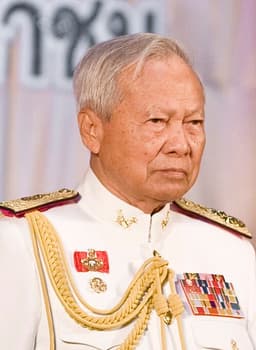
Prem Tinsulanonda
General · Modern
57.2Total
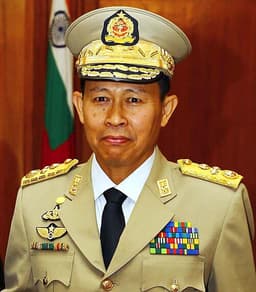
Soe Win
General · Modern
41.7Total
Basic Information
Born
1920
1947
Died
—
—
Era
Modern
Modern
Nationality
Thailand
Myanmar
Occupation
General
General
Civilization
Eastern
Eastern
Score Comparison
Military (10%)
50.0
25.9
Political (20%)
59.3
30.8
Influence (20%)
54.9
48.6
Legacy (20%)
47.5
40.0
Leadership (15%)
78.0
57.6
Strategy (15%)
60.0
36.8
TOTAL
57.2
41.7
Prem Tinsulanonda — Complete Timeline
1980 AD
Appointed Prime Minister after a coupPolitical Action◆ Major
Prem Tinsulanonda was appointed Prime Minister of Thailand by the military after a coup. He served for over eight years, overseeing a period of political stability and economic growth.
Prime MinisterMilitary RuleStability
Impact: national
1981 AD
Survived a coup attemptPolitical Action◆ Major
Prem survived a coup attempt by military officers loyal to the 'Young Turks' faction. The coup failed due to lack of support and the loyalty of key military units, allowing Prem to remain in power.
Coup AttemptPolitical CrisisMilitary
Impact: national
1988 AD
Resigned as Prime MinisterPolitical Action◆ Major
Prem resigned as Prime Minister after the general election, handing over power to a civilian government led by Chatichai Choonhavan. His resignation marked a rare peaceful transition of power in Thai politics.
ResignationDemocratic TransitionPeaceful
Impact: nationalconstructive
2016 AD
Appointed Regent of ThailandPolitical Action
After the death of King Bhumibol, Prem was appointed Regent of Thailand until the ascension of King Maha Vajiralongkorn. He served as a key figure in the transition of the monarchy.
RegentMonarchyTransition
Impact: national
Soe Win — Complete Timeline
2004 AD
Appointed Prime Minister of MyanmarPolitical Action◆ Major
Soe Win was appointed Prime Minister of Myanmar by the State Peace and Development Council, succeeding Khin Nyunt. He served as a key figure in the military junta's government.
Military JuntaGovernment Appointment
Impact: national
2007 AD
Saffron Revolution CrackdownPolitical Action
As Prime Minister, Soe Win oversaw the military's violent suppression of the Saffron Revolution, a series of anti-government protests led by Buddhist monks. The crackdown resulted in numerous deaths, arrests, and international condemnation.
Saffron RevolutionHuman RightsRepression
Impact: nationaldestructive
Death in OfficeOther
Soe Win died in office on October 12, 2007, from leukemia. His death occurred shortly after the Saffron Revolution crackdown, and he was succeeded by Thein Sein.
DeathSuccession
Impact: national
Expert Analysis
Prem Tinsulanonda vs Soe Win
### The General and the Regent: Prem Tinsulanonda and Soe Win, Two Paths from the Barracks
In the autumn of 2007, the world watched in horror as Burmese soldiers fired upon unarmed Buddhist monks marching through the streets of Rangoon. The saffron robes of the protesters, once symbols of peace, were stained with blood. Half a world away and a generation earlier, in April 1981, another Asian general faced a coup attempt from his own military's "Young Turks." He did not call for a massacre. He waited, let the coup collapse from its own lack of legitimacy, and then quietly returned to power. One man would die in office, his name synonymous with violent repression. The other would outlive his premiership by decades, becoming the revered regent of a beloved king. What made the difference? The answer lies not in the uniforms they wore, but in the political soil in which they were planted.
### Origins: The Crucibles of Empire and Independence
Prem Tinsulanonda was born in 1920 in Songkhla, a southern province of Siam, a kingdom that had never been colonized. His father was a middle-ranking official, a teacher who imbued in young Prem a deep respect for hierarchy, Buddhism, and the monarchy. The absolute monarchy had fallen in 1932, but the institution remained the spiritual center of the nation. Prem grew up in a world where legitimacy flowed from the throne, not just the barrel of a gun. His career began in the cavalry, a gentleman's arm of the military, where loyalty and protocol were prized above brute force.
Soe Win, born in 1947, entered a very different world. Burma (now Myanmar) had just gained independence from British rule, but it was a nation already fracturing along ethnic lines. The army, led by General Ne Win, seized power in 1962, imposing a brutal, isolationist "Burmese Way to Socialism." Soe Win was a product of this system. He rose through the ranks of a military that saw itself not just as the guardian of the state, but as the state itself. For him, there was no king, no parliament, no civil society—only the chain of command and the threat of disintegration. The era of their upbringing shaped their core assumptions: Prem saw the military as a pillar of a broader, stable order; Soe Win saw it as the only order.
### Rise to Power: The Coup and the Purge
Prem entered the political stage through a coup, but it was a coup of a peculiar Thai style. In 1980, after a period of unstable civilian governments and a failed military uprising, the parliament elected General Prem as Prime Minister. He was a compromise candidate, a general acceptable to both the military and the palace. He did not seize power; it was handed to him. His key turning point came in 1981, when the "Young Turks" attempted to oust him. Prem, with the support of King Bhumibol and the royalist faction, simply waited them out. The coup failed not because of superior force, but because it lacked legitimacy.
Soe Win’s path was darker. He rose under the State Peace and Development Council (SPDC), the junta that ruled Myanmar with an iron fist. In 2004, he was appointed Prime Minister after a dramatic purge of his predecessor, Khin Nyunt, who was seen as too moderate. Soe Win was chosen precisely for his hardline credentials. He was a loyalist, a man who had never questioned the junta's monopoly on power. His rise was not a matter of political maneuvering or public support; it was an internal promotion within a secretive, paranoid dictatorship.
### Leadership & Governance: The Bridge and the Wall
Prem’s leadership style was one of quiet consensus. He was not a charismatic speaker or a flamboyant commander. His genius was political: he understood that Thailand's stability depended on three pillars—the monarchy, the military, and the emerging democratic institutions. He governed as a bridge, allowing the economy to liberalize, encouraging foreign investment, and slowly ceding power to elected politicians. His greatest reform was not a single law, but a process: the gradual, peaceful transition from military rule to civilian democracy. He stepped down in 1988 after a general election, handing power to Chatichai Choonhavan, a civilian. It was an act almost unprecedented in Thai history.
Soe Win governed as a wall, sealing the country off from the world. His tenure was marked by economic stagnation, brutal suppression of ethnic minorities, and the continued house arrest of Aung San Suu Kyi. His political wisdom was nonexistent; he believed only in repression. The Saffron Revolution of 2007 was a direct result of his government’s decision to remove fuel subsidies, crushing the poor. When the monks marched, Soe Win saw only a threat to be eliminated. He ordered the crackdown, a decision that would forever stain his legacy.
### Triumph & Tragedy: The Peaceful Exit and the Bloody End
Prem’s greatest triumph was his resignation in 1988. By stepping down, he prevented a potential civil-military crisis and allowed Thailand to take a step toward democracy. It was a masterclass in strategic self-restraint. His tragedy was that this democratic opening would later close, with coups in 1991, 2006, and 2014. But the fault was not his alone; he had built a fragile bridge, not a permanent one.
Soe Win’s tragedy was his entire premiership. His "triumph," if it can be called that, was the suppression of the Saffron Revolution. The streets were cleared, the monks were beaten, and the junta survived. But the cost was catastrophic. The crackdown triggered international sanctions, deepened Myanmar's isolation, and turned the world’s sympathy firmly toward the pro-democracy movement. Soe Win died of leukemia on October 12, 2007, just weeks after the bloodshed. He left behind a country more broken than he found it.
### Character & Destiny: The King's Man and the Junta's Soldier
Prem’s character was defined by a deep, almost feudal loyalty to the monarchy. He saw himself as a servant of the king, not a ruler. This gave him a moral compass beyond personal ambition. When he became regent in 2016 after the death of King Bhumibol, it was the natural culmination of a life lived in service to an institution.
Soe Win’s character was defined by fear and paranoia. He was a product of a system that rewarded unquestioning obedience and punished dissent. He had no external source of legitimacy—no king, no constitution, no popular mandate—only the guns of his fellow generals. This insecurity made him ruthless. His destiny was to be a footnote in Myanmar’s long tragedy, the man who shot the monks.
### Legacy: The Elder Statesman and the Forgotten Butcher
Today, Prem Tinsulanonda is remembered as a wise elder statesman, a key figure in Thailand's modern political history. His legacy is complex—critics note his role in perpetuating military influence—but he died respected, his portrait hanging in government offices next to the king’s. He is a symbol of how a general can choose to be a statesman.
Soe Win is remembered, if at all, as a butcher. His name is synonymous with the Saffron Revolution crackdown. In Myanmar, he is not honored; he is a ghost. His legacy is a warning of what happens when a military leader sees his country as a barracks and his people as enemies.
### Conclusion: Two Paths, One Lesson
Prem and Soe Win both wore the same uniform. Both came to power through political crises. But one chose to build bridges, the other to build walls. The difference was not talent or luck, but the political culture that shaped them. Prem had a king to serve, a constitution to respect, and a society that demanded legitimacy. Soe Win had only a junta, a gun, and a country that had forgotten how to trust. Their stories remind us that the character of a leader is not born in isolation—it is forged by the institutions, traditions, and expectations of the world that raised him. And in that forging, the fate of millions is decided.
Rankings
🥇
Prem TinsulanondaLeader
Mil: 50.0Pol: 59.3Inf: 54.9
57.2
🥈
Soe Win
Mil: 25.9Pol: 30.8Inf: 48.6
41.7
+15.5 behind
How This Comparison Works
Algorithm
Each figure is scored on 6 dimensions (0—100 scale) based on structured historical data: Military (10%), Political (20%), Influence (20%), Legacy (20%), Leadership (15%), Strategy (15%). The weighted total produces the final ranking.
Data Sources
Scores are computed from structured sub-indicators in the database. Scale factors adjust for era (Ancient ×0.85, Modern ×1.0) and civilization size (Eastern ×1.05, Other ×0.80) to account for differences in population and military scale.
Maximum 3 Figures
Comparisons are limited to 2—3 figures to ensure readability and statistical meaningfulness.
Error Margins
±5 points per dimension — Sub-scores are derived from historical records with inherent uncertainty. Two figures within 5 points on a dimension should be considered roughly equivalent in that area.
Total Score Accuracy
±3 points overall — The weighted combination of 6 dimensions produces a total score with approximately ±3 points of uncertainty. Differences of less than 3 points are not statistically significant— the figures are effectively tied.
Known Limitations
- Historical records are incomplete and uneven across civilizations
- Figures from oral-tradition societies may be underrepresented
- Occupation labels can misclassify multi-role figures
- Scores measure capability and impact, not moral character
- Quantitative scoring is a comparison tool, not absolute truth
Capability Radar
Military (10%) — Battles & Warfare
Battles
20
10
Win Rate
25
10
Expansion
10
10
Political (20%) — Governance & Reform
Reform
55
10
Diplomacy
60
10
Economy
50
10
Influence (20%) — Cultural & Global Reach
Cultural
30
10
Global
30
10
Legacy (20%) — Historical Impact
Historical
40
20
Longevity
35
10
Leadership (15%) — Power & Stability
Tenure
65
30
Stability
60
10
Strategy (15%) — Tactics & Innovation
Strategy
30
10
Tactics
30
10
Reform
35
10
Similar Comparisons
Comments & Discussion
TankieTruther6/16/2026
Prem Tinsulanonda was a political survivalist, not a principled leader. The 1981 "Young Turks" coup he faced wasn't some noble test of legitimacy—it was a power struggle he won because he had King Bhumibol's backing, not because he was morally superior. Compare that to Soe Win, who actually had to enforce a military junta's rule while facing international sanctions. Different constraints, not different souls. Prem died a revered statesman because he played the game smarter, not because he was mo
历史辩证家6/16/2026
别天真了,把Prem美化成"仁慈将军"完全是西方中心论的历史滤镜。Prem执政期间,泰国左翼学生、农民就没被镇压过?1970年代泰国军方屠杀数千名进步人士时,Prem可是在国防部任职。Soe Win的缅甸至少保持了主权独立,没让美国驻军。Prem的"合法性"来自国王,Soe Win的"合法性"来自反殖民斗争—两个都是军事政权,只是包装不同。非要分好坏,不如比谁对本国百姓危害更小。