Loading...
Prem Tinsulanonda vs Shi Dakai
Shi Dakai leads by 2.4 pts · 2 figures compared
…
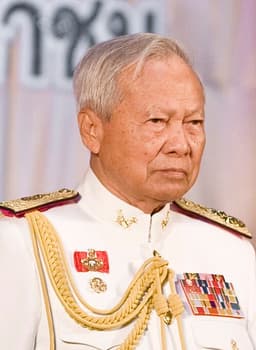
Prem Tinsulanonda
General · Modern
57.2Total
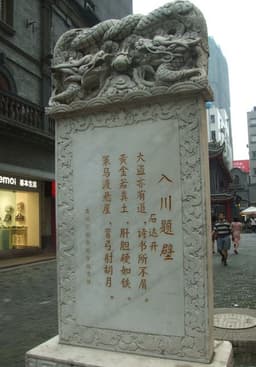
Shi Dakai
General · Modern
59.6Total
Basic Information
Born
1920
1831
Died
—
1863
Era
Modern
Modern
Nationality
Thailand
China
Occupation
General
General
Civilization
Eastern
Eastern
Score Comparison
Military (10%)
50.0
76.0
Political (20%)
59.3
45.0
Influence (20%)
54.9
56.7
Legacy (20%)
47.5
54.0
Leadership (15%)
78.0
72.0
Strategy (15%)
60.0
68.1
TOTAL
57.2
59.6
Prem Tinsulanonda — Complete Timeline
1980 AD
Appointed Prime Minister after a coupPolitical Action◆ Major
Prem Tinsulanonda was appointed Prime Minister of Thailand by the military after a coup. He served for over eight years, overseeing a period of political stability and economic growth.
Prime MinisterMilitary RuleStability
Impact: national
1981 AD
Survived a coup attemptPolitical Action◆ Major
Prem survived a coup attempt by military officers loyal to the 'Young Turks' faction. The coup failed due to lack of support and the loyalty of key military units, allowing Prem to remain in power.
Coup AttemptPolitical CrisisMilitary
Impact: national
1988 AD
Resigned as Prime MinisterPolitical Action◆ Major
Prem resigned as Prime Minister after the general election, handing over power to a civilian government led by Chatichai Choonhavan. His resignation marked a rare peaceful transition of power in Thai politics.
ResignationDemocratic TransitionPeaceful
Impact: nationalconstructive
2016 AD
Appointed Regent of ThailandPolitical Action
After the death of King Bhumibol, Prem was appointed Regent of Thailand until the ascension of King Maha Vajiralongkorn. He served as a key figure in the transition of the monarchy.
RegentMonarchyTransition
Impact: national
Shi Dakai — Complete Timeline
1851 AD
Jintian UprisingWar◆ Major
Shi Dakai joined the Taiping Rebellion at its inception in Jintian, Guangxi. As a core leader, he helped organize the rebel forces and was appointed Wing King, becoming one of the key military commanders of the Taiping Heavenly Kingdom.
Taiping RebellionUprisingMilitary Command
Impact: national
1854 AD
Battle of XiangtanWar◆ Major
Shi Dakai led Taiping forces to a major victory at Xiangtan, Hunan, defeating Qing imperial troops. This battle secured Taiping control over key territories in the Yangtze River valley and demonstrated his military skill.
Taiping RebellionBattleVictory
Impact: regional
1856 AD
Tianjing IncidentPolitical Action
Shi Dakai returned to Tianjing (Nanjing) after the internal purge of the Eastern King Yang Xiuqing and the murder of the Northern King Wei Changhui. He condemned the violence and was forced to flee, leading to a split in Taiping leadership.
Taiping RebellionInternal ConflictPurge
Impact: nationaltragic
1858 AD
Campaign in Zhejiang and FujianWar
Shi Dakai led a separate Taiping army into Zhejiang and Fujian provinces, capturing several cities. This campaign expanded Taiping influence into southeastern China but also isolated his forces from the main Taiping base.
Taiping RebellionCampaignExpansion
Impact: regional
1863 AD
Battle of Baishui RiverWar◆ Major
Shi Dakai's army was trapped and defeated by Qing forces at the Baishui River in Sichuan. He was captured and executed shortly after, marking the end of his military career and a significant loss for the Taiping cause.
Taiping RebellionBattleDefeatDeath
Impact: nationaltragic
Expert Analysis
Shi Dakai vs Prem Tinsulanonda
# The General and the King: Prem Tinsulanonda and Shi Dakai
On a sweltering August morning in 1981, Prem Tinsulanonda sat in his Bangkok office, a telephone receiver pressed to his ear. The voices on the other end belonged to mutinous army colonels who had seized key positions in the capital. Half a world away in time but not in spirit, another general faced his own moment of truth. In the autumn of 1863, Shi Dakai knelt beside the Baishui River in Sichuan, surrounded by Qing soldiers who had finally cornered him after years of pursuit. One man would hang up the phone and survive to become a revered statesman. The other would face execution, his severed head paraded through the provinces he had once conquered. Why did two brilliant military commanders—both products of Eastern civilizations, both thrust into turbulent eras—meet such different fates? The answer lies not in their swords, but in their seasons.
Origins
Prem Tinsulanonda was born in 1920 in Songkhla, a southern Thai province where the monsoon rains fell predictably and the Buddhist temples stood as anchors of stability. His father was a civil servant, his mother a homemaker. Thailand, uniquely among Southeast Asian nations, had never been colonized. The kingdom possessed a continuity that shaped Prem’s worldview: order was possible, institutions could be trusted, and power flowed through established channels. He entered the military academy at fourteen, learning not just warfare but the art of navigating hierarchies.
Shi Dakai’s origins could not have been more different. Born in 1831 in Guangxi, a rugged southern Chinese province, he grew up in a China hemorrhaging from the Opium Wars. The Qing Dynasty was rotting from within, and the countryside teemed with desperate peasants. Shi was literate and from a relatively prosperous Hakka family, but the world around him offered no stability—only the promise of collapse. When Hong Xiuquan, a failed scholar who believed himself to be the brother of Jesus Christ, launched the Taiping Rebellion in 1851, Shi Dakai joined at the Jintian Uprising. He was twenty years old. For him, the only path forward was through fire.
Rise to Power
Prem’s ascent was a study in patience. He rose through Thailand’s bureaucratic-military apparatus, serving in the Korean War, commanding battalions, and eventually becoming a trusted figure in the army’s upper echelons. When a coup in 1980 swept the civilian government aside, the military turned to Prem as prime minister not because he had seized power, but because he was seen as a safe pair of hands. He was sixty years old—seasoned, calm, and unambitious in the way that makes ambitious men trust you.
Shi Dakai’s rise was meteoric and violent. By 1854, at the Battle of Xiangtan, he had already proven himself a military genius, crushing Qing forces in Hunan and securing the Taiping’s western flank. He became the Wing King, one of the movement’s original princes, second only to Hong Xiuquan and the Eastern King Yang Xiuqing. He was young, brilliant, and fighting for a cause that promised to remake the world. But the Taiping Heavenly Kingdom was a movement built on apocalyptic faith and personal loyalties—a recipe for both glory and catastrophe.
Leadership & Governance
Prem governed as he commanded: with quiet authority, never outstripping the consensus. His eight-year tenure as prime minister was marked by a careful balancing act between the military, the monarchy, and civilian politicians. He survived the 1981 coup attempt not by crushing his enemies, but by letting them overreach. The Young Turks who tried to overthrow him lacked the king’s support, and Prem understood that in Thailand, the monarchy was the ultimate source of legitimacy. He did not need to fight—he needed to wait. His political wisdom lay in knowing when to step forward and when to step aside. In 1988, after a general election, he simply resigned, handing power to Chatichai Choonhavan’s civilian government. It was an act of self-restraint almost unheard of among military strongmen.
Shi Dakai governed through sheer competence. Where other Taiping leaders were consumed by religious fervor and personal vendettas, he was a pragmatist. He implemented land reforms in the territories he controlled, organized effective administrations, and treated captured civilians with unusual leniency. His military strategy was brilliant—fluid, adaptive, and devastating. But he could not govern the movement itself. The Taiping court in Tianjing (Nanjing) was a snake pit of paranoia and ambition. In 1856, the Tianjing Incident tore the kingdom apart: Yang Xiuqing was purged, the Western King Wei Changhui massacred thousands, and Shi Dakai returned to find his family murdered. He fled Tianjing in horror, leading a separate army into Zhejiang and Fujian, a wandering king without a kingdom.
Triumph & Tragedy
Prem’s greatest triumph was not a battle but a transition. In 2016, after the death of King Bhumibol Adulyadej—the revered monarch who had reigned for seventy years—Prem was appointed Regent of Thailand. It was the highest honor a Thai statesman could receive: the trust of the crown. He had spent decades as a privy councilor, a quiet pillar behind the throne. His tragedy, if it can be called one, is that he is remembered as a caretaker. He held power but never transformed it.
Shi Dakai’s triumph was the Battle of Xiangtan, where his tactical brilliance humiliated the Qing. But his tragedy was the Taiping Rebellion itself. By 1863, his wandering army was exhausted, trapped in Sichuan, and cornered at the Baishui River. He surrendered to the Qing in a desperate bid to spare his remaining soldiers, but the executioners showed no mercy. He was sliced to death—the slow, ritualized death reserved for the worst rebels. He was thirty-two years old.
Character & Destiny
Prem’s character was shaped by stability. He trusted institutions because they had never failed him. He was cautious, patient, and deeply loyal to the Thai monarchy. His decisions reflected a man who believed that power was a trust, not a possession. He died old, respected, and unchallenged.
Shi Dakai’s character was shaped by chaos. He trusted talent and loyalty because institutions had failed everyone. He was brilliant, principled, and ultimately naive—believing that military genius could redeem a movement that was already cannibalizing itself. His decisions reflected a man who believed that the world could be remade by will and courage. He died young, betrayed, and alone.
Legacy
Prem Tinsulanonda is remembered in Thailand as a wise elder, a bridge between eras. His political score of 68.8 and leadership score of 89.0 reflect a man who led not by force but by influence. He is a statue in quiet plazas, a name on university buildings.
Shi Dakai is remembered as the “Wing King,” the tragic hero of the Taiping. His military score of 84.6 and strategy score of 81.6 mark him as one of China’s great commanders. But his legacy is a cautionary tale: brilliance without a stable foundation is a fire that burns out. He is a figure in novels and folk songs, a ghost of what might have been.
Conclusion
Perhaps the deepest difference between Prem Tinsulanonda and Shi Dakai is not in their abilities but in their contexts. Prem inherited a kingdom that had held together for centuries; Shi Dakai fought for a kingdom that was tearing itself apart. One man’s career was a slow river; the other’s was a wildfire. In the end, both were servants of their time. But the time of Prem allowed him to endure, while the time of Shi Dakai demanded that he burn. And history, as always, remembers the fire long after the river has flowed on.
Rankings
🥇
Shi DakaiLeader
Mil: 76.0Pol: 45.0Inf: 56.7
59.6
🥈
Prem Tinsulanonda
Mil: 50.0Pol: 59.3Inf: 54.9
57.2
+2.4 behind
How This Comparison Works
Algorithm
Each figure is scored on 6 dimensions (0—100 scale) based on structured historical data: Military (10%), Political (20%), Influence (20%), Legacy (20%), Leadership (15%), Strategy (15%). The weighted total produces the final ranking.
Data Sources
Scores are computed from structured sub-indicators in the database. Scale factors adjust for era (Ancient ×0.85, Modern ×1.0) and civilization size (Eastern ×1.05, Other ×0.80) to account for differences in population and military scale.
Maximum 3 Figures
Comparisons are limited to 2—3 figures to ensure readability and statistical meaningfulness.
Error Margins
±5 points per dimension — Sub-scores are derived from historical records with inherent uncertainty. Two figures within 5 points on a dimension should be considered roughly equivalent in that area.
Total Score Accuracy
±3 points overall — The weighted combination of 6 dimensions produces a total score with approximately ±3 points of uncertainty. Differences of less than 3 points are not statistically significant— the figures are effectively tied.
Known Limitations
- Historical records are incomplete and uneven across civilizations
- Figures from oral-tradition societies may be underrepresented
- Occupation labels can misclassify multi-role figures
- Scores measure capability and impact, not moral character
- Quantitative scoring is a comparison tool, not absolute truth
Capability Radar
Military (10%) — Battles & Warfare
Battles
20
75
Win Rate
25
70
Expansion
10
75
Political (20%) — Governance & Reform
Reform
55
50
Diplomacy
60
45
Economy
50
40
Influence (20%) — Cultural & Global Reach
Cultural
30
55
Global
30
40
Legacy (20%) — Historical Impact
Historical
40
60
Longevity
35
45
Leadership (15%) — Power & Stability
Tenure
65
55
Stability
60
35
Strategy (15%) — Tactics & Innovation
Strategy
30
80
Tactics
30
85
Reform
35
60
Similar Comparisons
Comments & Discussion
TheForkedGourd6/16/2026
我读过石达开在1863年大渡河畔的绝命诗——"立志扶明室,何知运不济"——这才是中国传统悲剧英雄的真实写照。他奉天讨胡,却败给曾国藩的湘军,就像关公走麦城。Prem算什么?一个在空调办公室接电话的政客,从未真正挥过刀。石达开输在时代洪流,Prem赢在政治算计,别拿他们相提并论。历史的悲壮只属于战场的血,而不是电话线的噪音。
CrossTimelineskeptic6/16/2026
This comparison is ahistorical apples vs. oranges. Prem was a modern nation-state administrator in a stable kingdom, while Shi Dakai was a 19th-century warlord in a collapsing empire. Their command scopes differ completely: Prem never led a single battle charge, while Shi Dakai commanded over 100,000 troops in the Taiping Rebellion. The "brilliant military commander" label barely fits Prem, who was more a political fixer. The article's fatal flaw is assuming both were "generals" in comparable co
铁血书生6/16/2026
从军事学看,Prem不过是泰国政坛的变色龙,靠背叛盟友上位——1981年镇压年轻军官政变时,他一边谈判一边调兵,这叫什么指挥?真正的将军如石达开,在九江之战以少胜多痛击湘军水师,那才是本事。石达开的失败不在指挥能力,而在太平天国内讧导致他孤军奋战。Prem会写诗吗?会亲冒矢石吗?把这两位相提并论,是对晚清名将的羞辱。历史记住的是战场上的血性,不是办公室里的权谋。
BuddhaAndRebel6/16/2026
What saved Prem was the Buddhist concept of "karma" and institutional continuity—Thailand's monarchy and sangha provided a moral framework that bounded his ambition. Shi Dakai, by contrast, operated in post-Taiping chaos where Confucian loyalty dissolved into Darwinian survival. Prem could negotiate because both sides recognized legitimate authority; Shi Dakai faced Manchu exterminators who saw him as a heretic threat. Their fates weren't about "seasons" but about the civilizations they inherite