Loading...
Prem Tinsulanonda vs Ranoji Scindia
Prem Tinsulanonda leads by 0.2 pts · 2 figures compared
…
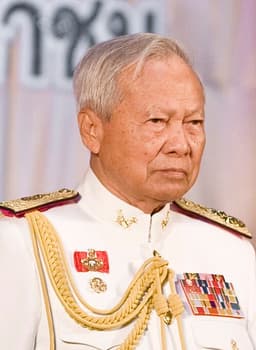
Prem Tinsulanonda
General · Modern
57.2Total
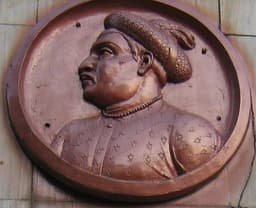
Ranoji Scindia
General · Modern
57.0Total
Basic Information
Born
1920
1700
Died
—
1745
Era
Modern
Modern
Nationality
Thailand
India
Occupation
General
General
Civilization
Eastern
Indian
Score Comparison
Military (10%)
50.0
50.0
Political (20%)
59.3
54.7
Influence (20%)
54.9
58.0
Legacy (20%)
47.5
54.0
Leadership (15%)
78.0
65.0
Strategy (15%)
60.0
60.0
TOTAL
57.2
57.0
Prem Tinsulanonda — Complete Timeline
1980 AD
Appointed Prime Minister after a coupPolitical Action◆ Major
Prem Tinsulanonda was appointed Prime Minister of Thailand by the military after a coup. He served for over eight years, overseeing a period of political stability and economic growth.
Prime MinisterMilitary RuleStability
Impact: national
1981 AD
Survived a coup attemptPolitical Action◆ Major
Prem survived a coup attempt by military officers loyal to the 'Young Turks' faction. The coup failed due to lack of support and the loyalty of key military units, allowing Prem to remain in power.
Coup AttemptPolitical CrisisMilitary
Impact: national
1988 AD
Resigned as Prime MinisterPolitical Action◆ Major
Prem resigned as Prime Minister after the general election, handing over power to a civilian government led by Chatichai Choonhavan. His resignation marked a rare peaceful transition of power in Thai politics.
ResignationDemocratic TransitionPeaceful
Impact: nationalconstructive
2016 AD
Appointed Regent of ThailandPolitical Action
After the death of King Bhumibol, Prem was appointed Regent of Thailand until the ascension of King Maha Vajiralongkorn. He served as a key figure in the transition of the monarchy.
RegentMonarchyTransition
Impact: national
Ranoji Scindia — Complete Timeline
1726 AD
Appointed Subedar of MalwaPolitical Action◆ Major
Ranoji Scindia was appointed as the Maratha subedar of Malwa by Peshwa Baji Rao I. This gave him control over a large territory and laid the foundation for the Scindia dynasty of Gwalior.
Maratha EmpireMalwaScindia Dynasty
Impact: regionalconstructive
1737 AD
Battle of DelhiWar◆ Major
Ranoji Scindia participated in the Maratha raid on Delhi under Baji Rao I. The attack on the Mughal capital demonstrated Maratha power and led to the extraction of tribute.
Maratha-Mughal WarsDelhiRaid
Impact: national
1739 AD
Battle of VasaiWar
Ranoji Scindia fought alongside Malhar Rao Holkar in the siege of Vasai against the Portuguese. The victory ended Portuguese control in the Konkan region.
Maratha-Portuguese WarsSiegeKonkan
Impact: regional
1740 AD
Founded Gwalior as CapitalPolitical Action◆ Major
Ranoji Scindia established his capital at Gwalior, fortifying the Gwalior Fort and building a palace. This city became the center of Scindia power for over a century.
FoundingGwaliorScindia Dynasty
Impact: regionalconstructive
1745 AD
Death in BattleWar
Ranoji Scindia was killed in a battle against the Nizam of Hyderabad's forces near the Narmada River. His death occurred during a Maratha campaign to expand into the Deccan.
DeathBattleMaratha-Nizam Wars
Impact: regionaltragic
Expert Analysis
Prem Tinsulanonda vs Ranoji Scindia
# The General Who Ruled Without Power
On a warm Bangkok evening in August 1988, Prem Tinsulanonda walked into the Government House and did something almost unheard of in modern Thai history: he resigned. Not because he was forced out, not because a coup had deposed him, but because he believed his time was done. Across the Indian subcontinent, two and a half centuries earlier, another general named Ranoji Scindia fell in battle near the Narmada River, his body lost to the currents, his dynasty just beginning. One man gave up power voluntarily; the other died grasping for more. What drove these two men—both generals, both founders of political legacies—to such different ends?
Origins
Prem Tinsulanonda was born in 1920 in Songkhla, southern Thailand, into a family of modest means but deep loyalty to the monarchy. His father was a minor official, his mother a homemaker. Young Prem grew up in a kingdom that had never been colonized, where the king was a sacred figure and the military was the guardian of national identity. He entered the Chulachomklao Royal Military Academy as a cadet, absorbing a culture of hierarchy, discipline, and reverence for the throne.
Ranoji Scindia, born in 1700, came from a different world—the chaotic, violent landscape of eighteenth-century India, where the Mughal Empire was crumbling and the Maratha Confederacy was rising. His family were hereditary village headmen in the Deccan, but Ranoji had ambition. He joined the service of the Peshwa, the de facto ruler of the Maratha Empire, as a young soldier. The Maratha world was one of constant warfare, shifting alliances, and brutal competition. Loyalty meant survival; betrayal meant death.
The difference in their eras is crucial. Prem came of age in a stable, centralized state with an ancient monarchy. Ranoji was born into a world where power was up for grabs, and only the strong survived.
Rise to Power
Prem’s path was slow, methodical, and institutional. He climbed the ranks of the Thai army for decades, serving as a staff officer, then as a division commander, then as army commander-in-chief. His reputation was not for battlefield brilliance but for careful political maneuvering. When a military coup in 1980 overthrew the civilian government, the generals needed a figure who could stabilize the country. They chose Prem—a man with no personal political base, no faction, no enemies. He was the perfect compromise.
Ranoji’s rise was faster and bloodier. He caught the eye of Peshwa Baji Rao I, one of the greatest military commanders in Indian history. In 1726, Baji Rao appointed Ranoji as the Maratha subedar of Malwa, a vast territory in central India. This was not a gift—it was a commission. Ranoji had to conquer and hold the land himself, fighting against Mughal governors, Rajput princes, and rival Maratha chieftains. He did so with ferocity, building a personal army and a reputation for relentless aggression.
Prem was chosen because he was safe. Ranoji was chosen because he was dangerous.
Leadership & Governance
Prem governed Thailand for eight years as prime minister, from 1980 to 1988. He was not a visionary reformer or a charismatic speaker. He was a manager, a consensus-builder, a man who listened more than he spoke. His leadership style was indirect—he preferred to work through committees, to let others take credit, to avoid confrontation. He survived a coup attempt in 1981 by the "Young Turks" faction, not by fighting but by waiting, letting the coup collapse under its own lack of support. He understood that in Thai politics, the key was not to defeat your enemies but to outlast them.
Ranoji was the opposite. He ruled Malwa through force and fear. He built the Gwalior Fort into an impregnable stronghold, turning it into the heart of his power. He fought alongside Malhar Rao Holkar at the Battle of Vasai in 1739, smashing Portuguese defenses and ending their influence in the region. He raided Delhi in 1737, a symbolic blow to Mughal prestige. His governance was personal, direct, and violent. When he needed money, he took it. When he needed land, he conquered it.
Prem governed through institutions. Ranoji governed through personality.
Triumph & Tragedy
Prem’s greatest triumph was his resignation. In 1988, after a general election, he handed power to Chatichai Choonhavan, a civilian politician. This was unprecedented in modern Thai history—a military-backed leader voluntarily stepping down. It was a quiet, dignified act that preserved the fragile democracy. His tragedy was that the cycle of coups continued after him, and his legacy of stability proved temporary.
Ranoji’s greatest triumph was founding the Scindia dynasty of Gwalior, which would rule for over two centuries. His tragedy was dying in battle in 1745, struck down by the Nizam of Hyderabad’s forces near the Narmada River. He never saw the empire he built. His body was never recovered.
Character & Destiny
Prem was a man who understood limits. He knew that power in Thailand was not absolute—it was shared with the monarchy, the military, the bureaucracy, and the public. He saw himself as a caretaker, not a ruler. His famous saying, often repeated in Thai political circles, was: "I don't want to be prime minister forever." He meant it.
Ranoji believed in no limits. He was a product of his time, when the Maratha Empire was expanding in all directions, when a man could carve out a kingdom with a sword and a horse. He saw himself as a conqueror, not a caretaker. His motto was action, not reflection.
Prem’s caution saved him. Ranoji’s ambition killed him.
Legacy
Today, Prem is remembered as a figure of stability and integrity. He served as regent of Thailand after the death of King Bhumibol in 2016, a final honor that cemented his place as a guardian of the monarchy. But his legacy is ambiguous—he stabilized a system that was fundamentally unstable, and his resignation did not break the cycle of military intervention.
Ranoji is remembered as the founder of one of India’s most powerful princely states. The Scindia family ruled Gwalior until independence in 1947, and their descendants remain influential in Indian politics. But his legacy is also violent—he conquered through destruction, and his dynasty was built on the bodies of his enemies.
Conclusion
Prem and Ranoji were both generals, both founders, both men of their time. But one ruled by stepping back, the other by charging forward. One died in bed, the other on a battlefield. One left a stable legacy, the other a powerful one. Their stories remind us that leadership is not a single path but a thousand forks, and that the choices we make—to hold power or to release it, to build or to destroy—are shaped by the world we are born into, the ambitions we nurture, and the limits we accept.
Rankings
🥇
Prem TinsulanondaLeader
Mil: 50.0Pol: 59.3Inf: 54.9
57.2
🥈
Ranoji Scindia
Mil: 50.0Pol: 54.7Inf: 58.0
57.0
+0.2 behind
How This Comparison Works
Algorithm
Each figure is scored on 6 dimensions (0—100 scale) based on structured historical data: Military (10%), Political (20%), Influence (20%), Legacy (20%), Leadership (15%), Strategy (15%). The weighted total produces the final ranking.
Data Sources
Scores are computed from structured sub-indicators in the database. Scale factors adjust for era (Ancient ×0.85, Modern ×1.0) and civilization size (Eastern ×1.05, Other ×0.80) to account for differences in population and military scale.
Maximum 3 Figures
Comparisons are limited to 2—3 figures to ensure readability and statistical meaningfulness.
Error Margins
±5 points per dimension — Sub-scores are derived from historical records with inherent uncertainty. Two figures within 5 points on a dimension should be considered roughly equivalent in that area.
Total Score Accuracy
±3 points overall — The weighted combination of 6 dimensions produces a total score with approximately ±3 points of uncertainty. Differences of less than 3 points are not statistically significant— the figures are effectively tied.
Known Limitations
- Historical records are incomplete and uneven across civilizations
- Figures from oral-tradition societies may be underrepresented
- Occupation labels can misclassify multi-role figures
- Scores measure capability and impact, not moral character
- Quantitative scoring is a comparison tool, not absolute truth
Capability Radar
Military (10%) — Battles & Warfare
Battles
20
45
Win Rate
25
50
Expansion
10
55
Political (20%) — Governance & Reform
Reform
55
30
Diplomacy
60
45
Economy
50
35
Influence (20%) — Cultural & Global Reach
Cultural
30
30
Global
30
30
Legacy (20%) — Historical Impact
Historical
40
50
Longevity
35
55
Leadership (15%) — Power & Stability
Tenure
65
40
Stability
60
40
Strategy (15%) — Tactics & Innovation
Strategy
30
45
Tactics
30
40
Reform
35
35
Similar Comparisons
Comments & Discussion
ThePiedPiperOfData6/16/2026
Prem's "voluntary resignation" is a myth perpetuated by royalist historians. He didn't just walk away—he ensured his successor was his puppet, Chatichai Choonhavan. Prem remained de facto ruler through the appointed Senate and Privy Council for years. Compare this to Ranoji, who actually died in battle leading from the front. One gave up a title to keep power; the other died expanding his. Give me a battlefield corpse over a backroom schemer any day. The numbers on Thai coups prove Prem's system
数字考古学家6/16/2026
把一位在18世纪马哈拉施特拉邦混乱中从村级头人崛起建立王朝的将军,与一位在20世纪君主立宪制中升任高位后“优雅退位”的将军比较?这是拿苹果比榴莲。兰诺吉·辛迪亚在1700年代的真实权力基线几乎是零——他没有国家机器,没有内阁制度。他的“权力”完全是靠剑赢来的。普雷姆则是在一个稳定的官僚体系中运作。说兰诺吉“渴望更多权力”而普雷姆“放弃权力”,完全忽略了两人各自面对的是完全不同的权力结构。这种叙事本身就有缺陷。