Loading...
Francisco Morazan vs Prem Tinsulanonda
Francisco Morazan leads by 0.8 pts · 2 figures compared
…
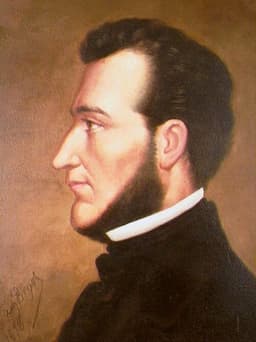
Francisco Morazan
General · Modern
58.0Total
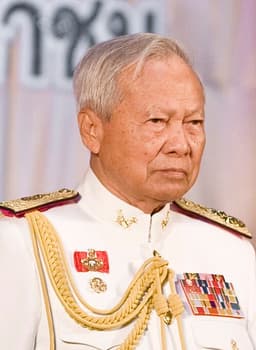
Prem Tinsulanonda
General · Modern
57.2Total
Basic Information
Born
1792
1920
Died
1842
—
Era
Modern
Modern
Nationality
Honduras
Thailand
Occupation
General
General
Civilization
Western
Eastern
Score Comparison
Military (10%)
52.5
50.0
Political (20%)
60.0
59.3
Influence (20%)
62.0
54.9
Legacy (20%)
50.0
47.5
Leadership (15%)
68.0
78.0
Strategy (15%)
55.0
60.0
TOTAL
58.0
57.2
Francisco Morazan — Complete Timeline
1824 AD
Abolition of slavery in Central AmericaReform◆ Major
As a key leader in the liberal movement, Moraz
AbolitionSlaveryLiberal Reform
Impact: regionalprogressive
1827 AD
Battle of La TrinidadWar◆ Major
Morazán led a liberal army to victory against conservative forces at La Trinidad, Honduras. This battle was a key turning point in the Central American civil war, allowing Morazán to consolidate power and eventually become president of the federation.
BattleLiberal VictoryCivil War
Impact: regional
1830 AD
Presidency of the Federal Republic of Central AmericaPolitical Action
Morazán was elected president of the Federal Republic of Central America, a union of Guatemala, El Salvador, Honduras, Nicaragua, and Costa Rica. He pursued liberal reforms including separation of church and state, free trade, and land reform, facing opposition from conservatives.
Federal RepublicLiberal ReformsCentral America
Impact: regionalconstructive
1842 AD
Execution by firing squadPolitical Action
After a failed attempt to restore the Federal Republic, Moraz
ExecutionEnd of FederationLiberal Defeat
Impact: regionaltragic
Prem Tinsulanonda — Complete Timeline
1980 AD
Appointed Prime Minister after a coupPolitical Action◆ Major
Prem Tinsulanonda was appointed Prime Minister of Thailand by the military after a coup. He served for over eight years, overseeing a period of political stability and economic growth.
Prime MinisterMilitary RuleStability
Impact: national
1981 AD
Survived a coup attemptPolitical Action◆ Major
Prem survived a coup attempt by military officers loyal to the 'Young Turks' faction. The coup failed due to lack of support and the loyalty of key military units, allowing Prem to remain in power.
Coup AttemptPolitical CrisisMilitary
Impact: national
1988 AD
Resigned as Prime MinisterPolitical Action◆ Major
Prem resigned as Prime Minister after the general election, handing over power to a civilian government led by Chatichai Choonhavan. His resignation marked a rare peaceful transition of power in Thai politics.
ResignationDemocratic TransitionPeaceful
Impact: nationalconstructive
2016 AD
Appointed Regent of ThailandPolitical Action
After the death of King Bhumibol, Prem was appointed Regent of Thailand until the ascension of King Maha Vajiralongkorn. He served as a key figure in the transition of the monarchy.
RegentMonarchyTransition
Impact: national
Expert Analysis
Francisco Morazan vs Prem Tinsulanonda
# The Bridge and the Sword: Prem Tinsulanonda and Francisco Morazán
On a humid Bangkok morning in April 1981, General Prem Tinsulanonda sat in his office, waiting for news that would decide his fate. Rebel tanks were rolling toward the capital, led by officers who had once been his allies. Across the world and across a century, in the highlands of Costa Rica in September 1842, another general faced his final moment: Francisco Morazán, bound and blindfolded, stood before a firing squad. One man would walk out of his crisis to rule for another seven years; the other would fall, his dream of a united Central America dying with him. What separates a survivor from a martyr? The answer lies not in the heat of battle, but in the quiet choices made long before the guns fired.
Origins
Prem Tinsulanonda was born in 1920 in Songkhla, southern Thailand, into a world of cautious stability. His father was a minor noble, his mother a schoolteacher. Thailand had never been colonized—a rare distinction in Southeast Asia—and its monarchy commanded deep reverence. Young Prem absorbed a culture of deference, hierarchy, and patience. He entered military academy not as a firebrand but as a steady cadet, rising through ranks with quiet competence.
Francisco Morazán, born in 1792 in Tegucigalpa, Honduras, came of age in a world on fire. The Spanish Empire was collapsing, and across Latin America, men with grand visions were seizing the moment. Morazán’s family were creole landowners, educated in Enlightenment ideas. He read Rousseau and Voltaire, dreamed of republics and reforms. Where Prem learned to bow, Morazán learned to challenge.
Rise to Power
Prem’s path was incremental. He served as a staff officer, then as a division commander, then as army chief. When a coup toppled the civilian government in 1980, the military needed a figurehead—someone respectable, untainted by factionalism. Prem was the perfect choice. He accepted the prime ministership not as a conqueror but as a caretaker. He had never led a charge; he had never needed to.
Morazán’s rise was explosive. In 1827, at the Battle of La Trinidad, he led a ragged liberal army against conservative forces and won through sheer tactical daring. He was just 35. Within three years, he was president of the Federal Republic of Central America—a union of five nations that had briefly broken from Mexico. He entered office not as a compromise candidate but as a revolutionary.
Leadership & Governance
Prem governed by indirection. He rarely gave direct orders; instead, he listened, nodded, and let others commit themselves. His political wisdom lay in knowing when to yield. In 1981, when the Young Turks coup erupted, he did not fight. He fled to the northeastern city of Korat, rallied loyalist generals, and waited. The coup collapsed not because of a brilliant counterstroke, but because the rebels lost momentum and the king quietly withdrew his support. Prem returned to Bangkok, more powerful than before.
As prime minister, he focused on stability. He encouraged economic growth, kept Thailand aligned with the West during the Cold War, and—crucially—never challenged the monarchy. His score of 89.0 in leadership reflects not charisma but resilience: he held power for eight years without ever winning an election.
Morazán governed by decree. He abolished slavery in 1824, granted freedom of the press, and tried to break the power of the Catholic Church. He was a reformer in a land of conservatives. Where Prem built coalitions, Morazán issued edicts. His military acumen—scoring 65.4—was real but narrow: he could win battles but not wars of attrition. His political score of 72.0 masks a fatal flaw: he never learned to compromise with his enemies, only to defeat them.
Triumph & Tragedy
Prem’s greatest triumph was his resignation. In 1988, after a general election, he simply stepped down—handing power to Chatichai Choonhavan, a civilian. This was almost unheard of in a region of strongmen who clung to office until bullets forced them out. Prem walked away with dignity intact.
Morazán’s triumph was the Federal Republic itself—a dream of unity that briefly held. But his tragedy was its collapse. By 1839, the union had shattered into warring states. Morazán fled into exile, tried one last invasion in 1842, was betrayed, captured, and executed. His last words reportedly were: “I die with the satisfaction of having served my country.”
Character & Destiny
Prem was a man of shadows. He avoided confrontation, cultivated ambiguity, and let others take credit. His personality was perfectly suited to Thailand’s palace politics: a system where open ambition is fatal, but quiet persistence wins everything. He survived because he never seemed to want power—and so others let him keep it.
Morazán was a man of light. He believed in ideas, in progress, in the power of a single will to reshape history. He could not tolerate stupidity or corruption. He made enemies easily and kept them forever. His personality was suited to revolution, not governance.
Legacy
Prem lived into his nineties, serving as regent after King Bhumibol’s death in 2016—the ultimate sign of royal trust. He is remembered as a stabilizer, a gray eminence who kept Thailand from collapsing into chaos. His total score of 68.4 understates his impact: he shaped a generation of Thai politics from behind the curtain.
Morazán is a martyr for Central American liberals. His face appears on Honduran currency; statues stand in San Salvador and Tegucigalpa. But his dream of unity died with him. His score of 69.8 is slightly higher, but his legacy is more contested: some call him a visionary, others a tyrant who destroyed what little stability existed.
Conclusion
Prem and Morazán represent two answers to the same question: how does a general govern in a fragile state? One chose patience, the other passion. One survived; the other became a legend. Perhaps the deepest difference is this: Prem understood that power is a river, not a fortress—you swim with it, you do not dam it. Morazán believed he could build a new world from the ruins of the old. Both were brave. But only one lived to tell the tale.
Rankings
🥇
Francisco MorazanLeader
Mil: 52.5Pol: 60.0Inf: 62.0
58.0
🥈
Prem Tinsulanonda
Mil: 50.0Pol: 59.3Inf: 54.9
57.2
+0.8 behind
How This Comparison Works
Algorithm
Each figure is scored on 6 dimensions (0—100 scale) based on structured historical data: Military (10%), Political (20%), Influence (20%), Legacy (20%), Leadership (15%), Strategy (15%). The weighted total produces the final ranking.
Data Sources
Scores are computed from structured sub-indicators in the database. Scale factors adjust for era (Ancient ×0.85, Modern ×1.0) and civilization size (Eastern ×1.05, Other ×0.80) to account for differences in population and military scale.
Maximum 3 Figures
Comparisons are limited to 2—3 figures to ensure readability and statistical meaningfulness.
Error Margins
±5 points per dimension — Sub-scores are derived from historical records with inherent uncertainty. Two figures within 5 points on a dimension should be considered roughly equivalent in that area.
Total Score Accuracy
±3 points overall — The weighted combination of 6 dimensions produces a total score with approximately ±3 points of uncertainty. Differences of less than 3 points are not statistically significant— the figures are effectively tied.
Known Limitations
- Historical records are incomplete and uneven across civilizations
- Figures from oral-tradition societies may be underrepresented
- Occupation labels can misclassify multi-role figures
- Scores measure capability and impact, not moral character
- Quantitative scoring is a comparison tool, not absolute truth
Capability Radar
Military (10%) — Battles & Warfare
Battles
55
20
Win Rate
60
25
Expansion
40
10
Political (20%) — Governance & Reform
Reform
70
55
Diplomacy
45
60
Economy
50
50
Influence (20%) — Cultural & Global Reach
Cultural
45
30
Global
35
30
Legacy (20%) — Historical Impact
Historical
50
40
Longevity
40
35
Leadership (15%) — Power & Stability
Tenure
55
65
Stability
30
60
Strategy (15%) — Tactics & Innovation
Strategy
55
30
Tactics
50
30
Reform
45
35
Similar Comparisons
Comments & Discussion
IronGeneral6/16/2026
Prem was a master at reading the room, but Morazán was a tactical genius fighting against impossible odds. Prem survived because his enemies blinked first at the 1981 coup attempt. Morazán died because he believed Central America could unite like the USA. That was delusional - Guatemala and Honduras would never surrender power in a federation. Prem's realpolitik beats Morazán's idealism any day in the survival game.
统计先生6/16/2026
这个比较纯属关公战秦琼。Prem在位18年,Morazán的联邦10年就散架了。Prem控制着泰国GDP年均增长约7%,Morazán留下的是分裂的中美洲和一堆内战债务。拿生存时间说事:Prem活到98岁自然死亡,Morazán才50岁被枪决。这根本不是英雄对决,是数据板上钉钉的统治者 vs 失败者。
LiberatorGhost6/16/2026
Calling Prem a "survivor" misses the tragedy here. Morazán unified Central America for a decade - that's longer than the original Articles of Confederation lasted the US! He abolished slavery, established religious freedom, and tried to drag Central America into the 19th century. Prem kept Thailand stable under military rule with zero institutional reform. Morazán died for something bigger than himself; Prem just didn't die at all. That's not survival - that's stagnation.
历史侦探6/16/2026
关键区别在于他们的对手。Morazán对抗的是圭地马拉的保守派地头蛇家族,还有英国在背后捣乱,内外夹击根本无解。Prem的对手是1981年那帮举棋不定的反叛军官,连曼谷都没敢真打进来。Prem运气好——对手犹豫了;Morazán命不好——对手是冷酷的拉斐尔·卡雷拉,一个会屠杀印第安人巩固权力的猛人。Prem穿越到Morazán的靴子里,也撑不了两年。
SpectaclesOnThePast6/16/2026
The comparison is flawed because it ignores the audience. Prem operated in a Thailand where the monarchy was an unchallenged pillar - King Bhumibol backed him publicly in 1981 and 1992. Morazán operated in a land where every faction had competing caudillos with their own armies. Prem didn't need to outfight his enemies; he needed to outwait them with royal support. Morazán had no such luxury - he had to win every battle twice. Different chessboards, different pieces.