Loading...
Prayut Chan-o-cha vs Sitiveni Rabuka
Sitiveni Rabuka leads by 3.6 pts · 2 figures compared
…
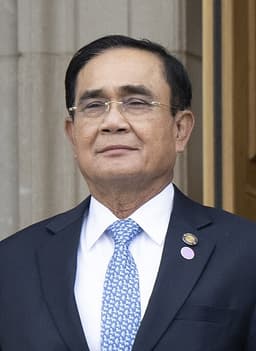
Prayut Chan-o-cha
General · Modern
48.1Total
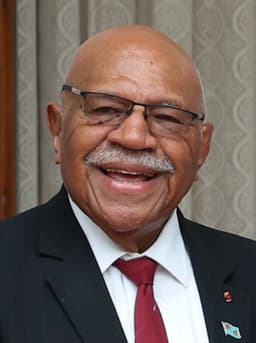
Sitiveni Rabuka
General · Modern
51.7Total
Basic Information
Born
1954
1948
Died
—
—
Era
Modern
Modern
Nationality
Thailand
Fiji
Occupation
General
General
Civilization
Eastern
Other
Score Comparison
Military (10%)
10.2
10.2
Political (20%)
68.0
60.0
Influence (20%)
51.8
53.3
Legacy (20%)
40.8
46.7
Leadership (15%)
68.0
85.0
Strategy (15%)
35.7
39.6
TOTAL
48.1
51.7
Prayut Chan-o-cha — Complete Timeline
2014 AD
Led the 2014 military coupPolitical Action
General Prayut Chan-o-cha, as Army Commander-in-Chief, led a coup d'
CoupMilitaryThailand
Impact: nationaldestructive
Appointed Prime Minister by military legislaturePolitical Action◆ Major
Following the coup, Prayut was appointed Prime Minister by the military-controlled National Legislative Assembly. He assumed executive power, leading a government that promised reforms and national reconciliation.
AppointmentMilitary RuleThailand
Impact: national
2017 AD
Promulgation of the 2017 ConstitutionReform◆ Major
Prayut's government oversaw the drafting and approval of a new constitution that strengthened the military's political role and created a fully appointed Senate. The charter was criticized for entrenching military influence.
ConstitutionMilitaryThailand
Impact: national
2019 AD
Re-elected Prime Minister after 2019 electionPolitical Action◆ Major
Prayut was re-elected Prime Minister following a general election that was criticized for being manipulated to favor pro-military parties. He formed a coalition government, continuing his rule under a civilian facade.
ElectionContinuityThailand
Impact: national
Sitiveni Rabuka — Complete Timeline
1987 AD
1987 Fijian Coup d'étatPolitical Action
Rabuka, as a colonel in the Fijian military, led a coup overthrowing the elected government of Timoci Bavadra. The coup was motivated by ethnic Fijian opposition to Indo-Fijian political influence. Rabuka declared Fiji a republic.
CoupMilitary InterventionEthnic Tension
Impact: nationaldestructive
1992 AD
1992 Election as Prime MinisterPolitical Action◆ Major
Rabuka transitioned from military leader to civilian politician, winning the 1992 general election as leader of the Fijian Political Party. He became Prime Minister, serving until 1999.
ElectionCivilian GovernmentPolitical Transition
Impact: national
1997 AD
1997 Constitution ReformReform◆ Major
Rabuka's government oversaw the adoption of a new constitution that removed ethnic-based voting and provided for a multi-ethnic government. The constitution aimed to reduce ethnic tensions and promote national unity.
ConstitutionReformEthnic Reconciliation
Impact: nationalconstructive
1999 AD
1999 General Election DefeatPolitical Action◆ Major
Rabuka's government was defeated in the general election by the Labour Party led by Mahendra Chaudhry. Rabuka stepped down as Prime Minister, marking the end of his first period in power.
Election DefeatGovernment ChangeChaudhry
Impact: national
2022 AD
2022 Return as Prime MinisterPolitical Action◆ Major
Rabuka led the People's Alliance to victory in the 2022 general election, forming a coalition government. He became Prime Minister again, 23 years after his previous tenure, promising democratic reforms.
ElectionReturn to PowerCoalition Government
Impact: national
Expert Analysis
Sitiveni Rabuka vs Prayut Chan-o-cha
# The General Who Would Be Prime Minister
On a May morning in 2014, Bangkok woke to the sight of tanks rolling through its streets. A stern-faced general in a crisp uniform stepped before television cameras to announce that the military had seized control of the country. Half a world away and thirty years earlier, a Fijian colonel named Sitiveni Rabuka had done the same thing—storming parliament in a coup that would define his nation's modern history. Both men began as soldiers who overthrew elected governments. But where one spent decades trying to undo the damage of his own coup, the other built an entire system to ensure such a coup could never be reversed.
Origins
Prayut Chan-o-cha was born in 1954 in northeastern Thailand, the son of a schoolteacher and a police officer. He grew up in a country that had already endured a dozen coups, where the military was not merely an institution but the invisible hand shaping national destiny. He entered the Chulachomklao Royal Military Academy at sixteen, absorbing a worldview in which order and hierarchy were sacred, and democracy was a messy Western import that Thailand had never quite mastered.
Sitiveni Rabuka, born six years earlier in 1948, came from a different world entirely. He was the son of a Fijian Methodist minister, raised in a village where communal loyalty and chiefly authority defined social life. Fiji, independent from Britain only since 1970, was a fragile experiment in multi-ethnic democracy, with indigenous Fijians and Indo-Fijians locked in a tense competition for political power. Rabuka joined the military not as a careerist but as a patriot who believed his duty was to protect indigenous Fijian interests above all else.
Rise to Power
Prayut's path to power was methodical, almost bureaucratic. He climbed the ranks of the Thai army for four decades, serving in counter-insurgency operations and rising to become Army Commander-in-Chief in 2010. By then, Thailand was locked in a cycle of political crisis—protesters in red shirts and yellow shirts clashing in the streets, governments collapsing, and the military watching from the wings. When the caretaker government of Yingluck Shinawatra lost control of Bangkok in 2014, Prayut saw his moment. He declared martial law, then, when negotiations failed, simply arrested the rival factions and announced a coup. It was a textbook military takeover, executed with precision and ruthlessness.
Rabuka's coup was far more impulsive. In May 1987, as a 39-year-old colonel, he watched with alarm as the newly elected government of Timoci Bavadra—dominated by Indo-Fijians—took power. Fearing the loss of indigenous Fijian land rights and political dominance, Rabuka acted on his own initiative. He marched into parliament with ten soldiers, arrested the prime minister, and declared himself head of state. It was a raw, emotional act, driven not by strategic calculation but by a conviction that he was saving his people.
Leadership & Governance
As prime ministers, the two men governed in radically different styles. Prayut ruled Thailand with the heavy hand of a general who never quite became a politician. He spoke in cryptic, rambling press conferences, dismissed criticism as a threat to national security, and used draconian laws—especially the lese-majeste statute—to silence dissent. His signature achievement was the 2017 constitution, a masterwork of military engineering that created an unelected senate controlled by the armed forces, ensuring that even if elections were held, the military would never lose control. When elections finally came in 2019, they were designed to keep Prayut in power, and they did.
Rabuka, by contrast, evolved. After winning the 1992 election as a civilian politician, he surprised everyone. Instead of entrenching military rule, he began dismantling it. In 1997, he oversaw the adoption of a new constitution that removed ethnic-based voting and created a multi-racial democracy. It was an act of extraordinary political courage—a coup leader voluntarily surrendering the very system his coup had been meant to protect. When he lost the 1999 election to an Indo-Fijian prime minister, Rabuka stepped down peacefully, accepting defeat with a grace that Prayut never showed.
Triumph & Tragedy
Prayut's greatest triumph was also his tragedy: he stabilized Thailand. For nearly a decade, there were no mass protests, no street battles, no tanks in the streets. But the price was a hollowed-out democracy, a generation of activists in prison, and a political system so rigged that even his own supporters began to question its legitimacy. When massive youth-led protests erupted in 2020, demanding his resignation and reform of the monarchy, Prayut responded with the only tool he knew—more force.
Rabuka's tragedy was that his greatest act—the 1997 constitution—unraveled. In 2000, a coup by another general overthrew the government he had helped create. Rabuka spent years in political exile, his reputation stained by his earlier actions. Yet his triumph came late. In 2022, at age 74, he returned to lead a coalition government as prime minister once more, this time as a democrat who had learned the hard lessons of power.
Character & Destiny
What drove these men down such different paths? The answer lies in how they understood themselves. Prayut saw himself as a guardian—a father figure who knew what was best for a childlike nation. He once said, "I have to take care of the people like my own children." This paternalism, rooted in Thai military culture, left no room for the messy, unpredictable business of democracy. Power was not something to be shared but to be held, tightly, forever.
Rabuka, in his memoirs, wrote with painful honesty about his coup: "I was young, foolish, and I thought I knew what was best." He came to see his actions as a mistake, and spent the rest of his career trying to atone for them. His faith—he is a devout Methodist—and his exposure to international diplomacy helped him grow beyond the narrow nationalism of his youth. He learned that true leadership means trusting the people, not controlling them.
Legacy
Prayut's legacy is Thailand's broken democracy. He will be remembered as the general who perfected the art of the coup, turning it into a permanent feature of governance. The 2017 constitution may outlive him, a machine designed to keep the military in power long after he is gone.
Rabuka's legacy is more complex. He is both the man who destroyed Fiji's first democracy and the man who rebuilt it. His name is cursed by some and honored by others. But in his final act—returning as a democratically elected prime minister at 74—he offered a rare redemption arc. He proved that even those who break a nation can help mend it.
Conclusion
Standing at the end of their careers, Prayut and Rabuka offer a profound lesson about power and its uses. One man seized control and never let go, building walls around his nation's freedom. The other seized control, then spent a lifetime trying to tear those walls down. Their stories remind us that history judges leaders not by the force they wield, but by the courage they show in surrendering it. In the end, the general who learns to become a civilian may leave a deeper mark than the general who remains a general forever.
Rankings
🥇
Sitiveni RabukaLeader
Mil: 10.2Pol: 60.0Inf: 53.3
51.7
🥈
Prayut Chan-o-cha
Mil: 10.2Pol: 68.0Inf: 51.8
48.1
+3.6 behind
How This Comparison Works
Algorithm
Each figure is scored on 6 dimensions (0—100 scale) based on structured historical data: Military (10%), Political (20%), Influence (20%), Legacy (20%), Leadership (15%), Strategy (15%). The weighted total produces the final ranking.
Data Sources
Scores are computed from structured sub-indicators in the database. Scale factors adjust for era (Ancient ×0.85, Modern ×1.0) and civilization size (Eastern ×1.05, Other ×0.80) to account for differences in population and military scale.
Maximum 3 Figures
Comparisons are limited to 2—3 figures to ensure readability and statistical meaningfulness.
Error Margins
±5 points per dimension — Sub-scores are derived from historical records with inherent uncertainty. Two figures within 5 points on a dimension should be considered roughly equivalent in that area.
Total Score Accuracy
±3 points overall — The weighted combination of 6 dimensions produces a total score with approximately ±3 points of uncertainty. Differences of less than 3 points are not statistically significant— the figures are effectively tied.
Known Limitations
- Historical records are incomplete and uneven across civilizations
- Figures from oral-tradition societies may be underrepresented
- Occupation labels can misclassify multi-role figures
- Scores measure capability and impact, not moral character
- Quantitative scoring is a comparison tool, not absolute truth
Capability Radar
Military (10%) — Battles & Warfare
Battles
5
5
Win Rate
5
5
Expansion
5
5
Political (20%) — Governance & Reform
Reform
30
50
Diplomacy
40
45
Economy
35
40
Influence (20%) — Cultural & Global Reach
Cultural
20
30
Global
20
20
Legacy (20%) — Historical Impact
Historical
20
40
Longevity
15
30
Leadership (15%) — Power & Stability
Tenure
60
55
Stability
25
35
Strategy (15%) — Tactics & Innovation
Strategy
15
10
Tactics
10
10
Reform
20
5
Similar Comparisons
Comments & Discussion
Old-School Coup6/16/2026
Rabuka’s apology tour versus Prayut’s cementing of power is the real lesson here. One admits coups ruin democracy, the other builds a constitution to justify it. Rabuka at least tried to undo his 1987 mess—Prayut’s still in office a decade later, rewriting election rules. That’s the difference between a soldier with a conscience and one with a permanent grip on the wheel.
数据侦探6/16/2026
别看俩人都是政变出身,数据不会撒谎:斐济在Rabuka下台后民主指数从2.4升到5.6(2021年数据),泰国在Prayut治下从2014年的4.9降到2023年的3.2。一个在修复创伤,一个在巩固权力。光看“将军变总理”的标题就下结论?太天真了。
Classics Skeptic6/16/2026
Stop romanticizing Rabuka’s “redemption.” He led two coups, not one—1987 and 2000. That’s not a mea culpa, that’s a pattern. Prayut’s at least consistent: military rule is the default for Thailand. Comparing them as different paths is like saying a serial arsonist and a career firefighter are both “in fire management.” Rabuka’s just better at PR.
历史博弈论6/16/2026
重点不是道德比较,是制度选择。Rabuka的1990年宪法给了斐济原住民绝对权力,后来才被迫修正;Prayut的2017年宪法直接让军方控制上议院。两种“由乱到治”的路径:一个后来妥协开放,一个持续封闭。哪个更危险?看看斐济现在旅游业恢复率和泰国政局的不确定性就知道了。
Classroom General6/16/2026
Rabuka’s 1987 coup was about protecting indigenous Fijian land rights from a perceived Indian-dominated government—he admitted he was wrong. Prayut’s 2014 coup was about purging Thaksin’s influence—he never apologized. One evolved, the other stayed a general in civilian clothes. History’s verdict is already written in their speeches: Rabuka says “sorry,” Prayut says “next election, maybe.”