Loading...
Muhammadu Buhari vs Prayut Chan-o-cha
Muhammadu Buhari leads by 3.4 pts · 2 figures compared
…
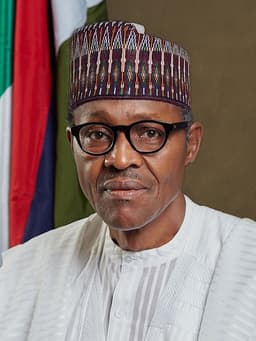
Muhammadu Buhari
General · Modern
51.5Total
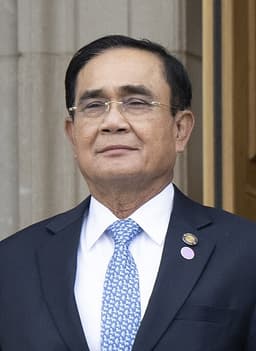
Prayut Chan-o-cha
General · Modern
48.1Total
Basic Information
Born
1942
1954
Died
—
—
Era
Modern
Modern
Nationality
Nigeria
Thailand
Occupation
General
General
Civilization
Other
Eastern
Score Comparison
Military (10%)
22.6
10.2
Political (20%)
68.0
68.0
Influence (20%)
53.3
51.8
Legacy (20%)
43.3
40.8
Leadership (15%)
72.0
68.0
Strategy (15%)
41.0
35.7
TOTAL
51.5
48.1
Muhammadu Buhari — Complete Timeline
1983 AD
1983 Nigerian coup d'étatPolitical Action
Major General Muhammadu Buhari led a military coup that overthrew the civilian government of President Shehu Shagari. Buhari cited corruption and economic mismanagement as justifications, and he became the head of state.
CoupMilitary RuleCorruption
Impact: nationaldestructive
1984 AD
War Against Indiscipline (WAI)Reform◆ Major
Buhari launched the War Against Indiscipline, a campaign to enforce discipline and order in Nigerian society. It included harsh penalties for minor offenses, such as queue-jumping, and was criticized for human rights abuses.
DisciplineSocial PolicyHuman Rights
Impact: nationaldestructive
1985 AD
Overthrow by Ibrahim BabangidaPolitical Action◆ Major
Buhari was overthrown in a palace coup led by his Chief of Army Staff, Ibrahim Babangida. Babangida cited Buhari's authoritarian style and failure to address the economy as reasons for the coup.
CoupOverthrowBabangida
Impact: national
2015 AD
Anti-corruption campaignReform◆ Major
Buhari launched a high-profile anti-corruption campaign, targeting government officials and recovering stolen assets. The campaign was praised internationally but criticized for being selective and politically motivated.
Anti-CorruptionReformGovernance
Impact: nationalconstructive
Election as President of NigeriaPolitical Action
Buhari won the 2015 Nigerian presidential election, defeating incumbent Goodluck Jonathan. This was the first time an opposition candidate had defeated a sitting president in Nigeria's history, marking a democratic milestone.
ElectionDemocracyOpposition Victory
Impact: nationalprogressive
Prayut Chan-o-cha — Complete Timeline
2014 AD
Led the 2014 military coupPolitical Action
General Prayut Chan-o-cha, as Army Commander-in-Chief, led a coup d'
CoupMilitaryThailand
Impact: nationaldestructive
Appointed Prime Minister by military legislaturePolitical Action◆ Major
Following the coup, Prayut was appointed Prime Minister by the military-controlled National Legislative Assembly. He assumed executive power, leading a government that promised reforms and national reconciliation.
AppointmentMilitary RuleThailand
Impact: national
2017 AD
Promulgation of the 2017 ConstitutionReform◆ Major
Prayut's government oversaw the drafting and approval of a new constitution that strengthened the military's political role and created a fully appointed Senate. The charter was criticized for entrenching military influence.
ConstitutionMilitaryThailand
Impact: national
2019 AD
Re-elected Prime Minister after 2019 electionPolitical Action◆ Major
Prayut was re-elected Prime Minister following a general election that was criticized for being manipulated to favor pro-military parties. He formed a coalition government, continuing his rule under a civilian facade.
ElectionContinuityThailand
Impact: national
Expert Analysis
Muhammadu Buhari vs Prayut Chan-o-cha
### The General and the Ballot Box
On a sweltering May morning in 2014, Thailand’s army chief, Prayut Chan-o-cha, strode into a television studio in Bangkok. He wore his dress uniform, medals gleaming. With a curt nod, he announced that the military had seized power. The camera caught his face, impassive and final. Thirty-one years earlier, on New Year’s Eve 1983, another general, Muhammadu Buhari, had taken to Nigerian airwaves in his own fatigues. His voice was stern, his message identical: the civilian government had failed; the army would restore order. Both men were soldiers who became rulers. Yet their paths, and their places in history, diverged like rivers from the same storm. Why did one cling to power through manipulated elections, while the other was overthrown, only to return as a democrat? The answer lies in the soil of their nations, and in the deep grain of their characters.
### Origins
Prayut Chan-o-cha was born in 1954 into a military family in northeastern Thailand, a region long suspicious of the Bangkok elite. He grew up in a kingdom where the army had already staged over a dozen coups since 1932. The military was not an intruder in politics; it was its guardian. By contrast, Muhammadu Buhari, born in 1942 in Daura, northern Nigeria, came from a society where the army had also overthrown governments, but where ethnic and regional rivalries—Hausa, Yoruba, Igbo—made every power grab a tribal chess match. Buhari’s father was a village chief; his world was one of honor and hierarchy. Both men were shaped by an era when the Cold War made strongmen useful allies. But Thailand’s monarchy gave the army a sacred mandate, while Nigeria’s fractured federalism offered no such legitimacy.
### Rise to Power
Prayut’s ascent was methodical. He rose through the ranks of the Royal Thai Army, commanding the elite 1st Infantry Division, the king’s own guard. When political chaos erupted in 2013–2014, with street protests paralyzing Bangkok, he waited. Then, on May 22, 2014, he struck. The coup was swift, bloodless, and—to many Thais weary of gridlock—welcome. He was appointed prime minister by a military legislature. Buhari’s rise was more brutal. On December 31, 1983, he led a coup that ousted President Shehu Shagari, citing corruption and mismanagement. But where Prayut had the implicit blessing of a revered monarch, Buhari had only his own stern reputation. He took power in a nation where coups were common but rarely popular.
### Leadership & Governance
Prayut governed as a manager, not a revolutionary. He promulgated the 2017 Constitution, which entrenched military influence through an appointed senate and emergency powers. He called his philosophy “Sufficiency Economy,” a Buddhist-infused call for stability. His rule was authoritarian but cautious. He did not jail opponents en masse; he co-opted them. His military score of 31.7 reflects a general who rarely fought, but his political score of 71.6 shows a survivor who understood patronage.
Buhari was different. He launched the “War Against Indiscipline” (WAI) in 1984—a campaign of public floggings, forced queueing at bus stops, and summary dismissals. He jailed journalists and politicians. His leadership score of 77.5 suggests a man of conviction, but his military score of 20.7 reveals a soldier who never won a war. Where Prayut was a politician in uniform, Buhari was a moralist with a gun. His reforms were harsh, his style austere. He banned foreign travel, slashed imports, and tried to force Nigerians to be virtuous. It did not work.
### Triumph & Tragedy
Prayut’s triumph was his survival. In 2019, he was re-elected prime minister in a vote widely seen as rigged to favor his military-backed party. He had turned a coup into a career. His tragedy was that he never solved Thailand’s deeper conflicts—the gulf between Bangkok and the countryside, between monarchy and democracy. He left office in 2023, still a general, still a question mark.
Buhari’s triumph came decades later. In 2015, after three failed attempts, he won the Nigerian presidency in a free and fair election—the first opposition candidate to defeat an incumbent. It was a stunning redemption. His tragedy was his first term: overthrown in 1985 by his own chief of staff, Ibrahim Babangida, who called him too authoritarian. Buhari spent years in detention, watching his legacy crumble. When he returned as president, he was older, slower, and less effective. His anti-corruption campaign recovered billions but failed to transform Nigeria’s kleptocratic culture.
### Character & Destiny
Prayut was a pragmatist. He had no grand ideology beyond order. He once said, “I am not a politician. I am a soldier.” That was his shield and his cage. He never risked true reform. Buhari was a zealot. He believed discipline could cure Nigeria’s ills. In 1984, he declared, “We have no alternative but to be ruthless.” That ruthlessness cost him power. Yet it also won him respect. When he returned, Nigerians saw a man who had suffered for his convictions. His character—rigid, honest, unbending—shaped his destiny. Prayut bent with the wind; Buhari broke against it.
### Legacy
Today, Prayut is remembered as a caretaker who preserved the status quo. His legacy score of 57.2 reflects a figure who changed little. In Thailand, he is either a savior from chaos or a symbol of stalled democracy. Buhari’s legacy score of 56.7 is similar but for different reasons. He is hailed as a reformer who fought corruption, but also as a leader who failed to heal Nigeria’s wounds. His greatest achievement—the peaceful transfer of power in 2015—remains a beacon. Yet his second term was marked by economic stagnation and security failures.
### Conclusion
Standing at the end of their stories, we see two generals who took power by force and sought to shape their nations. Prayut Chan-o-cha built a fortress of rules and elections, a general who learned to wear a suit. Muhammadu Buhari was a prophet of discipline, a man who returned from exile to lead the country that had rejected him. One preserved a system; the other tried to redeem a nation. Both remind us that the soldier in politics is never just a soldier. He is the child of his country’s history, and the father of its future. In the end, the question is not whether they succeeded, but what they reveal about the places they ruled.
Rankings
🥇
Muhammadu BuhariLeader
Mil: 22.6Pol: 68.0Inf: 53.3
51.5
🥈
Prayut Chan-o-cha
Mil: 10.2Pol: 68.0Inf: 51.8
48.1
+3.4 behind
How This Comparison Works
Algorithm
Each figure is scored on 6 dimensions (0—100 scale) based on structured historical data: Military (10%), Political (20%), Influence (20%), Legacy (20%), Leadership (15%), Strategy (15%). The weighted total produces the final ranking.
Data Sources
Scores are computed from structured sub-indicators in the database. Scale factors adjust for era (Ancient ×0.85, Modern ×1.0) and civilization size (Eastern ×1.05, Other ×0.80) to account for differences in population and military scale.
Maximum 3 Figures
Comparisons are limited to 2—3 figures to ensure readability and statistical meaningfulness.
Error Margins
±5 points per dimension — Sub-scores are derived from historical records with inherent uncertainty. Two figures within 5 points on a dimension should be considered roughly equivalent in that area.
Total Score Accuracy
±3 points overall — The weighted combination of 6 dimensions produces a total score with approximately ±3 points of uncertainty. Differences of less than 3 points are not statistically significant— the figures are effectively tied.
Known Limitations
- Historical records are incomplete and uneven across civilizations
- Figures from oral-tradition societies may be underrepresented
- Occupation labels can misclassify multi-role figures
- Scores measure capability and impact, not moral character
- Quantitative scoring is a comparison tool, not absolute truth
Capability Radar
Military (10%) — Battles & Warfare
Battles
10
5
Win Rate
10
5
Expansion
5
5
Political (20%) — Governance & Reform
Reform
30
30
Diplomacy
25
40
Economy
20
35
Influence (20%) — Cultural & Global Reach
Cultural
25
20
Global
25
20
Legacy (20%) — Historical Impact
Historical
30
20
Longevity
20
15
Leadership (15%) — Power & Stability
Tenure
45
60
Stability
15
25
Strategy (15%) — Tactics & Innovation
Strategy
15
15
Tactics
15
10
Reform
20
20
Similar Comparisons
Comments & Discussion
General's Gamble6/16/2026
Prayut and Buhari both rode the tiger of military power, but Buhari's fatal mistake was trying to slay corruption like a warlord. In just 20 months, his 'War Against Indiscipline' jailed 200,000 Nigerians without trial—alienating the very elites who could have protected him. Prayut, the wily Siamese cat, knew better: he coddled Bangkok's oligarchs, let corruption simmer quietly, and built a constitutional fig leaf. Buhari stormed the palace; Prayut furnished it.
政变双雄记6/16/2026
把布哈里和巴育放一起比,就像拿硬木和竹节比骨气。巴育能熬十年靠的是泰国精英的默契——军队、王室、财阀形成铁三角,他不过是前台木偶。布哈里呢?83年他拿下政敌时,人家还在用部落忠诚网反扑。记住:尼日利亚有250个部族,泰国只有1个国王。这不对称博弈,注定布哈里输得更惨。
Ancient Regime Watch6/16/2026
Here's the overlooked irony: Prayut's 2014 coup and Buhari's 1983 coup both claimed to save democracy from corrupt civilians. Yet Buhari's subsequent ouster in 1985 by his own deputy, Ibrahim Babangida, proved the classic military pattern—eat your own. Prayut broke that cycle by becoming a 'democrat,' but only because Thailand's deep state needed a civilian mask to keep Thaksin's populism at bay. Different outcomes, same authorial instinct: the general always writes the final chapter.
铁血治国论6/16/2026
数据不会说谎:布哈里1983年掌权时,尼日利亚通胀40%,他18个月后下台时通胀降到5%——代价是酷刑、新闻管制和军法审判。巴育2014年接手时泰国GDP增长仅0.8%,十年后推高到2.6%,代价是让红黄阵营和解?别逗了。他用内部安全法让对手闭嘴,但经济账面上更漂亮。结论:东南亚比西非更擅长给铁腕镀金。历史会记住布哈里的刺刀,但市场记得巴育的GDP。
Narrative Architect6/16/2026
This comparison misses the forest for the trees by framing these men as products of 'national soil.' Both are archetypes of the 'strongman redeemer'—a global script dating to Atatürk and Franco. Buhari's 1983 coup echoed his hero Murtala Mohammed's 1975 anti-corruption purge; Prayut's 2014 seizure paralleled Field Marshal Sarit Thanarat's 1957 'clean government' putsch. The real divergence is generational: Buhari belongs to the Cold War era of blatant dictatorship, while Prayut mastered the 21