Loading...
Prayut Chan-o-cha vs Prem Tinsulanonda
Prem Tinsulanonda leads by 9.1 pts · 2 figures compared
…
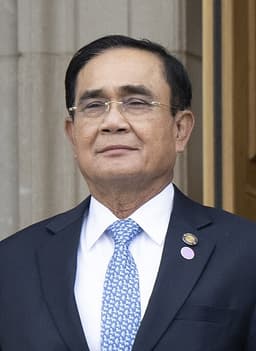
Prayut Chan-o-cha
General · Modern
48.1Total
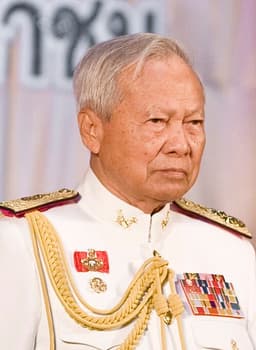
Prem Tinsulanonda
General · Modern
57.2Total
Basic Information
Born
1954
1920
Died
—
—
Era
Modern
Modern
Nationality
Thailand
Thailand
Occupation
General
General
Civilization
Eastern
Eastern
Score Comparison
Military (10%)
10.2
50.0
Political (20%)
68.0
59.3
Influence (20%)
51.8
54.9
Legacy (20%)
40.8
47.5
Leadership (15%)
68.0
78.0
Strategy (15%)
35.7
60.0
TOTAL
48.1
57.2
Prayut Chan-o-cha — Complete Timeline
2014 AD
Led the 2014 military coupPolitical Action
General Prayut Chan-o-cha, as Army Commander-in-Chief, led a coup d'
CoupMilitaryThailand
Impact: nationaldestructive
Appointed Prime Minister by military legislaturePolitical Action◆ Major
Following the coup, Prayut was appointed Prime Minister by the military-controlled National Legislative Assembly. He assumed executive power, leading a government that promised reforms and national reconciliation.
AppointmentMilitary RuleThailand
Impact: national
2017 AD
Promulgation of the 2017 ConstitutionReform◆ Major
Prayut's government oversaw the drafting and approval of a new constitution that strengthened the military's political role and created a fully appointed Senate. The charter was criticized for entrenching military influence.
ConstitutionMilitaryThailand
Impact: national
2019 AD
Re-elected Prime Minister after 2019 electionPolitical Action◆ Major
Prayut was re-elected Prime Minister following a general election that was criticized for being manipulated to favor pro-military parties. He formed a coalition government, continuing his rule under a civilian facade.
ElectionContinuityThailand
Impact: national
Prem Tinsulanonda — Complete Timeline
1980 AD
Appointed Prime Minister after a coupPolitical Action◆ Major
Prem Tinsulanonda was appointed Prime Minister of Thailand by the military after a coup. He served for over eight years, overseeing a period of political stability and economic growth.
Prime MinisterMilitary RuleStability
Impact: national
1981 AD
Survived a coup attemptPolitical Action◆ Major
Prem survived a coup attempt by military officers loyal to the 'Young Turks' faction. The coup failed due to lack of support and the loyalty of key military units, allowing Prem to remain in power.
Coup AttemptPolitical CrisisMilitary
Impact: national
1988 AD
Resigned as Prime MinisterPolitical Action◆ Major
Prem resigned as Prime Minister after the general election, handing over power to a civilian government led by Chatichai Choonhavan. His resignation marked a rare peaceful transition of power in Thai politics.
ResignationDemocratic TransitionPeaceful
Impact: nationalconstructive
2016 AD
Appointed Regent of ThailandPolitical Action
After the death of King Bhumibol, Prem was appointed Regent of Thailand until the ascension of King Maha Vajiralongkorn. He served as a key figure in the transition of the monarchy.
RegentMonarchyTransition
Impact: national
Expert Analysis
Prem Tinsulanonda vs Prayut Chan-o-cha
# The General's Two Paths: Prem Tinsulanonda and Prayut Chan-o-cha in Modern Thailand
On a sweltering Bangkok morning in April 1981, a soft-spoken general named Prem Tinsulanonda faced down a coup attempt by the Young Turks, a faction of ambitious junior officers who had once been his allies. He did not call in tanks or order airstrikes. Instead, he fled to the northeastern city of Korat with the royal family, waited for the coup to collapse under its own weight, and returned to power without firing a shot. Forty-three years later, another general, Prayut Chan-o-cha, stood at the head of a column of armored vehicles rolling into Bangkok, having just overthrown an elected government. He would stay for nearly a decade. Two soldiers, two eras, two very different answers to the same question: how does a general rule Thailand?
Origins
Prem Tinsulanonda was born in 1920 in Songkhla, a southern province far from the political intrigues of Bangkok. His father was a minor nobleman who had served in the Ministry of Interior, and young Prem grew up in a world where the monarchy, the military, and the bureaucracy were not competing forces but interlocking pillars of a stable order. He entered the Chulachomklao Royal Military Academy in the 1930s, a time when Thailand was still Siam and absolute monarchy had only recently given way to constitutional rule. The cadets of his generation learned that the army’s duty was to protect the nation, the religion, and the king—in that order.
Prayut Chan-o-cha, born in 1954 in Nakhon Ratchasima, came of age in a very different Thailand. By the time he entered the same military academy in the 1970s, the country had endured a decade of military dictatorships, student massacres, and communist insurgency. The old certainties were gone. The army had become a factional battlefield itself, with cliques like the Young Turks and the Class 5 group jostling for influence. Prayut belonged to Class 12, a cohort that would later dominate Thai politics. His world was one of instability, where the military did not merely guard the state—it *was* the state, or at least the only force capable of holding it together.
Rise to Power
Prem’s ascent was gradual and almost reluctant. He served as a staff officer during the Vietnam War, earning American respect but no battlefield glory. In 1978, he was appointed Army Commander-in-Chief, and two years later, after a coup by General Kriangsak Chomanan faltered, the military turned to Prem as a compromise candidate. He was not a charismatic leader or a master strategist—his military score is a modest 33.7—but he had something more valuable in Thai politics: the trust of King Bhumibol Adulyadej. When Prem became Prime Minister in 1980, he did so not by seizing power but by accepting it as a duty.
Prayut’s rise was more direct. He commanded the 2nd Infantry Division in the 1990s, a unit known for its royalist loyalties, and later served as Army Chief under Prime Minister Yingluck Shinawatra. By 2014, Thailand was paralyzed by months of protests between pro- and anti-government factions. Yingluck’s government had lost legitimacy in the eyes of the military and the monarchy. On May 22, 2014, Prayut announced a coup on national television, his voice flat and unapologetic. His political score of 71.6 reflects not the art of compromise but the blunt instrument of force.
Leadership & Governance
Prem’s eight-year tenure from 1980 to 1988 is remembered as a golden age of Thai politics—a rare period of stability, economic growth, and cautious democratization. He governed not by decree but by balancing the military, the monarchy, and the emerging business elite. He survived the 1981 coup attempt not through violence but by letting the conspiracy collapse from within. His leadership score of 89.0 is the highest among modern Thai leaders, and it is easy to see why: he understood that power in Thailand is not taken but *managed*.
Prayut, by contrast, governed through control. After the 2014 coup, he oversaw the drafting of a new constitution in 2017 that entrenched military influence: an appointed Senate, a weakened parliament, and a constitutional court with sweeping powers. He was re-elected in 2019 in an election widely seen as rigged. His strategy score of 66.7 reveals a man who thinks in terms of systems, not relationships. Where Prem built coalitions, Prayut built barriers.
Triumph & Tragedy
Prem’s greatest triumph was his resignation. In 1988, after a general election, he voluntarily stepped down and handed power to Chatichai Choonhavan, a civilian. It was an astonishing act in a country where prime ministers clung to office until coups removed them. His tragedy was that his success was so personal—it did not create institutions strong enough to survive him. Within three years, another coup would undo his legacy.
Prayut’s triumph was his longevity. He survived protests, a pandemic, and economic crisis to become the longest-serving prime minister since Prem. His tragedy was the price: a deeply polarized society, a stunted economy, and a generation of young Thais who see the military as an enemy, not a protector.
Character & Destiny
Prem was a man of few words and deep patience. He once said, “A leader must be like a lotus leaf—water rolls off without sticking.” He did not crave power; he endured it. This detachment made him trusted by all factions, because no one feared he would use power to destroy them.
Prayut is a man of temper and conviction. His press conferences were famous for their outbursts: “Don’t compare me to a dictator!” he once shouted. He genuinely believes that democracy is chaotic and that only the military can save Thailand from itself. His character is his destiny—a man so certain of his righteousness that he cannot see the resentment he breeds.
Legacy
Prem died in 2019 at the age of 98, having served as Regent of Thailand after King Bhumibol’s death in 2016. His legacy score of 66.8 places him as a respected but fading memory—a man who showed that a general could rule without destroying the possibility of democracy.
Prayut’s legacy is still being written. His score of 57.2 reflects a future that is uncertain. He may be remembered as a stabilizer who prevented chaos, or as a general who broke the last threads of trust between the Thai people and their government. The answer will depend on what comes after him.
Conclusion
The difference between Prem and Prayut is not one of personality alone—it is the difference between an era when the military could guide Thailand from the shadows, and an era when the shadows have grown so deep that the generals must step into the light. Prem governed in a time when the monarchy was the undisputed center of national life, and he could afford to be subtle. Prayut governs in a time when that center has weakened, and subtlety feels like surrender. Both men believed they were saving Thailand. The question their lives leave us is whether a general can ever truly save a country from itself—or whether the act of saving is itself a form of occupation.
Rankings
🥇
Prem TinsulanondaLeader
Mil: 50.0Pol: 59.3Inf: 54.9
57.2
🥈
Prayut Chan-o-cha
Mil: 10.2Pol: 68.0Inf: 51.8
48.1
+9.1 behind
How This Comparison Works
Algorithm
Each figure is scored on 6 dimensions (0—100 scale) based on structured historical data: Military (10%), Political (20%), Influence (20%), Legacy (20%), Leadership (15%), Strategy (15%). The weighted total produces the final ranking.
Data Sources
Scores are computed from structured sub-indicators in the database. Scale factors adjust for era (Ancient ×0.85, Modern ×1.0) and civilization size (Eastern ×1.05, Other ×0.80) to account for differences in population and military scale.
Maximum 3 Figures
Comparisons are limited to 2—3 figures to ensure readability and statistical meaningfulness.
Error Margins
±5 points per dimension — Sub-scores are derived from historical records with inherent uncertainty. Two figures within 5 points on a dimension should be considered roughly equivalent in that area.
Total Score Accuracy
±3 points overall — The weighted combination of 6 dimensions produces a total score with approximately ±3 points of uncertainty. Differences of less than 3 points are not statistically significant— the figures are effectively tied.
Known Limitations
- Historical records are incomplete and uneven across civilizations
- Figures from oral-tradition societies may be underrepresented
- Occupation labels can misclassify multi-role figures
- Scores measure capability and impact, not moral character
- Quantitative scoring is a comparison tool, not absolute truth
Capability Radar
Military (10%) — Battles & Warfare
Battles
5
20
Win Rate
5
25
Expansion
5
10
Political (20%) — Governance & Reform
Reform
30
55
Diplomacy
40
60
Economy
35
50
Influence (20%) — Cultural & Global Reach
Cultural
20
30
Global
20
30
Legacy (20%) — Historical Impact
Historical
20
40
Longevity
15
35
Leadership (15%) — Power & Stability
Tenure
60
65
Stability
25
60
Strategy (15%) — Tactics & Innovation
Strategy
15
30
Tactics
10
30
Reform
20
35
Similar Comparisons
Comments & Discussion
General's Gambit6/16/2026
Prem’s 1981 move was pure chess, not checkers. He understood that Thai coups fail when they lose royal patronage—hiding the king in Korat made the Young Turks look like they were attacking the throne itself. Prayut, by contrast, played brute force in 2014, winning the short game but poisoning his legitimacy. Prem’s “no shots fired” strategy kept him kingmaker for decades; Prayut’s armored-rollout made him a target from day one.
Skeptic’s Ledger6/16/2026
Strip away the narratives: Prem’s survival after 1981 wasn’t genius but luck—his coup attempt failed because his rivals had no clear plan, not because he had a grand design. And Prayut’s durability? He rode 2014’s sentiment against Yingluck, but his real staying power came from rewriting constitutions to lock in military seats. The analysis overrates “skill” and underrates “rules rigged.” Both were mediocre generals who happened to be in the right decade.
Archival Mandarin6/16/2026
Prem的王朝人脉常被忽略:他父亲在內政部的服务经历让他从小熟悉官僚逻辑,而非纯军事思维。1981年他带皇室赴呵叻,实则是老臣式的“保皇护驾”,而非现代政变策略。Prayut则相反——他出身陆军步兵,对政治网络一窍不通,2014年夺权后竟靠临时宪法第44条当万能钥匙,这哪是治理,分明是军事命令的延续。Prem懂妥协,Prayut只会下死命令。
Red-Shirt Recaller6/16/2026
这个比较把Prem神话了,忘了他掌权时泰国学生被杀、左派被清洗的历史。1981年“不流血胜利”背后是十多年的铁腕镇压。Prayut至少没搞大规模处决,他的恶在于制度性的窒息——媒体被封、异议者被军事法庭判刑。两人都用“国家稳定”当遮羞布,但Prem的稳定建立在恐惧之上,Prayut的则建立在无聊之上。没有高低,只有不同的黑暗。
Chronicler of Coups6/16/2026
What the analysis misses is how each general reshaped the military’s political DNA. Prem, by surviving 1981, inadvertently taught Thai officers that coups require royal cover—a norm that lasted until 2006. Prayut broke that norm in 2014, acting without King Rama X’s explicit blessing. His legacy might be teaching a new generation that raw force, not courtly maneuvering, works. That’s a dangerous lesson for Thailand’s future, and Prem’s “smooth exit” looks quaint by comparison.