Loading...
Pedro I of Brazil vs Wu Zetian
Wu Zetian leads by 15.4 pts · 2 figures compared
…
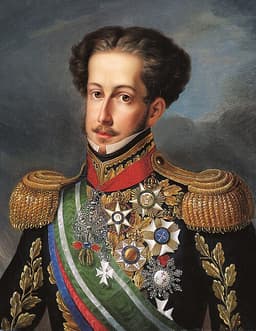
Pedro I of Brazil
Emperor · Modern
54.6Total

Wu Zetian
Emperor · Medieval
70.0Total
Basic Information
Born
1798
624
Died
1834
705
Era
Modern
Medieval
Nationality
Brazil
China
Occupation
Emperor
Emperor
Civilization
Western
Eastern
Score Comparison
Military (10%)
55.0
60.0
Political (20%)
62.7
62.7
Influence (20%)
59.0
65.0
Legacy (20%)
50.0
80.0
Leadership (15%)
53.2
78.0
Strategy (15%)
45.0
66.3
TOTAL
54.6
70.0
Pedro I of Brazil — Complete Timeline
1822 AD
Declaration of Independence of BrazilPolitical Action
Pedro I declared Brazil's independence from Portugal on September 7, 1822, at the Ipiranga River in S
Impact: globalprogressive
Coronation as Emperor of BrazilPolitical Action◆ Major
Pedro I was crowned Emperor of Brazil on December 1, 1822, in Rio de Janeiro. The coronation formalized the new imperial government, with Pedro I as constitutional monarch, though he retained significant executive powers.
Impact: nationalconstructive
1823 AD
War of Independence of BrazilWar◆ Major
Pedro I led Brazilian forces against Portuguese loyalists in the War of Independence. Key battles occurred in Bahia, Maranh
Impact: national
Dissolution of the Constituent AssemblyPolitical Action◆ Major
Pedro I dissolved the Constituent Assembly after conflicts over the constitution's limits on imperial power. He then imposed the 1824 Constitution, which granted the emperor extensive powers, including the Moderating Power, centralizing authority.
Impact: nationaldestructive
1831 AD
Abdication of the Brazilian ThronePolitical Action
Pedro I abdicated the Brazilian throne in favor of his five-year-old son Pedro II on April 7, 1831. He returned to Portugal to claim the Portuguese throne, leaving Brazil under a regency until his son came of age.
Impact: national
Wu Zetian — Complete Timeline
655 AD
Became Empress ConsortPolitical Action◆ Major
Wu Zetian was elevated from concubine to empress consort of Emperor Gaozong of Tang in 655. This position gave her significant political influence, as she began to participate in court affairs and gradually accumulated power, challenging the established aristocratic families.
Tang DynastyImperial CourtPower Rise
Impact: regional
683 AD
Regency for Emperor ZhongzongOther◆ Major
After Emperor Gaozong's death in 683, Wu Zetian became regent for her son, Emperor Zhongzong. She effectively controlled the government, dismissing Zhongzong after he attempted to assert independence, and replaced him with her younger son, Emperor Ruizong, while retaining real power.
Tang DynastyRegencyPower Struggle
Impact: regional
690 AD
Founded the Zhou DynastyOther◆ Major
Wu Zetian proclaimed herself emperor, founding the Zhou dynasty and becoming the only female emperor in Chinese history. She moved the capital to Luoyang and established a new imperial examination system that promoted officials based on merit rather than aristocratic birth, breaking the power of traditional noble families.
Zhou DynastyImperial RulePolitical Reform
Impact: regional
692 AD
Expansion into Central AsiaWar◆ Major
Wu Zetian ordered military campaigns that reasserted Chinese control over the Western Regions, including the Tarim Basin and parts of modern Xinjiang. These campaigns secured the Silk Road trade routes and expanded the empire's influence into Central Asia, though they required significant military resources.
Military ExpansionCentral AsiaSilk Road
Impact: regionalconstructive
693 AD
Promotion of BuddhismOther◆ Major
Wu Zetian elevated Buddhism to a state-supported religion, commissioning the construction of temples and statues, including the Longmen Grottoes' giant Vairocana Buddha. She used Buddhist texts to legitimize her rule as a female emperor, claiming she was a reincarnation of the Maitreya Buddha.
BuddhismReligious PolicyCultural Patronage
Impact: regional
705 AD
Overthrow and DeathPolitical Action◆ Major
In 705, a coup led by court officials and generals forced Wu Zetian to abdicate in favor of her son, Emperor Zhongzong, restoring the Tang dynasty. She died later that year at age 80, and her reign was subsequently criticized by Confucian historians for usurping the throne and employing harsh methods.
Tang DynastyCoupAbdication
Impact: regionaldestructive
Expert Analysis
Wu Zetian vs Pedro I of Brazil
# The Emperor and the Empress: Two Paths to Power, Two Destinies
On a September morning in 1822, Pedro I stood at the banks of the Ipiranga River in São Paulo, tore the Portuguese insignia from his uniform, and shouted “Independência ou Morte!” It was a moment of pure theater, perfectly staged—a young prince choosing nation over dynasty. Thirteen centuries earlier and half a world away, Wu Zetian faced no such dramatic choice. As a teenage concubine in the Tang imperial palace, she learned a quieter truth: for a woman in power, survival itself was a kind of war. One founded an empire with a cry; the other built one with whispers. Both became emperors. But what drove their radically different outcomes—and why does one inspire reverence while the other provokes unease?
Origins
Wu Zetian was born in 624, the daughter of a timber merchant who had risen to minor nobility. China’s Tang dynasty was at its zenith—cosmopolitan, militaristic, and deeply Confucian. For a woman, the path to power was almost invisible. Wu entered the palace at fourteen as a low-ranking concubine of Emperor Taizong, where she learned that intelligence was dangerous and beauty a weapon. When Taizong died, she was sent to a Buddhist convent, as custom demanded. But she had already caught the eye of his son, the future Emperor Gaozong. Her return to court defied tradition, and her subsequent rise—from concubine to empress to regent to emperor—was a masterclass in patience and ruthlessness.
Pedro I, born in 1798, inherited a different world. He was a prince of the Portuguese House of Braganza, raised in Rio de Janeiro after Napoleon’s invasion forced the royal court to flee to Brazil. His childhood was a collision of European enlightenment and tropical reality. He read Voltaire and Rousseau, but he also learned to ride horses bareback and swore in Portuguese like a sailor. Unlike Wu, who clawed her way up from nothing, Pedro was born into the highest echelon. His struggle was not to gain power but to keep it—and to decide what kind of power it would be.
Rise to Power
Wu Zetian’s ascent was a decade-long chess game. After Gaozong suffered a stroke in 660, she began ruling through him, issuing edicts and receiving officials. She purged rivals—most famously, she had her own infant daughter smothered to frame the empress, a story that may be legend but captures her reputation. In 690, after Gaozong’s death and a brief interlude with her sons, she declared herself emperor of her own Zhou dynasty. She was sixty-six years old. The Confucian establishment was horrified: a woman on the dragon throne was an inversion of heaven’s order. But Wu had already neutralized the aristocracy by creating a new examination system that promoted talented commoners, ensuring loyalty from those who owed everything to her.
Pedro’s rise was faster and more public. In 1821, when his father King João VI returned to Portugal, he left Pedro as regent of Brazil. The Portuguese parliament then tried to reduce Brazil to colonial status. Pedro refused. On January 9, 1822, he declared “Fico” (“I stay”), defying orders to return to Lisbon. Eight months later came the Ipiranga declaration. He was crowned emperor in December at age twenty-four. Where Wu moved in shadows, Pedro performed in sunlight.
Leadership & Governance
As emperor, Wu Zetian governed with ruthless efficiency. She expanded China’s borders into Central Asia, built the new capital of Luoyang, and patronized Buddhism to legitimize her rule. Her political score of 80 reflects a leader who understood that power required both terror and talent. She executed thousands of nobles who opposed her, but she also promoted officials like Di Renjie, a commoner who became her most trusted chancellor. Her military score of 62 is modest—she relied on capable generals rather than personal command. But her strategy score of 65.6 shows she knew when to fight and when to bribe.
Pedro I’s leadership was more chaotic. His military score of 65 edges Wu’s, and he personally led Brazilian forces in the War of Independence (1823), defeating Portuguese loyalists in Bahia. But his political score of 60.2 reveals a ruler who could inspire a crowd but could not govern a nation. He dissolved the Constituent Assembly in 1823 when it tried to limit his power, then imposed a constitution that was more liberal than he wanted. He fought a disastrous war with Argentina over Uruguay (the Cisplatine War), draining Brazil’s treasury. His strategy score of 50—the lowest in this comparison—speaks to impulsive decisions that alienated allies and emboldened enemies.
Triumph & Tragedy
Wu Zetian’s greatest triumph was simply existing as emperor for fifteen years—a feat so unprecedented that no Chinese woman has repeated it. She died in 705 at age eighty-one, having been forced to abdicate in a coup that restored the Tang dynasty. Her tragedy was that her legacy was immediately distorted. Tang historians painted her as a monstrous usurper, and for centuries she was remembered as a sexual predator who murdered her own children. Only in the twentieth century did scholars begin to rehabilitate her as a capable ruler who broke a glass ceiling made of iron.
Pedro’s triumph was Brazil itself. He gave the nation independence without the bloody wars that fractured Spanish America. His tragedy came in 1831, when he abdicated after nine years of mounting unpopularity. He left the throne to his five-year-old son Pedro II and returned to Portugal, where he died three years later at age thirty-five from tuberculosis. He was a founder who could not finish what he started.
Character & Destiny
The differences between these two rulers are not merely biographical; they are structural. Wu Zetian operated in a system where power was absolute and legitimacy was everything. She could only succeed by becoming more ruthless than any man, because a woman who showed mercy was seen as weak. Pedro, by contrast, ruled in an age of revolutions, where constitutions, parliaments, and public opinion constrained even an emperor. His impulsiveness—his temper, his infidelities, his refusal to compromise—was a character flaw in a system that required diplomacy. Wu’s ruthlessness was a survival strategy; Pedro’s recklessness was a luxury he could not afford.
Legacy
Today, Wu Zetian’s legacy score of 85 reflects a grudging respect. She is a symbol of female ambition in a patriarchal civilization, a figure both admired and feared. Pedro’s legacy of 70 is more straightforward: he is Brazil’s founding father, the man who said “Independência ou Morte.” But his son Pedro II would reign for forty-nine years, becoming a beloved figure who modernized Brazil. Pedro I was the spark; his son was the flame. Wu Zetian was both.
Conclusion
Standing at the Ipiranga River, Pedro I chose the future over the past. Wu Zetian, in the Forbidden City, chose herself over everyone. Both were emperors, but they inhabited different worlds—one of inherited privilege, the other of earned survival. Pedro’s story ends with a boy-king and a quiet abdication; Wu’s ends with a dynasty she founded but could not preserve. Perhaps the deepest difference is this: Pedro I is remembered for what he began, while Wu Zetian is remembered for what she was. And in that distinction lies the tragedy of the woman who dared to be emperor in a world that could not forgive her for succeeding.
Rankings
🥇
Wu ZetianLeader
Mil: 60.0Pol: 62.7Inf: 65.0
70.0
🥈
Pedro I of Brazil
Mil: 55.0Pol: 62.7Inf: 59.0
54.6
+15.4 behind
How This Comparison Works
Algorithm
Each figure is scored on 6 dimensions (0—100 scale) based on structured historical data: Military (10%), Political (20%), Influence (20%), Legacy (20%), Leadership (15%), Strategy (15%). The weighted total produces the final ranking.
Data Sources
Scores are computed from structured sub-indicators in the database. Scale factors adjust for era (Ancient ×0.85, Modern ×1.0) and civilization size (Eastern ×1.05, Other ×0.80) to account for differences in population and military scale.
Maximum 3 Figures
Comparisons are limited to 2—3 figures to ensure readability and statistical meaningfulness.
Error Margins
±5 points per dimension — Sub-scores are derived from historical records with inherent uncertainty. Two figures within 5 points on a dimension should be considered roughly equivalent in that area.
Total Score Accuracy
±3 points overall — The weighted combination of 6 dimensions produces a total score with approximately ±3 points of uncertainty. Differences of less than 3 points are not statistically significant— the figures are effectively tied.
Known Limitations
- Historical records are incomplete and uneven across civilizations
- Figures from oral-tradition societies may be underrepresented
- Occupation labels can misclassify multi-role figures
- Scores measure capability and impact, not moral character
- Quantitative scoring is a comparison tool, not absolute truth
Capability Radar
Military (10%) — Battles & Warfare
Battles
35
65
Win Rate
40
70
Expansion
30
75
Political (20%) — Governance & Reform
Reform
45
85
Diplomacy
50
80
Economy
30
85
Influence (20%) — Cultural & Global Reach
Cultural
40
85
Global
45
70
Legacy (20%) — Historical Impact
Historical
55
90
Longevity
50
85
Leadership (15%) — Power & Stability
Tenure
55
90
Stability
25
75
Strategy (15%) — Tactics & Innovation
Strategy
35
75
Tactics
30
60
Reform
20
80
Similar Comparisons
Comments & Discussion
EmpressVsEmperor6/16/2026
Wu Zetian was the real strategist; Pedro’s "Independência ou Morte!" was just a PR stunt. She spent decades maneuvering in a Tang court where a single wrong word meant death, while he inherited a throne and played king. She didn't need a catchy slogan—she outlived rivals, rewrote succession laws, and ruled for 15 years as emperor. Pedro abdicated after 9. That's not a comparison; it's a mismatch.
史辩师6/16/2026
把女皇和佩德罗放一起比,就像拿《资治通鉴》对比一本旅游小册子。武则天用一辈子在男性天下的缝隙里杀出血路,活活把“牝鸡司晨”从骂名变成史书承认的“贞观遗风”。佩德罗一世呢?喊句口号、打几场小仗、退位跑路去欧洲。一个靠杀人治国,一个靠离婚收场,差远了。
DataSkeptic6/16/2026
Let’s talk numbers: Wu Zetian’s reign saw the Tang population jump from about 37 million to over 50 million, despite political purges. Pedro’s Brazil? Stagnant census figures and a debt default. She expanded trade along the Silk Road; he left Brazil with a bloated military budget. The "great cry" didn't pay the bills. Her whisper economy outperformed his theater every time.
古典学人6/16/2026
论历史厚度,佩德罗一世就是个暴发户。他在拉丁美洲搞独立那一套,莎士比亚写来也就一出闹剧。武则天却把自己融进《唐六典》和科举制度里,连韩国和日本文献都得记她一笔。一个只是被现代巴西人勉强记住的开国者,另一个是东亚文明绕不过的影子——这拳我打给女皇,别争了。
RevisionistCritic6/16/2026
Fine, Wu was efficient, but let's not romanticize tyranny. She executed rivals, crushed palace factions, and controlled eunuchs through fear. Pedro I, for all his theater, at least signed Brazil’s first constitution and stepped down when it failed. He wasn't a saint, but he gave up power. Wu held it until death, leaving a legacy of court intrigue and no smooth succession. Choose your flawed emperor.