Loading...
Francisco Morazan vs Pedro I of Brazil
Francisco Morazan leads by 3.4 pts · 2 figures compared
…
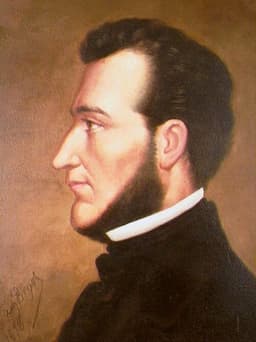
Francisco Morazan
General · Modern
58.0Total
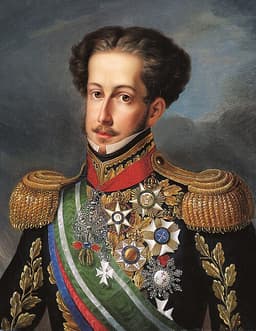
Pedro I of Brazil
Emperor · Modern
54.6Total
Basic Information
Born
1792
1798
Died
1842
1834
Era
Modern
Modern
Nationality
Honduras
Brazil
Occupation
General
Emperor
Civilization
Western
Western
Score Comparison
Military (10%)
52.5
55.0
Political (20%)
60.0
62.7
Influence (20%)
62.0
59.0
Legacy (20%)
50.0
50.0
Leadership (15%)
68.0
53.2
Strategy (15%)
55.0
45.0
TOTAL
58.0
54.6
Francisco Morazan — Complete Timeline
1824 AD
Abolition of slavery in Central AmericaReform◆ Major
As a key leader in the liberal movement, Moraz
AbolitionSlaveryLiberal Reform
Impact: regionalprogressive
1827 AD
Battle of La TrinidadWar◆ Major
Morazán led a liberal army to victory against conservative forces at La Trinidad, Honduras. This battle was a key turning point in the Central American civil war, allowing Morazán to consolidate power and eventually become president of the federation.
BattleLiberal VictoryCivil War
Impact: regional
1830 AD
Presidency of the Federal Republic of Central AmericaPolitical Action
Morazán was elected president of the Federal Republic of Central America, a union of Guatemala, El Salvador, Honduras, Nicaragua, and Costa Rica. He pursued liberal reforms including separation of church and state, free trade, and land reform, facing opposition from conservatives.
Federal RepublicLiberal ReformsCentral America
Impact: regionalconstructive
1842 AD
Execution by firing squadPolitical Action
After a failed attempt to restore the Federal Republic, Moraz
ExecutionEnd of FederationLiberal Defeat
Impact: regionaltragic
Pedro I of Brazil — Complete Timeline
1822 AD
Declaration of Independence of BrazilPolitical Action
Pedro I declared Brazil's independence from Portugal on September 7, 1822, at the Ipiranga River in S
Impact: globalprogressive
Coronation as Emperor of BrazilPolitical Action◆ Major
Pedro I was crowned Emperor of Brazil on December 1, 1822, in Rio de Janeiro. The coronation formalized the new imperial government, with Pedro I as constitutional monarch, though he retained significant executive powers.
Impact: nationalconstructive
1823 AD
War of Independence of BrazilWar◆ Major
Pedro I led Brazilian forces against Portuguese loyalists in the War of Independence. Key battles occurred in Bahia, Maranh
Impact: national
Dissolution of the Constituent AssemblyPolitical Action◆ Major
Pedro I dissolved the Constituent Assembly after conflicts over the constitution's limits on imperial power. He then imposed the 1824 Constitution, which granted the emperor extensive powers, including the Moderating Power, centralizing authority.
Impact: nationaldestructive
1831 AD
Abdication of the Brazilian ThronePolitical Action
Pedro I abdicated the Brazilian throne in favor of his five-year-old son Pedro II on April 7, 1831. He returned to Portugal to claim the Portuguese throne, leaving Brazil under a regency until his son came of age.
Impact: national
Expert Analysis
Francisco Morazan vs Pedro I of Brazil
# The Emperor and the Reformer
On a September morning in 1822, a young prince stood at the banks of the Ipiranga River in São Paulo, tore the Portuguese insignia from his uniform, and shouted words that would echo through the Americas: "Independence or death!" Five years later, in the mountains of Honduras, a general with a law degree led a ragged army of liberals against entrenched conservatives at the Battle of La Trinidad, winning a victory that would make him the champion of a united Central America. Pedro I of Brazil and Francisco Morazán both fought to forge new nations from the wreckage of empire, but their paths could not have diverged more dramatically—one became an emperor who abandoned his throne, the other a reformer who died before a firing squad.
Origins
Pedro I was born into the heart of European monarchy. His father was King John VI of Portugal, and the royal family had fled Napoleon's armies to rule their vast empire from Rio de Janeiro. Young Pedro grew up in a court that combined Old World ceremony with New World chaos, learning to ride and fight but receiving little formal education. He was impulsive, passionate, and deeply aware of his royal blood—a man who believed that power flowed from God and dynasty.
Francisco Morazán came from a different world entirely. Born in Tegucigalpa, Honduras, to a Creole family of modest means, he educated himself in law, philosophy, and military tactics. The son of a merchant, he absorbed the Enlightenment ideas sweeping through Latin America—liberty, equality, constitutional government. Where Pedro saw himself as a ruler by divine right, Morazán saw himself as an instrument of progress.
Rise to Power
Pedro's rise was almost accidental. When his father returned to Portugal in 1821, leaving Pedro as regent in Brazil, the Portuguese court demanded that the colony return to subordinate status. Brazilian elites, fearing a loss of autonomy, pushed Pedro to stay and lead. He chose independence, and on December 1, 1822, he crowned himself Emperor Pedro I in Rio de Janeiro—a monarch who had become a revolutionary almost by circumstance.
Morazán earned his place through sheer will. In 1827, when conservative forces controlled the Federal Republic of Central America, he gathered a small army of exiles and defeated them at La Trinidad with tactical brilliance that belied his lack of formal military training. By 1830, he was elected president of the Federal Republic—a union of Guatemala, El Salvador, Honduras, Nicaragua, and Costa Rica—pledged to create a modern, liberal state.
Leadership & Governance
Pedro I ruled as a traditional monarch in an age of revolutions. He granted Brazil a constitution in 1824, but one that preserved his veto power, his control over the judiciary, and his ability to dissolve the legislature. When the Constituent Assembly tried to limit his authority in 1823, he simply dissolved it with bayonets. He led Brazilian forces to victory in the War of Independence against Portuguese loyalists, but his military strategy was more about personal bravery than strategic genius—his score of 50.0 in strategy reflects a ruler who fought with passion rather than calculation.
Morazán governed as a radical reformer. He abolished slavery in Central America in 1824, ended church courts, promoted public education, and tried to break the power of the landed aristocracy. His military leadership—scoring 76.7—was both inspiring and effective, but his political vision exceeded his resources. The Federal Republic was a fragile union of states that resented central authority, and Morazán's reforms alienated the conservative elites who controlled the countryside.
Triumph & Tragedy
Pedro's greatest triumph was securing Brazil's independence intact—a vast nation that did not fragment into warring republics. But his tragedy was personal and political: he could not adapt to the demands of constitutional rule. By 1831, after years of conflict with the legislature, economic crisis, and a disastrous war with Argentina, he abdicated in favor of his five-year-old son, Pedro II, and sailed for Portugal. He left Brazil not as a defeated man but as a frustrated one, unable to reconcile his vision of monarchy with the realities of governance.
Morazán's triumph was the dream of a united Central America—a liberal republic that could stand alongside the United States. His tragedy was that the dream was too fragile. By 1839, the Federal Republic had collapsed into civil war. Morazán fled into exile, but he could not abandon his vision. In 1842, he invaded Costa Rica, was captured, and was executed by firing squad. His last words reportedly were: "I die with the conviction that the union of Central America is the only hope for our liberty."
Character & Destiny
Pedro was a man of contradictions: a liberal who loved power, a revolutionary who kept a crown. His political score of 60.2 reflects a leader who never fully understood that independence required more than a declaration—it required compromise. He was brave, charismatic, and ultimately self-indulgent, choosing personal honor over political necessity.
Morazán was a true believer, driven by ideas rather than ambition. His political score of 72.0 shows a reformer who understood the machinery of government but underestimated the forces of tradition. He was disciplined, principled, and ultimately inflexible—a man who would rather die for his ideals than live with half-measures.
Legacy
Pedro I left Brazil a nation, but it was his son, Pedro II, who would build it into an empire that lasted until 1889. Today, Brazilians remember him as the "Liberator" but also as a flawed founder—a man who gave them independence but could not give them stability. His legacy score of 70.0 reflects this ambiguity.
Morazán left Central America a legend. Today, he is honored as a hero in Honduras and El Salvador, a symbol of the dream of unity that still haunts the region. His legacy score of 68.9 is lower than his influence suggests, because his failure was so complete—the Federal Republic never rose again, and Central America remains divided into quarrelsome nations.
Conclusion
The emperor and the reformer both tried to build something new in the Americas. Pedro I wanted a monarchy that could bridge the Old World and the New; Morazán wanted a republic that could realize the Enlightenment. One abdicated and returned to Europe; the other died before a firing squad in a country he had tried to save. Their stories remind us that history rewards not just vision but adaptability—and that the difference between triumph and tragedy is often the distance between what we dream and what we are willing to compromise.
Rankings
🥇
Francisco MorazanLeader
Mil: 52.5Pol: 60.0Inf: 62.0
58.0
🥈
Pedro I of Brazil
Mil: 55.0Pol: 62.7Inf: 59.0
54.6
+3.4 behind
How This Comparison Works
Algorithm
Each figure is scored on 6 dimensions (0—100 scale) based on structured historical data: Military (10%), Political (20%), Influence (20%), Legacy (20%), Leadership (15%), Strategy (15%). The weighted total produces the final ranking.
Data Sources
Scores are computed from structured sub-indicators in the database. Scale factors adjust for era (Ancient ×0.85, Modern ×1.0) and civilization size (Eastern ×1.05, Other ×0.80) to account for differences in population and military scale.
Maximum 3 Figures
Comparisons are limited to 2—3 figures to ensure readability and statistical meaningfulness.
Error Margins
±5 points per dimension — Sub-scores are derived from historical records with inherent uncertainty. Two figures within 5 points on a dimension should be considered roughly equivalent in that area.
Total Score Accuracy
±3 points overall — The weighted combination of 6 dimensions produces a total score with approximately ±3 points of uncertainty. Differences of less than 3 points are not statistically significant— the figures are effectively tied.
Known Limitations
- Historical records are incomplete and uneven across civilizations
- Figures from oral-tradition societies may be underrepresented
- Occupation labels can misclassify multi-role figures
- Scores measure capability and impact, not moral character
- Quantitative scoring is a comparison tool, not absolute truth
Capability Radar
Military (10%) — Battles & Warfare
Battles
55
35
Win Rate
60
40
Expansion
40
30
Political (20%) — Governance & Reform
Reform
70
45
Diplomacy
45
50
Economy
50
30
Influence (20%) — Cultural & Global Reach
Cultural
45
40
Global
35
45
Legacy (20%) — Historical Impact
Historical
50
55
Longevity
40
50
Leadership (15%) — Power & Stability
Tenure
55
55
Stability
30
25
Strategy (15%) — Tactics & Innovation
Strategy
55
35
Tactics
50
30
Reform
45
20
Similar Comparisons
Comments & Discussion
LegacyDevil6/16/2026
别吹Morazán了,他的“统一中美洲”纯粹是政治梦话。他靠军事胜利上位,但缺乏长期治理能力,1839年就被保守派推翻,最后惨遭枪决。Pedro虽然放弃王位,但至少建立了巴西帝国,稳住独立局面。Morazán呢?留下一堆内战和失败联邦,除了理想,什么都没建成。吹他的人没看到他的失败率有多高。
HistorySkeptic6/16/2026
Let’s be real: both men failed miserably. Pedro I abdicated in 1831 after a series of constitutional crises, leaving a mess that his son had to fix. Morazán was executed in 1842 after his federal republic collapsed. The comparison is less about success and more about flavor—one was a dramatic monarch with a famous “Independence or Death” moment, the other a liberal martyr. Neither achieved lasting stability. Sorry, romanticism doesn’t change bad results.
北境老兵6/16/2026
从军事征服角度看,Pedro更像一个投机者,靠着葡萄牙皇室背景和英国势力的支持,轻松拿下了巴西。Morazán才是真正的硬汉——他带领中美洲农民军对抗的是西班牙旧势力的精英部队,打的是不对称战争。Pedro的独立和Morazán的牺牲,完全不是一个能量级。Pedro跑了,Morazán被枪杀,这才是区别。
OldSpearShaker6/16/2026
As a military historian, I see Morazán as the better tactician. Pedro I inherited an empire with a ready-made army and Portuguese backing; his victories were more about consolidation than real strategy. Morazán, by contrast, led a ragtag liberal coalition with minimal resources against entrenched conservatives—his 1827 La Trinidad triumph was a masterclass in guerrilla-style positioning on difficult terrain. One inherits a crown, the other earns his stripes in the mud.