Loading...
Afonso de Albuquerque vs Pedro I of Brazil
Afonso de Albuquerque leads by 25.0 pts · 2 figures compared
…
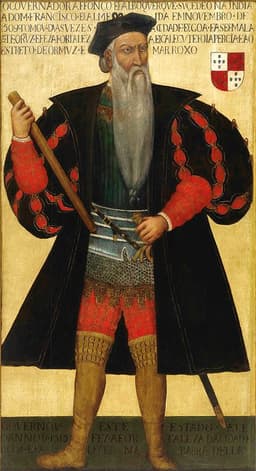
Afonso de Albuquerque
General · Medieval
79.6Total
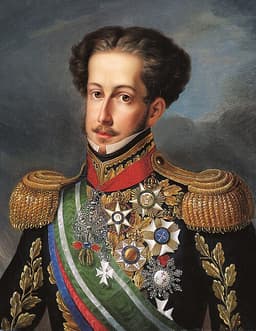
Pedro I of Brazil
Emperor · Modern
54.6Total
Basic Information
Born
1453
1798
Died
1515
1834
Era
Medieval
Modern
Nationality
Portugal
Brazil
Occupation
General
Emperor
Civilization
Western
Western
Score Comparison
Military (10%)
77.5
55.0
Political (20%)
88.0
62.7
Influence (20%)
80.0
59.0
Legacy (20%)
75.0
50.0
Leadership (15%)
78.0
53.2
Strategy (15%)
82.0
45.0
TOTAL
79.6
54.6
Afonso de Albuquerque — Complete Timeline
1503 AD
First voyage to IndiaWar◆ Major
Afonso de Albuquerque led a fleet to India, establishing the first Portuguese fort at Cochin. This voyage laid the foundation for Portuguese control of the Indian Ocean trade.
ExplorationColonialismIndia
Impact: global
1510 AD
Conquest of GoaWar◆ Major
Albuquerque captured Goa from the Sultan of Bijapur. He made Goa the capital of Portuguese India, a position it held for over 400 years.
ConquestColonialismIndia
Impact: regional
1511 AD
Conquest of MalaccaWar◆ Major
Albuquerque led a Portuguese fleet to capture the strategic port of Malacca. This gave Portugal control of the spice trade route between the Indian Ocean and the Pacific.
ConquestSpice TradeSoutheast Asia
Impact: global
1513 AD
Siege of AdenWar
Albuquerque attempted to capture Aden in Yemen but failed. This failure prevented Portugal from controlling the entrance to the Red Sea and limited their influence in the region.
SiegeFailureRed Sea
Impact: regional
1515 AD
Death at seaOther◆ Major
Afonso de Albuquerque died at sea off the coast of Goa, possibly from illness or poison. His death left the Portuguese Empire in the Indian Ocean without its most capable leader.
DeathLeadershipEmpire
Impact: regionaltragic
Pedro I of Brazil — Complete Timeline
1822 AD
Declaration of Independence of BrazilPolitical Action
Pedro I declared Brazil's independence from Portugal on September 7, 1822, at the Ipiranga River in S
Impact: globalprogressive
Coronation as Emperor of BrazilPolitical Action◆ Major
Pedro I was crowned Emperor of Brazil on December 1, 1822, in Rio de Janeiro. The coronation formalized the new imperial government, with Pedro I as constitutional monarch, though he retained significant executive powers.
Impact: nationalconstructive
1823 AD
War of Independence of BrazilWar◆ Major
Pedro I led Brazilian forces against Portuguese loyalists in the War of Independence. Key battles occurred in Bahia, Maranh
Impact: national
Dissolution of the Constituent AssemblyPolitical Action◆ Major
Pedro I dissolved the Constituent Assembly after conflicts over the constitution's limits on imperial power. He then imposed the 1824 Constitution, which granted the emperor extensive powers, including the Moderating Power, centralizing authority.
Impact: nationaldestructive
1831 AD
Abdication of the Brazilian ThronePolitical Action
Pedro I abdicated the Brazilian throne in favor of his five-year-old son Pedro II on April 7, 1831. He returned to Portugal to claim the Portuguese throne, leaving Brazil under a regency until his son came of age.
Impact: national
Expert Analysis
Afonso de Albuquerque vs Pedro I of Brazil
The Emperor and the Admiral
On a September morning in 1822, a young prince stood beside the Ipiranga River in São Paulo, tore the Portuguese insignia from his uniform, and shouted “Independence or Death!” Three centuries earlier, another Portuguese man, grey-haired and battle-hardened, watched from the deck of a carrack as the walls of Malacca loomed before him, knowing that capturing this city would make his king master of the Indian Ocean. Both men built empires. One created a nation; the other, a commercial network that stretched from Africa to Japan. But their fates diverged as sharply as their temperaments. Pedro I of Brazil and Afonso de Albuquerque—one an emperor who abdicated, the other a conqueror who died at sea—offer a study in how personality, circumstance, and the very nature of power determine whether a leader builds a dynasty or a legend.
Origins
Pedro I was born into a world of upheaval. In 1798, the Portuguese royal family still reigned, but Napoleon’s armies were already reshaping Europe. When French troops invaded Portugal in 1807, the entire Braganza court fled to Brazil, making Rio de Janeiro the de facto capital of the Portuguese Empire. Young Pedro grew up not in Lisbon’s palaces but in the tropical grandeur of Rio, surrounded by slaves, courtiers, and the constant tension between Old World traditions and New World realities. His education was erratic—he learned to ride and shoot before he learned to read state papers.
Albuquerque came from a different Portugal entirely. Born in 1453, the year Constantinople fell to the Turks, he belonged to a generation that believed the world was there for the taking. His family had served the crown for generations, and he trained for war from adolescence. While Pedro learned politics by watching his father’s court, Albuquerque learned strategy by studying the campaigns of the Reconquista—the centuries-long Christian reconquest of Iberia. Both men inherited a Portuguese identity, but Pedro’s was defensive, reactive, while Albuquerque’s was expansive, aggressive.
Rise to Power
Pedro’s path to power came through crisis. When his father, King João VI, returned to Portugal in 1821, he left Pedro as regent in Brazil. The Portuguese Cortes then tried to reduce Brazil to colonial status, stripping away the autonomy the colony had enjoyed since 1808. Pedro faced a choice: submit to Lisbon or lead a rebellion. His decision to declare independence on September 7, 1822, was as much about personal ambition as national sentiment. He was crowned emperor on December 1, 1822, at age twenty-four, with little military experience and no clear plan for governing.
Albuquerque’s rise was slower and harder. He first sailed to India in 1503, commanding a small fleet to establish a fort at Cochin—a toehold on a continent that would soon become Portugal’s eastern empire. For years he fought and negotiated, learning the complex politics of Indian princely states, the monsoon winds, and the art of naval warfare. His breakthrough came in 1510, when he captured Goa from the Sultan of Bijapur. Unlike Pedro, who inherited a throne, Albuquerque earned his command through relentless campaigning.
Leadership & Governance
Pedro ruled as an enlightened despot in an age of revolutions. He granted Brazil a constitution in 1824—liberal by contemporary standards—but retained the power to dissolve the assembly, which he did in 1823 when deputies tried to limit his authority. He modernized the army, founded newspapers, and patronized the arts. Yet he governed through personal charisma and coercion, not institutions. His military score of 65.0 reflects a leader competent but not brilliant; he won the War of Independence (1823) against Portuguese loyalists more through attrition than strategy.
Albuquerque governed by terror and calculation. He executed prisoners, burned cities, and installed puppet rulers—but he also married his soldiers to local women, established mixed-race garrisons, and studied Arabic and Persian to negotiate with sultans. His conquest of Malacca in 1511 gave Portugal control of the spice trade, but he knew that forts, not battles, held empires together. His military score of 82.2 and strategy of 75.5 reflect a commander who thought in decades, not days. While Pedro struggled with the daily politics of Rio, Albuquerque was building a network of bases from Hormuz to Timor.
Triumph & Tragedy
Pedro’s greatest moment was the declaration of independence itself—a dramatic, almost theatrical act that gave Brazil a founding myth. But his tragedy came seven years later. Weakened by a disastrous war with Argentina over Uruguay, unpopular with landowners who resented his abolitionist sympathies, and facing revolts in the provinces, he abdicated the Brazilian throne on April 7, 1831, in favor of his five-year-old son Pedro II. He returned to Portugal, where he died of tuberculosis three years later at age thirty-five, having failed to hold either crown.
Albuquerque’s triumph was the capture of Malacca in 1511, a victory that made Portugal the dominant power in Southeast Asia for a century. But his tragedy was his death at sea in 1515, possibly poisoned, returning from a failed siege of Aden. He died knowing his king had replaced him, that his enemies at court had won, and that the empire he built would soon be run by lesser men. Unlike Pedro, he never saw his work undone.
Character & Destiny
Pedro was impulsive, romantic, and quick to despair. He loved music, women, and public acclaim—but lacked the patience for administration and the cunning for long-term politics. His abdication was not forced; it was chosen, a surrender to exhaustion. Albuquerque was relentless, paranoid, and ruthless. He trusted no one, kept his plans secret, and drove himself and his men to the breaking point. Pedro’s score of 74.5 in leadership reflects a natural charisma that could inspire but not sustain; Albuquerque’s 84.3 reflects a will that bent reality to its purpose.
Their scores tell the story: Pedro’s influence (72.3) and legacy (70.0) are high because he founded a nation. Albuquerque’s military (82.2) and political (80.0) scores are higher, but his legacy (67.4) is lower because his empire was absorbed by others. One man created a country; the other created a system.
Legacy
Brazil remembers Pedro I as the “Liberator,” though historians note his authoritarian tendencies and his abandonment of the throne. His son Pedro II would reign for nearly fifty years, building a stable empire—but the father’s legacy remains the founding act. Albuquerque is remembered in Portugal as a national hero, but his greatest monument is invisible: the Portuguese language spoken in Goa, the churches in Malacca, the mixed-race communities that still bear Portuguese names. Both men were imperialists, but Pedro’s empire became a nation; Albuquerque’s became a memory.
Conclusion
Standing at the Ipiranga River, Pedro I shouted for independence and won a country. Sailing toward Malacca, Albuquerque said nothing—he simply gave the order to fire. One leader created a nation by breaking from the past; the other created an empire by seizing the future. Both paid the price of ambition: Pedro died young, defeated by his own weaknesses; Albuquerque died alone, defeated by the sea. Their stories remind us that power is not simply won or lost—it is shaped by the men who hold it, and by the moment that holds them.
Rankings
🥇
Afonso de AlbuquerqueLeader
Mil: 77.5Pol: 88.0Inf: 80.0
79.6
🥈
Pedro I of Brazil
Mil: 55.0Pol: 62.7Inf: 59.0
54.6
+25.0 behind
How This Comparison Works
Algorithm
Each figure is scored on 6 dimensions (0—100 scale) based on structured historical data: Military (10%), Political (20%), Influence (20%), Legacy (20%), Leadership (15%), Strategy (15%). The weighted total produces the final ranking.
Data Sources
Scores are computed from structured sub-indicators in the database. Scale factors adjust for era (Ancient ×0.85, Modern ×1.0) and civilization size (Eastern ×1.05, Other ×0.80) to account for differences in population and military scale.
Maximum 3 Figures
Comparisons are limited to 2—3 figures to ensure readability and statistical meaningfulness.
Error Margins
±5 points per dimension — Sub-scores are derived from historical records with inherent uncertainty. Two figures within 5 points on a dimension should be considered roughly equivalent in that area.
Total Score Accuracy
±3 points overall — The weighted combination of 6 dimensions produces a total score with approximately ±3 points of uncertainty. Differences of less than 3 points are not statistically significant— the figures are effectively tied.
Known Limitations
- Historical records are incomplete and uneven across civilizations
- Figures from oral-tradition societies may be underrepresented
- Occupation labels can misclassify multi-role figures
- Scores measure capability and impact, not moral character
- Quantitative scoring is a comparison tool, not absolute truth
Capability Radar
Military (10%) — Battles & Warfare
Battles
85
35
Win Rate
80
40
Expansion
95
30
Political (20%) — Governance & Reform
Reform
80
45
Diplomacy
85
50
Economy
80
30
Influence (20%) — Cultural & Global Reach
Cultural
70
40
Global
85
45
Legacy (20%) — Historical Impact
Historical
85
55
Longevity
80
50
Leadership (15%) — Power & Stability
Tenure
70
55
Stability
65
25
Strategy (15%) — Tactics & Innovation
Strategy
95
35
Tactics
90
30
Reform
75
20
Similar Comparisons
Comments & Discussion
**The Galleon's Ghost**6/16/2026
Albuquerque built an empire of trade routes and fortresses that lasted centuries; Pedro built a monarchy that crumbled within a decade of his abdication. The admiral understood something Pedro never did: power isn't a birthright you shout into the wind—it's a system you construct, stone by stone, treaty by treaty, siege by siege. Malacca fell in 1511 and remained Portuguese for 130 years. Brazil's "independence" barely survived Pedro's reign before his son had to clean up the mess. Results speak
**数据铁匠**6/16/2026
你拿一个连税收数据都整不明白的君主去比一个把帝国账目精确到胡椒粒的总督?阿尔布开克在1509年写的信里记录了他给每个堡垒分配的士兵数量和火药库存,而佩德罗一世1823年解散制宪会议时连军队工资都发不出。一个是管理大师,一个是纨绔子弟——别用"民族英雄"这种标签混淆视听。
**The Lotus Reader**6/16/2026
Pedro represents the end of something; Albuquerque, the beginning. The admiral carved Portuguese presence into Asia's maritime landscape when no European had done it before—not with armies, but with intelligence gathering, local alliances, and terrifying speed. He captured Goa in 20 hours. Pedro, by contrast, presided over Brazil's fragmentation into factions and debt. The comparison isn't close: one man built the blueprint; the other just stamped "Emperor" on a tattered copy.
**墨迹考据家**6/16/2026
说佩德罗"创建了一个国家"?别忘了,巴西独立本质上是一场精英政变,避免被葡萄牙彻底革命化。阿尔布开克在印度洋建立的才真是从无到有——他从不在已有王国里抢王冠,而是直接创造了全新的政治实体:葡萄牙印度总督辖区。1515年他死时,那个架构还能自己运转。佩德罗1822年喊完口号,1826年就跑去葡萄牙抢王位了——这算什么创始人?
**The Crow's Nest**6/16/2026
Both men died in obscurity—Albuquerque at sea, abandoned by his king; Pedro in a Lisbon palace, his young son Emperor of a thing that had already slipped away. But here's the difference: Albuquerque's crew wept when he died. They knew they'd lost the last man who could hold the Eastern seas together with sheer will and tactical genius. Pedro's court? Half of them were already plotting his abdication before his horse arrived at the palace. Legacy is what your people say when you're gone.