Loading...
Pedro I of Brazil vs Shi Dakai
Shi Dakai leads by 5.0 pts · 2 figures compared
…
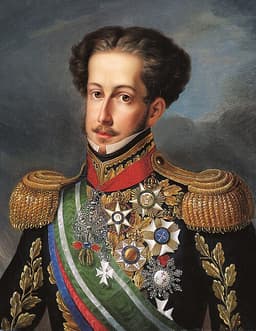
Pedro I of Brazil
Emperor · Modern
54.6Total
Shi Dakai
General · Modern
59.6Total
Basic Information
Born
1798
1831
Died
1834
1863
Era
Modern
Modern
Nationality
Brazil
China
Occupation
Emperor
General
Civilization
Western
Eastern
Score Comparison
Military (10%)
55.0
76.0
Political (20%)
62.7
45.0
Influence (20%)
59.0
56.7
Legacy (20%)
50.0
54.0
Leadership (15%)
53.2
72.0
Strategy (15%)
45.0
68.1
TOTAL
54.6
59.6
Pedro I of Brazil — Complete Timeline
1822 AD
Declaration of Independence of BrazilPolitical Action
Pedro I declared Brazil's independence from Portugal on September 7, 1822, at the Ipiranga River in S
Impact: globalprogressive
Coronation as Emperor of BrazilPolitical Action◆ Major
Pedro I was crowned Emperor of Brazil on December 1, 1822, in Rio de Janeiro. The coronation formalized the new imperial government, with Pedro I as constitutional monarch, though he retained significant executive powers.
Impact: nationalconstructive
1823 AD
War of Independence of BrazilWar◆ Major
Pedro I led Brazilian forces against Portuguese loyalists in the War of Independence. Key battles occurred in Bahia, Maranh
Impact: national
Dissolution of the Constituent AssemblyPolitical Action◆ Major
Pedro I dissolved the Constituent Assembly after conflicts over the constitution's limits on imperial power. He then imposed the 1824 Constitution, which granted the emperor extensive powers, including the Moderating Power, centralizing authority.
Impact: nationaldestructive
1831 AD
Abdication of the Brazilian ThronePolitical Action
Pedro I abdicated the Brazilian throne in favor of his five-year-old son Pedro II on April 7, 1831. He returned to Portugal to claim the Portuguese throne, leaving Brazil under a regency until his son came of age.
Impact: national
Shi Dakai — Complete Timeline
1851 AD
Jintian UprisingWar◆ Major
Shi Dakai joined the Taiping Rebellion at its inception in Jintian, Guangxi. As a core leader, he helped organize the rebel forces and was appointed Wing King, becoming one of the key military commanders of the Taiping Heavenly Kingdom.
Taiping RebellionUprisingMilitary Command
Impact: national
1854 AD
Battle of XiangtanWar◆ Major
Shi Dakai led Taiping forces to a major victory at Xiangtan, Hunan, defeating Qing imperial troops. This battle secured Taiping control over key territories in the Yangtze River valley and demonstrated his military skill.
Taiping RebellionBattleVictory
Impact: regional
1856 AD
Tianjing IncidentPolitical Action
Shi Dakai returned to Tianjing (Nanjing) after the internal purge of the Eastern King Yang Xiuqing and the murder of the Northern King Wei Changhui. He condemned the violence and was forced to flee, leading to a split in Taiping leadership.
Taiping RebellionInternal ConflictPurge
Impact: nationaltragic
1858 AD
Campaign in Zhejiang and FujianWar
Shi Dakai led a separate Taiping army into Zhejiang and Fujian provinces, capturing several cities. This campaign expanded Taiping influence into southeastern China but also isolated his forces from the main Taiping base.
Taiping RebellionCampaignExpansion
Impact: regional
1863 AD
Battle of Baishui RiverWar◆ Major
Shi Dakai's army was trapped and defeated by Qing forces at the Baishui River in Sichuan. He was captured and executed shortly after, marking the end of his military career and a significant loss for the Taiping cause.
Taiping RebellionBattleDefeatDeath
Impact: nationaltragic
Expert Analysis
Shi Dakai vs Pedro I of Brazil
### The Emperor and the Wing King
On a September morning in 1822, Dom Pedro stood at the banks of the Ipiranga River in São Paulo, tore the Portuguese insignia from his uniform, and shouted “Independence or Death!” Forty-one years later, on a bleak stretch of the Baishui River in Sichuan, Shi Dakai watched his army disintegrate under Qing cannon fire, knowing his fate was sealed. One man founded an empire; the other died defending a doomed kingdom. Both were young, brilliant, and destined for tragedy. But why did one succeed and the other fail? The answer lies not in their talents—which were considerable—but in the worlds they inherited and the choices those worlds forced upon them.
### Origins
Pedro I of Brazil was born in 1798 into the House of Braganza, a Portuguese royal family that had fled Napoleon’s armies and taken refuge in Rio de Janeiro. He grew up in a palace where the court spoke French, the libraries brimmed with Enlightenment texts, and his father, King João VI, ruled over a vast transatlantic empire. Pedro was impulsive, charming, and deeply insecure—a prince who craved glory but lacked the patience for statecraft. His education was haphazard, but his exposure to liberal ideas was real. He saw himself as a modern monarch, a constitutionalist who could reconcile order with liberty.
Shi Dakai, born in 1831 in Guangxi, southern China, emerged from a very different world. The Qing Empire was crumbling under population pressure, official corruption, and the humiliation of the Opium Wars. Shi came from a Hakka family of modest means; his father was a farmer who managed to give him a classical Confucian education. He was known for his intelligence and his temper, a combination that would serve him well on the battlefield but poorly in politics. Where Pedro inherited a throne, Shi inherited a crisis. He joined the Taiping Rebellion in 1851 at the Jintian Uprising, drawn not by royal blood but by the vision of a new dynasty—the Heavenly Kingdom of Great Peace.
### Rise to Power
Pedro’s path to power was almost accidental. When his father returned to Portugal in 1821, leaving Pedro as regent of Brazil, the young prince faced an impossible choice: obey the Portuguese Cortes, which sought to reduce Brazil to a colony, or defy them and risk war. He chose defiance. On September 7, 1822, he declared independence, and by December he was crowned Emperor. The transition was swift, almost bloodless—a palace revolution dressed as a national liberation. Pedro’s military score of 65.0 reflects his limited combat experience; he was no general, but he was a symbol, and symbols matter.
Shi Dakai rose through the ranks of the Taiping army on sheer competence. By 1854, at the Battle of Xiangtan, he had proven himself a master of maneuver, outflanking Qing forces and securing Hunan for the Heavenly Kingdom. His military score of 84.6 and strategy score of 81.6 place him among the great commanders of his era. But the Taiping movement was not a monarchy; it was a theocracy led by Hong Xiuquan, a man who believed he was the brother of Jesus Christ. Shi’s rise depended on the whims of a prophet, not the logic of succession.
### Leadership & Governance
As emperor, Pedro I governed with a mix of liberal rhetoric and autocratic instinct. He granted a constitution in 1824, but when the Constituent Assembly tried to limit his powers, he dissolved it in 1823 and imposed his own charter. His political score of 60.2 captures this tension: he wanted to be a modern ruler, but he could not tolerate opposition. He led Brazil through the War of Independence (1823), a series of skirmishes against Portuguese loyalists in Bahia, Maranhão, and Pará. The war was small by global standards, but it was enough to secure Brazil’s borders. Pedro’s leadership score of 74.5 reflects his ability to inspire loyalty—but not the patience to build institutions.
Shi Dakai governed differently. As the Wing King, he was responsible for administering the Taiping’s western territories, where he earned a reputation for fairness and efficiency. He reduced taxes, suppressed banditry, and tried to implement land reforms. But the Taiping state was a nightmare of factionalism and religious extremism. In 1856, the Tianjing Incident—a brutal purge of the Eastern King Yang Xiuqing—shattered the movement’s unity. Shi returned to the capital to find his colleagues murdered, and he barely escaped with his life. After that, he led a separate army into Zhejiang and Fujian, a desperate campaign that expanded Taiping territory but also fragmented its forces. His political score of 64.8 is higher than Pedro’s, but it was exercised in a system that was already cannibalizing itself.
### Triumph & Tragedy
Pedro’s greatest moment was the declaration of independence itself—a dramatic act that still resonates in Brazilian memory. His greatest failure was his inability to sustain that momentum. By 1831, after a series of political crises, a disastrous war with Argentina over Uruguay, and growing unpopularity, he abdicated in favor of his five-year-old son, Pedro II. He returned to Portugal, where he died three years later at the age of 36, exhausted and embittered.
Shi Dakai’s triumph was his survival—and his army’s—through years of relentless campaigning. His tragedy was the Battle of the Baishui River in 1863. Trapped between Qing forces and a flooded river, he surrendered in the hope of sparing his men. He was executed by slow slicing, a death that reflected the Qing’s determination to crush the Taiping utterly. His total score of 71.4 outranks Pedro’s 65.7, but the comparison is deceptive. Shi fought for a losing cause; Pedro fought for a winning one.
### Character & Destiny
Pedro was a man of passion, not principle. He loved horses, women, and the sound of his own voice. He was brave but reckless, idealistic but impulsive. His character made him a natural leader for a revolution, but a terrible ruler for a peace. He needed a crisis to thrive, and when the crisis passed, he crumbled.
Shi Dakai was a man of discipline, not charisma. He was a brilliant tactician but a poor politician. He could win battles but not the trust of his superiors. His destiny was to be a loyal servant of a mad king—a role that guaranteed both glory and annihilation.
### Legacy
Pedro I is remembered as the Father of the Nation, the man who gave Brazil its independence. His legacy score of 70.0 reflects this foundational role. But his reign is also a cautionary tale: a leader who could start a revolution but not finish it.
Shi Dakai is remembered as a tragic hero in Chinese folklore, a general of almost mythical skill who was betrayed by fate. His legacy score of 65.9 is lower, but it is more intimate. He is a figure of poetry, not politics.
### Conclusion
In the end, the difference between Pedro and Shi is not one of ability but of context. Pedro inherited a nation that wanted independence; Shi joined a movement that wanted the impossible. One was a prince who became a liberator; the other was a soldier who became a legend. Both were young, both were brilliant, and both were crushed by the weight of their own ambitions. They remind us that history is not a meritocracy. It is a lottery of time and place, and the winners are not always the most talented—only the luckiest.
Rankings
🥇
Shi DakaiLeader
Mil: 76.0Pol: 45.0Inf: 56.7
59.6
🥈
Pedro I of Brazil
Mil: 55.0Pol: 62.7Inf: 59.0
54.6
+5.0 behind
How This Comparison Works
Algorithm
Each figure is scored on 6 dimensions (0—100 scale) based on structured historical data: Military (10%), Political (20%), Influence (20%), Legacy (20%), Leadership (15%), Strategy (15%). The weighted total produces the final ranking.
Data Sources
Scores are computed from structured sub-indicators in the database. Scale factors adjust for era (Ancient ×0.85, Modern ×1.0) and civilization size (Eastern ×1.05, Other ×0.80) to account for differences in population and military scale.
Maximum 3 Figures
Comparisons are limited to 2—3 figures to ensure readability and statistical meaningfulness.
Error Margins
±5 points per dimension — Sub-scores are derived from historical records with inherent uncertainty. Two figures within 5 points on a dimension should be considered roughly equivalent in that area.
Total Score Accuracy
±3 points overall — The weighted combination of 6 dimensions produces a total score with approximately ±3 points of uncertainty. Differences of less than 3 points are not statistically significant— the figures are effectively tied.
Known Limitations
- Historical records are incomplete and uneven across civilizations
- Figures from oral-tradition societies may be underrepresented
- Occupation labels can misclassify multi-role figures
- Scores measure capability and impact, not moral character
- Quantitative scoring is a comparison tool, not absolute truth
Capability Radar
Military (10%) — Battles & Warfare
Battles
35
75
Win Rate
40
70
Expansion
30
75
Political (20%) — Governance & Reform
Reform
45
50
Diplomacy
50
45
Economy
30
40
Influence (20%) — Cultural & Global Reach
Cultural
40
55
Global
45
40
Legacy (20%) — Historical Impact
Historical
55
60
Longevity
50
45
Leadership (15%) — Power & Stability
Tenure
55
55
Stability
25
35
Strategy (15%) — Tactics & Innovation
Strategy
35
80
Tactics
30
85
Reform
20
60
Similar Comparisons
Comments & Discussion
武悼天王转世6/16/2026
老兄,你拿石达开跟佩德罗一世比?石达开是什么人物?16岁就带兵打仗,天京事变后单骑入京力挽狂澜,最后舍命保军被凌迟处死。这种悲壮在中国历史上是独一档的。佩德罗?不过是个欧洲幸运儿,仗着拿破仑跑路捡个王位,还为了情妇把江山赔上。石达开的失败是悲剧英雄的宿命,佩德罗的成功是投机分子的偶然。
Iron Emperor6/16/2026
Pedro I was a tactical genius who actually built something—the Brazilian Empire that lasted 67 years. Shi Dakai was a brilliant rebel who never learned logistics or statecraft. In 1863, Pedro crushed a revolt in Pernambuco while running a functioning government. Shi lost his entire army crossing the Dadu River because he waited three days for his newborn son. That’s not martyrdom; that’s catastrophic leadership. One built an empire from scratch; the other led his people to genocide.
钱塘书生6/16/2026
数据上看,佩德罗一世统治的巴西面积830万平方公里,人口400万,而石达开巅峰时控制的长江流域不过100万平方公里,人口却超过3000万。石达开的输是数学必然——清廷有8亿两白银的税收和持续的人力补充,太平天国连稳定的粮饷体系都没有。拿独立战争对内战,根本就是苹果比橘子。
Liberty Doctor6/16/2026
Comparing a Chinese rebel to a Brazilian emperor? Please. Pedro I was a European monarch cosplaying as a liberal, giving Brazil a constitution while owning African slaves. Shi Dakai was a genuine radical who abolished private property and practiced communal living. Pedro succeeded because he was backed by Rio's elites; Shi failed because he threatened China's entire feudal system. The Wing King died for something real. Pedro died in a Lisbon palace, drunk and irrelevant.