Loading...
Pedro I of Brazil vs Ramon Castilla
Ramon Castilla leads by 5.1 pts · 2 figures compared
…
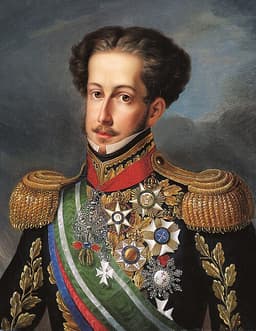
Pedro I of Brazil
Emperor · Modern
54.6Total
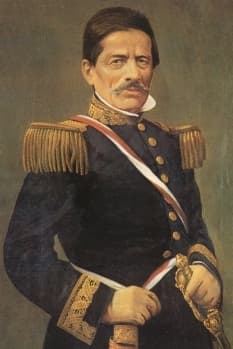
Ramon Castilla
General · Modern
59.7Total
Basic Information
Born
1798
1797
Died
1834
1867
Era
Modern
Modern
Nationality
Brazil
Peru
Occupation
Emperor
General
Civilization
Western
Western
Score Comparison
Military (10%)
55.0
40.0
Political (20%)
62.7
72.0
Influence (20%)
59.0
56.7
Legacy (20%)
50.0
52.0
Leadership (15%)
53.2
78.0
Strategy (15%)
45.0
60.0
TOTAL
54.6
59.7
Pedro I of Brazil — Complete Timeline
1822 AD
Declaration of Independence of BrazilPolitical Action
Pedro I declared Brazil's independence from Portugal on September 7, 1822, at the Ipiranga River in S
Impact: globalprogressive
Coronation as Emperor of BrazilPolitical Action◆ Major
Pedro I was crowned Emperor of Brazil on December 1, 1822, in Rio de Janeiro. The coronation formalized the new imperial government, with Pedro I as constitutional monarch, though he retained significant executive powers.
Impact: nationalconstructive
1823 AD
War of Independence of BrazilWar◆ Major
Pedro I led Brazilian forces against Portuguese loyalists in the War of Independence. Key battles occurred in Bahia, Maranh
Impact: national
Dissolution of the Constituent AssemblyPolitical Action◆ Major
Pedro I dissolved the Constituent Assembly after conflicts over the constitution's limits on imperial power. He then imposed the 1824 Constitution, which granted the emperor extensive powers, including the Moderating Power, centralizing authority.
Impact: nationaldestructive
1831 AD
Abdication of the Brazilian ThronePolitical Action
Pedro I abdicated the Brazilian throne in favor of his five-year-old son Pedro II on April 7, 1831. He returned to Portugal to claim the Portuguese throne, leaving Brazil under a regency until his son came of age.
Impact: national
Ramon Castilla — Complete Timeline
1824 AD
Battle of AyacuchoWar
Castilla fought as a junior officer in the decisive Battle of Ayacucho, which ended Spanish rule in Peru. This victory secured Peruvian independence and marked the end of the Spanish Empire in South America, shaping Castilla's nationalist views.
Peruvian War of IndependenceBattleLiberation
Impact: regional
1845 AD
First Presidency of PeruPolitical Action◆ Major
Castilla was elected President of Peru in 1845, serving until 1851. His first term focused on economic development, including the guano boom, and infrastructure projects such as railroads and ports, modernizing the Peruvian state.
PresidencyEconomic DevelopmentGuano
Impact: nationalconstructive
1854 AD
Abolition of Slavery in PeruReform◆ Major
During his second presidency, Castilla issued a decree abolishing slavery in Peru on December 3, 1854. This reform freed approximately 25,000 slaves and was part of a broader liberal agenda, though it faced opposition from slave-owning elites.
AbolitionSlaveryHuman Rights
Impact: nationalprogressive
Abolition of Indigenous TributeReform◆ Major
Castilla also abolished the indigenous tribute tax in 1854, which had been a burden on native communities since colonial times. This measure aimed to integrate indigenous peoples into the Peruvian state as equal citizens, though its implementation was uneven.
Indigenous RightsTax ReformCitizenship
Impact: nationalprogressive
1855 AD
Second Presidency and Guano BoomPolitical Action◆ Major
Castilla served a second term from 1855 to 1862, during the peak of the guano export boom. He used guano revenues to fund public works, pay off foreign debt, and modernize the military, but also faced criticism for corruption and over-reliance on a single resource.
PresidencyGuanoModernization
Impact: nationalconstructive
1860 AD
Constitutional Reform of 1860Reform◆ Major
Castilla oversaw the adoption of a new constitution in 1860, which established a centralized republic with a strong executive. The constitution remained in effect until 1920 and shaped Peru's political structure, though it limited regional autonomy.
ConstitutionPolitical ReformCentralization
Impact: nationalconstructive
Expert Analysis
Ramon Castilla vs Pedro I of Brazil
# The Emperor and the General: Two Paths to Nationhood in the Americas
On a warm September morning in 1822, a 23-year-old prince stood beside the Ipiranga River in São Paulo, tore the Portuguese insignia from his uniform, and shouted “Independence or Death!” Two years later, on a frozen December plain in Ayacucho, a 27-year-old junior officer from a remote Peruvian province fought in the battle that ended three centuries of Spanish rule. Pedro I and Ramón Castilla were nearly exact contemporaries, born just a year apart, yet their lives unfolded as mirror images of triumph and tragedy. One founded an empire and lost it; the other built a republic and saw it flourish. Why did one man’s story end in abdication and exile, while the other’s ended in national veneration?
Origins
Pedro de Alcântara was born into the House of Braganza, a Portuguese prince who arrived in Rio de Janeiro as a child when Napoleon’s armies forced the royal court to flee across the Atlantic. He grew up in a palace, tutored by priests and courtiers, surrounded by the elaborate rituals of monarchy. His father, King João VI, was a cautious, indecisive man; his mother, Carlota Joaquina, was a Spanish infanta with her own schemes. Pedro learned early that power was a birthright, but also that it came with constant intrigue.
Ramón Castilla y Marquesado came from a different world entirely. Born in the mining town of Tarapacá, then part of the Viceroyalty of Peru, his father was a Spanish official and his mother a local woman of mixed ancestry. He grew up in a frontier society where silver and saltpeter built fortunes, where the indigenous majority lived under tribute and forced labor, and where the winds of revolution from Buenos Aires and Caracas stirred restless dreams. Castilla knew poverty and struggle; his early career was a scramble for survival in the chaos of the wars for independence.
Rise to Power
Pedro I’s path was predetermined by blood. When his father returned to Portugal in 1821, pressured by liberal revolutionaries to accept a constitutional monarchy, he left Pedro as regent of Brazil. The Portuguese Cortes then attempted to reduce Brazil to colonial status, stripping away the autonomy the court had brought. Pedro faced a choice: submit to Lisbon or lead a breakaway. He chose independence, and on December 1, 1822, he crowned himself Emperor of Brazil.
Castilla’s rise was a soldier’s climb. He enlisted in the royalist army as a young man, then switched to the patriot cause when it became clear which way the wind was blowing. At Ayacucho, he fought under General Antonio José de Sucre in the final, crushing defeat of the Spanish viceroy. The battle made him a captain and a patriot, but not yet a leader. For two decades after independence, Peru descended into caudillo warfare—rival generals fighting for the presidency, the economy in ruins, the indigenous population still oppressed. Castilla waited, learned, and built alliances.
Leadership & Governance
Pedro I governed as an emperor, not a democrat. He dissolved the Constituent Assembly in 1823 when its members tried to limit his powers, then imposed a constitution that gave him a “moderating power” over the other branches of government. He fought the War of Independence against Portuguese loyalists in Bahia and Maranhão, proving himself a competent but not brilliant military commander—his strategy score of 50.0 reflects a leader who relied more on personal courage than tactical genius. His political score of 60.2 suggests a ruler who could seize power but could not sustain it through compromise.
Castilla governed as a reformer and modernizer. His political score of 77.4 and leadership score of 84.0 reveal a man who understood that power required legitimacy. During his first presidency from 1845 to 1851, he stabilized Peru’s chaotic finances and began building infrastructure. But his greatest achievements came during his second term, from 1855 to 1862, when Peru was riding the guano boom—the export of seabird droppings that became the world’s most valuable fertilizer. Castilla used this sudden wealth to abolish slavery in 1854, ending the forced labor of tens of thousands of Afro-Peruvians. He abolished the indigenous tribute tax, a colonial relic that had crushed native communities for three centuries. He oversaw a new constitution in 1860 that centralized the state while guaranteeing basic rights.
Triumph & Tragedy
Pedro I’s triumph was Brazil’s independence—a vast, peaceful transition from colony to empire that avoided the fragmentation suffered by Spanish America. His tragedy was his inability to govern afterward. The war with the Argentine provinces over the Banda Oriental (modern Uruguay) drained resources and morale. His Portuguese-born ministers and advisors provoked resentment among Brazilian-born elites. His personal life—public affairs, a scandal-ridden marriage, rumors of brutality—eroded his prestige. By 1831, facing revolts in the provinces and a hostile legislature, he abdicated in favor of his five-year-old son and sailed for Portugal, where he died three years later at 35.
Castilla’s triumph was the abolition of slavery and the modernization of Peru. His tragedy was that the guano boom he managed so effectively would later become a curse—a resource curse that bred corruption, dependency, and ultimately the disastrous War of the Pacific. But that was a tragedy for Peru, not for Castilla himself. He died in 1867 at age 70, still respected, having completed two full terms and retired peacefully—a rare feat in 19th-century Latin America.
Character & Destiny
Pedro I was impulsive, romantic, and proud. He once said, “I know that I am a despot, but I am a necessary despot.” His personality drove him to grand gestures—the cry of independence, the imposition of a constitution, the abdication itself—but also to fatal errors. He could not share power, could not tolerate dissent, could not build the alliances that sustain a ruler.
Castilla was pragmatic, patient, and shrewd. He was not a great orator or a charismatic hero; he was a manager, a builder, a man who understood that reform required timing. He waited for the guano revenues before abolishing slavery, ensuring compensation for slave owners and stability for the economy. He used the power of the state to dismantle the institutions of colonial oppression, rather than simply seizing power for its own sake.
Legacy
Pedro I left behind an independent Brazil, but his personal legacy was overshadowed by his son, Pedro II, who reigned for 49 years and became a symbol of stability and progress. Today, Pedro I is remembered as the father of Brazilian independence, but the man himself—impetuous, authoritarian, ultimately failed—is often seen as a flawed founder.
Ramón Castilla is remembered as one of Peru’s greatest presidents, the “Liberator of the Slaves” and the “Father of the Republic.” His abolition decree is celebrated annually, his name adorns streets and plazas, and his portrait hangs in the halls of power. His legacy score of 75.0 reflects a leader whose reforms endured because they were rooted in justice, not merely in power.
Conclusion
What separates the emperor from the general is not talent or ambition—both had plenty of both. What separates them is the ability to govern within the constraints of reality. Pedro I saw himself as the source of law; Castilla saw himself as the servant of law. One tried to impose his will on a nation; the other tried to build a nation worthy of its people. In the end, the prince who had everything lost it all, and the soldier who had nothing left behind everything. The difference was not in their stars, but in themselves.
Rankings
🥇
Ramon CastillaLeader
Mil: 40.0Pol: 72.0Inf: 56.7
59.7
🥈
Pedro I of Brazil
Mil: 55.0Pol: 62.7Inf: 59.0
54.6
+5.1 behind
How This Comparison Works
Algorithm
Each figure is scored on 6 dimensions (0—100 scale) based on structured historical data: Military (10%), Political (20%), Influence (20%), Legacy (20%), Leadership (15%), Strategy (15%). The weighted total produces the final ranking.
Data Sources
Scores are computed from structured sub-indicators in the database. Scale factors adjust for era (Ancient ×0.85, Modern ×1.0) and civilization size (Eastern ×1.05, Other ×0.80) to account for differences in population and military scale.
Maximum 3 Figures
Comparisons are limited to 2—3 figures to ensure readability and statistical meaningfulness.
Error Margins
±5 points per dimension — Sub-scores are derived from historical records with inherent uncertainty. Two figures within 5 points on a dimension should be considered roughly equivalent in that area.
Total Score Accuracy
±3 points overall — The weighted combination of 6 dimensions produces a total score with approximately ±3 points of uncertainty. Differences of less than 3 points are not statistically significant— the figures are effectively tied.
Known Limitations
- Historical records are incomplete and uneven across civilizations
- Figures from oral-tradition societies may be underrepresented
- Occupation labels can misclassify multi-role figures
- Scores measure capability and impact, not moral character
- Quantitative scoring is a comparison tool, not absolute truth
Capability Radar
Military (10%) — Battles & Warfare
Battles
35
45
Win Rate
40
50
Expansion
30
30
Political (20%) — Governance & Reform
Reform
45
85
Diplomacy
50
70
Economy
30
75
Influence (20%) — Cultural & Global Reach
Cultural
40
55
Global
45
50
Legacy (20%) — Historical Impact
Historical
55
65
Longevity
50
60
Leadership (15%) — Power & Stability
Tenure
55
65
Stability
25
60
Strategy (15%) — Tactics & Innovation
Strategy
35
45
Tactics
30
40
Reform
20
55
Similar Comparisons
Comments & Discussion
PerpetualMotionMan6/16/2026
As a military historian, I’ve got to call out the romanticized view of Pedro I’s “shout by the river.” That Ipiranga moment was pure theater—he arrived with a massive cavalry escort, and the Brazilian court had already decided on separation months earlier. Contrast Castilla, who actually fought at Ayacusa where 9,000 patriots crushed 7,000 royalists in a real battle. Pedro inherited an empire through royal blood; Castilla earned his republic through gunpowder.
数据侦探6/16/2026
数据分析?别逗了。说“几乎同龄”就离谱:Castilla生于1797年,Pedro生于1798年,但Pedro 1822年独立时23岁,Castilla 1824年在Ayacucho才27岁?这年龄差根本对不上。Pedro 15岁就结婚了,Castilla 30岁还在打游击。这种“镜像人生”叙事纯粹是文学修饰,连年代都凑不齐。历史分析得有点基本的时间线尊重吧?
ClassicsScoff6/16/2026
You’re framing this as emperors vs republics, but that’s lazy. Pedro I wasn’t some inept divine-right buffoon—he wrote Brazil’s 1824 constitution, limiting his own powers with a moderate monarchy model, while Castilla abolished slavery in Peru in 1854 through a decree. One was an aristocrat who actual constitutionalism; the other a caudillo who acted unilaterally. The real mirror isn’t abdication vs veneration, but institutional constraint vs personal authority.
历史八卦迷6/16/2026
说Pedro的妈Carlota Joaquina“有阴谋”?太客气了。这西班牙公主当年在巴西宫廷里策划政变,跟情夫私通,还试图废掉自己老公。Castilla的妈就是个普通殖民地贵妇人,根本没资格玩这种宫斗。两个人生差太远:一个从娘胎就掉进权力漩涡,一个得在战火中自己杀出来。拿皇室八卦对比边疆奋斗史,不公平。
RevisionistRage6/16/2026
Stop venerating Castilla as a national savior. He consolidated the Peruvian state, sure, but at what cost? His 1854 decree freed only slaves born after that date—a phased abolition that padded his political base while plantation owners cheered. Pedro I’s Brazil maintained slavery until 1888, so neither was a moral paragon. But Castilla’s myth as the “liberator” ignores how he crushed indigenous revolts in the 1850s with military force. Hero or oligarch in uniform?