Loading...
Pedro I of Brazil vs Peter the Great
Peter the Great leads by 18.6 pts · 2 figures compared
…
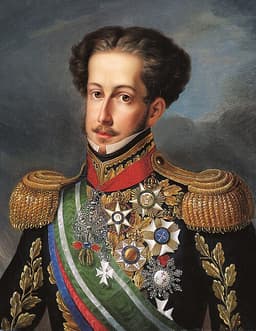
Pedro I of Brazil
Emperor · Modern
54.6Total
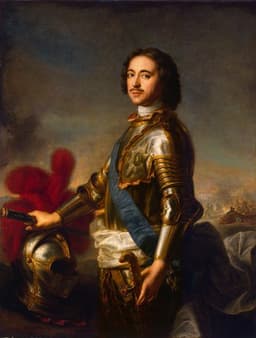
Peter the Great
Emperor · Modern
73.2Total
Basic Information
Born
1798
1672
Died
1834
1725
Era
Modern
Modern
Nationality
Brazil
Russia
Occupation
Emperor
Emperor
Civilization
Western
Western
Score Comparison
Military (10%)
55.0
75.0
Political (20%)
62.7
90.0
Influence (20%)
59.0
68.0
Legacy (20%)
50.0
65.0
Leadership (15%)
53.2
78.0
Strategy (15%)
45.0
72.0
TOTAL
54.6
73.2
Pedro I of Brazil — Complete Timeline
1822 AD
Declaration of Independence of BrazilPolitical Action
Pedro I declared Brazil's independence from Portugal on September 7, 1822, at the Ipiranga River in S
Impact: globalprogressive
Coronation as Emperor of BrazilPolitical Action◆ Major
Pedro I was crowned Emperor of Brazil on December 1, 1822, in Rio de Janeiro. The coronation formalized the new imperial government, with Pedro I as constitutional monarch, though he retained significant executive powers.
Impact: nationalconstructive
1823 AD
War of Independence of BrazilWar◆ Major
Pedro I led Brazilian forces against Portuguese loyalists in the War of Independence. Key battles occurred in Bahia, Maranh
Impact: national
Dissolution of the Constituent AssemblyPolitical Action◆ Major
Pedro I dissolved the Constituent Assembly after conflicts over the constitution's limits on imperial power. He then imposed the 1824 Constitution, which granted the emperor extensive powers, including the Moderating Power, centralizing authority.
Impact: nationaldestructive
1831 AD
Abdication of the Brazilian ThronePolitical Action
Pedro I abdicated the Brazilian throne in favor of his five-year-old son Pedro II on April 7, 1831. He returned to Portugal to claim the Portuguese throne, leaving Brazil under a regency until his son came of age.
Impact: national
Peter the Great — Complete Timeline
1697 AD
Grand EmbassyPolitical Action◆ Major
Peter the Great traveled incognito to Western Europe as part of a diplomatic mission. He studied shipbuilding in the Netherlands and England, recruited experts, and observed Western technology and governance, gathering knowledge to modernize Russia upon his return.
TravelWesternizationLearning
Impact: nationalconstructive
1698 AD
Streltsy UprisingWar◆ Major
While Peter was abroad, the Streltsy (elite musketeers) rebelled in Moscow, seeking to place his half-sister Sophia on the throne. Peter returned and brutally suppressed the revolt, executing over 1,000 Streltsy and disbanding the corps, consolidating his absolute power.
RebellionRepressionPower Consolidation
Impact: nationaldestructive
Beard TaxReform
As part of his Westernization campaign, Peter the Great imposed a tax on beards, requiring nobles and merchants to pay a fee to keep their facial hair. Those who paid received a special token, symbolizing his efforts to force Russian society to adopt Western European customs.
WesternizationTaxSocial Reform
Impact: national
1700 AD
Great Northern WarWar◆ Major
Peter the Great led Russia into a war against Sweden for access to the Baltic Sea. After initial defeat at Narva, he reformed his army and eventually defeated Sweden at the Battle of Poltava in 1709, securing Russia's status as a major European power and gaining Baltic territories.
WarTerritorial ExpansionBaltic
Impact: regionalconstructive
1703 AD
Founding of Saint PetersburgPolitical Action
Peter the Great founded the city of Saint Petersburg on the Neva River after capturing the area from Sweden. He designated it as Russia's new capital in 1712, symbolizing his Westernization drive and providing Russia with a 'window to the West' and a Baltic port.
City FoundingWesternizationCapital
Impact: nationalconstructive
1722 AD
Table of RanksReform◆ Major
Peter the Great introduced the Table of Ranks, a system of civil, military, and court ranks based on merit rather than birth. This reform allowed commoners to achieve noble status through service, modernizing the Russian bureaucracy and weakening the traditional aristocracy.
BureaucracyMeritocracySocial Reform
Impact: nationalprogressive
Expert Analysis
Peter the Great vs Pedro I of Brazil
# The Two Peters: How Russia and Brazil Forged Their Imperial Paths
On a cold morning in 1703, a giant of a man stood on marshy ground at the mouth of the Neva River, staring out at the Baltic Sea. He was six feet eight inches tall, with a violent temper and a vision that would reshape a nation. Peter the Great had just wrested this swamp from Swedish control, and he declared it would become his new capital—a "window on the West." A century later, on a warm September afternoon in 1822, another man named Pedro stood at the Ipiranga River in São Paulo, raised his sword, and shouted "Independence or Death!" He had just broken with his Portuguese royal family to become emperor of a new nation. Both men were monarchs, both were reformers, and both left indelible marks on their countries. Yet one is remembered as a titan who forged a world power, the other as a troubled founder who abandoned his throne. Why did their paths diverge so dramatically?
Origins
Peter was born in 1672 into a Russia still medieval in its soul—a land of boyars with long beards, wooden palaces, and a deep suspicion of foreigners. His father died when he was four, and he grew up in the shadow of the Kremlin's bloody power struggles, watching the Streltsy musketeers murder his uncles before his eyes. He spent his youth in the German Quarter of Moscow, where he befriended European merchants and engineers, learning to build boats with his own hands. The chaos of his childhood bred in him a ruthless determination to drag Russia into the modern world, by force if necessary.
Pedro I was born in 1798 into a very different world—the Portuguese royal family, fleeing Napoleon's armies, had established their court in Rio de Janeiro. He grew up in a tropical Versailles, surrounded by European refinement, but also by the tensions of a colony that suddenly found itself the seat of empire. His father, King João VI, was cautious and indecisive; his mother, Carlota Joaquina, was scheming and ambitious. Young Pedro learned early that power was a game of intrigue, and that his own family could not be trusted. Unlike Peter, who learned to build ships, Pedro learned to ride horses and charm crowds—a prince of the Enlightenment, not the workshop.
Rise to Power
Peter's rise was forged in war and rebellion. In 1697, he launched the Grand Embassy, traveling incognito to Western Europe—the first Russian ruler to leave his country since the Mongol invasion. He worked as a ship carpenter in the Dutch shipyards of Zaandam, learning the craft of naval construction with his own hands. But while he was abroad, the Streltsy rebelled in Moscow, seeking to place his half-sister Sophia on the throne. Peter returned in a fury, personally interrogating and executing hundreds of the rebels, their bodies left hanging outside the Kremlin walls as a warning. He had learned that power required blood.
Pedro's rise was gentler but no less dramatic. When his father returned to Portugal in 1821, leaving him as regent of Brazil, the young prince faced a choice: obey the Portuguese courts that wanted to reduce Brazil to colonial status, or side with the Brazilians who wanted independence. In January 1822, he made his famous "Fico" (I Stay) decision, defying Portuguese orders to return to Europe. By September, he had declared independence, and by December, he was crowned emperor. He was just twenty-four years old, and he had become the symbol of a nation's birth.
Leadership & Governance
Peter ruled Russia with an iron will and a hammer. He imposed a beard tax on nobles who refused to shave, forcing them to look like Europeans. He introduced the Table of Ranks in 1722, replacing hereditary privilege with merit-based advancement—a commoner could rise to the highest offices through service. He built Russia's first navy from nothing, personally overseeing the construction of hundreds of ships. When the Great Northern War against Sweden began in 1700, Russia suffered a catastrophic defeat at Narva, losing 6,000 men to Sweden's 700. Peter did not despair; he melted church bells for cannon, drafted peasants for soldiers, and rebuilt his army. By 1709, he crushed the Swedes at Poltava, and by 1721, he had won Russia's access to the Baltic. He founded St. Petersburg in 1703 as his "paradise," a city built on the bones of 100,000 serfs who died draining the swamps.
Pedro's governance was more improvisational. He led Brazilian forces against Portuguese loyalists in the War of Independence of 1823, winning key battles in Bahia and Maranhão. But his political skills were less sure. He clashed with the Constituent Assembly over the limits of imperial power, and in November 1823, he dissolved it by force, imposing his own constitution. The document was liberal on paper—guaranteeing civil rights and dividing government powers—but Pedro's autocratic tendencies alienated the very elites who had supported him. He could not balance the factions: the Portuguese-born merchants, the Brazilian landowners, the liberal intellectuals, the conservative monarchists. His military score of 65 and political score of 60 reflect a leader who won battles but lost the peace.
Triumph & Tragedy
Peter's greatest triumph was the founding of St. Petersburg, a city that became Russia's capital for two centuries and a symbol of his transformation. His navy, built from scratch, gave Russia a presence on the Baltic that it would never surrender. But his tragedy was personal: he tortured and executed his own son Alexei for opposing his reforms, leaving Russia without a capable heir. The cost of modernization was staggering—taxes crushed the peasantry, serfdom intensified, and thousands died building his canals and fortresses.
Pedro's triumph was the independence of Brazil—a peaceful transition compared to the bloody revolutions of Spanish America. His tragedy was his own character. He was impetuous, prone to affairs, and politically naive. His marriage to Leopoldina of Austria, a brilliant and beloved woman, fell apart after he publicly humiliated her with his mistress. Leopoldina died in 1826, possibly of a broken heart, and Pedro's popularity collapsed. By 1831, facing revolts across Brazil, he abdicated in favor of his five-year-old son Pedro II and sailed back to Portugal, where he fought a civil war to restore his daughter to the Portuguese throne. He died in 1834 at the age of 35, worn out by his own passions.
Character & Destiny
Peter was a force of nature—curious, brutal, and relentless. He personally pulled teeth, executed rebels, and oversaw the torture of his own son. "I am a student and I seek teachers," he once said, but he taught Russia through terror. His personality reflected the harshness of his world: a tsar who had to break his country to remake it. His total score of 78 reflects a leader who achieved enormous change at enormous cost.
Pedro was more romantic and less disciplined. "I am a liberal," he declared, but he could not live with the consequences of liberalism. He wanted to be loved, but he could not control his impulses. His total score of 65.7 reflects a leader who started a revolution but could not finish it. He gave Brazil independence, but he could not give it stability.
Legacy
Peter's legacy is Russia itself as a European power. He created the institutions—the Senate, the Table of Ranks, the navy, the capital—that would govern Russia for two centuries. His total score of 78, with leadership at 82 and influence at 78, places him among the great nation-builders. But his methods also entrenched autocracy and serfdom, the twin curses that would haunt Russia until 1917.
Pedro's legacy is Brazil's independence and its imperial system. His son Pedro II would rule for 58 years, bringing stability and progress. But Pedro I himself is remembered as a flawed founder—the man who shouted "Independence or Death" but could not live with the consequences. His legacy score of 70 reflects a nation that honors him as a father even as it acknowledges his failings.
Conclusion
Standing at the Neva River and the Ipiranga River, two men declared new worlds. Peter saw a swamp and built a city; Pedro saw a colony and built a nation. One forced his country to become European; the other led his country to become American. Both succeeded, both failed, and both left their names etched in history. The difference is not in their vision, but in their capacity to endure the suffering they inflicted—on others and on themselves. Peter broke Russia and rebuilt it; Pedro broke himself and left the rebuilding to his son. In the end, perhaps that is the difference between a great emperor and a tragic one: one survives his own revolution, and the other does not.
Rankings
🥇
Peter the GreatLeader
Mil: 75.0Pol: 90.0Inf: 68.0
73.2
🥈
Pedro I of Brazil
Mil: 55.0Pol: 62.7Inf: 59.0
54.6
+18.6 behind
How This Comparison Works
Algorithm
Each figure is scored on 6 dimensions (0—100 scale) based on structured historical data: Military (10%), Political (20%), Influence (20%), Legacy (20%), Leadership (15%), Strategy (15%). The weighted total produces the final ranking.
Data Sources
Scores are computed from structured sub-indicators in the database. Scale factors adjust for era (Ancient ×0.85, Modern ×1.0) and civilization size (Eastern ×1.05, Other ×0.80) to account for differences in population and military scale.
Maximum 3 Figures
Comparisons are limited to 2—3 figures to ensure readability and statistical meaningfulness.
Error Margins
±5 points per dimension — Sub-scores are derived from historical records with inherent uncertainty. Two figures within 5 points on a dimension should be considered roughly equivalent in that area.
Total Score Accuracy
±3 points overall — The weighted combination of 6 dimensions produces a total score with approximately ±3 points of uncertainty. Differences of less than 3 points are not statistically significant— the figures are effectively tied.
Known Limitations
- Historical records are incomplete and uneven across civilizations
- Figures from oral-tradition societies may be underrepresented
- Occupation labels can misclassify multi-role figures
- Scores measure capability and impact, not moral character
- Quantitative scoring is a comparison tool, not absolute truth
Capability Radar
Military (10%) — Battles & Warfare
Battles
35
85
Win Rate
40
80
Expansion
30
90
Political (20%) — Governance & Reform
Reform
45
95
Diplomacy
50
80
Economy
30
85
Influence (20%) — Cultural & Global Reach
Cultural
40
85
Global
45
85
Legacy (20%) — Historical Impact
Historical
55
90
Longevity
50
85
Leadership (15%) — Power & Stability
Tenure
55
90
Stability
25
70
Strategy (15%) — Tactics & Innovation
Strategy
35
85
Tactics
30
75
Reform
20
95
Similar Comparisons
Comments & Discussion
IVAN THE TERRIBLE'S COUSIN6/16/2026
Peter gets all the "Great" branding, but his real genius was seeing that Russia's future wasn't in Moscow's wooden walls but in clay and stone like Amsterdam. Pedro was a dilettante playing emperor with daddy's Portuguese money. Peter built a navy from nothing in the Baltic, personally laid bricks, and literally cut off beards to modernize. Pedro got Brazil handed to him, then abandoned it for a Portuguese throne. True greatness requires sacrifice, not a dramatic riverbank speech.
沼泽之狼6/16/2026
这对比根本不对等。彼得大帝在涅瓦河口建圣彼得堡时,那里是瑞典人统治的沼泽,他带三万农奴用白骨填地基。佩德罗一世只是在伊皮兰加河喊了句口号,巴西就从葡萄牙殖民变成独立帝国。彼得是亲手打造帝国,佩德罗是接过礼物。历史书把两人放一起,纯粹是标题党。
NUMBERS DON'T LIE6/16/2026
Let's look at the GDP growth. Peter inherited a Russia with zero Baltic ports and 14 million people; by his death, the population had grown to 18 million and trade tripled. Pedro inherited Brazil at 4 million and left it at 5 million with stagnant per capita income. Peter increased state revenue 400% through brutal taxation and industrial policy. Pedro's reign was five years of political chaos, then he fled for Portugal. One built an empire that lasted 200 years; the other built a personality cu
皇帝与逃兵6/16/2026
佩德罗一世是个被高估的花花公子。他独立巴西后不到十年就退位回葡萄牙争王位,把五岁的儿子丢给摄政团治国,导致国家分裂为军阀割据。彼得大帝在位42年从不逃跑,甚至亲率军队在波尔塔瓦击溃瑞典精锐,为俄罗斯赢得欧洲强权的入场券。伟大君主的标准很简单:你能不能死在你的王座上。
CLASSICS CONNOISSEUR6/16/2026
Ironically, both men copied Rome—Peter the autocratic style of Justinian building Constantinople, Pedro the constitutional trappings of a liberal monarch. But Peter understood that reform requires tyranny; he executed 1,700 Streltsy rebels personally, forcing modernization at gunpoint. Pedro tried to be both emperor and democrat, signing a constitution while owning slaves. You can't civilize with one hand and oppress with the other. Peter chose power; Pedro chose popularity. History doesn't reme