Loading...
Pachacuti vs Zhao Kuangyin
Zhao Kuangyin leads by 2.1 pts · 2 figures compared
…
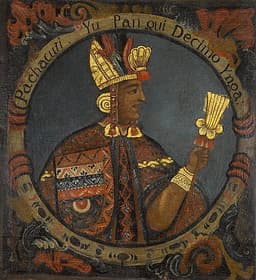
Pachacuti
Emperor · Medieval
69.4Total
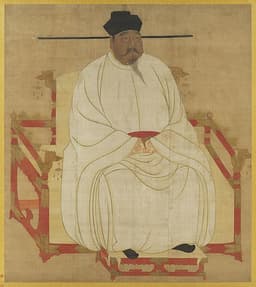
Zhao Kuangyin
Emperor · Medieval
71.5Total
Basic Information
Born
1418
927
Died
1472
976
Era
Medieval
Medieval
Nationality
Inca Empire
China
Occupation
Emperor
Emperor
Civilization
Other
Eastern
Score Comparison
Military (10%)
78.5
78.0
Political (20%)
58.1
84.0
Influence (20%)
65.0
68.0
Legacy (20%)
72.0
65.0
Leadership (15%)
78.0
74.0
Strategy (15%)
69.2
68.0
TOTAL
69.4
71.5
Pachacuti — Complete Timeline
1438 AD
Conquest of the Chanka KingdomWar
Pachacuti led the Inca army to defeat the Chanka, a powerful rival, in a decisive battle near Cusco. This victory secured his position as Sapa Inca and initiated a period of rapid expansion, transforming the Inca from a small kingdom into a vast empire.
ConquestInca ExpansionChanka
Impact: regional
1440 AD
Reconstruction of CuscoCultural◆ Major
Pachacuti rebuilt Cusco as the imperial capital, designing it in the shape of a puma and constructing massive stone structures like Sacsayhuam
Urban PlanningArchitectureInca Empire
Impact: regionalconstructive
1450 AD
Initiation of Machu Picchu's ConstructionCultural◆ Major
Pachacuti ordered the construction of Machu Picchu, a royal estate and ceremonial site high in the Andes. The complex featured sophisticated dry-stone masonry and terraced agriculture, serving as a symbol of Inca engineering and a retreat for the emperor.
ArchitectureRoyal EstateInca Engineering
Impact: regionalconstructive
Zhao Kuangyin — Complete Timeline
960 AD
Founded Song dynastyPolitical Action
Zhao Kuangyin, a general of Later Zhou, was proclaimed emperor by his troops at Chenqiao. He established the Song dynasty, ending the Five Dynasties period and beginning a new era of Chinese history.
Song dynastyFoundingChenqiao
Impact: globalconstructive
961 AD
Removed military power from generalsPolitical Action◆ Major
Zhao Kuangyin invited senior generals to a banquet and persuaded them to retire peacefully. This 'removal of military power over wine' prevented military coups and centralized control.
Song dynastyMilitary reformCentralization
Impact: nationalconstructive
963 AD
Unified southern ChinaWar◆ Major
Zhao Kuangyin launched campaigns to conquer the southern kingdoms, including Jingnan, Later Shu, and Southern Tang. By his death, most of China was reunified under Song rule.
Song unificationConquestSouthern kingdoms
Impact: national
Expert Analysis
Zhao Kuangyin vs Pachacuti
### The Emperor and the Unifier: How Two Medieval Rulers Forged Empires with Opposite Hands
In the high Andes of 1438, a prince not meant to rule stood before a shattered army. His father and brother had fled, leaving Cusco to fall to the Chanka warriors. Pachacuti, whose name means "he who remakes the world," did not flee. He rallied the terrified defenders and, in a single, desperate battle, crushed the Chanka and claimed his throne. Across the world, in 960, a Chinese general named Zhao Kuangyin was awakened by a clamor outside his tent. His soldiers, tired of weak emperors, draped a yellow robe over his shoulders and declared him their ruler. One man seized power through the fury of war; the other accepted it through the quiet coup of a garment. Both would become emperors. But the worlds they built could not have been more different.
### Origins
Pachacuti was born into a world of stone and sky. The Inca were one of many small kingdoms in the Peruvian highlands, constantly threatened by powerful neighbors like the Chanka. He was not the heir; his father, Viracocha Inca, had chosen another son. This rejection forged in Pachacuti a relentless ambition. He grew up watching the fragility of his people, understanding that survival meant either conquest or extinction. The rugged geography of the Andes taught him that power was physical—carved from mountains, defended by passes, and built on the backs of conquered peoples.
Zhao Kuangyin, born in 927, came from a China shattered into fragments. The Tang dynasty had collapsed, leaving a patchwork of warring kingdoms. He grew up in a military family and rose through the ranks of the Later Zhou, one of the northern states. Unlike Pachacuti, who inherited a kingdom on the edge of annihilation, Zhao inherited a world exhausted by chaos. His era was one of weary soldiers and hungry peasants, where the greatest threat was not an enemy army but the endless cycle of rebellion and betrayal that had plagued China for decades.
### Rise to Power
Pachacuti’s rise was a thunderclap. After the Chanka victory in 1438, he did not simply defend Cusco—he transformed survival into empire. He marched his armies outward, conquering the lands of the Colla, the Lupaca, and the Quechua. Each victory was a building block. He did not just defeat enemies; he incorporated them, forcing their nobles to live in Cusco and teaching them the Inca language. His path was one of blood and stone, each conquest adding a new province to his domain.
Zhao Kuangyin’s rise was a negotiation. When his troops declared him emperor at Chenqiao, he did not plunge China into civil war. Instead, he rode back to the capital, Kaifeng, and accepted the surrender of the Later Zhou’s child emperor. He then turned to the other kingdoms. But where Pachacuti charged, Zhao schemed. He offered titles, lands, and peace to the rulers of Jingnan, Later Shu, and Southern Tang. By 963, he had unified southern China with far less bloodshed than the era demanded. His power came not from the edge of a sword but from the weight of a promise.
### Leadership & Governance
As rulers, their styles were mirror opposites. Pachacuti governed through the sheer force of his vision. He rebuilt Cusco in the shape of a puma—a sacred animal—with massive stone walls that still defy explanation. He ordered the construction of Machu Picchu, not as a fortress but as a royal estate, a symbol of his divine connection to the sun. He created the *mitma* system, moving conquered peoples to new lands to break their identities, and demanded labor as a tax in the form of *mita*, a rotating service for public works. His state was a machine of conquest, built on obedience and fear.
Zhao Kuangyin governed through restraint. In 961, he performed the most famous act of his reign: he invited his most powerful generals to a banquet, poured them wine, and told them they were too dangerous to keep their commands. But instead of executing them, he gave them wealth, titles, and peaceful retirement. This "removal of military power over a cup of wine" became the founding myth of the Song dynasty. Zhao then placed civil officials above generals, built a massive bureaucracy, and encouraged scholarship over warfare. His empire was not a machine of conquest but a garden of culture—poetry, painting, and philosophy flourished under his rule.
### Triumph & Tragedy
Pachacuti’s greatest triumph was the creation of the Inca Empire. By his death in 1472, he had transformed a small kingdom into a realm stretching from modern Ecuador to Chile. His tragedy was that he built a system entirely dependent on his own genius. The empire he forged would, within a century, crumble before Spanish steel, in part because its subjects had no loyalty to the state—only to the emperor.
Zhao Kuangyin’s greatest triumph was the peace he brought to China. He unified the heartland, ended a century of war, and laid the foundation for the Song dynasty’s golden age. But his tragedy was the same as his triumph. By weakening the military, he left the Song vulnerable to northern invaders. Within decades, the Khitan Liao dynasty would extract tribute from his successors. The dynasty he founded would eventually fall to the Mongols. His peace, for all its beauty, was a fragile one.
### Character & Destiny
Pachacuti was a man of fire. His name means "earthquake" or "cataclysm," and he lived up to it. He was ruthless, visionary, and utterly convinced of his divine right. When a rival city refused to submit, he is said to have executed every noble and repopulated it with loyal subjects. His destiny was to build an empire that mirrored his own will—unbending, monumental, and terrifying.
Zhao Kuangyin was a man of water. He bent, he flowed, he found the easiest path. He once said, "The empire is not a place for one man to rule alone," and he meant it. He shared power, trusted his officials, and preferred diplomacy to war. His destiny was to create a civilization that valued harmony over heroism. Where Pachacuti carved his name into mountains, Zhao Kuangyin wrote his into a system of governance that would last three centuries.
### Legacy
Today, Pachacuti is remembered as the father of the Inca, the man who built Machu Picchu and reshaped the Andes. His legacy is written in stone—terraces, roads, and ruins that draw millions of visitors. But his empire vanished, leaving only fragments.
Zhao Kuangyin’s legacy is invisible but enduring. The Song dynasty he founded produced the world’s first paper money, the first standing navy, and some of China’s greatest poets and painters. His decision to prioritize civil over military power shaped Chinese governance for a millennium. He is remembered not as a conqueror but as a unifier—a man who understood that sometimes the strongest empire is the one that never needs to fight.
### Conclusion
Standing at the edge of Machu Picchu, looking down at the Urubamba River, one feels the weight of Pachacuti’s ambition. Standing in the quiet halls of the Forbidden City, one feels the calm of Zhao Kuangyin’s restraint. Both men faced the same question: how do you build something that lasts? Pachacuti answered with stone and sacrifice, Zhao with silk and scholarship. One empire crumbled; the other transformed a civilization. Their stories remind us that history is not a single path but a crossroads. The conqueror and the unifier both hold the keys to power—but only one builds a world that outlives him.
Rankings
🥇
Zhao KuangyinLeader
Mil: 78.0Pol: 84.0Inf: 68.0
71.5
🥈
Pachacuti
Mil: 78.5Pol: 58.1Inf: 65.0
69.4
+2.1 behind
How This Comparison Works
Algorithm
Each figure is scored on 6 dimensions (0—100 scale) based on structured historical data: Military (10%), Political (20%), Influence (20%), Legacy (20%), Leadership (15%), Strategy (15%). The weighted total produces the final ranking.
Data Sources
Scores are computed from structured sub-indicators in the database. Scale factors adjust for era (Ancient ×0.85, Modern ×1.0) and civilization size (Eastern ×1.05, Other ×0.80) to account for differences in population and military scale.
Maximum 3 Figures
Comparisons are limited to 2—3 figures to ensure readability and statistical meaningfulness.
Error Margins
±5 points per dimension — Sub-scores are derived from historical records with inherent uncertainty. Two figures within 5 points on a dimension should be considered roughly equivalent in that area.
Total Score Accuracy
±3 points overall — The weighted combination of 6 dimensions produces a total score with approximately ±3 points of uncertainty. Differences of less than 3 points are not statistically significant— the figures are effectively tied.
Known Limitations
- Historical records are incomplete and uneven across civilizations
- Figures from oral-tradition societies may be underrepresented
- Occupation labels can misclassify multi-role figures
- Scores measure capability and impact, not moral character
- Quantitative scoring is a comparison tool, not absolute truth
Capability Radar
Military (10%) — Battles & Warfare
Battles
85
75
Win Rate
90
85
Expansion
90
75
Political (20%) — Governance & Reform
Reform
92
90
Diplomacy
75
85
Economy
80
80
Influence (20%) — Cultural & Global Reach
Cultural
85
70
Global
65
60
Legacy (20%) — Historical Impact
Historical
80
80
Longevity
70
75
Leadership (15%) — Power & Stability
Tenure
85
65
Stability
82
85
Strategy (15%) — Tactics & Innovation
Strategy
88
80
Tactics
80
70
Reform
85
90
Similar Comparisons
Comments & Discussion
ROBES&RAMPARTS6/16/2026
Sorry, but "yellow robe" vs "battlefield desperation" is a false binary. Both men stole power; one just had better PR. Pachacuti's "desperate battle" myth conveniently ignores that he'd already been plotting against his father for years—Classic revisionist flattery. Meanwhile, Zhao's coup was a masterclass in *avoiding* civil bloodshed by bribing rival generals with silk and land. Pachacuti rebuilt Cusco with *mitmaq* forced migrations; Zhao built the Song bureaucracy with civil exams. One ruled
长城下的小人物6/16/2026
别吹什么“印加重塑世界”了,真当赵匡胤是随便披件黄袍就能当皇帝的小白脸?赵匡胤登基前在陈桥驿驻扎时是殿前都点检,手里攥着后周最精锐的禁军,他弟弟赵光义和谋士赵普早就把开封城里的老将和宰相都摸透了。这场戏演得滴水不漏:黄袍一披,假装“违心接受”,转头就给石守信、高怀德这些人解除兵权喝酒分地。反观帕查库蒂,打赢昌卡人后不过十年就被自己亲生儿子囚禁至死,家族内斗直接断送了帝国未来。帝国不是靠神话维持的,是靠政治手腕和稳定的权力交接。
INCA_RECIPE6/16/2026
Pachacuti would've laughed at Zhao's "stable bureaucracy." The Inca didn't *need* civil exams because they had *quipus*—knotted cords that stored census data, tax records, and even battle histories. While Zhao's Song officials wasted ink on poetry exams, Pachacuti's *tokoyrikoq* (inspectors) could travel from Quito to Santiago in weeks using the 40,000-km road system. Zhao unified China after fifty years of chaos, sure, but Pachacuti took the Inca from a hillfort kingdom to an empire spanning 2,